
In A Student’s Head – Mine From 26 Years Ago
Posted: August 11, 2012 Filed under: Education | Tags: advocacy, ALTA, blogging, collaboration, community, curriculum, design, education, educational problem, educational research, feedback, games, higher education, in the student's head, principles of design, student perspective, teaching, teaching approaches, thinking Leave a commentI attended an Australian Council of Deans of ICT Learning and Teaching Academy event run by Elena Sitnikova from the University of South Australia. Elena is one of the (my fellow?) Fellows in ALTA and works in Cyber Security and Forensic Computing. Today’s focus was on discussing the issues in ICT education in Australia, based on the many surveys that have been run, presenting some early work on learning and teaching grants and providing workshops on “Improving learning and teaching practice in ICT Education” and “Developing Teamwork that Works!”. The day was great (with lots of familiar faces presenting a range of interesting topics) and the first workshop was run by Sue Wright, graduate school in Education, University of Melbourne. This, as always, was a highly rewarding event because Sue forced me to go back and think about myself as a student.
This is a very powerful technique and I’m going to outline it here, for those who haven’t done it for a while. Drawing on Bordieu’s ideas on social and cultural capital, Sue asked us to list our non-financial social assets and disadvantages when we first came to University. This included things like:
- Access to resources
- Physical appearance
- Educational background
- Life experiences
- Intellect and orientation to study
- Group membership
- Accent
- Anything else!
When you think about yourself in this way, you suddenly have to think about not only what you had, but what you didn’t have. What helped you stay in class?What meant that you didn’t show up? From a personal perspective, I had good friends and a great tan but I had very little life experience, a very poor study ethic, no real sense of consequences and a very poor support network in an academic sense. It really brought home how lucky I was to have a group of friends that kept me coming to University. Of course, in those pre-on-line days, you had to come to Uni to see your friends, so that was a good reason to keep people on campus – it allowed for you to learn things by bumping into a people, which I like to refer to as “Brownian Communication”.

“Hey, Neutrino 3 is trying to put together a Learning and Teaching Grant. Who’s in?”
This exercise made me think about my transition to being a successful student. In my case, it took more than one degree and a great deal more life experience before I was ready to come back and actually succeed. To be honest, if you looked at my base degree, you’d never have thought that I would make it all the way to a PhD and, yet, here I am, on a path where I am making a solid and positive difference.
Sue then reminded people of Hofstede’s work on cultural dimensions – power distance, individualism versus collectivism, and uncertainty avoidance. How do students work – do they need a large ‘respect gap’ between student and teacher? Do they put family before their own study? Do they do anything rather than explore the uncertain? It’s always worth remembering that, where “the other” exists for us, we exist as “the other” reciprocally. While it’s comfortable as white, culturally English and English speaking people to assume that “the other” is transgressing with respect to our ‘dominant’ culture, we may be asking people to do something that is incredibly uncomfortable and goes far beyond learning another language.
One of the workshop participants was born and grew up in Korea and he made the observation that, when he was growing up, the teacher was held at the same level of the King and your father – and you don’t question the King or your father! He also noted that, on occasion, ‘respect’ had to be directed towards teachers that they did not actually respect. He had one bad teacher and, in that class, the students asked no questions and just let the teacher talk. As someone who works within a very small power distance relationship with y students, I have almost never felt disrespected by anything that my students do, unless they are actively trying to be rude and disrespectful. If I have nobody following, or asking questions, then I always start to wonder if I’ve been tuned out and they are listening to the music in their heads. (Or on their iPhones, as it is the 21st Century!)
Australia is a low power distance/high individualism culture with a focus on the short-term in many respects (as evidence by profit and loss quarterly focus and, to be frank, recent political developments). Bringing people from a high PD/high collectivism culture, such as some of those found in South East Asia, will need some sort of management to ensure that we don’t accidentally split the class. It’s not enough to just say “These students do X” because we know that we can, with the right approach, integrate our student body. But it does take work.
As always, working with Sue (you never just listen to Sue, she always gets you working) was a very rewarding and reflective activity. I spent 20 minutes trying to learn enough about a colleague from UniSA, Sang, that I could answer questions about his life. While I was doing this, he was trying to become Nick. What emerged from this was how amazingly similar we actually are – different Unis, different degrees, different focus, one Anglo-origin, one Korean-origin – and it took us quite a while to find things where we were really so different that we could talk about the challenges if we had to take on each other’s lives.
It was great to see most of the Fellows again but, looking around a large room that wasn’t full to the brim, it reminded me that we are often talking to those people who already believe that what we’re doing is the right thing. The people that really needed to be here were the people who weren’t in the room.
I’m still thinking about how we can continue our work to reach out and bring more people into this very, very rewarding community.
Silk Purses and Pig’s Ears
Posted: August 6, 2012 Filed under: Education | Tags: advocacy, authenticity, community, curriculum, design, education, educational problem, educational research, ethics, feedback, grand challenge, higher education, in the student's head, learning, principles of design, resources, student perspective, teaching, teaching approaches, thinking, winemaking 2 CommentsThere’s an old saying “You can’t make a silk purse out of a pig’s (or sow’s) ear”. It’s the old chestnut that you can’t make something good out of something bad and, when you’re talking about bad grapes or rotten wood, then it has some validity (but even then, not much, as I’ll note later). When it’s applied to people, for any of a large range of reasons, it tends to become an excuse to give up on people or a reason why a lack of success on somebody’s part cannot be traced back to you.
I’m doing a lot of reading in the medical and general ethics as part of my preparation for one of the Grand Challenge lectures. The usual names and experiments show up, of course, when you start looking at questionable or non-existent ethics: Milgram, the Nazis, Stanford Prison Experiment, Unit 731, Tuskegee Syphilis Experiment, Little Albert and David Reimer. What starts to come through from this study is that, in many of these cases, the people being experimented upon have reached a point in the experimenter’s eyes where they are not people, but merely ‘subjects’ – and all too often in the feudal sense as serfs, without rights or ability to challenge what is happening.
But even where the intention is, ostensibly, therapeutic, there is always the question of who is at fault when a therapeutic procedure fails to succeed. In the case of surgical malpractice or negligence, the cause is clear – the surgeon or a member of her or his team at some point made a poor decision or acted incorrectly and thus the fault lies with them. I have been reading up on early psychiatric techniques, as these are full of stories of questionable approaches that have been later discredited, and it is interesting in how easy it is for some practitioners to wash their hands of their subject because they had a lack of “good previous personality” – you can’t make a silk purse out of a pig’s ear. In many cases, with this damning judgement, people with psychiatric problems would often be shunted off to the wards of mental hospitals.
I refer, in this case, to William Sargant (1907-1988), a British psychiatrist who had an ‘evangelical zeal’ for psychosurgery, deep sleep treatment, electroconvulsive therapy (ECT) and insulin shock therapy. Sargant used narcosis extensively, drug induced deep sleep, as he could then carry out a range of procedures on the semi- and unconscious patients that they would have possibly learned to dread if they have received them while conscious. Sargant believed that anyone with psychological problems should be treated early and intensively with all available methods and, where possible, all these methods should be combined and applied as necessary. I am not a psychiatrist and I leave it to the psychiatric and psychotherapy community to assess the efficacy and suitability of Sargant’s methods (they disavow them, for the most part, for what it’s worth) but I mention him here because he did not regard failures as being his fault. It is his words that I am quoting in the previous paragraph. People for whom his radical, often discredited, zealous and occasionally lethal experimentation did not work were their own problem because they lacked a “good previous personality”. You cannot, as he was often quoted to have said, make a silk purse out of a pig’s ear.
How often I have heard similar ideas being expressed within the halls of academia and the corridors of schools. How easy a thing it is to say. Well, one might say, we’ve done all that we can with this particular pupil, but… They’re just not very bright. They daydream in class rather than filling out their worksheets. They sleep at their desks. They never do the reading. They show up too late. They won’t hang around after class. They ask too many questions. They don’t ask enough questions. They won’t use a pencil. They only use a pencil. They talk back. They don’t talk. They think they’re so special. Their kind never amounts to anything. They’re just like their parents. They’re just like the rest of them.
“We’ve done all we can but you can’t make a silk purse out of a sow’s ear.”
As always, we can look at each and every one of those problems and ask “Why?” and, maybe, we’ll get an answer that we can do something about. I realise that resources and time are both scarce commodities but, even if we can’t offer these students the pastoral care that they need (and most of those issues listed above are more likely to be social/behavioural than academic anyway), let us stop pretending that we can walk away, blameless, as Sargant did because these students are fundamentally unsalvageable.
Yeah, sorry, I know that I go on about this but it’s really important to keep on hammering away at this point, every time that I see how my own students could be exposed to it. They need to know that the man that they’re working with expects them to do things but that he understands how much of his job is turning complex things into knowledge forms that they can work with – even if all he does is start the process and then he hands it to them to finish.
Do you want to know how to make great wine? Start with really, really good grapes and then don’t mess it up. Want to know how to make good wine? Well, as someone who used to be a reasonable wine maker, you can give me just about anything – good fruit, ok fruit, bad fruit, mouldy fruit – and I could turn it into wine that you would happily drink. I hasten to point out that I worked for good wineries and the vast quantity of what I did was making good wine from good grapes, but there were always the moments where you had something that, from someone else’s lack of care or inattention, had got into a difficult spot. Understanding the chemical processes, the nature of wine and working out how we could recover the wine? That is a challenge. It’s time consuming, it takes effort, it takes a great deal of scholarly knowledge and you have to try things to see if they work.
In the case of wine, while I could produce perfectly reasonable wine from bad grapes, simple chemistry prevents me from leaving in enough of the components that could make a wine great. That is because wine recovery is all about taking bad things out. I see our challenge in education as very different. When we find someone who is need of our help, it is what we can put in that changes them. Because we are adding, mentoring, assisting and developing, we are not under the same restrictions as we are with wine – starting from anywhere, I should be able to help someone to become a great someone.
The pig’s ears are safe because I think that we can make silk purses out of just about anything that we set our minds to.
Wading In: No Time For Paddling
Posted: July 31, 2012 Filed under: Education | Tags: collaboration, community, curriculum, design, education, educational problem, feedback, Generation Why, grand challenge, grand challenges, higher education, in the student's head, principles of design, reflection, student perspective, teaching, teaching approaches, thinking, universal principles of design, work/life balance 1 CommentI’m up to my neck in books on visualisation and data analysis at the moment. So up to my neck that this post is going to be pretty short – and you know how much I love to talk! I’ve spent most of the evening preparing for tomorrow’s visualising data tutorial for Grand Challenges and one of the things I was looking for was bad visualisations. I took a lot away from Mark’s worked examples posts, and I look forward to seeing the presentation, but visualisation is a particularly rich area for worked ‘bad’ examples. With code, it has to work to a degree or manifest its failure in interesting ways. A graphic can be completely finished and still fail to convey the right information.
(I’ve even thrown in some graphics that I did myself and wasn’t happy with – I’m looking forward to the feedback on those!) (Ssh, don’t tell the students.)
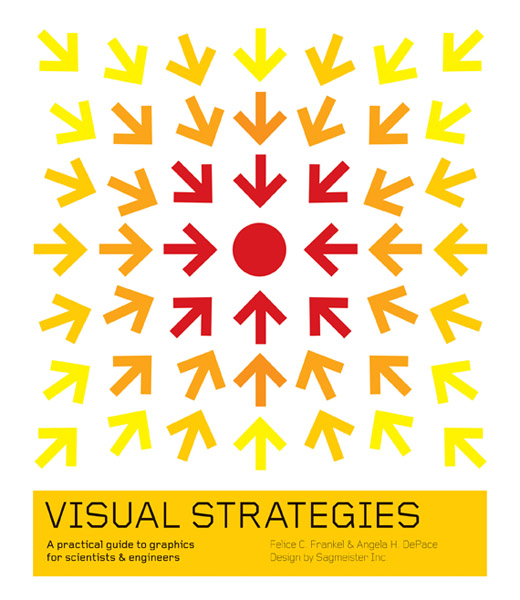
I had the good fortune to be given a copy of Visual Strategies (Frankel and DePace) which was designed by one of the modern heroes of design – the amazing Stefan Sagmeister. This is, without too much hyperbole, pretty much the same as being given a book on painting where Schiele had provided the layout and examples. (I’m a very big fan of Egon Schiele and Hundertwasser for that matter. I may have spent a little too much time in Austria.) The thing I like about this book is that it brings a lot of important talking and thinking points together: which questions should you ask when thinking about your graphic, how do you start, what do you do next, when do you refine, when do you stop?
Thank you, again, Metropolis Bookstore on Swanston Street in Melbourne! You had no real reason to give a stranger a book for free, except that you thought it would be useful for my students. It was, it is, and I thank you again for your generosity.
I really enjoy getting into a new area and I think that the students are enjoying it too, as the entire course is a new area for them. We had an excellent discussion of the four chapters of reading (the NSF CyberInfrastructure report on Grand Challenges), where some of it was a critique of the report itself – don’t write a report saying “community engagement and visualisation are crucial” and (a) make it hard to read, even for people inside the community or (b) make it visually difficult to read.
On the slightly less enthusiastic front, we get to the crux of the course this week – the project selection – and I’m already seeing some hesitancy. Remember that these are all very good students but some of them are not comfortable picking an area to do their analysis in. There could be any number of reasons so, one on one, I’m going to ask them why. If any of them say “Well, I could if I wanted to but…” then I will expect them to go and do it. There’s a lot of scope for feedback in the course so an early decision that doesn’t quite work out is not a death sentence, although I think that waiting for permission to leap is going to reduce the amount of ownership and enjoyment that the student feels when the work is done.
I have no time for paddling in the shallows, personally, and I wade on in. I realise, however, that this is a very challenging stance for many people, especially students, so while I would prefer people to jump in, I recognise my job as life guard in this area and I am happy to help people out.
However, these students are the Distinction/High Distinction crowd, the ones who got 95-100 on leaving secondary school and, as we thought might occur, some of them are at least slightly conditioned to seek my approval, a blessing for their project choice before they have expended any effort. Time to talk to people and work with them to help them move on to a more confident and committed stance – where that confidence is well-placed and the commitment is based on solid fact and thoughtful reasoning!
Reflecting on rewards – is Time Banking a reward or a technique?
Posted: July 29, 2012 Filed under: Education | Tags: education, educational problem, educational research, feedback, higher education, in the student's head, measurement, reflection, student perspective, teaching, teaching approaches, thinking, time banking, tools, universal principles of design Leave a comment
The Reward As It Is Often Implemented
(In Advance and Starting With a B)
Enough advocacy for a while, time to think about research again! Given that I’ve just finished Alfie Kohn’s Punished by Rewards, and more on that later, I’ve been looking very carefully at everything I do with students to work out exactly what I am trying to do. One of Kohn’s theses is that we tend to manipulate people towards compliance through extrinsic tools such as incentives and rewards, rather than provide an environment in which their intrinsic motivational aspects dominate and they are driven to work through their own interest and requirements. Under Kohn’s approach, a gold star for sitting quietly achieve little except to say that sitting quietly must be so bad that you need to be bribed, and developing a taste for gold stars in the student. If someone isn’t sitting quietly, is it because they haven’t managed sitting quietly (the least rewarding unlockable achievement in any game) or that they are disengaged, bored or failing to understand why they are there? Is it, worse, because they are trying to ask questions about work that they don’t understand or because they are so keen to discuss it that they want to talk? Kohn wants to know WHY people are or aren’t doing things rather than just to stop or start people doing things through threats and bribery.
Where, in this context, does time banking fit? For those who haven’t read me on this before, time banking is described in a few posts I’ve made, with this as one of the better ones to read. In summary, students who hand up work early (and meet a defined standard) get hours in the bank that they can spend at a later date to give themselves a deadline extension – and there are a lot of tuneable parameters around this, but that’s the core. I already have a lot of data that verifies that roughly a third of students hand in on the last day and 15-18% hand up late. However, the 14th highest hand-in hour is the one immediately after the deadline. There’s an obvious problem where people aren’t giving themselves enough time to do the work but “near-missing” by one hour is a really silly way to lose marks. (We won’t talk about the pedagogical legitimacy of reducing marks for late work at the moment, that’s a related post I hope to write soon. Let’s assume that our learning design requires that work be submitted at a certain time to reinforce knowledge and call that the deadline – the loss, as either marks or knowledge reinforcement, is something that we want to avoid.)
But, by providing a “reward” for handing up early, am I trying to bribe my students into behaviour that I want to see? I think that the answer is “no”, for reasons that I’ll go into.
Firstly, the fundamental concept of time banking is that students have a reason to look at their assignment submission timetable as a whole and hand something up early because they can then gain more flexibility later on. Under current schemes, unless you provide bonus points, there is no reason for anyone to hand up more than one second early – assuming synchronised clocks. (I object to bonus points for early hand-in for two reasons: it is effectively a means to reward the able or those with more spare time, and because it starts to focus people on handing up early rather than the assignment itself.) This, in turn, appears to lead to a passive, last minute thinking pattern and we can see the results of that in our collected assignment data – lots and lots of near-miss late hand-ins. Our motivation is to focus the students on the knowledge in the course by making them engage with the course as a whole and empowering themselves into managing their time rather than adhering to our deadlines. We’re not trying to control the students, we’re trying to move them towards self-regulation where they control themselves.
Secondly, the same amount of work has to be done. There is no ‘reduced workload’ for handing in early, there is only ‘increased flexibility’. Nobody gets anything extra under this scheme that will reinforce any messages of work as something to be avoided. The only way to get time in the bank is to do the assignments – it is completely linked to the achievement that is the core of the course, rather than taking focus elsewhere.
Thirdly, a student can choose not to use it. Under almost every version of the scheme I’ve sketched out, every student gets 6 hours up their sleeve at the start of semester. If they want to just burn that for six late hand-ins that are under an hour late, I can live with that. It will also be very telling if they then turn out to be two hours late because, thinking about it, that’s a very interesting mental model that they’ve created.
But how is it going to affect the student? That’s a really good question. I think that, the way that it’s constructed, it provides a framework for students to work with, one that ties in with intrinsic motivation, rather than a framework that is imposed on students – in fact, moving away from the rigidly fixed deadlines that (from our data) don’t even to be training people that well anyway is a reduction in manipulate external control.
Will it work? Oh, now, there’s a question. After about a year of thought and discussion, we’re writing it all up at the moment for peer review on the foundations, the literature comparison, the existing evidence and the future plans. I’ll be very interested to see both the final paper and the first responses from our colleagues!
Grand Challenges and the New Car Smell
Posted: July 26, 2012 Filed under: Education | Tags: ALTA, community, curriculum, data visualisation, design, education, educational problem, educational research, ethics, feedback, grand challenge, higher education, in the student's head, learning, student perspective, teaching approaches Leave a comment
It has been a crazy week so far. In between launching the new course and attending a number of important presentations, our Executive Dean, Professor Peter Dowd, is leaving the role after 8 years and we’re all getting ready for the handover. At time of writing, I’m sitting in an airport lounge in Adelaide Airport waiting for my flight to Melbourne to go and talk about the Learning and Teaching Academy of which I’m a Fellow so, given that my post queue is empty and that I want to keep up my daily posting routine, today’s post may be a little rushed. (As one of my PhD students pointed out, the typos are creeping in anyway, so this shouldn’t be too much of a change. Thanks, T. 🙂 )
The new course that I’ve been talking about, which has a fairly wide scope with high performing students, has occupied five hours this week and it has been both very exciting and a little daunting. The student range is far wider than usual: two end-of-degree students, three start-of-degree students, one second year and one internal exchange student from the University of Denver. As you can guess, in terms of learning design, this requires me to have a far more flexible structure than usual and I go into each activity with the expectation that I’m going to have to be very light on my feet.
I’ve been very pleased by two things in the initial assessment: firstly, that the students have been extremely willing to be engage with the course and work with me and each other to build knowledge, and secondly, that I have the feeling that there is no real ‘top end’ for this kind of program. Usually, when I design something, I have to take into account our general grading policies (which I strongly agree with) that are not based on curve grading and require us to provide sufficient assessment opportunities and types to give students the capability to clearly demonstrate their ability. However, part of my role is pastoral, so that range of opportunities has to be carefully set so that a Pass corresponds to ‘acceptable’ and I don’t set the bar so high that people pursuing a High Distinction (A+) don’t destroy their prospects in other courses or burn out.
I’ve stressed the issues of identity and community in setting up this course, even accidentally referring to the discipline as Community Science in one of my intro slides, and the engagement level of the students gives me the confidence that, as a group, they will be able to develop each other’s knowledge and give them some boosting – on top of everything and anything that I can provide. This means that the ‘top’ level of achievements are probably going to be much higher than before, or at least I hope so. I’ve identified one of my roles for them as “telling them when they’ve done enough”, much as I would for an Honours or graduate student, to allow me to maintain that pastoral role and to stop them from going too far down the rabbit hole.
Yesterday, I introduced them to R (statistical analysis and graphical visualisation) and Processing (a rapid development and very visual programming language) as examples of tools that might be useful for their projects. In fairly short order, they were pushing the boundaries, trying new things and, from what I could see, enjoying themselves as they got into the idea that this was exploration rather than a prescribed tool set. I talked about the time burden of re-doing analysis and why tools that forced you to use the Graphical User Interface (clicking with the mouse to move around and change text) such as Excel had really long re-analysis pathways because you had to reapply a set of mechanical changes that you couldn’t (easily) automate. Both of the tools that I showed them could be set up so that you could update your data and then re-run your analysis, do it again, change something, re-run it, add a new graph, re-run it – and it could all be done very easily without having to re-paste Column C into section D4 and then right clicking to set the format or some such nonsense.
It’s too soon to tell what the students think because there is a very “new car smell” about this course and we always have the infamous, if contested, Hawthorne Effect, where being obviously observed as part of a study tends to improve performance. Of course, in this case, the students aren’t part of an experiment but, given the focus, the preparation and the new nature – we’re in the same territory. (I have, of course, told the students about the Hawthorne Effect in loose terms because the scope of the course is on solving important and difficult problems, not on knee-jerk reactions to changing the colour of the chair cushions. All of the behaviourists in the audience can now shake their heads, slowly.)
Early indications are positive. On Monday I presented an introductory lecture laying everything out and then we had a discussion about the course. I assigned some reading (it looked like 24 pages but was closer to 12) and asked students to come in with a paragraph of notes describing what a Grand Challenge was in their own words, as well as some examples. The next day, less than 24 hours after the lecture, everyone showed up and, when asked to write their description up on the white board, all got up and wrote it down – from their notes. Then they exchanged ideas, developed their answers and I took pictures of them to put up on our forum. Tomorrow, I’ll throw these up and ask the students to keep refining them, tracking their development of their understanding as they work out what they consider to be the area of grand challenges and, I hope, the area that they will start to consider “their” area – the one that they want to solve.
If even one more person devotes themselves to solving an important problem to be work then I’ll be very happy but I’ll be even happier if most of them do, and then go on to teach other people how to do it. Scale is the killer so we need as many dedicated, trained, enthusiastic and clever people as we can – let’s see what we can do about that.
The Heart of Darkness
Posted: July 23, 2012 Filed under: Education, Opinion | Tags: advocacy, authenticity, blogging, community, education, educational problem, educational research, ethics, feedback, Generation Why, higher education, in the student's head, reflection, resources, student perspective, teaching, teaching approaches, thinking Leave a commentMy friend, fellow educator and cousin, Liz, commented on yesterday’s post where I (basically) asked why we waste educational opportunities by being unpleasant or bullying. Here’s something that she wrote in the comments:
How we respond to young people is vitally important. How a parent or teacher responds is so important to the self-esteem of a child/student. There is rarely a call for being brutally blunt or thoughtlessly cruel. But bashing is in style. It’s been in style a long time, long enough for an entire generation to think it is the norm.
The emphasis of that phrase “But bashing is in style” is mine because I couldn’t agree with it more. You can see it where we knock people down for being good in ways that we think that we may not be able to attain, while feting people who are wealthy, because somehow we can see ourselves being millionaires. Steinbeck, unsurprisingly, said it best and we paraphrase is longer thoughts on this as:
“Socialism never took root in America because the poor see themselves not as an exploited proletariat but as temporarily embarrassed millionaires.” as given in A Short History of Progress (2005) by Ronald Wright.
So there’s surprisingly little bashing of the “haves that we might attain if we are really lucky or play the game in the right way”, but there is a great deal of bashing of visionaries, dreamers, risk-takers, experimenters, those who challenge the status quo and those who dare to dabble within a field in which we consider ourselves expert. I think that list of ‘types’ pretty much describes every single good student I’ve ever had so it’s not that surprising that a large number of the experiences that these students have are negative.
This has not always happened – the forward thinking, the intellectual, the artistic manifesto maker have been highly prized before but, somehow, this seems to have faded away. (I know that every generation complains about this but, with our media saturation and our near-instantaneous communication, I think that the impact of negative feedback and bashing has a far wider reach, as well as being less focused on debate and more on cruelty, destruction and brutality.)
Let me give you an example. I am an artist, across a few different outlets but mainly writing and design, and I am creating a manifesto to describe my intentions in the artistic space, my motives in doing so, and my views on the fusion between creativity and the more rigid aspects of my discipline. The reaction to this, if I tell people, is predominantly negative. Firstly, due to a certain famous manifesto, most people assume that I am making some sort of revolutionary political statement. (The book “100 Artistic Manifestos” is an excellent reference to get a different view on this.) Secondly, most people assume that I am somehow incapable of doing this – I suspect it’s because they believe that my job is me or that Computer Scientists can’t be creative. The general reaction is one of “knocking”, a gentle form of dismissive undermining common in Australia, but this is just a polite version of bashing. People don’t believe I can do this and have no problem expressing this in a variety of ways. Fortunately, I’ve reached the point in my career and my art that the need to write a manifesto is based on a desire to explain and to share, so people not understanding why I would do it just tells me that I need to do it. (Of course, calling yourself an artist is a hard one, as well. Am I published? No. Do I have any works on display? No. Do I make my living from it? No. Am I driven to create art? Yes. By my definition, I’m an artist. If I ever sell two paintings, of any kind, I’ve doubled Van Gogh’s lifetime sales. 🙂 )
This is the environment in which my students are learning and growing – and it’s a dark one. If I have noted nothing else from working with the young, it is that they are amazingly fragile at some points. The moments that you have to work with people, when they feel comfortable enough to be open and honest with you, are surprisingly few and far between – being cruel, taking a cheap shot, not having the time, cutting them down, not listening… it’ll have an effect, alright, and it may even be an effect that stays with that student for life. Going back over your memory of your teachers and lecturers, I bet you can remember every single one that changed your life, whether for good or for ill.
I don’t really want to harden my students, to make them into living armour, because I think that is really going to get in the way of them being people. Yes, I need them to be resilient but that’s a very different thing to rigid or tough. I need them to be able to commit to a particular set of ideas, that they choose, and to be able to withstand reasonable argument and debate, because this is the burden of the critical thinker. But I’m always worried that making them insensitive to criticism risks making them easily manipulable and ignorant of useful sources. It’s far too easy to respond to people you see as bashers with bashing – Richard Dawkins and Christopher Hitchens both spring to mind as people who wield words and ideas as weapons in an (on occasion) unnecessarily cruel, dismissive or self-satisfied way. There is a particular smugness of “basher-bashing” that is as repellent as the original action and this is also not a great way to train people that you wish to be out there, sharing and discussing ideas. If I wanted repellently smug and self-serving prose, I’d read Jeremy Clarkson, who is (at least) occasionally funny.
The obvious rejoinder to this is that “well, we need people on our side who are as tough as the opponents” and, frankly, I don’t buy it. That sounds more like revenge to me, with a side order of schaudenfreude. If we don’t act top stop it, then we make an environment in which bashing is tolerated and, if we do that, then the most successful basher will win. I’ll tell you right now that it won’t have to be the person who is smartest, most correct, most well-prepared – it is far more likely that it is the person who is willing to be the most cruel, the utterly vindictive and the inescapable persecutor who will win that battle.
So, longwindedly, I complete agree with Liz and want to finish by emphasising the start of her quote: “How we respond to young people is vitally important. How a parent or teacher responds is so important to the self-esteem of a child/student. There is rarely a call for being brutally blunt or thoughtlessly cruel.”
I am convinced that the majority of educators and parents are doing everything that needs to be done to give a good environment, but we also have to look at the world around us and ask how we can make that better.
A Missed Opportunity: Miles Davis and “Little Miles”
Posted: July 22, 2012 Filed under: Education, Opinion | Tags: advocacy, authenticity, community, education, educational problem, feedback, Generation Why, higher education, in the student's head, reflection, resources, student perspective, teaching, teaching approaches, thinking 10 Comments(Edit: someone claiming to be “Little Miles” has now commented on this and said that he was fine with it. That’s great, but he also says that he accepted Miles’ comments in the face of him being known for being curt. It’s worth a read and, of course, I was speculating but my comments on the utility of Miles’ comments stand. Miles was known for being like this and I don’t see talent, even talent as great as Miles’, as being an excuse for bad behaviour. Jazz people may feel differently. I’m in the business of education, not torturing students. I would suggest that this is something all exemplars in a field should keep in mind if they want their area to flourish.)
If you click on this linked video (SFW) (YouTube), you’ll see a young trumpet player, who goes by the nickname “Little Miles”, play “On Green Dolphin Street” in front of Miles Davis. Now, it appears that, if I’ve done my detective work correctly, it’s a 1986 interview conducted by Bill Boggs (corrections welcome!).
Now, if you’ve watched that video, you’ve seen three things.
- You’ve seen a young trumpet player, who really isn’t that good, do a tolerable version of a song with a couple of mistakes.
- You’ve seen Miles Davis sit all the way back in his chair, then, finally, in a dismissive tone offer the advice of “Get some more practice” and “It’s in E Flat, you’re playing it in D Natural”, which is about as close to telling the kid to go back to wherever he came from and take up the tambourine as you can without actually going to the effort of doing so.
- You’ve seen a young trumpet player who, more than likely, is not going to keep playing the trumpet for much longer. The host quickly gets him off stage before anything more unpleasant can happen to him.
Now there is a world of wrong-thinking going on here to even let a young boy, who is called (whether he calls it himself or not) “Little Miles”, anywhere within fifty metres of Miles Davis, unless that young trumpet player is so, SO, good that Miles is going to have to accept that it’s not that much of an insult. And, being honest, the kid’s not that good. When you look at Miles Davis’ past, he was playing professionally for 3-4 years and studying at Juilliard before he went out and hunted down his idol, Coltrane. (Edit: my apologies, it was, of course, Charlie Parker. Thank you, Lewis, for noticing this!) When you think about it like that, wandering into a television studio calling yourself “Little Bird” after playing the sax for a few years and, obviously, not at a standard where you could play professionally – that’s a pretty silly thing to do.
But, of course, Miles’ reaction was pretty toxic. It was unnecessary. The kid wasn’t a threat to anyone and, after playing that way, “Little Miles” was going to fade away, unless he practiced a whole heap more. Taking Miles’ comments at face value, could they have been educational? Ehhhh, not in that tone and with that delay and posture. It was a “Buzz off, kid” if it was anything.
The funny thing is that this is a cascade of bad decision making, which resulted in the worst kind of outcome – no-one actually learned anything.
- Whoever was putting the boy up should have either prepared him better or held him back until he was. He shouldn’t have been here.
- Whoever gave the kid the name or encouraged him to use it should really had thought twice about it, if proximity to the real thing was even on the horizon.
- Someone let this train-wreck happen in front of Miles Davis.
- Someone didn’t get the kid off or go to commercial when it was (blatantly) obvious what was about to happen.
- Miles was offensively honest in a way designed to injure.
So, someone had put together a view of jazz trumpet playing and exposed the student to it so that they thought that their version of “On Green Dolphin Street” was good enough that they could stand on a stage, called “Little Miles” and expect anything else. That’s a problem with the teacher, for me.
That name… Oh! That name! The hubris required to call yourself that, unless you are so, so, very good that the comparisons leap to all lips. Somebody didn’t sit back and look at that from enough perspectives to work out that it was sending completely the wrong message.
What could the boy learn from listening to Miles? Practice more and stay on key. Wow. Thanks. It was, as I’ve said, not designed to be educational but hurtful – and of course it had no real educational value. It was a punishment and, like any punishment, it’s designed to make you avoid a behaviour, not train you into a new behaviour. Stay away from the trumpet, Kid.
The boy learned nothing that he couldn’t have known by playing with some echo. He certainly didn’t learn anything from one of the finest horn players in the world. What worries me the most is that, after this all happened, his parents or his teacher came up to him and said something “Well, what does that Miles Davis know, anyway?”
“What does he know? I named myself (or you named me) after him as a nickname. I’ve been looking forward to this for three months (say). And now you say it’s nothing?”
Little Miles now has two extreme options, as well as the continuum of compromise in the middle. Either he’s crazy enough to believe that Miles Davis was wrong and that he’s going to be the best ever, spending his life pursuing a vindictive dream where any intrinsic motivation is swamped by a burning hatred for Gold Lamé, or he suddenly realises that his teachers and his parents don’t know that much about music – and that everything that they’ve said has been wrong.
I started out talking about education, but I’m coming to finish up talking about joy. Yes, there was a failure to educate, a failure of guardianship, many failures of judgement but there has also been a loss of joy. That young man was happy, mistakes and all, until Miles Davis slammed his angry fist down on him and I can’t really see how his love of trumpet would have survived that, without being at least a little bent and mangled.
It’s really easy to be unpleasantly critical and it’s hard to be constructively critical, especially when people are washed in the warm milk of low expectations, but I really wonder sometime why more people just don’t try a little harder to do it.
Relationship Management: Authenticity
Posted: July 21, 2012 Filed under: Education, Opinion | Tags: advocacy, authenticity, community, curriculum, design, education, educational problem, ethics, feedback, Generation Why, higher education, in the student's head, resources, student perspective, teaching, teaching approaches, thinking 5 Comments(Edit note: I tried to use a formatting mechanism that would make the e-mail examples stand out but in broke things for people with different browsers and for me on mobile browsers. I’ve switched it back to normal text and indented for clarity.)
I belong to the Qantas Frequent Flyer program and have a reasonable amount of status. The last time I hit ‘Gold’, they sent me a letter telling me about all of the perks if I then went to ‘Platinum’. This struck me as curious because, by doing so, they immediately reduced the reward of ‘going Gold’ (because it was now second best) and completely failed to show me that they had looked at my flying habits. To go to ‘Platinum’, I would have had to take all of the flights I just took – AGAIN. So, now, thanks to an ill-thought out letter I’m aware of two things: firstly, that Gold is for dummies and that the cool kids are Platinum, and, secondly, that the airline I’ve been flying with since the mid-90s doesn’t regard me as serious enough to track. It makes you question the relationship.
Now it’s not as if I’d actually expended any effort to go ‘Gold’, I’d just sat on a lot of Qantas planes, watched a lot of Futurama and Big Bang Theory, and accumulated points. What Qantas sent me was a message that basically said “Hey, just fly twice as often as you and, because you fly discount economy and we don’t give you that much for it, that means we want you to spend about 3 months of the year in the air. In Economy long haul.” That’s a bit irritating because, as someone who works with computers, it’s pretty easy to look at things like accrual rate, current time of the year and my flying pattern and realise that you were sending me the aviation equivalent of “Hey, you made your mortgage payment, want to buy Paris?”
There’s a lot of lip service given to the idea of relationship management and, while it’s easy to talk about, it’s hard to do. There’s a great deal of difference between sending students an e-mail if they’re not attending and trying to actually make a connection with the student. One of these can be done with a message like this:
From: Nick Falkner
To: Nick Falkner
BCC: list of students but put in to the mail message in a way that doesn’t show up.
Hey, I noticed that you haven’t been showing up in class for a while and that you also haven’t handed up a number of assignments. If you’d like to get in touch, please see me after class or send me an e-mail to organise a time.
Regards, Nick.
Now, this is, to me, disingenuous, because while it may all be true, it looks like it’s a personal message when it’s really a form letter. Hand on heart, yes, I’ve done this but, on reflection, it’s not really good enough. Yes, any attempt to get in touch with a student is better than nothing, but this has no personalisation to it. (Yes, large classes can be hard to personalise. We ran a course for 360 engineers and we had weekly assignments with a marking load of 36 hours. We had to use team marking, with me as quality control and arbiter. Because each student got the same marker each time, we managed to maintain a relationship through personalised feedback and consistency that would have been hard to manage with only one person – but, obviously, students in different blocks could have different experiences and we did have to swap in/out more than one marker.)
I spend a lot of time establishing relationships with my students but that means that I then have to spend a lot of time maintaining the relationships with my students. Even in large classes, if I’ve spoken to someone once, they expect me to remember their names! (And I certainly try to – I don’t always succeed but I’ve got better at it with practice.)
Even those students I haven’t yet managed to develop a relationship with can benefit from my attempts to try. So this is probably much closer to what I try to send. (My explanatory notes on this are also attached after two dashes — and in italics.)
From: Nick Falkner
To: Student Name — E-mail is to the student, not an anonymous list
CC: Any other lecturers in the course — This is so that the student knows that all lecturers are getting this info.
Dear Firstname, — This can be hard to know, even when you can see the full name, due to cultural issues. If you make a fair stab, most people help you out.
I was looking at the course “Underwater Knitting in Perl” and you haven’t submitted any work for assignments 2 and 3. I was wondering if you there was something that you wanted to talk about? If you have medical or compassionate extension requests for this time, then you do need to let me know, as we need to work out an alternative submission schedule if that’s appropriate. As a reminder, you do need to obtain at least 40% of the available marks in the assignment work component to pass but you can easily get back on track if you start doing the work again now.
— It’s not too late but it can be too late! You may need help! Can I help you?
If you’d like to talk to me in person, I have an office drop-in time from 2-4pm on Friday, and you can find me in office 9.99, Building 4, Third Circle, or you can call me on xxxxx if that’s easier. Obviously, e-mail is always great as that gets me wherever I am – but I don’t promise to reply immediately to e-mail sent at midnight! — How to get me! I also reserve the right to be inject humour randomly. 🙂
Are you available on Friday at 2pm? If so, please let me know.
— Easy question to answer. Last thing the student reads. Need to keep it short so it can be read quickly and easily. This may, actually, be slightly too long.
This isn’t perfect, obviously, and I’m sure I’ve broken any number of good rules by doing this but the most important thing is that the tone is very different. I’ve thought about this student and my concern appears more authentic because it is more authentic. Of course, it took me much longer to write but the chances of having a positive response are far greater. It’s also based on my knowledge of the student which, right now, is a little limited but at least I’ve dug up as much as I can. I’ve reminded them of the mechanisms that are in place to help, as an introductory step, without saying that there’s anything wrong with them and I’ve given them a reason to respond (you may put yourself at risk but it’s not too late) and a direct question (can you see me on Friday) to respond to.
[…] thanks for your help during the semester, without it I wouldn’t have been able to pass [the course]. I really appreciate it. I was actually a bit surprised to even manage a [B], so again cheers.
Intervention and Risk: An Anonymised Anecdote
Posted: July 19, 2012 Filed under: Education | Tags: advocacy, authenticity, community, design, education, educational problem, educational research, ethics, feedback, higher education, in the student's head, middleware, reflection, student perspective, teaching, teaching approaches, thinking Leave a commentYesterday morning, we found some students sleeping in one of our computing labs. This isn’t that uncommon, especially during the crunch times, but it is uncommon to see people disrobed and obviously moved in, with food, clothes and the like. The initial reactions are almost always “Argh, what are you doing in here?” and “Grr, have you been getting in the way of other students.” However, and I can’t go into too much detail, as the story unfurled, with the intervention of some excellent staff members who managed to get the students talking, what appeared to be students taking advantage of our resources quickly turned out to be a situation where one student in extremis was being watched and cared for by another student – while both students were dealing with other, far more serious, problems.
To put it simply, one student had almost run out of hope and places to be. When you think about it, you’re not going anywhere good when you end up hiding in the corner of a lab that’s going through software rebuild and, hence, has no-one in it. The initial problem that we had was that, for mainly cultural reasons, the students had a great deal of difficulty talking to the first people to contact them – because we were lecturers and there is a great deal of potential embarrassment for certain people in admitting to problems in front of us. Fortunately, many heads knocked together to look at the problem, someone managed to start the students talking, we got more information and, as of this morning, a number of key problems have been solved. The major issue (stress regarding study) has been dealt with and the intervention to address other problems continues.
Reflecting upon this situation, I was reminded again of the burden that is placed upon the relationship between student and staff member when there is a cultural gap, especially one involving academic staff. I tried to talk to the students but, having been set up into fixed roles (in their heads), we couldn’t communicate. It was only once someone outside of the academic hierarchy got involved that information started to flow. Yes, there were linguistic issues but, ultimately, it didn’t come down to language, it came down to willingness to talk and these students didn’t want to open up. After they were reached, then the vast array of helpful resources that we do have were suddenly available to them.
As was noted at HERDSA recently, students don’t look at the ‘where to go for help’ slides early on in a course because they don’t need help. If students do need help, but can’t ask for it or don’t know where to go, then all of our helpful and assistive systems just won’t be able to help. But, of course, expecting students to know when they need help does give us a convenient ‘out’. Given that we can see their marks, and to a large extent their academic performance in courses that we administer, we should be able to see students who are heading towards crisis points. (We do look at this in our Faculty but more on that later.)
My own research, to be presented at ICER in September, talks about the amount of information that appears to be contained in the first submission that a student makes. But let’s say that all I can see is a semester of Fail grades – given that performance like that wouldn’t have got them into my course, I’m looking at a problem. Now, we can and we do redirect students to our (very good) Transitions and Advisory Service but this is a manual step. I’ve been looking at automated solutions to this for some time, and I’m looking forward to talking to people in more detail about AWE (the Wellness Engine) at University of New England, because I should not have to use myself as a processing element in order to achieve something that can be done better by a computer.
A colleague and friend of mine was describing middleware to some people at the University. If you don’t know what it means, middleware is software that connects two or more other systems together. Rather than writing one big piece that does everything, or two pieces that fit together like a jigsaw, middleware allows you to bring together lots of different systems that weren’t necessarily designed to work with each other. Probably the example that you’ve seen, and not realised, is using a database through a web-page. The underlying data (like Amazon’s store) is one system. Your web browser is another. Middleware allows you to exchange data with the data store and buy books. Middleware sounds great, right? It is – but here comes the catch.
Dave’s killer question on this is “Why are we using our staff as middleware?”
He’s right, of course. We take data from our marking of assignments, put into another system (by changing format and restructuring it), then we put that into another system (with manual intervention and checking) and this is then finally made available to students. Now if I want to see how the students are doing, I need to remember to manually request that a search be made, showing me all students who have failed anything – and then give me their GPA for this semester. I note that we already do this at the Faculty level using a mechanism called the Unsatisfactory Academic Progress process, which has identified a lot of at-risk students and helped a lot of people back, but how is it done? People acting as middleware.
What I want is a system that alerts me to problems automatically. If I have to search, it takes time and (worse) it becomes a task to be prioritised because there many not always be problems. If I am contacted when there is a problem, the task is automatically high priority. That requires a good set of middleware that spans all of a University’s systems and can bring that data together, then get in touch with the right people when there’s a problem. We’re actually not that far away from it – the systems are all there, we just need to streamline some processes. Fewer people acting as middleware means more people doing the things that we actually pay them for, especially when it’s academics!
There are lots of things that can get in the way of a good working relationship between educator and student. We don’t have to be friends, but we do have to be willing and able to talk to each other. Taking that further, it would be nice if the systems all talked to each other as well, including yelling at us when a student hits a mark where we might be able to intervene and do something useful, sooner.
A Design Challenge, a Grand Design Challenge, if you will.
Posted: July 18, 2012 Filed under: Education | Tags: education, educational problem, educational research, feedback, Generation Why, grand challenge, higher education, in the student's head, measurement, principles of design, student perspective, teaching, teaching approaches, thinking, tools, universal principles of design, vygotsky, work/life balance 1 CommentQuestion: What is one semester long, designed as a course for students who perform very well academically, has no prerequisites and can be taken by students with no programming exposure and by students with a great deal of programming experience?
Answer: I don’t know but I’m teaching it on Monday.

While I talk about students who perform well academically, this is for the first instance of this course. My goal is that any student can take this course, in some form, in the future.
The new course in our School, Grand Challenges in Computer Science, is part of our new degree structure, the Bachelor of Computer Science (Advanced). This adds lot more project work and advanced concepts, without disrupting the usual (and already excellent) development structure of the degree. One of the challenges of dealing with higher-performing students is keeping them in a sufficiently large and vibrant peer group while also addressing the minor problem that they’re moving at a different pace to many people that they are friends with. Our solution has been to add additional courses that sit outside of the main progression but still provide interesting material for these students, as well as encouraging them to take a more active role in the student and general community. They can spend time with their friends, carry on with their degrees and graduate at the same time, but also exercise themselves to greater depth and into areas that we often don’t have time to deal with.
In case you’re wondering, I know that some of my students read this blog and I’m completely comfortable talking about the new course in this manner because (a) they know that I’m joking about the “I don’t know” from the Answer above and (b) I have no secrets regarding this course. There are some serious challenges facing us as a species. We are now in a position where certain technologies and approaches may be able to help us with this. One of these is the notion of producing an educational community that can work together to solve grand challenges and these students are very much a potential part of this new community.
The biggest challenge for me is that I have such a wide range of students. I have students who potentially have no programming background and students who have been coding for four years. I have students who are very familiar with the School’s practices and University, and people whose first day is Monday. Of course, my solution to this is to attack it with a good design. But, of course, before a design, we have to know the problem that we’re trying to solve.
The core elements of this course are the six grand challenges as outlined but he NSF, research methods that will support data analysis, the visualisation of large data sources as a grand challenge and community participation to foster grand challenge communities. I don’t believe that a traditional design of lecturing is going to support this very well, especially as the two characteristics that I most want to develop in the students are creativity and critical thinking. I really want all of my students to be able to think their way around, over or through an obstacle and I think that this course is going to be an excellent place to be able to concentrate on this.
I’ve started by looking at my learning outcomes for this course – what do I expect my students to know by the end of this course? Well, I expect them to be able to tell me what the grand challenges are, describe them, and then provide examples of each one. I expect them to be able to answer questions about key areas and, in the areas that we explore in depth, demonstrate this knowledge through the application of relevant skills, including the production of assignment materials to the best of their ability, given their previous experience. Of course, this means that every student may end up performing slightly differently, which immediately means that personalised assessment work (or banded assessment work) is going to be required but it also means that the materials I use will need to be able to support a surface reading, a more detailed reading and a deep reading, where students can work through the material at their own pace.
I don’t want the ‘senior’ students to dominate, so there’s going to have be some very serious scaffolding, and work from me, to support role fluidity and mutual respect, where the people leading discussion rotate to people supporting a point, or critiquing a point, or taking notes on the point, to make sure that everyone gets a say and that we don’t inhibit the creativity that I’m expecting to see in this course. I will be setting standards for projects that take into account the level of experience of each person, discussed and agreed with the student in advance, based on their prior performance and previous knowledge.
What delights me most about this course is that I will be able to encourage people to learn from each other. Because the major assessment items are all unique to a student, then sharing knowledge will not actually lead to plagiarism or copying. Students will be actively discouraged from doing work for each other but, in this case, I have no problem in students helping each other out – as long as the lion’s share of the work is done by the main student. (The wording of this is going to look a lot more formal but that’s a Uni requirement. To quote “The Castle”, “It’s about the vibe.”) Students will regularly present their work for critique and public discussion, with their response to that critique forming a part of their assessment.
I’m trying to start these students thinking about the problems that are out there, while at the same time giving them a set of bootstrapping tools that can set them on the path to investigation and (maybe) solution well ahead of the end of their degrees. This then feeds into their project work in second and third year. (And, I hope, for at least some of them, Honours and maybe PhD beyond.)
Writing this course has been a delight. I have never had so much excuse to buy books and read fascinating things about challenging issues and data visualisation. However, I think that it will be the student’s response to this that will give me something that I can then share with other people – their reactions and suggestions for improvement will put a seal of authenticity on this that I can then pack up, reorganise, and put out into the world as modules for general first year and high school outreach.
I’m very much looking forward to Monday!

 Nick Falkner