
Intervention and Risk: An Anonymised Anecdote
Posted: July 19, 2012 Filed under: Education | Tags: advocacy, authenticity, community, design, education, educational problem, educational research, ethics, feedback, higher education, in the student's head, middleware, reflection, student perspective, teaching, teaching approaches, thinking Leave a commentYesterday morning, we found some students sleeping in one of our computing labs. This isn’t that uncommon, especially during the crunch times, but it is uncommon to see people disrobed and obviously moved in, with food, clothes and the like. The initial reactions are almost always “Argh, what are you doing in here?” and “Grr, have you been getting in the way of other students.” However, and I can’t go into too much detail, as the story unfurled, with the intervention of some excellent staff members who managed to get the students talking, what appeared to be students taking advantage of our resources quickly turned out to be a situation where one student in extremis was being watched and cared for by another student – while both students were dealing with other, far more serious, problems.
To put it simply, one student had almost run out of hope and places to be. When you think about it, you’re not going anywhere good when you end up hiding in the corner of a lab that’s going through software rebuild and, hence, has no-one in it. The initial problem that we had was that, for mainly cultural reasons, the students had a great deal of difficulty talking to the first people to contact them – because we were lecturers and there is a great deal of potential embarrassment for certain people in admitting to problems in front of us. Fortunately, many heads knocked together to look at the problem, someone managed to start the students talking, we got more information and, as of this morning, a number of key problems have been solved. The major issue (stress regarding study) has been dealt with and the intervention to address other problems continues.
Reflecting upon this situation, I was reminded again of the burden that is placed upon the relationship between student and staff member when there is a cultural gap, especially one involving academic staff. I tried to talk to the students but, having been set up into fixed roles (in their heads), we couldn’t communicate. It was only once someone outside of the academic hierarchy got involved that information started to flow. Yes, there were linguistic issues but, ultimately, it didn’t come down to language, it came down to willingness to talk and these students didn’t want to open up. After they were reached, then the vast array of helpful resources that we do have were suddenly available to them.
As was noted at HERDSA recently, students don’t look at the ‘where to go for help’ slides early on in a course because they don’t need help. If students do need help, but can’t ask for it or don’t know where to go, then all of our helpful and assistive systems just won’t be able to help. But, of course, expecting students to know when they need help does give us a convenient ‘out’. Given that we can see their marks, and to a large extent their academic performance in courses that we administer, we should be able to see students who are heading towards crisis points. (We do look at this in our Faculty but more on that later.)
My own research, to be presented at ICER in September, talks about the amount of information that appears to be contained in the first submission that a student makes. But let’s say that all I can see is a semester of Fail grades – given that performance like that wouldn’t have got them into my course, I’m looking at a problem. Now, we can and we do redirect students to our (very good) Transitions and Advisory Service but this is a manual step. I’ve been looking at automated solutions to this for some time, and I’m looking forward to talking to people in more detail about AWE (the Wellness Engine) at University of New England, because I should not have to use myself as a processing element in order to achieve something that can be done better by a computer.
A colleague and friend of mine was describing middleware to some people at the University. If you don’t know what it means, middleware is software that connects two or more other systems together. Rather than writing one big piece that does everything, or two pieces that fit together like a jigsaw, middleware allows you to bring together lots of different systems that weren’t necessarily designed to work with each other. Probably the example that you’ve seen, and not realised, is using a database through a web-page. The underlying data (like Amazon’s store) is one system. Your web browser is another. Middleware allows you to exchange data with the data store and buy books. Middleware sounds great, right? It is – but here comes the catch.
Dave’s killer question on this is “Why are we using our staff as middleware?”
He’s right, of course. We take data from our marking of assignments, put into another system (by changing format and restructuring it), then we put that into another system (with manual intervention and checking) and this is then finally made available to students. Now if I want to see how the students are doing, I need to remember to manually request that a search be made, showing me all students who have failed anything – and then give me their GPA for this semester. I note that we already do this at the Faculty level using a mechanism called the Unsatisfactory Academic Progress process, which has identified a lot of at-risk students and helped a lot of people back, but how is it done? People acting as middleware.
What I want is a system that alerts me to problems automatically. If I have to search, it takes time and (worse) it becomes a task to be prioritised because there many not always be problems. If I am contacted when there is a problem, the task is automatically high priority. That requires a good set of middleware that spans all of a University’s systems and can bring that data together, then get in touch with the right people when there’s a problem. We’re actually not that far away from it – the systems are all there, we just need to streamline some processes. Fewer people acting as middleware means more people doing the things that we actually pay them for, especially when it’s academics!
There are lots of things that can get in the way of a good working relationship between educator and student. We don’t have to be friends, but we do have to be willing and able to talk to each other. Taking that further, it would be nice if the systems all talked to each other as well, including yelling at us when a student hits a mark where we might be able to intervene and do something useful, sooner.
Training for Resilience: Building Students from Steel, not Pot Metal
Posted: July 13, 2012 Filed under: Education, Opinion | Tags: advocacy, community, curriculum, education, educational problem, educational research, ethics, higher education, in the student's head, principles of design, research, resources, student perspective, teaching, teaching approaches, thinking Leave a commentResilience is “… the inherent and nurtured capacity of individuals to deal with life’s stresses in ways that enable them to lead healthy and fulfilled lives” (Howard & Johnson, 1999)
Pot metal can be prone to instability over time, as it has a tendency to bend, distort, crack, shatter, and pit with age. (Pot Metal, Wikipedia)
The steel is then tempered, […]which ultimately results in a more ductile and fracture-resistant metal. [S]teel [is] used widely in the construction of roads, railways, other infrastructure, appliances, and buildings. Most large modern structures […] are supported by a steel skeleton. Even those with a concrete structure will employ steel for reinforcing. (Steel, Wikipedia)

Building strength, in terms of people and materials, has been a human pursuit for as long as we have been human. Stronger civilisations were able to resist invaders, bronze swords shattered and deformed under the blows of iron, steel allowed us to build our cities, our ships, our cars and our air travel industries. Steel requires some care in the selection of the initial iron ore that is used and, for a particular purpose, we have to carefully select the alloy components that we will use to produce just the right steel and then our smelting and casting must be done in the right way or we have to start again. Pot metal, on the other hand, can be made out of just about anything, smelted at low temperatures without sophisticated foundry equipment or specialist tools.
One of these metals drives a civilisation – the other one flakes, corrodes, bubbles, fails and can’t be easily glued, soldered or welded. Steel can be transformed, fused and joined, but pot metal can only be as fit as the day it was made and then it starts a relatively rapid descent into uselessness. Pot metal does have one good use, for making prototypes before you waste better metal, but that just confirms its built-in obsolescence.
One of the most important transitions for any student is from external control and motivation to self-regulation, intrinsically motivated and ready to commit to a reasoned course of action. Of course, such intention is going to wither away quickly if the student doesn’t actually have any real resilience. If the student isn’t “tough enough” to take on the world then they are unlikely to be able to achieve much.
The steel industry is an interesting analog for this. There are many grades of iron ore and some are easier to turn into steel than others because of carbon levels or things like phosphorus contamination. (No, I’m not saying any of our students are contaminated – I’m emphasising regional and graded difference.) While certain ore sources were originally preferred, later developments in technique made it possible to use more and more different starting points. Now, electric arc furnaces can convert pig iron or scrap metal back to new steel easily but require enough power – sensible use of the widest range of resources requires a cheap and plentiful power source.
The educational equivalent of pot metal manufacture is the production of a student who is not ready for the world, is barely fit for one purpose when they graduate and whose skills will degrade over time – because the world develops but their fragile skills base cannot be extended or redeveloped.
Steel, however, can be redeveloped, reworked, extended. We can build ultra-flexible steels, strong steels, hard steels, corrosion resistant steels and we can temper it to make it easier to work with and less likely to break. The steps that we take in the production process are vital but they incur a cost, require careful planning, take skill and can undergo constant improvement if we keep putting effort into the process.
The tempering process is as vital for students as it is for steel because we want the same things. We want a student who will stand strong but be able to bend without breaking. We want a student who is held up by strong ideas, good teaching and a genuine faith in their own abilities – not the rough and ready imitation of completeness that we get from throwing things together.
I’m not suggesting that we heat up our students and throw them into cold oil, as we would quench and temper steel, but it’s important to look at why we heat steel for annealing/tempering and what we intend to achieve. By understanding the steel and the materials science, we know that reaching certain temperatures changes the nature of the material, changing properties such as hardness and ductility. Sometimes we do this to make the material easier to work, sometimes to make it more flexible in use. The key point is that by knowing the material, and by knowing what happens when we apply changes, we can choose what happens. By knowing which factors to combine at key points we can build something incredible.
There’s a lot of literature on resilience, a lot dealing with disadvantaged students, and the words that spring out are things like “attention” and “caring”, “support” and “trust”. Having a positive and high expectation of students helps to build self-esteem and sense of intrinsic worth through the application of extrinsic factors – you don’t have to make life easy for people because all you’re doing then is taking the Pot Metal approach. But making life too hard, through ignorance or carelessness, doesn’t produce resilience. It breaks people.
The notion of the modern steel foundry is probably quite apt here as we’re at a point in our history where we can offer education to most people, with a reasonable expectation of a good outcome. Our processes are steadily improving, resources for assisting students who have previously been disadvantaged are becoming increasingly widespread, students can now study anywhere (to a great extent) and we have a growing focus on educational research as it can be applied back into our teaching institutions. The problem, of course, and as we have already seen with the Electric Arc Furnace, is that smart and powerful machinery needs power to run it.
In this case, that’s us. The high quality students of the future, coming from every possible source, don’t depend upon limited amounts of rare earths and special metals to form the most resilient people. They need us to make sure that we know our students, know how we can build their strength through careful tempering and then make sure that we’re always doing it. The vast majority of the people that I know are doing this and it’s one of the things that gives me great hope for the future. But no more Pot Metal solutions, please!
HERDSA 2012: Final Keynote, “Connecting with the Other: Some ideas on why Black America likes to sing Bob Dylan”, Professor Liz McKinley
Posted: July 7, 2012 Filed under: Education | Tags: advocacy, authenticity, blogging, collaboration, community, design, education, educational problem, educational research, ethics, feedback, Generation Why, herdsa, higher education, identity, in the student's head, measurement, mr tambourine man, principles of design, protest song, reflection, resources, student perspective, teaching, teaching approaches, thinking 2 CommentsI’ve discussed this final talk in outline but it has had such an impact on me that I wanted to share it in its own post. This also marks the end of my blogging from HERDSA, but I’m sure that you’ve seen enough on this so that’s probably a good thing. (As a note, the next conference that I’ll be at is ICER, in September, so expect some more FrenetoBlogging (TM) then.)
Professor Elizabeth (Liz) McKinley has a great deal of experience in looking at issues of otherness, from her professional role in working with Māori students and postgraduates, and because she is of Ngāti Kahungunu ki Wairarapa and Ngāi Tahu descent herself. She began her talk with a long welcome and acknowledgement speech in an indigenous language (I’m not sure which one it was and I haven’t been able to find out), which she then repeated in English, along with an apology to the local indigenous peoples for her bad pronunciation of some of their words.
She began by musing on Bob Dylan, poet, protest song writer, and why his songs, especially “Blowing in the Wind”, were so popular with African Americans. Dylan’s song, released at a turbulent time in US History, asked a key question: “How many roads must a man walk down, before you call him a man?” At a time when African Americans were barely seen as people in some quarters, despite the Constitutional Amendments that had been made so long before, these lyrics captured the frustrations and aspirations of the Black people of the US and it became, in Professor McKinley’s opinion, anthemic in the civil rights movement because of this. She then discussed how many of Bob Dylan’s other songs had been reinterpreted, repurposed, and moved into the Black community, citing “Mr Tambourine Man” as covered by Con Funk Shun as an example of this. (I have been unable to locate this on Youtube or my usual sources but, I’ve been told, it’s not the version that you’re used to and it has an entirely new groove.)
Reinterpretation pays respect to the poet but we rediscover new aspects about the work and the poet and ourselves when we work with another artist. We learn from each other when we share and we see each other’s way of doing things. These are the attributes that we need to adopt if we want to bring in more underrepresented and disadvantaged students from outside of our usual groups – the opportunities to bring their talents to University to share them with us.
She then discussed social justice education in a loose overview: the wide range of pedagogies that are designed to ameliorate the problems caused by unfair practices and marginalisation. Of course, to be marginalised and to be discriminated against, we must have a dominant (or accepted) form, and an other. It is the Other that was a key aspect of the rest of the talk.
The Other can be seen in two very distinct ways. There is the violent Other, the other that we are scared of, that physically repels us, that we hide from and seek to destroy, sideline or ignore. This is drive by social division and inequity. When Gil Scott-Heron sang of the Revolution that wouldn’t be televised, he was speaking to his people who, according to people who look like me, were a violent and terrifying Otherness that lived in the shadows of every city in America. People are excluded when they don’t fit the mainstream thinking, when we’re scared of them – but we can seek to understand the other’s circumstances, which are usually a predicament, to understand their actions and motivations so that we can ameliorate or remedy them.
But there is also the non-violent Other, a philosophical separation, independent of social factors. We often accept this Other, letting it be different and even seeking knowledge from this unknowable other and, rather than classify it as something to be shunned or feared, we defer our categorisation. My interpretation of this non-violent other is perhaps that of those who seek religious orders, at the expense of married life, even small possessions or a personal life within a community that they control. In many regards this is very much an Otherness but we have tolerated and welcomed the religiously Other into our lives for millennia. It has only been reasonably recently that aspects of this, for certain religious orders, has now started to associate a violent Otherness with the mystical and philosophical Otherness that we would usually associate with clerics.
Professor McKinley went on to identify some of the Others in Australia and New Zealand: the disadvantaged, those living in rural or remote areas, the indigenous peoples. Many of the benchmarks for these factors are set against nations like the UK, the US and Canada. She questioned why, given how different our nations are, we benchmarked ourselves against the UK but identified that all of this target setting, regardless of which benchmarks were in use, were set against majority groups that were largely metropolitan/urban and non-indigenous. In New Zealand, the indigenous groups are the Māori and the Pacific Islanders (PI), but there is recognition that there is a large degree of co-location between these peoples and the lower socio-economic status groups – a double whammy as far as Otherness goes compared to affluent white culture.
Professor McKinley has been heavily involved and leading three projects, although she went to great lengths to thank the many people who were making it all work while she was, as she said, running around telling everyone about it. These three projects were the Starpath Project, the Māori and Indigenous (MAI) Doctoral Programme, and the Teaching and Learning in the Supervision of Māori PhD students (TLRI).
The Starpath Project was designed to undertake research and develop and evaluated evidence-based initiatives, designed to improve educational participation and achievement of students from groups currently under-represented in degree level education. This focuses on the 1st decile schools in NZ, those who fall into the bottom 10%, which includes a high proportion of Māori and PI students. The goal was to increase the number of these students who went into Uni out of school, which is contrary to the usual Māori practice of entering University as mature age students when they have a complexity in their life that drives them to seek University (Liz’s phrase, which I really like).
New Zealand is trying to become a knowledge economy, as they have a small population on a relatively small country, and they want more people in University earlier. While the Pākehā, those of European descent, make up most of those who go to Uni, the major population growth is the Māori and PI communities. There are going to be increasingly large economic and social problems if these students don’t start making it to University earlier.
This is a 10-year project, where phase 1 was research to identify choke points and barriers in to find some intervention initiatives, and phase 2 is a systematic implementation, transferable, sustainable, to track students into Uni. This had a strong scientific basis with emphasis on strong partnerships, leading to relationships with nearly 10% of the secondary schools in New Zealand, focused on the low decile groups that are found predominantly around Auckland. The partnerships were considered to be essential here and the good research was picked up and used to form good government policy – a fantastic achievement.
Another key aspect, especially from the indigenous perspective, was to get the families on board. By doing this, involving parents and family, guardian participation in activities shot up from 20% to 80% but it was crucial to think beyond the individual, including writing materials for families – parents and children. Families are the locus of change in these communities. Part of the work here involved transitions support for students to get from school to uni, supported by scholarships to show both the students and the community that they can learn and achieve to the same degree as any other student.
One great approach was that, instead of targeting the disadvantaged kids for support, everyone got the same level of (higher) support which normalised the student support and reduced the Otherness in this context.
The next project, the MAI programme, was a challenge to Māori researchers to develop a doctoral programme and support that didn’t ignore the past while still conforming to the academic needs of the present. (“Decolonizing methodologies: Research and Indigenous Peoples” by Linda Tuhiwai Smith, 1999, was heavily referenced throughout this.) Māori students have cultural connections and associations that can make certain PhD work very difficult: consider a student who is supposed to work with human flesh samples, where handling dead tissue is completely inappropriate in Māori culture. It is profoundly easy, as well as lazy, to map an expectation of conformity over the top of this (Well, if you’re doing our degree then you follow our culture) but this is the worst example of a colonising methodology and this is exactly what MAI was started to address.
MAI works through communities, meeting regularly. Māori academics, students and cultural advisors meet regularly to alleviate the pressures of cross-cultural issues and provide support through meetings and retreats.
The final project, the Māori PhD project, was initiated by MAI (above) to investigate indigenous students, to understand why they were carrying out their PhDs. Students were having problem, as with the tissue example above, so the project also provided advice to institutions and to students, encouraging Pākehā supervisors to work with Māori students, as well as the possibility of Māori supervision if the student needed to feel culturally safe. This was a bicultural project, with five academics across four institutions.
From Smith, 1997, p203, “educational battleground for Māori is spatial. It is about theoretical spaces, pedagogical spaces, structural spaces.” From this project there were differences in what the students were seeking and the associated pedagogies. Some where seeking difference from their own basis, an ancestral Māori basis. Some were Māori but not really seeking that culture. Some, however, were using their own thesis to regain their lost identity as Māori.
The phrase that showed up occasionally was a “colonised history” – even your own identity is threatened by the impact of the colonists on the records, memories and freedoms of your people. We had regularly seen colonists move to diminish and reduce the Other, as a perceived threat, where they classify it as a violent other. The third group of students, above, are trying to rebuild what it meant to be Māori for them, in the face of New Zealand’s present state as a heavily colonised country, where most advantage lies with the Pākehā and Asian communities. They were addressing a sense of loss, in the sense of their loss of what it meant to be Māori. This quest for Māori identity was sometimes a challenge to the institution, hence the importance of this project to facilitate bicultural understanding and allow everyone to be happy with the progress and nature of the study.
At this point in my own notes I wrote “IDENTITY IDENTITY IDENTITY” because it became clearer and clearer to me that this was the key issue that is plaguing us all, and that kept coming up at HERDSA. Who are we? Who is my trusted group? How do I survive? Who am I? While this issues, associated with Otherness in the indigenous community, are particularly significant for low SES groups and the indigenous, they affect all of us in this times of great change.
An issue of identity that I have touched on, and that Professor McKinley brought up in her talk, was how we establish the identity of the teacher, in order to identify who should be teaching. In Māori culture, there are three important aspects: Matauranga (Knowledge), Whakapapa (ancestral links) and Tikanga (cultural protocols and customs). But this raises pedagogical issues, especially when two or more of these clash. Who is the teacher and how can we recognise them? There are significant cultural issues if we seek certain types of knowledge from the outside, because we run headlong into Tikanga. These knowledge barriers may not be flexible at all, which is confronting to western culture (except for all of the secret barriers that we choose not to acknowledge). The teachers may be parents, elders, grandparents – recognising this requires knowledge, time and understanding. And, of course, respect.
Another important aspect is the importance of the community. If you, as a Māori PhD student, go to a community and ask them to answer some questions, at some stage in the future, they’ll expect you back to help out with something else. So, time management becomes an issue because there is a spirit of reciprocity that requires the returned action – this is at odds with restricted time for PhDs and the desire for timely completion if you have to disappear for 2 weeks to help build or facilitate something.
Professor McKinley showed a great picture. A student, graduating with PhD gown surmounted by the sacred cloak of the Māori people. They have to have a separate graduation ceremony, as well as the small ‘two tickets maximum’ one in the hall, because community and family pride is strong – two tickets maximum won’t accommodate the two busloads of people who showed up to see this particular student graduate.
The summary of the Other was that we have two views:
- The Other as a consequence of social, economic and/or political disaffiliation (Don’t pathologise the learning by diagnosing it as a problem and trying to prescribe a remedy.)
- As an alterity that is independent of social force. (Welcoming the other on their own terms. A more generous form but a scarier form for the dominant culture.)
What can we learn from the other? My difference matters to my institution. We need to ensure that we have placed our ethics into social justice education – this stance allows us how to frame ethics across the often imposed barriers of difference.
Professor McKinley then concluded by calling up some of her New Zealand colleagues to the stage, to close the talk with a song. An unusual (for me) end to an inspiring and extremely thought-provoking talk. (Sadly, it wasn’t Bob Dylan, but it was in Māori so it may have secretly been so!)
Identity: Who am I?
Posted: July 7, 2012 Filed under: Education, Opinion | Tags: community, education, herdsa, higher education, identity, in the student's head, measurement, reflection, resources, student perspective, teaching approaches, thinking 2 Comments
The theme of last week’s HERDSA conference was supposed to be ‘connections’ and, while we certainly discussed that a lot, the fundamental requirement for a connection is that there is something similar between two points that allows them to connect in the first place. The underpinning of all of the connections was knowing enough about yourself or your area to work out who you could or should connect with. Even where we talked about inter-disciplinary issues, we established a commonality in our desire to learn from others, a need to educate. This was a discussion of greater identity – what we were beyond the basic statements of “I am from discipline X” and an affirmation of our desire to be seen as educators.
I have some more posts to make on the final talk on HERDSA, which moved me a great deal and gave me some very interesting pathways along which to think, but today I’m going to restrict myself to musing on identity and how we establish it.
Indigenous identity is an important part of life in Australia, whether those who wish to ignore the issue like it or not. The traditional owners of the land had ways very different from those of the white colonists and the clash of cultures has caused a great deal of sorrow and loss over the years, but it has also given rise to a great many meaningful and valuable opportunities where two cultures sit down and attempt to view each other. Something I find interesting, as someone who works with knowledge, is the care and attention given to statements of who people are, within their own culture.
When the speaker, about whom I will write much more, stood up to give the final keynote of HERDSA, we had already had her identified by her people and her place in New Zealand, and she spoke in another tongue when she began speaking, as the indigenous peoples here also often do. Because she is indigenous to another land, she then apologised for her pronunciation of local words because, of course, it is not as if this is British films of the 30s and every foreigner speaks the same ‘foreign lingo’. Her identity, her cultural locale, her zone of expertise and stewardship were clearly identified before she spoke but, as she immediately acknowledged, her status and place did not grant her mystical insights into the issues of local people. I found this very respectful but, of course, I look in from outside, without a clear notion of my own identity, and therefore I cannot speak for the traditional people of the region of Tasmania which I was visiting.
When I am introduced to people, my bio says something like this: “Nick Falkner is the Associate Dean of Information Technology for the Faculty of…” and then goes on to mention my linkage to the school of Computer Science as a lecturer, and I will probably mention my PhD if it hasn’t been put into the title. Why? Because it helps people to place me in context, to value the weight of my words, to determine if the knowledge that I speak comes from a point of authority.
But is this my identity?
My PhD is not the same as an initiation into sacred knowledge. We accept that gaining the PhD is the first step along the road, and not more than that. It is at best the journeyman qualification: apprenticeship complete and trade competent but not yet a master. Journeyman comes from the French journee (day) and refers to the fact that you can charge a wage for a day’s work – you have established your value. However, with increasing pressures on the PhD completion time, tied to funding and available resources, you cannot chip away at your task of knowledge until your apprenticeship is complete, regardless of the time it takes. Now, your supervisor, in the role of master, examines your works, guides you towards crafting that can be completed in time and then stamps you ready (with the help of many others) with a possible burden to be incurred as you pick up the additional skills.
There is so much disparity in what a PhD means, by discipline, by country, even by University within a state, that it is the loosest possible description of journeyman possible. No trades body would certify an electrician under such a rubbery and relaxed definition, without reserving the right to assess their skill at the trade.
So, in my bio, when I recite my list of the symbols and people that I come from, I list one that is either highly meaningful or absolutely meaningless, depending on where it comes from. But this is the line of my academic knowledge – my descent. And, on writing this, I realise that I have no idea who the supervisors of my supervisors were. I can tell you that I was the student of Dr Andrew Wendelborn and Dr Paul Coddington but there, it stops. Of course, I realise that there are people who can, and do, trace their thesis path back to Isaac Newton but, in our culture, where knowledge is largely mutated in transmission, rather than held sacred in one form as immutable knowledge, a grand truth handed down from the ancient and unknowable entities of the past, such a descent is an accident of structure and geography.
When someone calls himself a man of a tribe, they are saying much more than “I live in this area”, they are identifying themselves as someone who is linked to a tradition and carries on the essential knowledge of the tradition. This is part of their fabric.
When I call myself an Associate Dean, a lecturer, or a Computer Scientist, I’m telling you what I do, rather than addressing my fundamental identity. Now, I’m certainly not saying that I need to move myself to a place where I only pass on immutable knowledge or that I need to start some connection with the sacred. I have no real connection to the mystic and never really have, despite some false starts. But I have always been a thinker and now I’m thinking more about why I work the way I do – mostly it’s because I don’t know how to quantify myself or assess my worth except in terms of the things that I produce, the jobs that I do, the titles that I can present when asked a question that I loathe: “what do you do?”
For me, the answer for many years has always, implicitly, been “Never enough” and, on reflection, this is the answer of a man who really doesn’t understand his own nature enough to know when he can rest, or when he is done. My apprenticeship is long over and I am becoming more and more expert every day. But before I can claim mastery, I have to have knowledge and part of that knowledge is knowledge of myself.
Calling myself Nick Falkner is a label – it says nothing about who I am. In many senses, knowing what I am is identifying those aspects to which I could apply a modifier such as ‘better’ or ‘worse’ with a real sense of being able to achieve a change. I am the only Nickolas (middle names suppressed to avoid identity theft) Falkner that there is so I am the best and worst. I seek a functional model of my identity that allows me to able to improve myself and identify when I am heading the other way.
It is, of course, possible to be a disrespectful man of a tribe, a betraying man, a gluttonous woman, an untrustworthy elder, an ungrateful child. But this says nothing about the gender as a whole, and less about actual identity, and, frankly, falling back to those accidents of birth that define physical and spatial characteristics (including the location of birth or residence) seems rather weak in terms of the nature of identity.
Looking back through this blog, my identity becomes more clear to me but, because I am still unsure, I will probably spend some time working on this – drawing diagrams, thinking and discussing my thoughts with my wife. My partnership, my relationship, my bond with my wife is a core part of my identity but, of course, it is a shared component and describing myself in terms of this alone is like calling San Francisco “the place between the bridges”. We lose the point inside the connections.
Am I an educator? Am I a teacher? There is a subtle difference in that educators can plan and direct education, whereas teachers teach, but this is an empty sophistry for a busy century so let us establish a rough equivalence. Am I more than this? Am I a transformer? A creator?
I am leaving my journeyman days behind me. I am now on the path to mastery but the real question is, always, “Master of what?”
I look at the questions of identity that I have been posing, in reaction to HERDSA, in reaction to my increasing exposure to the nature of people and self that is now surrounding me as I learn more about the Australasian indigenous cultures. It is time to look at everything I’ve been doing and work out, behind the name and the titles and the qualifications that I have put in my biography for so long (as if they told anyone who I was), and think about who and what I actually am.
Because, of course, once I have mastery of that, then I can help other people. And, if I know anything about myself, it is that helping people is and will hopefully always be one of the best pieces of my identity.
HERDSA 2012: Final general talk – that tricky relationship, University/School
Posted: July 6, 2012 Filed under: Education, Opinion | Tags: authenticity, blogging, community, design, education, educational problem, educational research, ethics, feedback, Generation Why, herdsa, higher education, identity, in the student's head, learning, reflection, resources, student perspective, teaching, teaching approaches, thinking Leave a commentWhen working in Higher Education, you fairly quickly discover that there is not actually a genuine continuum between the school level and the University level. School curricula are set, with some input from the higher ed sector, mostly by school and government, but they have little-to-no voice at the Higher Education level. We listen to our peers across the water and around our country, adopting ACM and IEEE curricula suggestions, but while we have an awareness of what the different sectors are doing (in terms of local school and University) it’s certainly not a strong, bi-directional relationship.
That’s where the Australian government reforms of 2009, designed to greatly improve participation in University, get interesting. We’ve been told to increase participation from lower SES groups who hadn’t previously considered Higher Education. We, that is ‘we the university’, have been told this. Ok. Great. Now some people will (flippantly) start ranting about how we’ll have to drop quality standards to do this – an argument that I feel is both incorrect and somewhat unpleasant in its tone. Given that we haven’t gone out of our way to try and form a continuum before, well some people have but with limited success, we can certainly address some of the problem by identifying higher education as a destination to students who may not have been aware that it was even an option for them.
This is where the work of Dr Karma Pearce comes in, won “Building community, educational attainment and university aspirations through University-School mentoring partnerships”. Dr Pearce’s research was based on developing student aspirations from traditionally disadvantaged regions in South Australia. The aim was to look at the benefits of a University/High School mentoring program conducted in a University setting, targeting final year secondary school students from the low SES schools in the area.
We are all aware of the problems that disadvantaged schools face and the vicious circularity of some of these problems. Take Chemistry. To teach chemistry properly, you need teachers and lab resources, including consumables. It’s not like a computer lab that can be run on oldish equipment in a room somewhere – chemistry labs have big technical and safety requirements, and old chemicals either don’t work or get consumed in reactions. If your lab is bad, your numbers drop because the teaching suffers. If the numbers drop below a certain level for schools in South Australia – the class gets cancelled. Now you have a Chem teacher and no students. Therefore, repurposed teacher or, shortly, no teacher. (Of course, this assumes that you can even get a chemistry teacher.)
The University of South Australia had recently build new chemistry labs in another campus, leaving their old labs (which are relatively near to several traditionally disadvantaged areas) free. To the researcher’s and University’s credit (I’m serious, kudos!) they realised that they could use these labs to support 29 secondary school students from schools that had no chem labs. The school students participated in weekly lecture, tutorial and practical chemistry classes at Mawson Lakes campus, with the remaining theory conducted in their own schools. There were two High School teachers based in two of the schools, with a practical demonstrator based at Mawson Lakes. To add the mentoring aspect, four final year undergraduate students were chosen to be group mentors. The mentors required a minimum of credit (B) level studies for three chemistry courses. The mentor breakdown, not deliberately selected, was three women and one man, with two from private (fee-paying) schools and two from regional state schools. Mentors had transport provided, a polo shirt with logo, were paid for their time and received a significant amount of mentor training as well as a weekly meeting with a University coordinator.
The mentors assisted throughout the 26 week program and, apart from helping with chemistry, shared their experiences of University as they worked with the students. Of the 20 secondary students who completed the program (10 F, 10 M), they indicated in surveys that they thought they now understand what Uni life was going to be like but, more importantly to me, that they thought it was achievable for them. From that group, 35% of them had family who had been to University, but all of the secondary participants who made it to the end of the program had enrolled to go to Uni by the end of their Year 12 studies.
In discussion, a couple of points did emerge, especially regarding the very high teacher/student ratio, but overall the message from the research is pretty positive. Without having to change anything at the actual University level, a group of students, who didn’t come from a “university positive” environment and who were at some of the most disadvantaged schools in the state, now thought that University was somewhere that they could go – their aspirations now included University. What a fantastic result!
One side note, at the end, that I found a little depressing was that some students had opted to go to another University, not UniSA, and at least one gave the reason that they had been lured there by the free iPad that was being issued if you enrolled in a Bachelor of Science. Now, in the spirit of full honesty, that’s my University that they’re talking about and I know enough about the amazing work done by Bob Hill, Simon Pyke and Mike Seyfang (as well as a cast of hundreds) to completely rebuild the course to a new consistent standard, with a focus on electronic (and free) textbooks, to know that the iPad is the icing on the cake (so to speak). But, to a student from a disadvantaged school, one where a student going into medicine (and being the first one in the 50 year history of the school) is Page 3 news in the main state newspaper, an iPad is a part of a completely different world. If this student is away at a camp with students from more privileged background, this device is not about electronic delivery or lightening the text book burden or interactive science displays and instant communication – it’s about fitting in.
I found this overall talk very interesting, because it gave an excellent example of how we can lead educationally by sharing our resources while sharing the difficulties of the high school/University transition, but it also made me think about how students see the things that we do to improve their education. Where I see a lab full of new computers, do students see a sign of stability and affluence that convinces them that we’ll look after them or do they see “ho hum” because they’re only 21″ screens and not the i7 processor?
Once again, when I look at things from my view, what do my students see?
HERDSA 2012: Connecting with VET
Posted: July 6, 2012 Filed under: Education | Tags: blogging, community, education, educational problem, educational research, ethics, Generation Why, herdsa, higher education, learning, resources, student perspective, teaching, teaching approaches, thinking Leave a commentAs part of the final session I attended in the general conference, I attended a talk by A/Prof Anne Langworthy and Dr Susan Johns who co-presented a talk on “Why is it important for Higher Education to connect with the VET sector?” As a point of clarification, VET stands for Vocational Education and Training, as I’ve previously mentioned, and is generally concerned with trade qualifications, with some students going on to diplomas and advanced diplomas that may be recognised as some or all of a first-year University course equivalent. If a student starts in a trade and then goes to a certain point, we can then easily accept them into an articulation program.
The Tasmanian context, a small state that is still relatively highly ruralised, provides a challenging backdrop to this work, as less than 18% of school leavers who could go on to University actually do go on to University. Combine this with the highest lower socio-economic status (SES) population by percentage in Australia, and many Tasmanians can be considered to be disadvantaged by both access to and participation in University level studies. Family influence plays a strong part here – many families have no-one in their immediate view who has been to University at all, although VET is slightly more visible.
Among the sobering statistics presented, where that out of a 12 year schooling system, where Year 12 is the most usual pre-requisite to University entry, as a state, the percentage of people 15 years or older who had year 10 schooling or less was 54%. Over half the adult population had not completed secondary schooling, the usual stepping stone to higher education.
The core drivers for this research were the following:
- VET pathways are more visible and accessible to low SES/rural students because the entry requirements aren’t necessarily as high and someone in their family might be able to extol the benefits.
- There are very low levels of people articulating from VET to Higher Ed – so, few people are going on to the diploma.
- There is an overall decline in VET and HE participation.
- Even where skills shortages are identified, students aren’t studying in the areas of regional need.
- UTAS is partnering with the Tasmanian VET provider Tasmanian Polytechnic and Skills Institute.
An interesting component of this background data is that, while completion rates are dropping for the VET skills, individual module completion rates are still higher than the courses in which the modules sit. In other words, people are likely to finish a module that is of use to them, or an employer, but don’t necessarily see the need of completing the whole course. However, across the board, the real problem is that VET, so often a pathway to higher ed for people who didn’t quite finish skill, is dropping in percentage terms as a pathway to Uni. There has been a steady decline in VET to HE articulation in Tasmania across the last 6 years.
The researchers opted for an evidence based approach to examine those students who had succeeded in articulating from VET to HE, investigating their perceptions and then mapping existing pathways to discover what could be learned. The profile of VET and HE students from the SES/rural areas in Tas are pretty similar although the VET students who did articulate into Uni were less likely to seek pathways that rewarded them with specific credits and were more likely to seek general admission. Given that these targeted articulations, with credit transfer, are supposed to reflect student desire and reward it, or encourage participation in a specific discipline, it appears that these pathways aren’t working as well as they could.
So what are the motivators for those students who do go from VET to Uni? Career and vocational aspirations, increased confidence from doing VET, building on their practical VET basis, the quality and enthusiasm of their VET teachers, the need to bridge over an existing educational hurdle and satisfaction with their progress to date. While participation in VET generally increased a student’s positive attitude to study, the decision to (or not to) articulate often came down to money, time, perceived lack of industry connection and even more transitional assistance.
It’s quite obvious that our students, and industry, can become fixated with the notion of industrial utility – job readiness – and this may be to the detriment to Universities if we are perceived as ivory towers. More Higher Ed participation is excellent for breaking the poverty cycle, developing social inclusion and the VET to Higher Ed nexus offers great benefits in terms of good student outcomes, such as progression and retention, but it’s obvious that people coming from a practice-based area, especially in terms of competency training, are going to need bridging and some understanding to adapt to the University teaching model. Or, of course, our model has to change. (Don’t think I was going to sneak that one past you.)
The authors concluded that bridging was essential. articulation and credit transfer arrangement should be reviewed and that better articulation agreements should be offered in areas of national and regional priority. The cost of going to University, which may appear very small to students who are happy to defer payment, can be an impediment to lower SES participants because, on average, people in these groups can be highly debt averse. The relocation costs and support costs of moving away from a rural community to an urban centre for education is also significant. It’s easy sometimes to forget about how much it costs to live in a city, especially when you deprive someone of their traditional support models.
Of course, that connection to industry is one where students can feel closer when they undertake VET and Universities can earn some disrespect, fairly or not, for being seen to be ivory towers, too far away from industry. If you have no-one in your family who has been to Uni, there’s no advocate for the utility of ‘wasting’ three years of your life not earning money in order to get a better job or future. However, this is yet another driver for good industry partnerships and meaningful relationships between industry, VET and Higher Education.
It’s great to see so much work being down in both understanding and then acting to fix some of the more persistent problems with those people who may never even see a University, unless we’re dynamic and thoughtful in our outreach programs. On a personal note, while Tasmania has the lowest VET to HE conversion, I noticed that South Australia (my home state) has the second lowest and a similar decline. Time, I think, to take some of the lessons learned and apply them in our back yard!
HERDSA 2012: Final general session – connecting with the community.
Posted: July 5, 2012 Filed under: Education | Tags: blogging, collaboration, community, curriculum, education, herdsa, higher education, mentor, outreach, principles of design, reflection, teaching approaches Leave a commentToday I’m sitting in a session whose theme is engagement and connection, with the community, with Vocational Education and Training (VET) and the university-school relationship. All of this goes to our greater role in the community, as knowledge leaders, as mentors and in giving value to the community as a whole. This post is the first of a couple that I want to make about this session.
It would be fairly easy to only think about the students who are already in your class and, given that they’ve got in, that it is up to the student to do all of the heavy lifting to stay there but it’s becoming increasingly obvious that there are many students who, for reasons beyond their control, will have difficulty even making it to University, let alone staying there.
The first talk discussed the issues from the rural Canberra perspective. For those who don’t know, Australia is heavily urbanised with a coastal major city focus. There is still a rural community but with 201o numbers of rural population estimated at less than 2.5 million and steadily declining, Australia’s population heart is its cities. The declining rural employment sector and the movement of population, jobs and resources to the cities is leading to a drop in standards of living and rising unemployment. This is accompanied by a low percentage of families who have engaged in higher education and a very low level of attainment of the final years of secondary education. These low engagement rates with high secondary and higher ed make perfect sense when lifetime jobs are there without much further training, or with low levels of VET assistance, but become a trap once unskilled or traditionally apprenticed roles start to dry up.
The Commonwealth Government (that’s the Australian Federal Government for those who don’t know that we’re a commonwealth) has identified that they want to see a lot more low socio-economic status (SES) participants in higher ed by 2020 as they are largely unrepresented in the existing higher ed community. As people who did not traditionally attend University, this is a rich source of new students – assuming that we can solve some of the key problems in engaging, preparing and retaining these students.
Barbara Cram presented a paper on “Establishing a regional enabling pilot programme through uni-community engagement” which deals with the rural catchment area around the University of Canberra. Canberra, Australia’s capital city, is situated in the middle of a rural area and U Canberra sees itself as the University of the surrounding district. (The Australian National University is also in Canberra but, I believe, tends to focus on urban students from around Australia.) In the areas surrounding Canberra, roughly 8% of people have Bachelors’ degrees, well below the national levels, and, more depressingly, up to 50% of students who finish their schooling do not go on to either employment or further study. The social implications of this are profound – a community steadily heading towards disengagement and multi-generational unemployment, reducing opportunities further.
University of Canberra’s goal was to enhance regional participation in higher education in a thin market but what does it take to establish a new program in a regional town using a community-based participatory approach? The strategy is to use a community-based partnership strategy to develop community trust and to ensure that the community sees the value of the offering. Two course styles were offered: a community capacity development course (volunteer training and Certificate IV courses), or an enabling (university preparation) course. The community that U Can were working with, the town of Merimbula, decided that an enabling course was the best way forward.
The UCanReach program ran over 14 weeks, 2 evenings a week, and allowed participants to study three units: Learning at University, Communicating for Professional Futures (analysis of, and practice in, the range of text types of u/grad study), and Understanding Community (critical analysis, active participation, independent learning, primary and secondary research and academic literacy). The support provided here was considered critical to the success of the program, including in-house tutoring if students had particular difficulties and taxi vouchers to get people to the course if required. The support, from library resources to putting books into local bookshops, was based on the principle that all barriers to attendance should be reduced.
The overall results were very promising. From the 16 students who started, 14 stayed to the end of the course and, in an equivalence test to assess their University entrance rank, scored in the band 74-89 (out of 100). The benefits identified, through surveying, included the obvious educational benefits, economic and financial benefits, employment prospects, personal/family benefits and the community/social benefits. Ultimately, the last should be no great surprise, because there is less need to give support to these people and this reverses the overall trend of decline.
The major lessons learned here were that communities do place high value on university-community engagement but they need long lead times to ensure broad community-based promotion and ensures sustainable class sizes. Localisation into the community is important. You need to train local tutors in overall resources, keep links between the university and the students to maintain motivation, but relationship with other universities in the region is also important as enabled students may move to other Universities. However, support can’t finish at the end of the course. The presenter identified that there is still a need to provide scholarships for graduates wanting to study in Canberra.
The risks for the future, given how fragile this engagement is and that ongoing support is required, include the increasing costs for the students. When first run, the only cost was $40 for the textbook. Now, student amenities fees are going to add $200 for this. It is, of course, the mistake of privilege to make such statements as “well, if it’s important, then it’s only $200” and pick something that we perceive as a luxury for the target group to forgo. I found this talk interesting from many perspectives and also went up to thank the presenter for their efforts in trying to make a positive change to their region which, ultimately, will have great benefits for the community.
HERDSA 2012: Session 1 notes – Peer Assisted Teaching Schemes
Posted: July 4, 2012 Filed under: Education | Tags: angela carbone, blogging, collaboration, community, education, herdsa, higher education, mentor, teaching, teaching approaches, thinking, vygotsky, workload Leave a commentThe second talk I went to in session 1 was more work on A/Professor Angela Carbone’s work in Peer Assisted Teaching Schemes, for which she has highly awarded and, for 2013, will be taking up a senior fellowship at the national level to continue this work. Congratulations, Ange! The subtitle of the talk was “A Way of Creating and Developing New Connections”.
There is a lot of support for new academics in terms of induction and teacher preparation but what about those educators who are already established but have units that are in need of reform or reduce? Who do they turn to in order to get help? What if you just want to adopt new technologies and you’ve been in the game for decades? Who can you ask for help? The core of the PATS work is that we need to think about teaching standards, more experienced staff, transition issues, risks, and new technology.
We are constantly being assessed – CEQ, SETU/SELT, lots of controversy around these instruments. Arts and Humanities seem to appear better than physical sciences, and there is not much research from either side to answer the question ‘why?’ Do student evaluations measure student outcomes or teacher effectiveness? According to the research, they don’t actually measure either. The use of these things for management addds stress to academics and their school – people get stressed when they even just use these measures in their class.
So, if we’re stressed, struggling and trying to adapt, it’s pretty obvious that we need help but the question is “where does this help come from?
What is PATS: academics within a faculty are partnered together and follow an informal process to discuss strategies to improve unit quality and develop educational innovations.
Aim:
- to improve student satisfaction with units
- improve the quality of teaching
- to build leadership capacity amongst teachers.
A mentor and mentee are linked in a reciprocal partnership. The theoretical basis this comes from a large number of sources including Vygotsky, Lave, Gratch and Boud, looking at our teaching through four lenses, after Brookfield 1995. The four lenses are: the student view, the theoretical view, the autobiographical view and the colleague’s view, where another academic can serve as a critical friend.
The relationship between mentor and mentee begins before the semester, where the relationship is developed, with ongoing catch up sessions through the semester, discussion and review, including subsidised coffee meetings, culminating in a critical review (with a friendly perspective) and self-reflection. This is looking at all of the aspects with a critical eye but alongside someone that you now have a relationship with – a critical friend to assist you in your own reflection. However, within this, there are workshops and deliverables to make sure that both parties are actually working in and at the relationship – it’s not a free coffee club.
I can’t summarise all of the PATS work in one post but I think we can all identify people around us who might fall into this category: people who might need help but are outside of the traditional bootstrapping systems that we employ. A/Prof Carbone also commented that there were people that were taking part who were looking to improve good courses to really good ones, rather than just trying to fix courses that had been identified as under-performing. This was helping to reduce any lingering stigma at being in a PATS relationship with someone. Some of the unexpected results included the mentors and mentees forming a relationship that allowed them to work together on research and development beyond the designated course improvement.
In the framework of this conference, which is all about connections and community, it’s obvious that PATS is helping to link people together, making connections and building community. There are lots of works to read on this, and I enjoy reading through the theoretical underpinnings as well. (Plus, you know I’m a Vygotsky fan…) I already knew about this work but it’s always interesting to see how it’s evolving and developing.
The Community Lessons of In-Flight Entertainment
Posted: April 15, 2012 Filed under: Education | Tags: community, community building, education, feedback, higher education, reflection, teaching, teaching approaches 2 CommentsNow, this post isn’t just a reason to reuse that picture of the world’s most worrying looking pilot.

How YOU doin'?
It carries on from the discussion of blended learning that I started yesterday. These days we tend to mix face-to-face, on-line and mobile learning methods in order to deal with the varied nature of students who take part in our classes. It’s partly driven by accessibility, by geography, by the market and lots of other factor. My question yesterday was ‘What will the classroom look like in 2020?’ – my concern today is what will happen to our student communities if we don’t properly manage the transition to 2020.
Let me take you back to when I was much younger, flying from the UK to Australia on a 747. Back then, planes had smoking and non-smoking sections (with no real divider, apparently the smoke just knew), and the in-flight entertainment was some dodgy music channels on stethoscope-like headphones and one (or two) films played on big screens at low resolution. This was the norm for long haul (except for the smoking) up until the mid-late 90s. (Except for Business Class, I’m told, where the advances came in much earlier)

It's always better in business, even in the '70s.
What did this heavily synchronised central resource focus mean to the planes and their passengers?
- Individual requirements were ignored
If you needed to get up to go the bathroom, you missed part of the film. If the stewards asked you a question, you missed part of the film. If you fell asleep, you missed part of the film. The film was never replayed. Worse, films on planes were shown well in advance of their release into Australia (still happens occasionally) so it would be potentially months until you could see the rest of the film. Interestingly, and I remember this because I was very young, they showed films that would appeal to the majority of their paying passengers – grown-ups. One I remember was “The Drowning Pool”, rated PG, being shown. Violence, some blood, intense scenes and some swearing. Or so I found out after the fact because (a) I was 7 and couldn’t see over the seats and (b) I fell asleep. But you can probably imagine that a number of parents would have preferred that children not be exposed to a long and rather dull movie that nearly kills Paul Newman with a fairly intense drowning scene. (Sorry, spoilers, but it’s from 1975. And not very good. Watch Harper instead, the original movie about the character.) - It created an artificial scarcity
There are never enough bathrooms on a plane. Force people to sit down for 2 hours to watch a movie where they can’t pause it, stop watching or do anything else and you’ll cause a rush for the bathrooms at the end of the film. - People were still part of the plane ‘community’
If turbulence happened, as it does, or the pilot needed to make any other announcement, the fact that we were all wired into the same dissemination mechanisms meant that we could all still be reached. There was only one game in town, such as it was, and you were watching it, reading to ignore it (in which case the intercom would reach you) or asleep (but still reachable if the intercom pings are loud enough.)
Of course, this meant that a lot of people weren’t happy but they were all in one contactable community. Lots of conversation happened before the movies, while people queued in those big groups, and, depending on when the movie stopped, after the movie. Ideal? No. Frustrating? Yes, occasionally. Isolating? No, not really.
Then, of course, we moved to individual screens in the backs of seats (for most long haul carriers across the European Singapore to UK run and the trans-Pacific run) and, initially, this allowed you choice of title, but all synchronised to a repeating loop. Now you could have some control and, if you missed something for any reason, if you waited a couple of hours you could see it again. So point 1 was a little better. Point 2 still held because the end of movie times still ran into each other and bathroom queues were huge. We were, however, all hooked into the one entertainment system and still part of the plane community.
Next we got true video on demand – you could watch what you wanted, when you wanted (even from the moment you sat in your seat until the plane pulled up, recently). Now point 1 is dealt with. You can pause films, lock out the bad channels for your kids, rewind, flick, change your mind – and the queues for the toilets are way, way down. Point 2 is dealt with. What’s weird here is the change in community. Back when movies were synchronised, stewards would know roughly where everyone was in their movies and could, if they wanted to, work around it. With movies being personalised, any contact from a steward may force you to interrupt your activity – minor point, not too bad, but a change in the role of the steward. You are, however, still on the main information distribution mechanism, which is the intercom. I can still be reached.
You know where I’m going, I imagine. Last night I jumped on a plane that was only a 2.5 hour flight. Sometimes they have seat-back VOD, and I watched Tom Cruise on the way over on that system, and sometimes they don’t. I packed my iPad with lots of legally downloaded BBC goodies and, when I discovered that the plane only had an old AV system, I watched Dr Who episodes all the way home. Isolated. So disconnected from the plane community that a steward had to tap me on the shoulder to let me know that the announcement had gone through to tell me to switch off the iPad as I hadn’t heard it.
Right now I can completely meet my own individual requirements, without using the plane’s, and because so many other people around me were doing the same thing, we never got the synchronisation going to the point that we created artificial scarcity. Only one problem – we were completely divorced from the ‘official’ distribution systems of the plane, such as the intercom announcements, seat belt signs (why look up?) and dings. Sufficiently immersed in my personalised viewing that aircraft attitude changes, which I usually notice, passed me by.
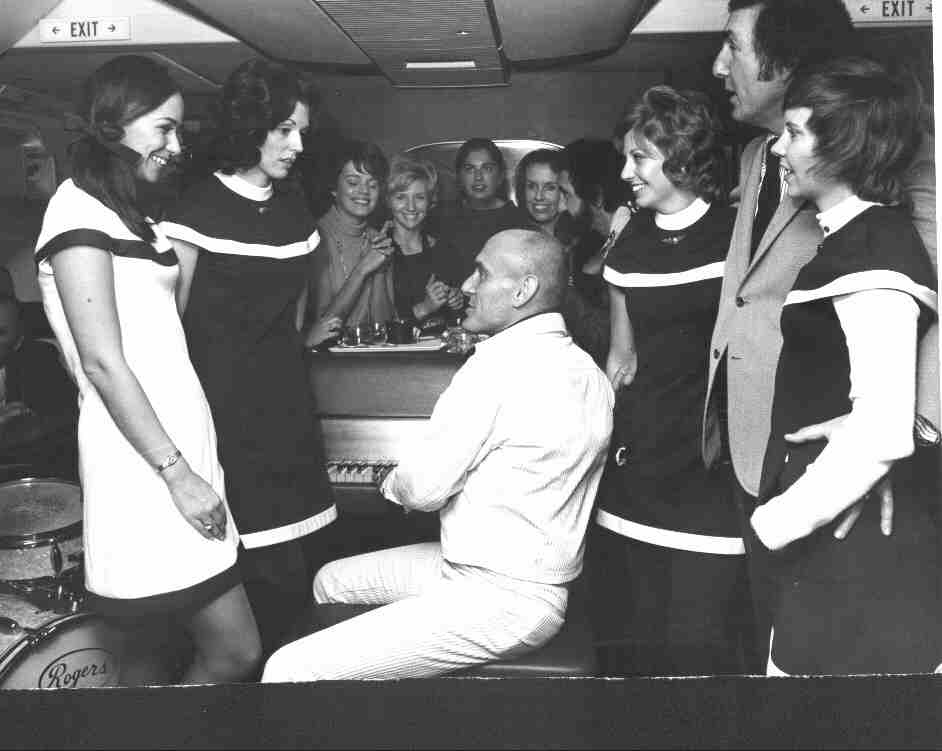
Excuse me, Sir, we need you to close the keyboard for landing.
As we develop the electronic communities of the future we have to remember that while allowing customisation and adaptation to individual needs is usually highly desirable, and that artificial restrictions, choke points and other points of failure are highly undesirable, that we have to juggle these with the requirement to be able to create a community. Lots of good research shows the value of a strong student community but, without the ability to oversee, suggest, guide and mentor that community, we end up with a separate community that may take directions that are not the ones that they should. Our challenge, as we work towards the classroom of 2020, is to work out which kinds of communities we want to build and how we construct systems around these that keep all the good things we want, while keeping educators and students connected.

 Nick Falkner