
Reflection: Why I’m stopping daily updates
Posted: February 15, 2016 Filed under: Education | Tags: aesthetics, authenticity, beauty, blogging, design, education, ethics, higher education, learning, reflection, teaching, thinking 4 CommentsI’ve written a lot in the past month and a half. Now, because I’m committed to evaluation, I have to look back at all of it and think about some difficult matters:
- Is anyone reading this?
- Are the people reading this the ones who can make change?
- Is the best way to do this?
- Should I be doing something else?
There are roughly 1,000 people who see my posts, between direct subscribers who read in e-mail, Facebook and the elusive following community on Twitter.
Twitter shouldn’t count, as I know from direct experience that the click-through rate from Twitter is tiny. (My posts have been shared by people with 5-10,000 followers and it has turned into maybe 10-20 more people reading.) Now I’m down to maybe 4-500 readers.
Facebook shares a longer fragment of my ideas but the click through is still small. Perhaps this brings me down to the roughly 200 followers I have, who have (over time) contributed about 1,000 ‘Likes’. However, almost all of these positive reinforcements stem from a different phase of the blog, a time when I was blogging conferences and being useful, rather than pontificating on the nature of beauty. My readership used to be 100 people a day, or more. I can’t crack 80 today and the way that I’m blogging is unlikely to reach that larger audience, yet it’s what I want to do.
The answer to 1 is that a few other people a day are reading what I write. I’d put it as high as twenty on a good day but most days it’s under ten.
2’s a tricky question. We can all make change; that’s one of my firmest beliefs. However, there is making change and then there are change makers. I know several people in this area quite well and they read me occasionally but it’s not something that they dedicate time to do. I have people that I always read but I can’t make the changes they need. It’s frustrating. No doubt, my ideas appeal to some people but change takes will and capacity to change, not just a sympathetic ear. I don’t want people to read this and feel trapped because they can’t make change. The answer to 2 is, probably, ‘no’.
3 follows from 1 and 2. If my readership is small and my ideas have little influence then this is not the best way to do things. We face enormous challenges. We need effective mechanisms for sharing information. If I am to make change, I have to invest my time wisely. I am not a large-scale player or a change maker. I need help to do it and if that help isn’t coming from this avenue, I have to choose another.
4 is easier. I can focus on my scholarship, practice, and research, rededicating the time I’ve been spending on this blog. People read papers where they don’t read blogs. Papers drive recognition. Recognition gets you the places to speak where your voice can be heard. There is no point having written all those words in a blog if it’s rarely read. This has been a highly rewarding experience in many ways but you have to wonder why you’re doing it if very few people read it or remember what you’ve written.
I wanted people to think and to talk about the ideas shared here. For those of you who have let me know that this worked, my thanks!
I’m tempted to keep going with the daily blog but the aesthetic argument traps me here. Spending time on something that isn’t working and insisting that it’s valuable is self-deception. Investing energy into an avenue that isn’t achieving your goals isn’t good. I cannot deprive my students of the hour or so a day that I’ve been spending doing this unless I achieve more for them than I would by doing some other aspect of my job.
Students and teachers: the true focus of any aesthetic discussion of education; the most important aspects of any discussion of what we should be doing because they are people and not just machine parts. As for us, so for them.
There are more discussions to be had but they’ll show up in more formal places, most likely. I’m always happy to talk to people about ideas at conferences. I’ve already started a face-to-face discussion about taking some of these ideas further in a more traditional research sense and I’m very excited about that.
But perhaps it’s time to let this blog go, listen to the numbers, reflect on the dissemination of knowledge, and accept that I would not be following my own advice if I were to continue. I love the beauty argument. I think it’s great. I stand by everything I’ve written this year. I just don’t think that this is the way to move people towards that agenda.
Thus, the daily updates stop with this post. I’ll still post things that interest me but there’ll be fewer of them.
I’ll leave you with the message I wanted to get across this year:
- Educational philosophy is full of the aesthetics of education. Dewey and Bloom just scratch the surface of this. The late 19th and early 20th century were an incredible time of upheaval and we still haven’t addressed many of the questions raised then. To the libraries!
- Fair, equitable, well-designed and evidence-based education is at the core of any beautiful system.
- Every day, we should ask ourselves if what we are doing is beautiful, good or true, taking into account all of the difficult questions of how we balance necessities against desirabilities, being honest about which is which. If we aren’t managing this, we need to either seek to change or accept that what we are doing isn’t right.
- We should leave enough time for ourselves in all of this, as there should be no sacrificial element to beautiful education.
- Change is coming. Change is here. Pretending that it won’t happen isn’t beautiful.
I hope that you all have a fantastic learning and teaching year, with many amazing and beautiful moments and outcomes!
This year, I hope to be at several conferences and I look forward to talking to anyone about the ideas in this phase (or any other phase) of the blog.
Have a great year!

Beautiful decomposition
Posted: February 14, 2016 Filed under: Education | Tags: advocacy, aesthetics, authenticity, beauty, blogging, community, competency-based assessment, education, educational problem, educational research, ethics, higher education, in the student's head, learning, small group learning, student perspective, teaching, teaching approaches, Workgroups Leave a commentNow there’s a title that I didn’t expect to write. In this case, I’m referring to how we break group tasks down into individual elements. I’ve already noted that groups like team members who are hard-working, able to contribute and dependable, but we also have the (conflicting) elements from the ideal group where the common goal is more important than individual requirements and this may require people to perform tasks that they are either not comfortable with or ideally suited for.

Kevin was nervous. The group’s mark depended upon him coming up with a “Knock Knock joke” featuring eyes.
How do we assess this fairly? We can look at what a group produces and we can look at what a group does but, to see the individual contribution, there has to be some allocation of sub-tasks to individuals. There are several (let’s call them interesting) ways that people divide up up tasks that we set. Here are three.
- Decomposition into dependent sub-tasks.
- Decomposition into isolated sub-tasks (if possible).
- Decomposition into different roles that spread across different tasks.
Part of working with a group is knowing whether tasks can be broken down, how that can be done successfully, being able to identify dependencies and then putting the whole thing back together to produce a recognisable task at the end.
What we often do with assignment work is to give students identical assignments and they all solemnly go off and solve the same problem (and we punish them if they don’t do enough of this work by themselves). Obviously, then, a group assignment that can be decomposed to isolated sub tasks that have no dependencies and have no assembly requirement is functionally equivalent to an independent assessment, except with some semantic burden of illusory group work.
If we set assignments that have dependent sub-tasks, we aren’t distributing work pressure fairly as students early on in the process have more time to achieve their goals but potentially at the expense of later students. But if the tasks aren’t dependent then we have the problem that the group doesn’t have to perform as a group, they’re a set of people who happen to have a common deadline. Someone (or some people) may have an assembly role at the end but, for the most part, students could work separately.
The ideal way to keep the group talking and working together is to drive such behaviour through necessity, which would require role separation and involvement in a number of tasks across the lifespan of the activity. Nothing radical about that. It also happens to be the hardest form to assess as we don’t have clear task boundaries to work with. However, we also have provided many opportunities for students to demonstrate their ability and to work together, whether as mentor or mentee, to learn from each other in the process.
For me, the most beautiful construction of a group assessment task is found where groups must work together to solve the problem. Beautiful decomposition is, effectively, not a decomposition process but an identification strategy that can pinpoint key tasks while recognising that they cannot be totally decoupled without subverting the group work approach.
But this introduces grading problems. A fluid approach to task allocation can quickly blur neat allocation lines, especially if someone occupies a role that has less visible outputs than another. Does someone get equal recognition for driving ideas, facilitating, the (often dull) admin work or do you have to be on the production side to be seen as valuable?
I know some of you have just come down heavily on one side or the other reading that last line. That’s why we need to choose assessment carefully here.
If you want effective group work, you need an effective group. They have to trust each other, they have to work to individual strengths, and they must be working towards a common goal which is the goal of the task, not a grading goal.
I’m in deep opinion now but I’ve always wondered how many student groups fall apart because we jam together people who just want a pass with people who would kill a baby deer for a high distinction. How do these people have common ground, common values, or the ability to build a mutual trust relationship?
Why do people who just want to go out and practice have to raise themselves to the standards of a group of students who want to get academic honours? Why should academic honours students have to drop their standards to those of people who are happy to scrape by?
We can evaluate group work but we don’t have to get caught up on grading it. The ability to work in a group is a really useful skill. It’s heavily used in my industry and I support it being used as part of teaching but we are working against most of the things we know about the construction of useful groups by assigning grades for knowledge and skill elements that are strongly linked into the group work competency.
Look at how teams work. Encourage them to work together. Provide escape valves, real tasks, things so complex that it’s a rare person who could do it by themselves. Evaluate people, provide feedback, build those teams.
I keep coming back to the same point. So many students dislike group work, we must be doing something wrong because, later in life, many of them start to enjoy it. Random groups? They’re still there. Tight deadlines? Complex tasks? Insufficient instructions? They’re all still there. What matters to people is being treated fairly, being recognised and respected, and having the freedom to act in a way to make a contribution. Administrative oversight, hierarchical relationships and arbitrary assessment sap the will, undermine morale and impair creativity.
If your group task can be decomposed badly, it most likely will be. If it’s a small enough task that one keen person could do it, one keen person probably will because the others won’t have enough of a task to do and, unless they’re all highly motivated, it won’t be done. If a group of people who don’t know each other also don’t have a reason to talk to each other? They won’t. They might show up in the same place if you can trigger a bribe reaction with marks but they won’t actually work together that well.
The will to work together has to be fostered. It has to be genuine. That’s how good things get done by teams.
Valuable tasks make up for poor motivation. Working with a group helps to practise and develop your time management. Combine this with a feeling of achievement and there’s some powerful intrinsic motivation there.
And that’s the fuel that gets complex tasks done.
Aesthetics of group work
Posted: February 13, 2016 Filed under: Education | Tags: aesthetics, authenticity, beauty, community, competency-based assessment, design, education, educational problem, ethics, higher education, in the student's head, learning, small group learning, teaching, teaching approaches, Workgroups Leave a commentWhat are the characteristics of group work and how can we define these in terms that allow us to form a model of beauty about them? We know what most people want from their group members. They want them to be:
- Honest. They do what they say and they only claim what they do. They’re fair in their dealings with others.
- Dependable. They actually do all of what they say they’re going to do.
- Hard-working. They take a ‘reasonable’ time to get things done.
- Able to contribute a useful skill
- A communicator. They let the group know what’s going on.
- Positive, possibly even optimistic.
A number of these are already included in the Socratic principles of goodness and truth. Truth, in the sense of being honest and transparent, covers 1, 2 and possibly even 5. Goodness, that what we set out to do is what we do and this leads to beauty, covers 3 and 4, and I think we can stretch it to 6.
But what about the aesthetics of the group itself? What does a beautiful group look like? Let’s ignore the tasks we often use in group environments and talk about a generic group. A group should have at least some of these (from) :
- Common goals.
- Participation from every member.
- A focus on what people do rather than who they are.
- A focus on what happened rather than how people intended.
- The ability to discuss and handle difference.
- A respectful environment with some boundaries.
- The capability to work beyond authoritarianism.
- An accomodation of difference while understanding that this may be temporary.
- The awareness that what group members want is not always what they get.
- The realisation that hidden conflict can poison a group.
Note how many of these are actually related to the task itself. In fact, of all of the things I’ve listed, none of the group competencies have anything at all to do with a task and we can measure and assess these directly by observation and by peer report.
How many of these are refined by looking at some arbitrary discipline artefact? If anything, by forcing students to work together on a task ‘for their own good’, are we in direct violation of this new number 7, allowing a group to work beyond strict hierarchies?

“I’m carrying my whole team here!”
I’ve worked in hierarchical groups in the Army. The Army’s structure exists for a very specific reason: soldiers die in war. Roles and relationships are strictly codified to drive skill and knowledge training and to ensure smooth interoperation with a minimum of acclimatisation time. I think we can be bold and state that such an approach is not required for third- or fourth-year computer programming, even at the better colleges.
I am not saying that we cannot evaluate group work, nor am I saying that I don’t believe such training to be valuable for students entering the workforce. I just don’t happen to accept that mediating the value of a student’s skills and knowledge through their ability to carry out group competencies is either fair or honest. Item 9, where group members may have to adopt a role that they have identified is not optimal, is grossly unfair when final marks depend upon how the group work channel mediates the perception of your contribution.
There is a vast amount of excellent group work analysis and support being carried out right now, in many places. The problem occurs when we try to turn this into a mark that is re-contextualised into the knowledge frame. Your ability to work in groups is a competency and should be clearly identified as such. It may even be a competency that you need to display in order to receive industry-recognised accreditation. No problems with that.
The hallmarks of traditional student group work are resentment at having to do it, fear that either their own contributions won’t be recognised or someone else’s will dominate, and a deep-seated desire to get the process over with.
Some tasks are better suited to group solution. Why don’t we change our evaluation mechanisms to give students the freedom to explore the advantages of the group without the repercussions that we currently have in place? I can provide detailed evaluation to a student on their group role and tell a lot about the team. A student’s inability to work with a randomly selected team on a fake project with artificial timelines doesn’t say anything that I would be happy to allocate a failing grade to. It is, however, an excellent opportunity for discussion and learning, assuming I can get beyond the tyranny of the grade to say it.
Challenge accepted: beautiful groupwork
Posted: February 12, 2016 Filed under: Education | Tags: advocacy, aesthetics, authenticity, beauty, community, competency-based assessment, design, education, educational problem, educational research, ethics, group work, higher education, in the student's head, learning, resources, small group learning, student perspective, teaching, teaching approaches, thinking Leave a commentYou knew it was coming. The biggest challenge of any assessment model: how do we handle group-based assessment?

Come out! We know that you didn’t hand it in on-time!
There’s a joke that says a lot about how students feel when they’re asked to do group work:
When I die I want my group project members to lower me into my grave so they can let me down one more time.
Everyone has horror stories about group work and they tend to fall into these patterns:
- Group members X and Y didn’t do enough of the work.
- I did all of the work.
- We all got the same mark but we didn’t do the same work.
- Person X got more than I did and I did more.
- Person X never even showed up and they still passed!
- We got it all together but Person X handed it in late.
- Person W said that he/she would do task T but never did and I ended up having to do it.
Let’s consolidate these. People are concerned about a fair division of work and fair recognition of effort, especially where this falls into an allocation of grades. (Point 6 only matters if there are late penalties or opportunities lost by not submitting in time.)
This is totally reasonable! If someone is getting recognition for doing a task then let’s make sure it’s the right person and that everyone who contributed gets a guernsey. (Australian football reference to being a recognised team member.)
How do we make group work beautiful? First, we have to define the aesthetics of group work: which characteristics define the activity? Then we maximise those as we have done before to find beauty. But in order for the activity to be both good and true, it has to achieve the goals that define and we have to be open about what we are doing. Let’s start, even before the aesthetics, and ask about group work itself.
What is the point of group work? This varies by discipline but, usually, we take a task that is too large or complex for one person to achieve in the time allowed and that mimics (or is) a task you’d expect graduates to perform. This task is then attacked through some sort of decomposition into smaller pieces, many of which are dependant in a strict order, and these are assigned to group members. By doing this, we usually claim to be providing an authentic workplace or task-focused assignment.
The problem that arises, for me, is when we try and work out how we measure the success of such a group activity. Being able to function in a group has a lot of related theory (psychological, behavioural, and sociological, at least) but we often don’t teach that. We take a discipline task that we believe can be decomposed effectively and we then expect students to carve it up. Now the actual group dynamics will feature in the assessment but we often measure the outputs associate with the task to determine how effective group formation and management was. However, the discipline task has a skill and knowledge dimension, while the group activity elements have a competency focus. What’s more problematic is that unsuccessful group work can overshadow task achievement and lead to a discounting of skill and knowledge success, through mechanisms that are associated but not necessarily correlated.
Going back to competency-based assessment, we assess competency by carrying out direct observation, indirect measures and through professional reports and references. Our group members’ reports on us (and our reports on them) function in the latter area and are useful sources of feedback, identifying group and individual perceptions as well as work progress. But are these inherently markable? We spend a lot of time trying to balance peer feedback, minimise bullying, minimise over-claiming, and get a realistic view of the group through such mechanisms but adding marks to a task does not make it more cognitively beneficial. We know that.
For me, the problem with most group work assessment is that we are looking at the output of the task and competency based artefacts associated with the group and jamming them together as if they mean something.
Much as I argue against late penalties changing the grade you received, which formed a temporal market for knowledge, I’m going to argue against trying to assess group work through marking a final product and then dividing those grades based on reported contributions.
We are measuring different things. You cannot just add red to melon and divide it by four to get a number and, yet, we are combining different areas, with different intentions, and dragging it into one grade that is more likely to foster resentment and negative association with the task. I know that people are making this work, at least to an extent, and that a lot of great work is being done to address this but I wonder if we can channel all of the energy spent in making it work into getting more amazing things done?
Just about every student I’ve spoken to hates group work. Let’s talk about how we can fix that.
More on the #ATAR, @birmo looks to the Higher Education Standards Panel
Posted: February 11, 2016 Filed under: Education | Tags: advocacy, ATAR, authenticity, community, education, educational problem, educational research, ethics, higher education, reflection, resources, tertiary admittance, tools 1 CommentThe Federal Education Minister, Senator Simon Birmingham, appears as concerned over the disconnect between the Australian Tertiary Admission Rank (ATAR) and university entry as I am. In his own words, students must have “a clear understanding of what they need to do to get into their course of choice and realising what will be expected of them through their further study.”
This article covers some of the issues already raised over transparency and having a system that people work with rather than around.
“While universities determine their own admission requirements, exploring greater transparency measures will ensure that Australian students are provided real information on what they need to do to be admitted to a course at a particular institution and universities are held to account for their public entry requirements,” Senator Birmingham said.
Ensuring that students are ready for university but it’s increasingly obvious that this role is not supported or validated through the current ATAR system, for a large number of students. I look forward to see what comes from the standards panel and I hope that it’s to everyone’s benefit, not just a rejigging of a number that was probably never all that representative to start with.
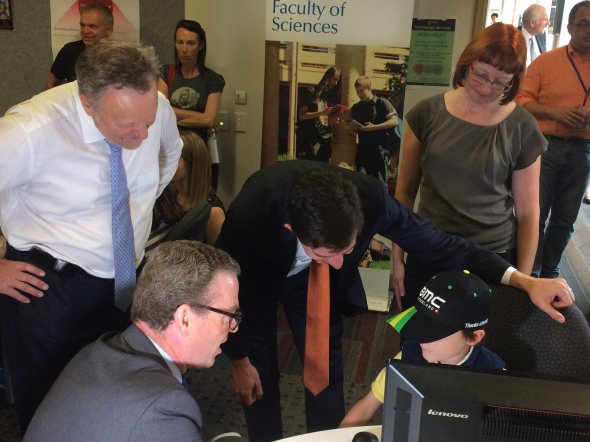
Senator Birmingham, Minister Pyne, Professor Bebbington (VC of Adelaide) and A/Prof Katrina Falkner with one of the Bright Spark participants.
Perhaps I should confess that I would like a system where any student could get into University (or VET or TAFE or whatever tertiary program they want to) but that we build our preparatory and educational systems to support this happening, rather than just bringing people in to watch them fail. Oh, but a boy can dream.
It’s not just GPAs
Posted: February 10, 2016 Filed under: Education | Tags: advocacy, aesthetics, ATAR, authenticity, balance, community, education, educational problem, educational research, ethics, fairness, GPA, higher education, resources, student perspective Leave a commentIf you’re watching the Australian media on higher education, you’ll have seen a lot of discussion regarding the validity of the Australian Tertiary Admission Rank (ATAR) as a measure of a student’s future performance and as an accurate summary of the previous years of education.

When you are being weighed in the balance, you probably want to know a lot about the scale and the measures.
This article, talking about students being admitted below the cut-offs, contains a lot of discussion on the issue. Not all of the discussion is equally valuable, in my opinion, as the when the question is the validity of the measure, being concerned about ‘standards slipping’ when a lower number is used isn’t that relevant. The interesting parts of the discussion are which mechanisms we should be using and making them transparent so that all students are on a level playing field.
The fact is that students are being admitted to, and passing, courses that have barriers in place which should clearly indicate their chances of success. Yet students are being admitted based on other pathways, using additional measures such as portfolios, and this makes a bit of a mockery on the apparent simplicity of the ATAR system.
My own analysis of student ATAR versus GPA is revelatory: the mapping is a very noisy correlation and, apart from the very highest ATARs, we see people who succeed or fail in a way that does not match their representative ATAR. Yes, there are rough ‘buckets’ but at a granularity of fewer than five buckets, rather than the thousand or so we’re pretending to have.
“Reducing six years of education to a single ranking is simplistic, let’s have a constructive debate about what could replace the ATAR alone as a fairer, more comprehensive and contextual measure of academic potential”.
Iain Martin, from this linked opinion piece.
I couldn’t agree more!
Streamlining for meaning.
Posted: February 9, 2016 Filed under: Education | Tags: advocacy, aesthetics, assessment, authenticity, beauty, competency-based assessment, design, education, educational problem, educational research, ethics, GPA, higher education, in the student's head, reflection, resources, student perspective, teaching, teaching approaches, thinking Leave a commentIn yesterday’s musings on Grade Point Average, GPA, I said:
But [GPA calculation adjustment] have to be a method of avoidance, this can be a useful focusing device. If a student did really well in, say, Software Engineering but struggled with an earlier, unrelated, stream, why can’t we construct a GPA for Software Engineering that clearly states the area of relevance and degree of information? Isn’t that actually what employers and people interested in SE want to know?
This hits at the heart of my concerns over any kind of summary calculation that obscures the process. Who does this benefit? What use it is to anyone? What does it mean? Let’s look at one of the most obvious consumers of student GPAs: the employers and industry.
Feedback from the Australian industry tells us that employers are generally happy with the technical skills that we’re providing but it’s the softer skills (interpersonal skills, leadership, management abilities) that they would like to see more of and know more about. A general GPA doesn’t tell you this but a Software Engineering focused GPA (as I mentioned above) would show you how a student performed in courses where we would expect to see these skills introduced and exercised.
Putting everything into one transcript gives people the power to assemble this themselves, yes, but this requires the assembler to know what everything means. Most employers have neither the time nor inclination to do this for all 39 or so institutions in Australia. But if a University were to say “this is a summary of performance in these graduate attributes”, where the GAs are regularly focused on the softer skills, then we start to make something more meaningful out of an arbitrary number.
But let’s go further. If we can see individual assessments, rather than coarse subject grades, we can start to construct a model of an individual across the different challenges that they have faced and overcome. Portfolios are, of course, a great way to do this but they’re more work to read than single measures and, too often, such a portfolio is weighed against simpler, apparently meaningful measures such as high GPAs and found wanting. Portfolios also struggle if placed into a context of previous failure, even if recent activity clearly demonstrates that a student has moved on from that troubled or difficult time.
I have a deep ethical and philosophical objection to curve grading, as you probably know. The reason is simple: the actions of one student should not negatively affect the outcomes of another. This same objection is my biggest problem with GPA, although in this case the action and outcomes belong to the same student at different points in her or his life. Rather than using performance in one course to determine access to the learning upon which it depends, we make these grades a permanent effect and every grade that comes afterwards is implicitly mediated through this action.

Sometimes you should be cautious regarding adding curves to address your problems.
Should Past Academic Nick have an inescapable impact on Now and Future Academic Nick’s life? When we look at all of the external influences on success, which make it clear how much totally non-academic things matter, it gets harder and harder to say “Yes, Past Academic Nick is inescapable.” Unfairness is rarely aesthetically pleasing.
An excellent comment on the previous post raised the issue of comparing GPAs in an environment where the higher GPA included some fails but the slightly lower GPA student had always passed. Which was the ‘best’ student from an award perspective? Student A fails three courses at the start of his degree, student B fails three courses at the end. Both pass with the same GPA, time to completion, and number of passes and fails. Is there even a sense of ‘better student’ here? B’s struggles are more immediate and, implicitly, concerns would be raised that these problems could still be active. A has, apparently, moved on in some way. But we’d never know this from simplistic calculations.
If we’re struggling to define ‘best’ and we’re not actually providing something that many people feel is useful, while burdening students with an inescapable past, then the least we can do is to sit down with the people who are affected by this and ask them what they really want.
And then, when they tell us, we do something about changing our systems.
Dances with GPAs
Posted: February 8, 2016 Filed under: Education | Tags: advocacy, aesthetics, assessment, authenticity, beauty, community, competency-based assessment, education, educational problem, educational research, ethics, GPA, higher education, in the student's head, resources, student perspective, teaching, thinking, tools 4 Comments
The trick to dancing with dragons is to never lose your grip on the tail.
If we are going to try and summarise a complicated, long-term process with a single number, and I don’t see such shortcuts going away anytime soon, then it helps to know:
- Exactly what the number represents.
- How it can be used.
- What the processes are that go into its construction.
We have conventions as to what things mean but, when we want to be precise, we have to be careful about our definition and our usage of the final value. As a simple example, one thing that often surprises people who are new to numerical analysis is that there is more than one way of calculating the average value of a group of numbers.
While average in colloquial language would usually mean that we take the sum of all of the numbers and divide them by their count, this is more formally referred to as the arithmetic mean. What we usually want from the average is some indication of what the typical value for this group would be. If you weigh ten bags of wheat and the average weight is 10 kilograms, then that’s what many people would expect the weight to be for future bags, unless there was clear early evidence of high variation (some 500g, some 20 kilograms, for example.)
But the mean is only one way to measure central tendency in a group of numbers. We can also measure the median, the number that separates the highest half of the data from the lowest, or the mode, the value that is the most frequently occurring value in the group.
(This doesn’t even get into the situation where we decide to aggregate the values in a different way.)
If you’ve got ten bags of wheat and nine have 10 kilograms in there, but one has only 5 kilograms, which of these ways of calculating the average is the one you want? The mode is 10kg but the mean is 9.5kg. If you tried to distribute the bags based on the expectation that everyone gets 9.5, you’re going to make nine people very happy and one person unhappy.
Most Grade Point Average calculations are based on a simple arithmetic mean of all available grades, with points allocated from 0 to an upper bound based on the grade performance. As a student adds more courses, these contributions are added to the calculation.
In yesterday’s post, I mused on letting students control which grades go into a GPA calculation and, to explore that, I now have to explain what I mean and why that would change things.
As it stands, because a GPA is an average across all courses, any lower grades will permanently drop the GPA contribution of any higher grades. If a student gets a 7 (A+ or High Distinction) for 71 of her courses and then a single 4 (a Passing grade) for one, her GPA will be 6.875. It can never return to 7. The clear performance band of this student is at the highest level, given that just under 99% of her marks are at the highest level, yet the inclusion of all grades means that a single underperformance, for whatever reason, in three years has cost her standing for those people who care about this figure.
My partner and I discussed some possible approaches to GPA that would be better and, by better, we mean approaches that encourage students to improve, that clearly show what the GPA figure means, and that are much fairer to the student. There are too many external factors contributing to resilience and high performance for me to be 100% comfortable with the questionable representation provided by the GPA.
Before we even think about student control over what is presented, we can easily think of several ways to make a GPA reflect what you have achieved, rather than what you have survived.
- We could only count a percentage of the courses for each student. Even having 90% counted means that students who stumble a little once or twice do not have this permanently etched into a dragging grade.
- We could allow a future attempt at a course with an improved to replace the previous grade. Before we get too caught up in the possibility of ‘gaming’, remember that students would have to pay for this (even if delayed) in most systems and it will add years to their degree. If a student can reach achievement level X in a course then it’s up to us to make sure that does correspond to the achievement level!
- We could only count passes. Given that a student has to assemble sufficient passing grades to be awarded a degree, why then would we include the courses that do not count in a calculation of GPA?
- We could use the mode and report the most common mark the student receives.
- We could do away with it totally. (Not going to happen any time soon.)
- We could pair the GPA with a statistical accompaniment that tells the viewer how indicative it is.
Options 1 and 2 are fairly straight-forward. Option 3 is interesting because it compresses the measurement band to a range of (in my system) 4-7 and this then implicitly recognises that GPA measures for students who graduate are more likely to be in this tighter range: we don’t actually have the degree of separation that we’d assume from a range of 0-7. Option 4 is an interesting way to think about the problem: which grade is the student most likely to achieve, across everything? Option 5 is there for completeness but that’s another post.
Option 6 introduces the idea that we stop GPA being a number and we carefully and accurately contextualise it. A student who receives all high distinctions in first semester still has a number of known hurdles to get over. The GPA of 7 that would be present now is not as clear an indicator of facility with the academic system as a GPA of 7 at the end of a degree, whichever other GPA adjustment systems are in play.
More evidence makes it clearer what is happening. If we can accompany a GPA (or similar measure) with evidence, then we are starting to make the process apparent and we make the number mean something. However, this also allows us to let students control what goes into their calculation, from the grades that they have, as a clear measure of the relevance of that measure can be associated.
But this doesn’t have to be a method of avoidance, this can be a useful focusing device. If a student did really well in, say, Software Engineering but struggled with an earlier, unrelated, stream, why can’t we construct a GPA for Software Engineering that clearly states the area of relevance and degree of information? Isn’t that actually what employers and people interested in SE want to know?
Handing over an academic transcript seems to allow anyone to do this but human cognitive biases are powerful, subtle and pervasive. It is harder for most humans to recognise positive progress in the areas that they are interested in, if there is evidence of less stellar performance elsewhere. I cite my usual non-academic example: Everyone thought Anthony La Paglia’s American accent was too fake until he stopped telling people he was Australian.
If we have to use numbers like this, then let us think carefully about what they mean and, if they don’t mean that much, then let’s either get rid of them or make them meaningful. These should, at a fundamental level, be useful to the students first, us second.
Total control: a user model for student results
Posted: February 7, 2016 Filed under: Education | Tags: aesthetics, beauty, design, education, educational problem, ethics, higher education, in the student's head, reflection, resources, teaching, teaching approaches, thinking, tools Leave a commentYesterday, I wrote:
We need assessment systems that work for the student first and everyone else second.

We want you to rank these students by accumulated radiation and wavelength.
Grades are the fossils of evaluation
Posted: February 6, 2016 Filed under: Education | Tags: advocacy, aesthetics, assessment, authenticity, competency-based assessment, design, education, educational problem, educational research, fossil, higher education, in the student's head, learning, ranking, reflection, resources, student perspective, teaching, teaching approaches, thinking, truth, Wolff 1 CommentAssessments support evaluation, criticism and ranking (Wolff). That’s what it does and, in many cases, that also constitutes a lot of why we do it. But who are we doing it for?
I’ve reflected on the dual nature of evaluation, showing a student her or his level of progress and mastery while also telling us how well the learning environment is working. In my argument to reduce numerical grades to something meaningful, I’ve asked what the actual requirement is for our students, how we measure mastery and how we can build systems to provide this.
But who are the student’s grades actually for?
In terms of ranking, grades allow people who are not the student to place the students in some order. By doing this, we can award awards to students who are in the awarding an award band (repeated word use deliberate). We can restrict our job interviews to students who are summa cum laude or valedictorian or Dean’s Merit Award Winner. Certain groups of students, not all, like to define their progress through comparison so there is a degree of self-ranking but, for the most part, ranking is something that happens to students.
Criticism, in terms of providing constructive, timely feedback to assist the student, is weakly linked to any grading system. Giving someone a Fail grade isn’t a critique as it contains no clear identification of the problems. The clear identification of problems may not constitute a fail. Often these correlate but it’s weak. A student’s grades are not going to provide useful critique to the student by themselves. These grades are to allow us to work out if the student has met our assessment mechanisms to a point where they can count this course as a pre-requisite or can be awarded a degree. (Award!)
Evaluation is, as noted, useful to us and the student but a grade by itself does not contain enough record of process to be useful in evaluating how mastery goals were met and how the learning environment succeeded or failed. Competency, when applied systematically, does have a well-defined meaning. A passing grade does not although there is an implied competency and there is a loose correlation with achievement.
Grades allow us to look at all of a student’s work as if this one impression is a reflection of the student’s involvement, engagement, study, mistakes, triumphs, hopes and dreams. They are additions to a record from which we attempt to reconstruct a living, whole being.
Grades are the fossils of evaluation.
Grades provide a mechanism for us, in a proxy role as academic archaeologist, to classify students into different groups, in an attempt to project colour into grey stone, to try and understand the ecosystem that such a creature would live in, and to identify how successful this species was.
As someone who has been a student several times in my life, I’m aware that I have a fossil record that is not traditional for an academic. I was lucky to be able to place a new imprint in the record, to obscure my history as a much less successful species, and could then build upon it until I became an ACADEMIC TYRANNOSAURUS.

LIFE LONG LEARNING, ROAARRRR!
But I’m lucky. I’m privileged. I had a level of schooling and parental influence that provided me with an excellent vocabulary and high social mobility. I live in a safe city. I have a supportive partner. And, more importantly, at a crucial moment in my life, someone who knew me told me about an opportunity that I was able to pursue despite the grades that I had set in stone. A chance came my way that I never would have thought of because I had internalised my grades as my worth.
Let’s look at the fossil record of Nick.
My original GPA fossil, encompassing everything that went wrong and right in my first degree, was 2.9. On a scale of 7, which is how we measure it, that’s well below a pass average. I’m sharing that because I want you to put that fact together with what happened next. Four years later, I started a Masters program that I finished with a GPA of 6.4. A few years after the masters, I decided to go and study wine making. That degree was 6.43. Then I received a PhD, with commendation, that is equivalent to GPA 7. (We don’t actually use GPA in research degrees. Hmmm.) If my grade record alone lobbed onto your desk you would see the desiccated and dead snapshot of how I (failed to) engage with the University system. A lot of that is on me but, amazingly, it appears that much better things were possible. That original grade record stopped me from getting interviews. Stopped me from getting jobs. When I was finally able to demonstrate the skills that I had, which weren’t bad, I was able to get work. Then I had the opportunity to rewrite my historical record.
Yes, this is personal for me. But it’s not about me because I wasn’t trapped by this. I was lucky as well as privileged. I can’t emphasise that enough. The fact that you are reading this is due to luck. That’s not a good enough mechanism.
Too many students don’t have this opportunity. That impression in the wet mud of their school life will harden into a stone straitjacket from which they may never escape. The way we measure and record grades has far too much potential to work against students and the correlation with actual ability is there but it’s not strong and it’s not always reliable.
The student you are about to send out with a GPA of 2.9 may be competent and they are, most definitely, more than that number.
The recording of grades is a high-loss storage record of the student’s learning and pathway to mastery. It allows us to conceal achievement and failure alike in the accumulation of mathematical aggregates that proxy for competence but correlate weakly.
We need assessment systems that work for the student first and everyone else second.

 Nick Falkner