
Leibhardt: The Game Sensation That’s… not sweeping anywhere (yet!)
Posted: February 27, 2012 Filed under: Education | Tags: design, education, games, higher education, leibhardt, reflection, resources, teaching, teaching approaches, universal principles of design Leave a commentToday’s post is going to tie together my posts on design and, to illustrate it, I’m going to show you one of the game screens that my Summer Research Scholarship student produced. The game is called Leibhardt and it’s a way of teaching students about adding and removing items to commonly used data structures in Computer Science and programming. Here’s the picture of the playing space, as seen by one of the opponents:
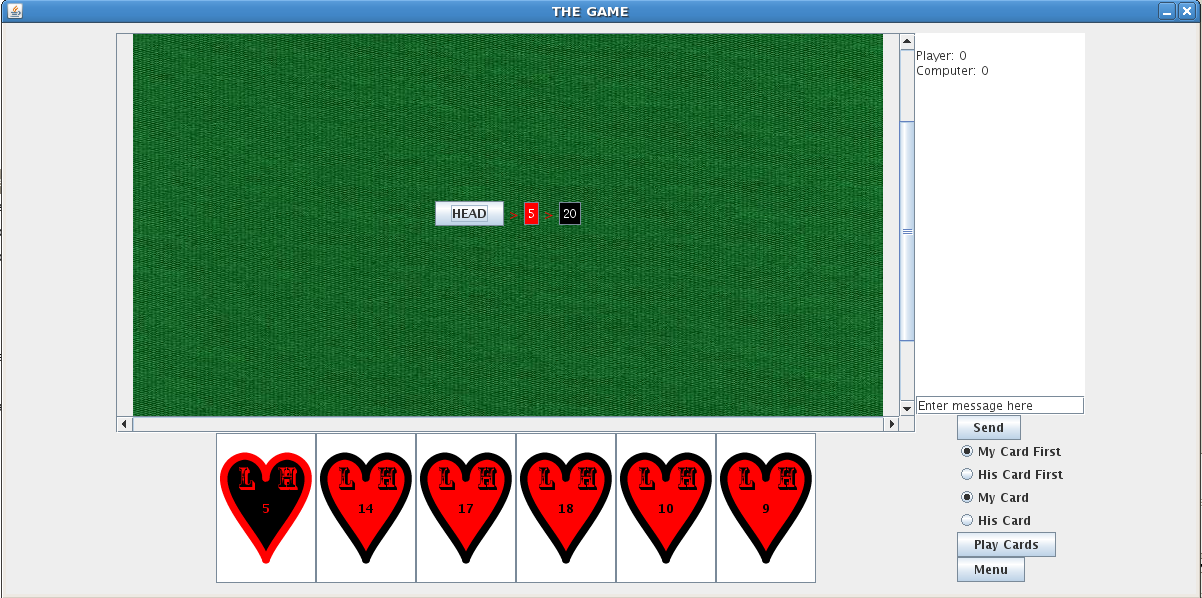
This is still a work in progress but let’s review the production and design process. I set the student a task: to find a way to teach a Computer Science concept using a game. I then gave him a stack of books, a central book as key text, and asked him to go away and come back with some ideas. He then presented a number of good ideas and I selected my prime candidate (which was also his). He then had to present a detailed plan with weekly goals. The project was only six weeks long so we had no time to waste. Over the next few weeks, we developed ideas, refined them and he turned it all into a game, with the assistance of another member of staff who I won’t uniquely identify but, thanks, Claudia!
Let’s look at this in terms of some of the principles I’ve been discussing. We decided to use a game because games are familiar to many people (functional consistency) and the appearance of card games is also something everyone understands (aesthetic consistency). Look at the image. Yes, the cards need some work but it’s got that green baize background we expect and, once the cards are finished, your fingers will naturally be drawn to the cards to select them for playing. I provided a set of nudges to keep the student on the right track, throughout the project, by providing appropriate and directed feedback, as well as controlling the books that he started with and keeping a fairly tight rein on the project until I was sure that he was on the right track. The game itself is full of nudge elements as well to keep the player going – this is a fairly addictive game. I’ve encouraged him to use GUI elements that can only be used in the right way (which is the affordance principle in action), as well as making sure that the system looks the same as every other Java-based game (external consistency). We’re still working on the look and feel of the structures themselves – they need to be consistent with what students have seen before, which is internal consistency in terms of the course context.
Finally, it’s possible for people to easily interrupt and resume games, for me to monitor activity so I can tell if people are undertaking assigned work on playing this game and there also degrees of difficulty involved. This gives us fairly fine-grained control over the performance load of the activity, and greatly reduces the kinematic and cognitive load of playing. Students who are new can choose to, or be expected to, expend less effort to achieve a good result. Expert students can crank up the difficulty and make the task harder. Any student can play it easily, stop playing and then pick it up again later.
I must point out that, while I’ve been heavily involved in the design and mentoring process, what I’ve mostly been doing is guiding a good student and helping him to make good decisions. I’m happy with my contribution but a lot of what I’ve been doing has been helping to organise information for decision making purposes – effectively providing guidance on using the five hat racks.
I hope that this helps you to understand that the design I’m talking about is not choosing Powerpoint templates, although that can be part of it, but is more of a deep-seated commitment to thinking about what we’re doing in order to produce the best work possible. We’re still working on the game and, with any luck we’ll have some versions available for teachers of Data Structures relatively soon.
Yes, you can! (Sorry, Mr President)
Posted: February 23, 2012 Filed under: Education, Opinion | Tags: design, education, higher education, reflection, teaching, teaching approaches, universal principles of design Leave a commentI put in a long post yesterday and today’s reward is that this post is short. I want to remind you all that you don’t have to be some sort of amazing educational designer to bring good design into your work. When most people think ‘design’ they think of graphic design, high-concept art, artistic ability and lots of words that aren’t in their standard vocabulary. I hope that, over the last three days, you’ve realised that we’re all using good design principles all the time – everywhere – and that’s it a matter of being aware of what we’re doing, so we can re-use those principles elsewhere. I’m certainly no expert but I can explain things fairly well and I like to bring new vocabularies to new audiences. I have a secret theory that most of the problems we have stem from people not being able to communicate and express themselves – maybe not all problems, but certainly a lot of those that lead to disengagement and frustration among our students.
One of the aspects of President Obama’s campaign that was both praised and ridiculed, depending upon which side of politics you found yourself, was the use of simple messages and clear design to make it easy for people to identify the campaign and associate with it. The imagery is simple and powerful. The logo includes references to the President’s initial (O), patriotic symbols and sunrise – a new beginning. That kind of simplicity and power takes some serious work and that’s where professional designers make their money. (I’ve deliberately not linked or included the logo here. I’m aware of the political divide in the US and don’t want people to think I’m advocating one political party or another – the title of this post is probably enough that I’ll get some interesting comments. You can easily find the logo for yourself by searching for Obama logo.)
But that’s not what we’re doing. We’re just trying to make our teaching more accessible, our materials easier to use and our students more knowledgable. By considering things we may not have considered, we can reduce problems. We can make our lecture notes available in ways we hadn’t thought of before. We can make a difference that assists our students in engaging with us and what we’re trying to teach them.
Electing a president? That’s probably beyond you. Looking at some of the things that I’ve been talking about and possibly helping a student learn from you? Yes, you can!
Challenging For All Or Just Impossible For Some? (Come back, Claude Shannon, we need you!)
Posted: February 20, 2012 Filed under: Education, Opinion | Tags: advocacy, education, higher education, reflection, teaching, teaching approaches 2 CommentsBack at the start of this blog I drew up a learning and teaching diagram, which I reproduce here:

The idea is simple. We learn from inputs and, having learned, can then teach and pass this information on to other people. This diagram represents a single person and shows the benefits of learning and teaching as separate and fusion activities. But can we guarantee that our outputs will reach someone else’s inputs without distortion – without information loss?
Well, that depends very much upon us and the receiver. If we’re not prepared to explain ourselves then our transmission will be less than 100%. If the student isn’t listening then their reception will be less than 100%. Combine these (by multiplying them) and we will definitely get less than 100%. If we add the medium into the mix, the environment that the transmission moves through to get to us from them, then we introduce another potential point of loss. I now have three places to reduce my efficiency. No wonder we spend so much time on trying to engage our students, to use sensible techniques and to present our ideas clearly!
Final transfer = %age of transmission * %age of successful medium passage * %age of reception.
For example, if you have no way of getting information to your students, then the %age of successful transmission is 0 and nothing is transferred. This is not anything amazing – it’s a simple application of the product rule. This is the effective percentage of the information that you sent out that is reaching the student. How bad is this? Let’s say you have a bad day and give a lecture where everything is working except you. You give a 30% lecture. Nothing else gets in the way. Your aids all work, your students are awake. Final result: 30% * 100% * 100% = 30%. Basically, if you don’t put it into the process at the start, nothing else is going to come out. (There are many ways to think about this, including ways with mathematical proofs, that I will discuss later in this post.)
How much does a student need? Good question! Some students will get by on a small amount and go off and do excellently. Some need a lot more. Unless you have a very good understanding of your students abilities, or a very tight cohort, the line between making something challenging and making it impossible is very hard to see.
I must be frank with you in that I find that some people I have observed, over the years, have not made it easy for the students to obtain the knowledge. As you can see from the model, if you’re not communicating 100%, then it doesn’t matter if the student is desperately trying to get information out of you – they can’t get what you’re not saying. Similarly, if you put it in a form that is muddled or confused then, once again, we reduce the chances of information going across.
If you’re in engineering or ICT you’ll probably have heard of Claude Shannon. Shannon effectively founded the field of Information Theory back in 1948, but also founded both digital computer and digital circuit theory 11 years earlier, as a masters student. A lot of Shannon’s work revolved around how much information you could transmit, given the physical characteristics of the medium you were using and how noisy it was. Rather than my primitive equation above, which talks in terms of probability (or possibly efficiency), Shannon’s Channel Capacity equation very sensibly states this in terms of the largest amount of information that can be shared. If you like, you can’t fit a bowling ball through a garden hose at the same rate you can push a bowling ball through a large pipe. When the pipe is full of noise, say water or concrete, you can’t treat it like a big pipe. If it gets full enough of noise, it will be a garden hose and things slow down. (My apologies to engineers, I didn’t feel up to a discussion of mutual information and input distributions.) The medium in this case is a noisy channel – a channel where things can and do go wrong, much as happens to us every day. Because most of us are time locked (lecture time, semester duration), any decrease in efficiency that requires more time will lead to us having to omit information.
Our lives are full of noise, distraction and days when things don’t go right. Whenever I see someone who is not making it easy for their students by trying to make the students drag information out of them, I think of the noisy channel that we have every day, and the fact that students may not have the best day sometimes. And then I think of what I get paid to do, which is to try and keep my part of the system transmitting as well I can, through the least noisy channel possible. There are enough things to go wrong, without me thinking that I’m making it challenging – and I may be making it impossible.
(If you’re interested, look up Claude Shannon, Channel Capacity, Shannon-Hartley Theorem and the Noisy Channel Coding Theorem. They’re a little mathematical but, if you add Nyquist-Shannoninto the mix, you’ll find out what the maximum frequency is that CDs can store. Have fun!)
James Frey’s Legacy: Authenticity needs to be authentic!
Posted: February 18, 2012 Filed under: Education, Opinion | Tags: authenticity, education, higher education, reflection, teaching approaches Leave a commentJames Frey is an American author who has been in the news on and off over the last few years. He published a book called A Million Little Pieces, which purported to be memoirs of his struggle with addiction, association with criminals and time in jail. On the strength of this account of his fall and rise, and his defeat of his demons, he sold a lot of books, went on Oprah and probably got to dive, Scrooge McDuck-like, into a giant pool filled with money.
There’s only one problem. Despite being billed as autobiographical, it turned out that his claims that, minor details aside, it was all true were false. It was sold as a memoir, an account of the life of the subject, and it was not an account of his life, but that of, in his own words, “about the person I created in my mind to help me cope, and not the person who went through the experience.”
Many people claimed to find inspiration in James Frey’s work, including Oprah, and the backlash against the book was severe. Once it was established that the path to redemption outlined in the book didn’t start from a sufficiently dark place, or wasn’t really based on fact, questioning arose over what could be learned or derived from a semi-fictional work, rather that a true memoir.
The question here is one of authenticity. If you, as a recovering addict, tell me that the way to beat addiction is to dance the Lambada (the forbidden dance) 7 times a day because that’s the only thing that stops the cravings and I act on this, then I am depending upon your representation of how you beat your demons as being accurate. This assumes that you were actually a drug addict in the first place. That you did dance the Lambada. That it did, to the best of your knowledge, deal with your problems. If you were never an addict in the first place, your undisputed credibility is now disputed and you have no authenticity.
James Frey is a writer. Not one that I enjoy, being frank, but there is no doubt that he can write and produce a book. If he wrote a book entitled “A Million Giant Suckers: How I Turned a Nation’s Obsession with Suffering and Redemption Into Cold, Hard Cash“, I would probably buy it because his credibility is beyond doubt in this regard! (I really want that swimming pool full of paper money, too. Note: never dive into gold, it’s not that soft.)
So how does this apply to teaching? There are two important aspects of authenticity in terms of teaching, for me. Firstly, that when we talk about something from ‘the real world’ outside of academia, that we have either directly experienced it or we have trustworthy accounts of it being in use. (And, in the case of reportage, we clearly state that it is reportage.) Secondly, when we present students with ‘real-world challenges’ that are experiences that will prepare them for the world outside!
To me, this means that when I quote statistics in support of arguments – they are real statistics, with credible sources, in the correct context. This means that I try and get industry involved where possible, if I don’t have the experience myself, and talk to people to get informed. I used to work in industry but that was over 10 years ago and industry has changed a lot in that time. Yes, I’m still a sys admin and network admin at heart, but I’ve never had to implement BGP or MPLS or run a Lion server cluster, and that means that I need to keep reading and talking to other people to maintain my credibility.
For me, though, I have to careful what I claim. I’m the first to admit that, while I have a good skill basis, I’m now rusty at systems because I’ve spent all my time polishing my research, teaching and admin. I’m comfortable talking here, because I feel have sufficient credibility to discuss these matters, but you wouldn’t find me holding forth on the administration of Linux boxes any time soon.
I don’t want my students to learn a good lesson if I’m presenting bad information to them – that, to me, has always been the cold comfort of scoundrels, that someone learnt a valuable life lesson from their dastardly deeds. I don’t think James Frey ever set out to go as far as he did, I doubt he’s that calculating, but taking an unsuccessful novel and turning it into a successful memoir may make good business sense… but it’s a terrible, terrible lesson on the value of authenticity.
Juggling the load – some free advice without the $4 words.
Posted: February 17, 2012 Filed under: Education, Opinion | Tags: education, higher education, reflection, tools, workload Leave a commentI have a list of things written on my wall, which I copied from “How to get things done” – one of my favourite ‘do something’ books. My favourite is:
Renegotiation: How can I achieve something AND make it awesome?
As I sit in my hotel room, at 10:48pm, after a fairly long day spent on planes and in talks, I have a chance to reflect on how I’m managing things. I’ve talked before about OmniFocus, mailboxes and to-do lists but, as always, there’s something else. Fortunately, I have no wish to get you to send me $1000 for the secret and I’m tired, so I’ll keep it short.
I realised that I’m handling things in a very ‘thought into action’ way. I have now assembled my tools, my iPad, my laptop and my phone, so that I can spring into action when I need to with the minimum of fuss. It doesn’t take me 15 minutes to locate something because it’s either in a paper folder or I can find it by searching electronically. This is not just liberating (because I am not bound to my office) but it allows for an immediacy of action. If I need it, I know where it is or I can find it easily. This reduces most problems down to read, think, decide, act, store. Once you take out ‘scrabble around on desk’ or ‘try to remember if you took this home’ or (worse) ‘become immobile because searching is now infeasible’, a lot of things start to look more possible.
It’s much like I imagine zen archery. The arrow is plucked from where the arrow must be, the arrow is set, the bow is drawn, the arrow is released and it flies through the air, inevitably striking the target. If there is another target, I already have my next arrow waiting. One motion, no hesitation.
Fluid. Efficient.
It has taken me weeks… possibly months… to get to a point where things are working smoothly but it has been worth it. A year ago I would have crumbled under this, especially with the teaching about to start again. Currently, things are working.
If I’m being perfectly honest, and I try to asymptotically (*ding* $4) approach this, sometimes I still miss the odd thing but it’s most likely to be a conscious choice. I can see it coming and I have to work out if I can do it or if I have to push that load off somewhere else. There’s still room for improvement, which is always good.
Looking back at what started this post, I’m now achieving things and, with luck, I can increase the overall level of awesomeness as well.
Awesome! 🙂
If you’re going to put the disadvantaged into a box, why not just nail it shut?
Posted: February 16, 2012 Filed under: Education, Opinion | Tags: education, educational problem, higher education, reflection, teaching 2 CommentsI’m currently attending a set of talks on preparedness for teaching first-year mathematics (if you’re at IISME, hi!) and the ‘pre’ talk was by Professor Celia Hoyles, from the UK, talking about her experiences in trying to get mathematics out of the doldrums in the UK.
Three things struck me about her talk.
- She had put a vast amount of effort into local and national initiatives, but there was no certainty in the future funding because of budget cuts.
- Too many students were exposed to mathematically-underqualified teachers. These teachers did not have sufficient mathematical training to actually be mathematicians and, in many cases, had no higher mathematics at all yet were teaching into that space.
- Even where funding was put into developing teachers, professional development was the first thing to be cut and the government-supplied teacher training scholarships, originally paid at a flat rate, was being awarded based on performance in the teaching degree.
The first fact is demoralising but it is the world we live in.
The second is terrible, because the vast majority of students in disadvantaged areas would never see a mathematics specialist, or someone who had seen any mathematics at all beyond that which they learned at 16 – certainly not at University.
The third fact caps it all off by saying that programs are doomed to be cut unless people put a priority on these programs! The kicker in the statement about training scholarships is that student teachers who completed a teaching and mathematics program at university would receive 20,000 pounds for a 1st Class degree, 15K for 2:1, 9K for 2:1 and nothing for a 3rd class degree. Now, for those unfamiliar with the UK system, 3rd class is not just a pass – it’s a little (not much) more than a pass. So you have passed your exams but we will pay you nothing for it. If that’s what you were depending upon – tough. Go and do something else. Even though you passed.
Would a University qualified mathematics teacher, whatever the degree, be more likely to have better mathematical knowledge than someone who didn’t study it all the way to the end of school? If the answer isn’t ‘yes’, then some serious introspection is required at certain higher educational institutions!
Fact 1 leads to Fact 3 – budget cuts lead to reduced expenditure and the most likely way to do that is to allocate money so that a reduced bucket goes to the ‘more deserving’. This is a tragedy in the context of Fact 2, because Fact 3 now means that a number of perfectly reasonable teachers may end up having to leave their degree because their funding dries up. Which means that the money expended is now wasted. So Fact 1 gets worse and Fact 2 gets worse.
Professor Hoyles started her talk by stating that her fundamental principle was that every student who wanted to study mathematics should be able to study mathematics, but 1, 2 and 3 conspire against this and restrict knowledge in a way that create a pit from which very few students will crawl out.
She mentioned a couple of reports, in outline, that I refer to here:
It’s getting more opinionated!
Posted: February 14, 2012 Filed under: Education, Opinion | Tags: education, higher education, reflection Leave a commentThe next few posts will feature some more opinion, some of which border on the implications of reducing government teacher funding. Some of you, politically, may find that distasteful but it is pretty mild.
I try to keep my politics out of this blog however, much as Wikipedia took steps to address something that it saw as a threat to its existence, I’m not sure there’s anything overtly political about opposing measures that would destroy the future of education or my career.
Either way, now you know.
To give you a constructive reason for reading this post, I’m currently reading ‘Visualise This’ by Nathan Yau – the definitive ‘how-to’ guide for data scientists who want to take the noisy, difficult-to-work-with numbers that they have and turn them into convincing and accurate visualisations. Be warned! Once you start going down this path, you may learn R, or python. Worse, you may enjoy it!
If you’re a teacher and you’re looking for something to keep the advanced kids busy, get them to take an area of public record data and turn it into visualisations that they then present to the class to see if everyone can work out what they’re talking about. It’s a good lesson that context is not always transferable and can really help guide people in how they communicate with other people. You can get all of the software that you need for free, for whatever platform – why not give it a try?
It’s okay to Karaoke (but why don’t you sing, instead?)
Posted: February 13, 2012 Filed under: Education, Opinion | Tags: education, higher education, measurement, reflection, teaching, teaching approaches 1 CommentToday’s post focuses on the difference between memorising information and gaining knowledge. I don’t normally lead off with a descriptive sentence but I have to in this case because I’m going to talk about my previous life as a karaoke singer. I don’t want you to think I’ve accidentally posted on the wrong blog.
I quite enjoy singing and I have a reasonable karaoke voice – you’d never pay to hear me sing but you probably wouldn’t pay me to stop. When we used to sing in bars, when the machines first hit, you’d sing, people would listen, sometimes they’d clap and the assessment of the whole activity was based on how much you enjoyed it and, if you decided to compete, which of the dud t-shirts you won. For the record, my best placing was third place, a Yellow Cutty Sark t-shirt that made me look both jaundiced and leprous (a clever trick). I loved that t-shirt because, although third place was the best I ever achieved, but it was based on what the crowd felt and it was honestly earned. (I sang Prince’s Kiss in the style of Tom Jones, to complete this confession, so you may weigh the honesty for yourself.)
Of course, the fact that I can retrieve this fact, some 20 years down the track and well after the t-shirt was consigned to the rag pile, tells you a lot about the impression that this feedback had on me. However, the point of this anecdote is not that successful reinforcement is memorable (although that’s a good point) but that I wasn’t performing for points into a karaoke machine, I was using the technology to sing to subjective, analogue measuring devices – people, in other words. Now, the whole time I was singing, I had my own auditory feedback and (potentially) some crowd-based feedback but, being realistic, the only feedback I had was at the end if I won a t-shirt or if my friends either said ‘Yeah!’ or passed me a drink with a supportive expression. (Don’t judge me until you’ve attempted “Take On Me” by A-ha in a public space.)
Fast forward to today and you can have a karaoke machine in your home for the price of a PS2, PS3, X-Box or Wii. SingStar, Guitar Hero and Rock Band all provide you with the ability to play like a star and be adulated, and win awards, in the comfort of your own living room. Don’t like to rock out with pants on? Your lounge room – your rock and rules, baby! How, in this context, do we provide guidance that what you’re doing matches the song on screen? How do I award you a yellow Cutty Sark t-shirt?
In most cases, there is a ‘correct’ interpretation of the musical line – based on tone for singing and choice of input pad and timing for the other instruments in rock band. If you perform the right action (with varying degrees of tolerance) at the right time (again, with tolerance) you are recorded as having done the right thing. Based on this you get points, awards, more opportunities. There is nothing intrinsically wrong with this – this is a valid feedback mechanism. The problem arises when you don’t regard the score as assessing the activity, but the activity as a means for maximising the score.
I was slightly surprised the first time I saw Rock Band being played by a group and the singer, instead of singing, mumbled the tones into the microphone, at a volume I could barely hear, in order to exactly match what was going across his screen without the risk of missing the note or stumbling by getting a word wrong. Sure enough, excellent score. I’ve seen people ace SingStar while singing out of tune because they completely repeated every phrasing, every tonal movement and every pause, but stayed within the tolerance, despite it being nearly painful to the human ear. Why were they still singing? Look at the score! I’m doing it right! I bet I can make a higher score if I sing the same song another 10,000 times!
At the same time, I’ve seen professional singers get canned by SingStar and given terrible scores, despite putting together a beautiful performance of the song. What’s going on?
Anyone who’s played any of these games probably knows why this is: SingStar (and RockBand to a great extent) reward memorisation and recall, not interpretation. It’s the degree to which you can recite the song that matters, not your knowledge of how the song is constructed and how it can be rearranged, while still being that song – or better.
Musically speaking, it takes a reasonable amount of experience and knowledge to be able to start interpreting songs in a way that sounds good. Anyone can hit vibrato and wave around the song like a 90s boy band on a roller-coaster – it takes talent to harmonise, built, manipulate cadence and involve the audience in something that makes them breathless. It takes even more talent to know that you don’t do that all the time but in the right place and at the right time. SingStar has no easy way to assess anything outside of the norm so it will reward you if you hit note X at time Y within tolerance Delta. If you decide to mess with the cadence or add some colour, which are both demonstrations of a sound knowledge of the underlying work and the techniques that are valid for manipulating it, you won’t do well. This makes sense from an electronic game designer’s perspective – you can’t encode all of musical theory into the game but you can easily check for conformity.
(To its credit, Rock Band does allow some room for free-styling on certain instruments and at certain times. However, I think it’s probably good that Keith Moon is dead or he would have personally picked up every kit and eaten it after his first encounter with that particular game.)
It should come as no surprise that I believe that we often fall into the trap of requiring memorisation and recitation, effectively in lieu of demonstration of knowledge. Recited answers are easy to mark, manually and automatically. Knowledge requires the marker to be knowledgeable – subtleties abound and there are fewer templates. Electronic systems often lean in this direction for exactly the same reason as SingStar. A simple script to check the output of something is far easier to write than a detailed analyser with all human knowledge in this area.
Knowledge has to be built upon a strong foundation of information – there have to be core facts to provide a basis for your learning (such as the multiplication tables or the names of human anatomy, as two obvious examples). But at the higher level, at the 2nd and 3rd year level of University, we shouldn’t be rewarding people purely for mumbling our own words back to us in the microphone. We’re after knowledge and the demonstration of knowledge and that means more than training parrots.
A bit of karaoke never hurt anyone, but we in higher ed should be training our students to interpret to the fullest, to learn everything and to be able to show us what they know in ways that surprise, delight and, yes, challenge us.
They should be singing.
The Impact of Snappy Titles, or, “You Must Read This Or Die”
Posted: February 11, 2012 Filed under: Education, Opinion | Tags: education, higher education, reflection 2 CommentsI’ve been experimenting with making my work easier to engage with in many ways. For students, this involves careful design and construction, structured development and all those good things. For you, my readers, I’ve been working with content, coming up with snappy titles to draw you in and trying to bring in graphics. Ultimately, I want my voice to be part of your thoughts on this area so I’m trying to make the blog itself attractive and engaging.
Apparently, the biggest impact on my readership appears to be the titles. Yesterday’s post had 22 readers within 6 hours of posting. It also had a really snappy title.
One of my recent posts. “This Is Five Minutes Work”, is, to me, one of the best posts I’ve put in – it’s a live writing exercise designed to show what five minutes of uninterrupted activity can look like. It’s designed to frame the old chestnut of ‘how much time do we allow in class’? And it attracted the least viewers of any of my posts, barring the time when I didn’t use categories or Facebook linking.
Five.
Five people read “Five Minutes”, either on Facebook or in the Edu stream. Somehow, for that post, less than 1/8 of my usual readership decided to read this post, across all of the countries and places that they normally read.
Given that the tags and categories are the same, I can only draw one conclusion – there is something about the title or initial set-up that makes people think “Meh.” Now this is fascinating but, at the same time, I found the challenge of producing “This Is Five Minutes Work” to be quite exacting and it is not something I would have done, if not to illustrate a point.
Regrettably, this point has not been made because almost no-one has read it.
I imagine that this post will have even fewer viewers. A number of people will refuse to read this BECAUSE of the title – they don’t want to be manipulated. Maybe I’m wrong – maybe the Oyster post will have enough follow-on ‘titleness’ to keep people coming back.
It’s interesting, isn’t it? I have some data but I’m not really sure what it means – the constant dilemma of the scientist.
I’m not sure what to do with this information but a good scientist continues to measure, even after they get the result that they want, to see what the result actually is. I thought that my days of sub-10 readers was behind me but, apparently, I still have to watch my step! 🙂
This is all part of being honest about the investment of effort, something that we should share with our students. The knowledge that one approach may not be working, and that it may be time to try others, is not defeatism but pragmatism. You’re not giving up, you’re trying another angle. One of the big benefits of this blogging process is that I’m, still, always learning something new from it, even on a low reach day.
A Quick 5 Tips: Surviving Intensive Teaching
Posted: February 8, 2012 Filed under: Education, Opinion | Tags: education, higher education, reflection, teaching approaches 1 CommentMy colleagues in K-12 are probably rolling about laughing at the thought that teaching 9-5 is considered ‘intensive’, but in my part of higher ed, teaching 16 hours solidly over a weekend is called intensive teaching. It’s very different from what I normally do so here are my five survival tips. The basic problem that I face is that I have a full day and no spare time – and no easy way to make up time if I lose time.
- Know the work
Yes, bit of a no-brainer but in intensive mode you have no ‘sneak off and look it up’ time. You have to go into each day’s session with either full knowledge of the 7-8 hours ahead or a well-constructed set of reminders, cheat sheets and mnemonics. I use extensive presenter notes to augment my presentations, as well as some easy to read notes that jog my memory. And I’ve taught this course over 6 times now. - Check your presentation gear
If you are using laptop, projector and slides, make sure that all of them work. Carry your charger, have a spare on USB or the network, know where the bulbs are. Using whiteboard? Have lots of pens, multiple erasers and check the whiteboard quality. Blackboard? Chalk, chalk and more chalk? Flip charts? Spare paper? Spare pens?
Do you have it? Does it work?
I run long distances and there’s a saying that you never change your gear for race day. It doesn’t matter if your current shorts are a health and safety violation in four states, don’t put on a brand new untried pair for race day. Chafing that starts at 20 kilometres is a road to agony by 42.
Your presentation gear and techniques should, for the most part, be your faithful set – your tried and true. - Check your environment
In Singapore, I check the rooms for good air conditioning, comfortable chairs and enough workspace. (I teach at a good facility so this is always true) Before teaching, I make sure that the air has been flowing for 30 minutes to cool the room BEFORE the lesson starts. I move chairs out from places where I don’t want students sitting. I align tables to form the collab environment that I want. I move my flip charts or whiteboards around. I set light levels.
These students are going to be sitting in a room, trying to stay awake and listening to me. I have to make their space work the best that it can for both us. I put up a plan so that students know what they’re doing when and where they’re supposed to be. That’s as much a part of my teaching space as the chairs or tables. - Allow enough time
I usually allow 30-60 minutes before and after class to give me enough time to set up and get things running, grab a coffee, and minimise my rush. I should be cool, calm, collected and ready to go by the time the first student appears. If a student, after 7 hours, has finally got the courage up to ask me some questions then I have to be available to give them some time outside of the intensive phase and talk to them.
That’s why I don’t jump on 8pm flight on a Sunday, because I’d need to leave bang on the dot of 5, cutting off any discussion and saying to the students “Well, that was nice, but I have important things to do now.” My students are working as hard, if not harder, than I am to listen, learn, stay alert, program, contribute, collaborate… allowing a little bit of no-rush time either side makes me more approachable and defuses the innate grind nature of the intensive. - Be interesting
Yeah, sorry, I’m ending with a hard one. I try to involve my class as much as possible in the learning activities. Sometimes this means that I have to be interesting – general information on CS, pertinent stories, anecdotes to engage interest. I try to cheat and bit and get the class to talk to each other, because they have far more in common. Being interesting isn’t about being a showman or a jester, but it does mean being willing to step away from didactic approaches and letting the reins of control slip a little, whether you’re handing over from strict learning to some background colour, or handing over to the class to work together for a while.
It doesn’t really matter what you do, in many ways, as long as different things happen occasionally and the students know what they’re doing and when.
As I said, my K-12 colleagues do this every day so I’d love to hear from other people how you face these challenges and what you’d suggest to make this task more manageable – or even enjoyable!

 Nick Falkner