
Rush, Rush: Baby, Please Plan To Submit Your Work Earlier Than The Last Minute
Posted: May 29, 2012 Filed under: Education | Tags: authenticity, context, curriculum, design, education, educational problem, higher education, measurement, MIKE, principles of design, reflection, resources, student perspective, teaching, teaching approaches, work/life balance, workload 4 CommentsSorry, Paula Abdul, but I had to steal a song lyric from you.
AND MANGLE IT!

This is the one of the first pictures that comes up when you search for ‘angry Paula Abdul”. Sorry, Lamar.
I’ve been marking the first “process awareness” written report from my first-year students. A one-page PDF that shows their reflections on their timeliness and assignment performance to date and how they think that they can improve it or maintain it. There have been lots of interesting results from this. From about 100 students, I’ve seen many reports along the lines of “I planned, I assigned time, SO WHY DIDN’T I FOLLOW THE PLAN?” or “Wow, I never realised how much I needed a design until I was stuck in the middle of a four-deep connection of dynamic arrays.”
This is great – understanding why you are succeeding or failing allows you to keep doing the things that work, and change the things that don’t. Before this first-year curriculum restructure, and this course, software development process awareness could avoid our students until late second- or third-year. Not any more. You got run over by the infamous Library prac? You know, you should have written a design first. And now my students have all come to this realisation as well. Two of my favourite quotes so far are:
“[Programming in C++] isn’t hard but it’s tricky.”
and
“It’s not until you have a full design [that you can] see the real scope of the project.”
But you know I’m all about measurement so, after I’d marked everything, I went back and looked at the scores, and the running averages. Now here’s the thing. The assignment was marked out of 10. Up until 2 hours before the due date, the overall average was about 8.3. For the last two hours, the average dropped to 7.2. The people commenting in the last two hours were making loose statements about handing up late, and not prioritising properly, but giving me enough that I could give them some marks. (It’s not worth a lot of marks but I do give marks for style and reflection, to encourage the activity.) The average mark is about 8/10 usually. So, having analysed this, I gave the students some general feedback, in addition to the personalised feedback I put on every assignment, and then told them about that divide.
The fact that the people before the last minute had the marks above the average, and that the people at the last minute had the marks below.
One of the great things about a reflection assignment like this is that I know that people are thinking about the specific problem because I’ve asked them to think about it and rewarded them with marks to do so. So when I give them feedback in this context and say “Look – planned hand-in gets better marks on average than last-minute panic” there is a chance that this will get incorporated into the analysis and development of a better process, especially if I give firm guidelines on how to do this in general and personalised feedback. Contextualisation, scaffolding… all that good stuff.
There are, as always, no guarantees, but moving this awareness and learning point forward is something I’ve been working on for some time. In the next 10 days, the students have to write a follow-up report, detailing how they used the lessons they learnt, and the strategies that they discussed, to achieve better or more consistent results for the next three practicals. Having given them guidance and framing, I now get to see what they managed to apply. There’s a bit of a marking burden with this one, especially as the follow-up report is 4-5 pages long, but it’s worth it in terms of the exposure I get to the raw student thinking process.
Apart from anything else, let me point out that by assigning 2/10 for style, I appear to get reports at a level of quality where I rarely have to take marks away and they are almost all clear and easy to read, as well as spell-checked and grammatically correct. This is all good preparation and, I hope, a good foundation for their studies ahead.
Proscription and Prescription: Bitter Medicine for Teachers
Posted: May 24, 2012 Filed under: Education | Tags: advocacy, blogging, curriculum, design, education, educational problem, higher education, learning, measurement, principles of design, reflection, resources, teaching, teaching approaches, tools, universal principles of design, workload Leave a commentAustralia is a big country. A very big country. Despite being the size of the continental USA, it has only 22,000,000 people, scattered across the country and concentrated in large cities. This allows for a great deal of regional variation in terms of local culture, accents (yes, there is more than one Australian accent) and local industry requirements. Because of this, despite having national educational standards and shared ideas of what constitutes acceptable entry levels for University, there are understandable regional differences in the primary, secondary and tertiary studies.
Maintaining standards is hard, especially when you start to consider regional issues – whose standards are you maintaining. How do you set these standards? Are they prescriptions (a list of things that you must do) or proscriptions (a list of things that you mustn’t do)? There’s a big difference in course and program definition depending upon how you do this. If you prescribe a set textbook then everyone has to use it to teach with but can bring in other materials. If you proscribe unauthorised textbooks then you have suddenly reduced the amount of initiative and independence that can be displayed by your staff.

Excuse me, Doctor, you appear to be writing in invisible ink…
As always, I’m going to draw an analogue with our students to think about how we guide them. Do we tell them what we want and identify those aspects that we want them to use, or do we tell them what not to do, limit their options and then look surprised when they don’t explore the space and hand in something that conforms in a dull and lifeless manner?
I’m a big fan of combining prescription, in terms of desirable characteristics, and proscription, in terms of pitfalls and traps, but in an oversight model that presents the desirable aspects first and monitors the situation to see if behaviour is straying towards the proscribed. Having said that, the frequent flyers of the proscription world, plagiarism and cheating, always get mentioned up front – but as the weak twin of the appropriate techniques of independent research, thoughtful summarisation, correct attribution and doing your own work. Rather than just saying “DO NOT CHEAT”, I try to frame it in terms of what the correct behaviour is and how we classify it if someone goes off that path.
However, any compulsory inclusions or unarguable exclusions must be justified for the situation at hand – and should be both defensible and absolutely necessary. When we start looking at a higher level, above the individual school to the district, to the region, to the state, to the country, any complex set of prescriptions and proscriptions is very likely to start causing regional problems. Why? Because not all regions are the same. Because not all districts have the money to meet your prescriptions. Because not all cultures may agree with your proscriptions.
This post was triggered by a post from a great teacher I know, to whom I am also related, who talked about having to take everything unofficial out of her class. Her frustration with this, the way it made her feel, the way it would restrict her – an award winning teacher – made me realise how privileged I am to work in a place where nobody really ever tells me what to do or how to teach. While it’s good for me to remember that I am privileged in this regard, perhaps it’s also good to think about the constant clash between state, bureaucracy and education that exist in some other places.
If We’re Going To Measure, Let’s Measure Properly: Teaching Isn’t a NASCAR Race
Posted: May 22, 2012 Filed under: Education | Tags: advocacy, education, educational problem, higher education, learning, measurement, measurement fallacy, MIKE, principles of design, teaching, teaching approaches 1 CommentI’ve been reading a Huff Post piece on teacher assessment, entitled “Carolyn Abbott, The Worst 8th Grade Math Teacher In New York City, Victim Of Her Own Success”, where a teacher, Carolyn Abbot, at a gifted and talented school in Manhattan was rated being the worst teacher in 8th grade.
The problem, it appears, is the measurement used where your contribution is based upon whether your students have performed better or worse than last year on the Teacher Data Report, a measure used to assess contribution to English and Math. So here’s the problem. The teacher taught maths to grades 7 and 8 and her Grade 7 students achieved at the 98th percentile for their test in 2009. Therefore, according to the Teacher Data Reports modelling process, the same students should have achieved 97th percentile in their Grade 8 tests the following year. They only managed 89th percentile. Abbot had made a significant negative contribution to her students, by this logic, and her ranking was the lowest in NYC 8th grade mathematics teachers.
Yes, you read that right. She’s kept the students in the 1.5-2 standard deviations above the norm category. The students have moved up a year and are now starting to run into the puberty zone, always fun, they’re still scoring in the 89th percentile – and she’s the worst teacher in NYC. Her students struggle with the standardised testing itself: the non-mathematical nature of the tests, the requirement to put in a single answer when the real answer is potentially more complex, the fact that multiple choice can be trained for (rather than test anything) – and they’re still kicking out at the +85 level. Yet, she’s the worst 8th grade math teacher in NYC.
This also goes against one of my general principles of assessment, in that the performance of someone else affects the assessment of your performance. (Yes, that leaves me at odds with national testing schemes, because I don’t see a way that they can be meaningfully calibrated across many different teaching systems and economic influences. It’s obvious that New York haven’t worked it out properly for one system and one economy!) Having a notion of acceptable and unacceptable is useful here. Having a notion of exemplary, acceptable and unacceptable is useful here. Having a notion of best and worst is meaningless, because all these teachers could score 100/100 and one scores 100/99 and they’re the worst. Ranking must be combined with standards of acceptability where professional practice is required. This isn’t a NASCAR race: in teaching, everyone can cross the line in a way that they win.
I am a big fan of useful, carefully constructed and correctly used measurement but this story is an example of what happens if you come up with a simple measure that gives you a single number that isn’t much use but is used as if it means something. Now, if over time, you saw a large slide in scores from one teacher and that dropped down low enough, then maybe this number would mean something but any time that you simple number has to come with an explanation – it’s not that simple anymore.
In this case, what’s worse is that the rankings were published with names. Names of teachers and names of schools. Abbott’s boss reassured her that he would still put her up for tenure but felt he had to warn her that someone else might take these rankings into account.
Abbott’s ranking doesn’t matter to her much anymore, because this teacher has now left teaching and is undertaking a PhD in Mathematics instead. Great for us at University because having good teachers who then successfully complete PhDs often works out very well – they’re highly desirable employees in many ways. Not so good for the students at her school who have been deprived of a teacher who managed to get a group of kids to the 98th percentile on Grade 7 Math, providing a foundation that will probably be with them for their whole lives (even if we quibble and it’s down to the 89th) and giving them a better start for their academic future.
But that’s ok, kids, because she was the worst teacher you’d ever have. Oh, of course, there’s another new “worst” teacher because that’s how our ranking system works. Sorry about that. Good luck, Carolyn Abbott!
Raising the Dead: The early and late lecture
Posted: May 15, 2012 Filed under: Education | Tags: education, energy drink, higher education, principles of design, teaching, teaching approaches, zombie Leave a commentI teach at a University that has about 25,000 students on a campus that is heavily constrained in terms of expansion space. To our Northern boundary lies a river, to the Western edge borders a road, the South has a very large road (one of the main streets of the CBD – and then the CBD) and our Eastern edge has both another University, then a road. When it comes to expanding, we have to go up or down.

Fortunately, students stack vertically. (As evidenced by this picture from Indiana University Northwest.)
Because of this, we have to make good use of our teaching spaces – because building more is a challenge and our University continues to grow! While we always have enough space, sometimes this means that lectures start at 8am or go until 6-7pm so that we can accommodate the rich diversity of course pathways that students choose and we can get enough bottoms into the proximity of sufficient seats.
Of course, the earlier the lecture, the more likely you are to have the dreaded zombie student.

These aren’t the walking dead – these are the barely waking alive. It can be hard enough to get information across to people when they’re awake let alone when they’re semi-conscious and attempting to wake themselves up with caffeine, guarana and whatever chemical is found in the energy drink of choice. Now this isn’t limited to the early or late but it’s more often seen in these sessions – for me at least.
My students in Singapore are coffee, tea or (brace yourself) coffee-mixed-with-tea drinkers and will drink one to two over a daily session. My students in Adelaide can consume 4-6 cans of Energy drink (large cans) and, by the end of it, appear awake but have the learning capacity of a slightly damaged brick.
I, as an ex-student, both understand and sympathise. For me, the early lecture meant dragging myself out of bed at the last minute, often after a late night, showering at speed, dashing into Uni and then, after all this adrenal explosion, sitting down for an hour of a traditional lecture. Back then, I didn’t drink coffee or tea, nor did I drink Coke that early in the morning and (strange to believe) we didn’t have energy drinks. As a result, the lecture had to complete with all of the lead-in excitement and, quite often, I had difficulty focusing. Later on, I discovered caffeine in a big way but, after finally working out the way between alert and awake, I stopped using it to try and stay awake and started focusing on getting enough sleep.
But that took me a while to figure out.
These days, of course, I may have to deal with students who dashed in to make an 8 or 9am lecture, under similar circumstances, or have spent all day with us and I’m seeing them out at 5-6pm. Up in Singapore I may be dealing with people who’ve worked 5 and a half days and then spend 6 or 7 hours with me on the Saturday and Sunday. What does this mean?
My only defence against the zombie student is to engage those parts of the brain that are still human, still alive, and try to keep them from going all the way to the dark side. I have to be interesting, engaging and I have to involve the students in the lecture. A traditional ‘stand out the front and talk’ lecture is just not going to fly in this slot. As it is I usually run around the room like a battery-powered cymbal clapping monkey, regardless of time, but at the early and the later I have to make sure that everyone is involved, especially if they look like they’re nodding off. Sometimes this can be as simple as getting people to talk in small groups and give me an answer.
You won’t always be able to stop the zombies from taking over, especially when it’s been a really big weekend, but we know that they’re out there.
Waiting… well, sleeping. Mostly sleeping.
Got Vygotsky?
Posted: April 25, 2012 Filed under: Education | Tags: Csíkszentmihályi, curriculum, design, education, flow, games, higher education, learning, principles of design, resources, teaching, teaching approaches, tools, vygotsky, Zone of proximal development, ZPD 4 CommentsOne of my colleagues drew my attention to an article in a recent Communications of the ACM, May 2012, vol 55, no 5, (Education: “Programming Goes to School” by Alexander Repenning) discussing how we can broaden participation of women and minorities in CS by integrating game design into middle school curricula (Thanks, Jocelyn!). The article itself is really interesting because it draws on a number of important theories in education and CS education but puts it together with a strong practical framework.
There’s a great diagram in it that shows Challenge versus Skills, and clearly illustrates that if you don’t get the challenge high enough, you get boredom. Set it too high, you get anxiety. In between the two, you have Flow (from Csíkszentmihályi’ s definition, where this indicates being fully immersed, feeling involved and successful) and the zone of proximal development (ZPD).

Extract of Figure from A. Repenning, "Programming Goes to School", CACM, 55, 5, May, 2012.
Which brings me to Vygotsky. Vgotsky’s conceptualisation of the zone of proximal development is designed to capture that continuum between the things that a learner can do with help, and the things that a learner can do without help. Looking at the diagram above, we can now see how learners can move from bored (when their skills exceed their challenges) into the Flow zone (where everything is in balance) but are can easily move into a space where they will need some help.
Most importantly, if we move upwards and out of the ZPD by increasing the challenge too soon, we reach the point where students start to realise that they are well beyond their comfort zone. What I like about the diagram above is that transition arrow from A to B that indicates the increase of skill and challenge that naturally traverses the ZPD but under control and in the expectation that we will return to the Flow zone again. Look at the red arrows – if we wait too long to give challenge on top of a dry skills base, the students get bored. It’s a nice way of putting together the knowledge that most of us already have – let’s do cool things sooner!
That’s one of the key aspects of educational activities – not they are all described in terms educational psychology but they show clear evidence of good design, with the clear vision of keeping students in an acceptably tolerable zone, even as we ramp up the challenges.
One the key quotes from the paper is:
The ability to create a playable game is essential if students are to reach a profound, personally changing “Wow, I can do this” realization.
If we’re looking to make our students think “I can do this”, then it’s essential to avoid the zone of anxiety where their positivity collapses under the weight of “I have no idea how anyone can even begin to help me to do this.” I like this short article and I really like the diagram – because it makes it very clear when we overburden with challenge, rather than building up skill and challenge in a matched way.
Beautiful Posters and Complicated Concepts Don’t Always Work – But That’s OK.
Posted: April 1, 2012 Filed under: Education | Tags: education, higher education, principles of design, reflection, resources, teaching, teaching approaches, universal principles of design Leave a commentI was recently reading Metafilter, a content aggregator, when I came upon a set of labels that came from the Information is Beautiful site and described a number of logical fallacies. Unfortunately, while these were quite nice to look at, the fallacy descriptions are at times inaccurate, and the diagrams don’t really convey the core idea sometimes. (There was an example of applying these labels to a speech and it was a bit of a stretch in many regards.) What disappointed me in the ensuing discussion on Metafilter was how overwhelmingly negative people were about this. There was a lot of “well, this is terrible logic” (and that statement was at times true) and “the application of labels simplistically leads to trouble” (which is also true) but let’s step back for a moment and look at the core idea.
Would it be helpful to use strong visual cues that students can attach to text for a subset of logical fallacies or rhetorical tricks to help in them marking up essays? How about the ability to click an ‘Ad Hominem’ button on Wikipedia when you’ve selected a box of text that contains an attack upon the person rather than their ideas?
While the original labels certainly need refinement and work, taking this as a starting point would have been both useful and constructive. Attacking it, deriding it and rejecting it because it isn’t perfect seems a wasted opportunity to me. It’s very easy to be dismissive but I’m not sure that there’s much long-term benefit in burning everything that’s not perfect. I much prefer a constructive approach – is there anything I can use from here? Can I take this and make it better? How can I achieve this and make it awesome? The Information is Beautiful site has lots of good stuff but there is the occasional miss, but you’re bound to learn something interesting anyway, or pick up a new way of seeing. Would I teach directly from it? No! Of course not. (Look at some of the labels, especially for Novelty and Design and tell me if this is all serious.)

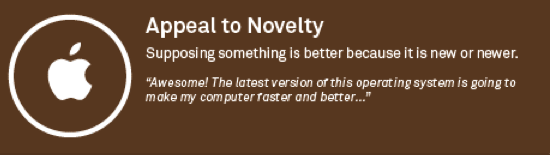
I should note that Metafilter user asavage, who some of you will know from burning off his eyebrows on Mythbusters, also noted that the IIB link wasn’t great but suggested an excellent alternative – A Visual Guide to Cognitive Biases.

Yes, asavage doesn’t much like what he read in the original links, and there’s good reason for it to be modified, but he provides a constructive suggestion. Now, fair warning, it’s a scribd link to get the slide pack, which is big and requires you to log in to the site or use a Facebook login, but if you teach any kind of logical thinking at all, it’s an essential resource. It’s the Cognitive Bias Wikipedia page with good graphics and it’s a great deal of fun.
Are either of these approaches the equivalent of a full lecture course on logic, reasoning and rhetoric? No. With thought, could you use elements from both in your teaching? I think the answer is a resounding yes and I hope that you have fun reading through them.
Making Time, Taking Time: 70, 10, 10, 10
Posted: March 29, 2012 Filed under: Education | Tags: education, higher education, measurement, mythical man month, principles of design, teaching approaches, work/life balance Leave a commentI just finished reading Katrina’s post on students who are scared to interrupt us because we look so busy and it made a lot of sense. It’s certainly something I’ve struggled with and anyone who has come into my office in the past few months has seen that I am really trying to give everyone as much time as possible – but I’m obviously balancing a lot of things.
I’ve been toying with some new models for setting up my time for the day and something I’m finding that works is 70/10/10/10 time. I can lose up to 70% of my day with pre-scheduled appointments, lectures, tutes, meetings and things like that, but the remaining 30% is broken down like this:
- 10% time reserved for the unforeseen – things like the opportunity to put a proposal in to attend an important meeting in California, that lobbed onto my desk yesterday and needed about 3 hours of work to get to fruition – completed by this Friday. I seem to get things like this every day!
- 10% time reserved for me to do things like go to the bathroom, eat lunch and enjoy a coffee. I need time to get from point A to point B – and sitting the whole day hungry, thirsty or … anything else will not produce my best work.
- 10% time, reserved in my head and on my calendar, for students who drop in to ask questions or who send me e-mail with questions (or post them on the forum). I should be making time. Yes, I have drop-in times normally but my students have a range of timetables and, after all, I am here to help. If I’m genuinely busy and out of time then I may have to use this time as well, but setting aside this time will help me to think about my students.
I look at the blog as an example. Every day, I put aside 20-30 minutes to write a post and, every day, I think of things that help me, or look for things to share, or go and do some research on CS Ed, or write up something interesting. (Some days I manage all of this!) Putting time aside for something gives you the mental ability to think “Yes, this is important and I should do this.”
Thanks, Katrina!
The ACID test: Teaching With Examples From Other Areas
Posted: March 20, 2012 Filed under: Education | Tags: collaboration, education, higher education, principles of design, resources, teaching, teaching approaches, tools 2 CommentsI’ve just returned from teaching an intensive module on Distributed Systems – no, don’t go, I have a point for everyone, not just the Computer Scientists in the audience. Dealing with computations that take place over several computers can be tricky because it can be difficult for everyone to agree whether all the things that they wanted to happen have actually happened. Combine that with the problems that occur when two or more people try to change the same thing at the same time and we need a strong mechanism to deal with it. The properties that refer to this are usually represented with the acronym ACID.

We use something called a transactional model – what we’re trying to achieve either happens or, if there’s a problem, we make it as if it never occurred (we call this atomicity). When we make change we want to keep the overall system consistent with regard to some key requirements (consistency). If two things are happening at once, but could fail, we set it up so that they don’t take account of each other’s changes until we’re sure that they’ve finished and are going to hang around (isolation). Finally, speaking of hanging around, once we’ve made something stick, we want it to stay stuck – that’s durability.
Why have I covered this? Because I want you to understand how I can take ACID (atomicity, consistency, isolation, durability) out of computer science and make students think about it in a different framework – that of the legal system. Here’s the question I posed to my students as part of a tutorial:
“Using Transaction Properties (ACID), discuss whether a person simultaneously accused of two crimes should be tried, in both cases, as if only one crime had been committed.”
Now this doesn’t seem related, but the complex issues in the presumption of innocence, not declaring previous crimes until sentencing and the nature of appeal can lead to a quite complicated and involved discussion. I like to start students off by getting them to think about the problem individually and asking questions to clear up any definitional problems. Then they go to their neighbour, then into small groups of 4-5. By the time we’re done the rooms full of discussion and we bring it together to illustrate that thinking about the problem in this way gets us away from memorised jargon inside the originating discipline and forces students to describe the situation based on their understanding of the concept.
This is a third year course so the question is designed to make people think – there are some answers that are better than others but almost all pathways based on careful thought will head towards a good answer.
Stepping outside the original discipline can be fun and useful – just make sure that you’re keeping the analogies accurate, precise and not too far from the original material. Hope this is useful to you!
The Binary World of Steve Jobs
Posted: March 11, 2012 Filed under: Education, Opinion | Tags: education, higher education, principles of design, reflection, steve jobs, teaching, teaching approaches Leave a commentI’ve commented before on Steve Jobs but, having just finished Walter Isaacson’s fascinating biography, I’ve had some other thoughts that I wanted to talk about here.
I stand by my previous post, regardless of the success of Apple or Steve Jobs’ achievements, I still wouldn’t let him near my classes but there are still many things that they can learn from his ideas, his example, his life and, of course, his death. It’s just important to separate some of the innate Steveness from the ideas. His desire for the right solution, his attention to design, his drive for perfection are all things that I can use in my teaching. The amount of time spent trying to make every piece of something functional and beautiful – I couldn’t find better exemplars of the design principles I’ve been talking about and you can find them in most homes and in most people’s hands.
But one thing that was thrown into sharp relief for me throughout the biography was the strictly dichotomous nature of his world view. A dichotomy is the splitting of something into two, non-overlapping parts. An often heard dichotomy is “if you’re not with us, you’re against us.” (This is usually a false dichotomy, implying that there are only two choices when there are probably more. If you’re curious, the “Saw” movie franchise exercises the false dichotomy for most of its running – pretending that the protagonists only have two options and that the choice that they make inside that morally and physically restrictive space is somehow a reflection of their ethics.)
Steve Jobs’ world was full of dichotomies. Things were either excellent or they were terrible. Sometimes this switched, very rapidly, depending on the day or who was being spoken to. People were heroes or… well, let’s say villains because I’m trying to keep this clean. There is no doubt that this contributed to the pursuit of excellence in many ways, but my reading of the biography rather obliquely suggests that it was the sheer brilliance and excellence of the people around in Apple that made this happen, to some extent despite this stark view.

This is pretty much what Isaacson reports as Steve Jobs’ world view and, while it’s quite clear and clean in many regards, it’s simplicity is undermined by the fact that the things in either set could cross that yellow line in unpredictable ways. Now, once again, yes, Apple are hugely successful and there is no doubt that this binary approach had a lot to do with a great deal of its success – but this is not a view that naturally generates discussion. Once again, this is an important part of my job: I need to get students talking.
It would be trivial for me to walk out, ask a question, mock people who give me a weak or incorrect answer, write ‘idiot’ on their assignments and never give them strong guidance as to how to fix it other than “It’s not right”, but it’s not what I’m getting paid for. I will happily talk to my students about purity of vision, strong design principles, try to give them feedback that they recognise as feedback to reinforce this (trickier than it looks) but, at the end of the day, me lecturing at people doesn’t get as much information across as me getting them involved in a broader discussion of issues and principles. It’s very easy to say “this sucks”. It’s much harder to say why this sucks and in discussing why we naturally start to head towards how we can fix it, because we can see the reasons that it’s terrible.
Now, I’m going to move away from Steve’s heroes/villains, great/terrible dichotomies to some of those I see from students while I teach. I have to be able to handle a far less dichotomous view of the world and I have to draw the students away from this as well. Hardware and OS dichotomies abound: PCs don’t suck, Macs don’t rule. Macs aren’t for grandmas and noobs, PCs aren’t the only true programming platform. There’s the regrettable and seemingly entrenched gender dichotomy in STEM – men and women are far more individually distinctive than any mindless and echolalic gender stereotypes that try to give a falsely dichotomous split. (And, of course, this doesn’t even begin to address the discussion on the number of gender identities being greater than two!)
I don’t have a fundamental problem with people being able to identify things that they like or don’t like, I just need to exercise this as a matter of degree in my teaching and I have to pass on to my students that even if they want to draw a line in the sand to separate their world, having only two categories imposes a very hard structure on a much more complicated world. I also need to be able to explain why a categorisation has been made or all I’m going to pass on is dogma – something indisputable that has to be specifically learned in order to be known, versus something that is a matter for discussion. I teach Computer Science – a discipline based heavily on mathematics, usually implemented in artificially-created, short-term universes with arbitrary physical rules inside the system. I’m not sure that I have enough hard ground to stand on to be dogmatic!
At the end of all this, there’s no doubt I would have found Steve Jobs charismatic, fascinating and terrifying, probably in equal parts, and I suspect that he would have had little time for my somewhat wooly, generous and contemplative approach. I certainly could never have achieved what he achieved and I don’t seek to criticise him for what he did because, frankly, I don’t really know enough about him and who am I to judge? But I can look at this example and think about it, in order to work out how I can improve the way that my students think, work and interact with other people. And, bottom line, I don’t think false dichotomies are the way to go forward.
SIGCSE, Birds of a Feather (BOF) Session “CS Unplugged”
Posted: March 3, 2012 Filed under: Education | Tags: curriculum, design, education, higher education, principles of design, puzzles, reflection, sigcse, teaching, teaching approaches, tools, universal principles of design, unplugged Leave a commentPoor Tim Bell. He must think I’m stalking him. I attended the BOF session for CS Unplugged, which quickly turned into the BOF on ‘Energising your Outreach to Schools” (my words). Once again Lynn Lambert and Tim shared their experiences with CS Unplugged to help us frame what was wrong with our outreach (or the problems that we had) in order to try and fix them.
The main issues were:
- How do we get into the curriculum?
- Bad/old equipment.
- Creating a meaningful activity in a very short time.
- Persistence – how we do we stay in their minds or their environment?
- Priming – how we prepare them for our visit?
- Time – how do we fit it all in and, more importantly, how does the teacher?
- Pick the right time to come in and interact with students, when teachers are happy to have you. Teachers don’t get a reward for dealing with students at elementary level.
- CS BIts and Bytes is a good newsletter
- cs4fn got another mention as a good website
- One amusing quote from a parent, after finding out what we did, was “I had no idea that CS had any application.” To our credit, nobody cried when this was told to the group.
- Involve people in discussing useful, relevant problems and how CS is used to help: suggestions included global warming and genomic sequencing.
Overall, another fun discussion with a lot of actively concerned people trying to make things better. Please leap in for corrections if I missed something important or got something wrong. I’m also happy to edit to add credits if required. 🙂

 Nick Falkner