
Teaching in Hong Kong, Day 7
Posted: July 15, 2014 Filed under: Education | Tags: alumni, AsiaBound, Central, CUHK, CUHK campus, education, exams, exchange, higher education, Hong Kong, learning, Lee Woo Sing, Lee Woo Sing College, networking, teaching Leave a commentI write today’s post over a cup of chamomile tea, as I’m taking a break from preparing for the next stages of the course and also doing some work on an ongoing research project. Like many (most) research-active academics, the contribution to research and the requirement to keep on plugging away never quite stops, wherever I am in the world. What is great, however, is that working with an active small group for teaching is quite energising, although it is intensive teaching, so I’m usually in a very positive mood for the afternoon’s continuing work. (Hooray!)
We went through the introduction to the network layer today and finished up with a small lab on practical use of this knowledge. It’s quite a lot to go through in this short a time (this sequence of lectures would usually take a week and a half) so there are additional materials, including podcasts, that I provide to make this easier. I recorded these some time ago but they have proved very useful as this section of the course “sticks” at different rates for different people.
As it happened, I had a producer working with me, so I narrated the slides and they were fused together post recording. These days I’d just use Camtasia but it’s very interesting to think of the techniques that we are still using up to just a few years ago. Now, between Explain Everything and Camtasia, I basically have a one-man recording studio!
No pictures today but we’re going to meet up with the Hong Kong Alumni of our University tomorrow down in Kowloon, which will be a great opportunity for our students to meet people who, with an Adelaide degree, are making their way in Hong Kong. Lots of great opportunities on this trip for everyone!
(I’ll pop up a picture of the Alumni magazine, The Roar, as I can’t find any HK chapter pictures.)

Image from Adelaide onLion site. © The University of Adelaide, 2014.
Teaching in Hong Kong, Day 6
Posted: July 14, 2014 Filed under: Education | Tags: AsiaBound, Central, CUHK, CUHK campus, education, Elephant, exams, exchange, higher education, Hong Kong, learning, Lee Woo Sing, Lee Woo Sing College, Maxims, Mongoose, MTR, networking, Run Run Shaw, teaching, the Chinese University of Hong Kong, Vamos Argentina!, World Cup Leave a commentWell, this is the 6th day of teaching and the first day of the second week. (I’m not counting weekends.) Some of the students went to Shenzen over the weekend and discovered “an electronics mall the size of Adelaide” which was the big motivator for going. Sadly, I wasn’t able to join them at the World Cup this morning as my flight got in late and I still had marking and work to do, but here’s a picture that one of the students, Sarah, took of the crowd – and they were a very vocal crowd for 3 in the morning!

Let’s not talk about the result. © Sarah Belet, 2014
Today we finished off talking about the way that programmers work with the network when they write applications. When someone sends information too fast for a receiver, we need to control the flow of the information, but when there’s just too much information on the network (from possibly many sources) we have to deal with the congestion. Both of these (and the solutions we use) are really important reasons why the Internet works today! We had a lot of discussion, group-based work and I spent a lot of whiteboard time motivating how we could get information out of the network without having to do anything beyond what we already wanted to do, just to use it.
We had started later so students could get some downtime and it certainly paid off because participation was as good as it had been on other days and brains were only slightly slower than usual. It’s the great thing about having the freedom we have here, teaching only one course and leaving time for work and thinking time. I certainly prefer it as a teaching approach!
Feedback on the quiz and short exam are also positive although there is work to do on making the questions slightly less ambiguous because the terminology of networking often coincides with other uses and there isn’t the same amount of time to get students used to a new reference frame.
After a steamy few days, it seems cooler today and we’re seeing a large amount of blue sky. Here’s what the campus looks like from outside the building I’m teaching in!
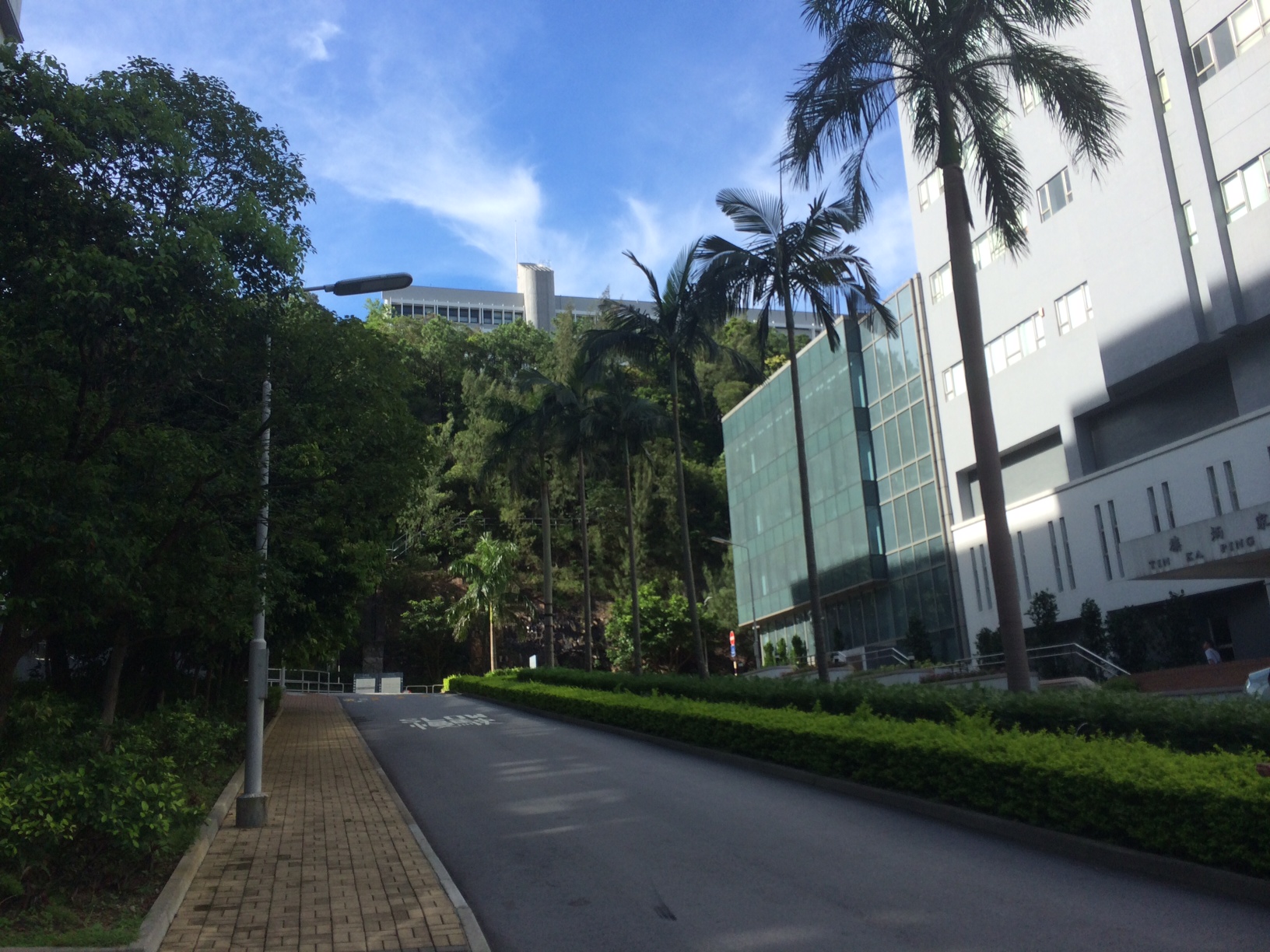

Teaching in Hong Kong, Day 5
Posted: July 11, 2014 Filed under: Education | Tags: AsiaBound, Central, CUHK, CUHK campus, education, Elephant, exams, exchange, higher education, Hong Kong, learning, Lee Woo Sing, Lee Woo Sing College, Maxims, Mongoose, MTR, networking, Run Run Shaw, teaching, the Chinese University of Hong Kong, Vamos Argentina!, World Cup 1 CommentWell, we had a normal session to start with, which consisted of discussion about the Transport layer (that bit of the network that makes it easier for the people who program your web browser to talk a web server) and some of it was good but some of it – ehhh, I think it got away from me. There are some really complicated diagrams and I’m still thinking about the best way to teach them. I suspect it’s something you go away and do, then discuss, then do again so that’s a note to self.
We broke for lunch and I (coincidentally) ended up at the same place as my students so I joined them. (There is no escaping the Nick.) They’re all doing the right thing and eating everywhere to see what’s good and basically getting into the whole experience. (They may all be addicted to duck’s web now. Sorry, that’s my fault.)

You can’t see Tom because he’s hiding off to the left, recovering from chilli overload.
After lunch, it was short quiz and short exam time – the students have weekly quizzes, marked automatically and worth 5% each, and then a short answer exam, which I mark manually and these are worth 10% each. Because of the compressed timescale, I’m trying to scaffold the revision process by requiring the knowledge earlier. From what I’ve seen so far, it appears to be working, although I’m not sure how appreciative the students are. Once I’ve marked everything, I’ll discuss it with them to see what their impressions are. I’m a great believer in working with students to try and build better courses and this is one of the best opportunities I’ll ever have.
I have to head back to Australia for the weekend but I’ll be back Sunday afternoon. Until then I’ve asked my students to work hard, play hard and be safe. I’ve delayed the class on Monday morning from 9am to 1pm, not because I’ll be jet lagged, but because CUHK is putting on a giant screen showing of the world cup with local commentators, starting from 3am. This is exactly the kind of serendipitous cultural moment that we want to capture in these sorts of exchanges so, not only am I shifting the class, I’m planning to go along myself.

Goal! Goal! Goal! (Or possibly Penalty! Penalty! Penalty!)
Sorry to my German readers but I have to support Argentina or my friend Guadalupe will kill me. Vamos Argentina! Have a great weekend and I’ll fill you in on Monday in a few days.
Teaching in Hong Kong, Day 4
Posted: July 10, 2014 Filed under: Education | Tags: AsiaBound, Central, CUHK, CUHK campus, education, Elephant, exchange, higher education, Hong Kong, learning, Lee Woo Sing, Lee Woo Sing College, Maxims, Mongoose, MTR, networking, Run Run Shaw, teaching, the Chinese University of Hong Kong Leave a commentWe were back in the classroom today and the overall plan was to talk about some teaching materials that I’d put on-line already on programming network-based applications. (A lot of work has gone into making it easier for people to write programs that talk across the network and it’s really useful to write these programs for practice because it exposes students to all of the problems that occur when an application spans more than one machine.)
Rather than just walk the students through some slides, I made it pre-reading and then asked them to produce a very small example that sent communication from one machine to another. We had some really interesting results – everyone had been working on it and had something to show, although a couple of people had discovered that trying to add features just before a demo can make a the demo a little less ‘demonstrative’ than it might otherwise have been. The demo code showed a lot of humour and also a high level of the understanding of the problems.
This led into discussion of why certain protocols work the way that they do and, in many cases, it’s because people wrote things that would work for the network of the ’70s and ’80s. These days, with the Web, video streaming and on-line gaming, we have different requirements in many senses and now that the students have written some code and tried some things, they’re ready to start thinking about the “whys” and the “hows” and, most importantly, the “what nexts” of the network.
It wasn’t a long day as the amount of work that had gone into the programs reduced the amount of time I had to spend explaining concepts (funny, that). After a quick design workshop on what the next assignment should look like, where everyone took part in forming ideas as to how we would build it, we broke early to give people more time to work on what they wanted to do.
Goodness – work done early leads to extra time for tasks later? Who thought that would ever work!
I’ve been trying to get a good picture of the Run Run Shaw Science Building, which is far more striking than it ever is in my photos, so here’s one I found on Wikimedia. It gives you some idea of the striking nature of CUHK – buildings nestled among the trees on the hillside.

The glorious colours of the Run Run Shaw Science Building. It dominates the CUHK vista from the MTR station.
Teaching in Hong Kong, Day 3 (Expeditions and Yum Cha!)
Posted: July 9, 2014 Filed under: Education | Tags: AsiaBound, Cats, Central, CUHK, CUHK campus, education, Elephant, exchange, higher education, Hong Kong, learning, Lee Woo Sing, Lee Woo Sing College, Maxims, Mongoose, MTR, teaching, the Chinese University of Hong Kong, the Hong Kong Harbour, Tsim Sha Tsui, yum cha 2 CommentsWe’ve built this course so that, while the students work reasonably hard, there are still days off and time to explore the new country – why on Earth would you take students to a different city that they then don’t get to see? Today’s expedition was MTR down to Tsim Sha Tsui and on to the Star Ferry to take the classic trip across the Hong Kong Harbour. It was a gorgeous day and we sat up the front to get good breeze and view – here they are!
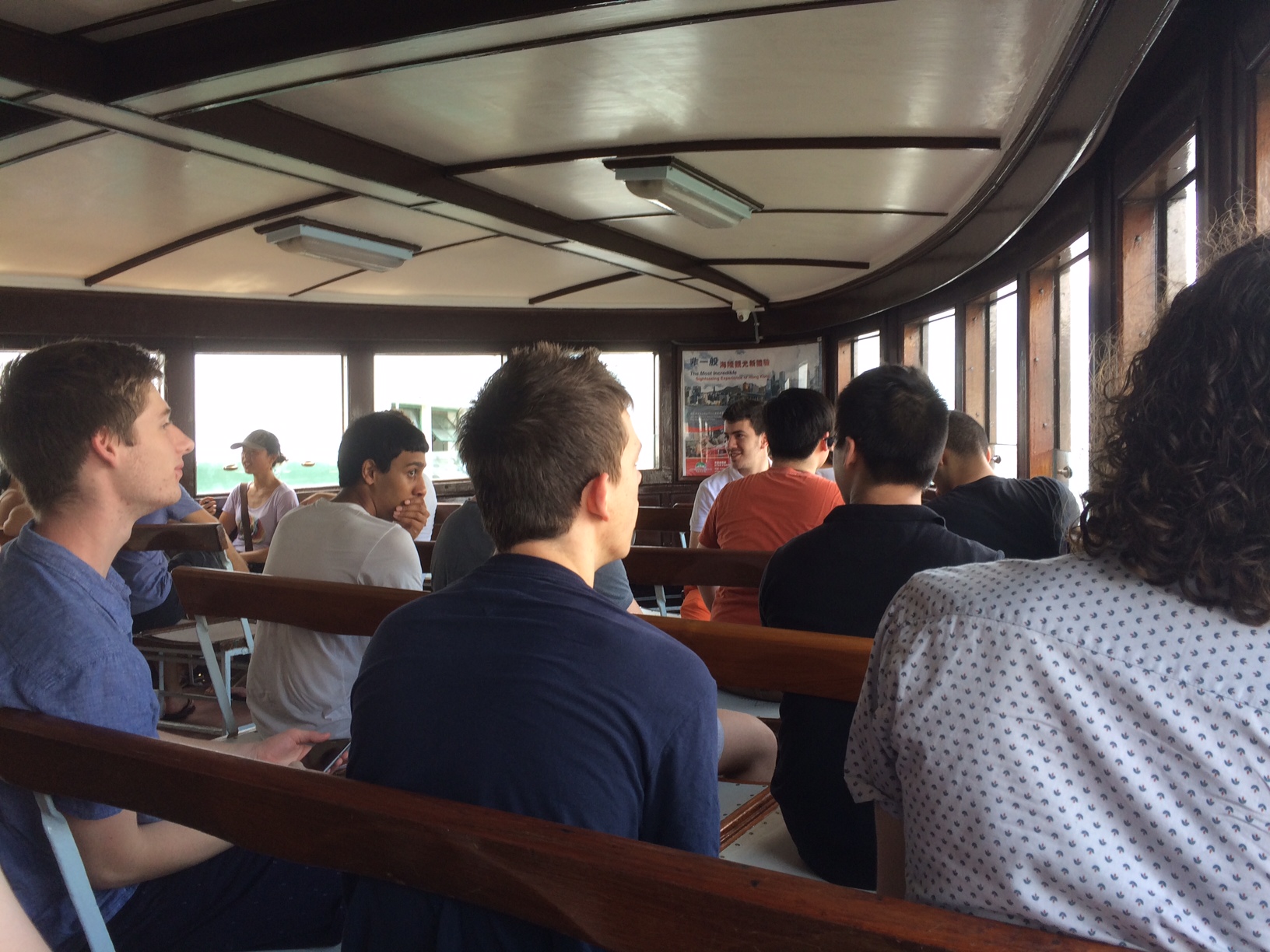
Taking in the (warm) sea air.
There’s always something happening in Hong Kong and, on the walk across the land fill towards City Hall, we ran across a movie being shot. We watched it until we chased away for “getting in the way” which I think is movie-making speak for “eh, go away”. After some questionable navigation due to the many changes in the area (sorry, everyone) we made it to Maxim’s and got a seat straight away. Fortinately, one of the students speaks Hokkien and some Mandarin which, combined with some pointing, got us an amazing feast of yum cha. Here’s the view from my seat:

The Panoramic Yum Cha Experience at Maxim’s!
It was great to relax and just hang out as we talked about all sorts of things and just enjoyed spending some time in a new place. The course starts again in earnest tomorrow at 9am, and the students have some work to do, but I left them to wander in Central – I think most of them were heading for the Peak as it was a most delightful day! Here’s a picture of what it looked like as we walked around:

Buildings are big in Hong Kong.
Teaching in Hong Kong, Day 2
Posted: July 8, 2014 Filed under: Education | Tags: AsiaBound, Cats, CUHK, CUHK campus, education, Elephant, exchange, higher education, Hong Kong, learning, Lee Woo Sing, Lee Woo Sing College, Mongoose, teaching, the Chinese University of Hong Kong 1 CommentWell, all of the students appeared again today so everyone made it through the night and managed to make it back to class. Hooray! More seriously, I’m now tracking the student attendance (which we usually don’t do) in order to make sure that I know immediately if something goes awry. The students are also happy to move as small groups, which gives me a little more peace of mind. I’m not here to chaperone them and they are adults AND Hong Kong is a safe city but you always have that niggling concern when you are, even vaguely, in loco parentis.
I now have all of the photo releases back so I can show you some pictures of the class in action. The students are in two table groups of 5: Team Elephant and Team Mongoose, because I refuse to number or alphabetise them. (The students are going along with this, before anyone wonders.) I like to get the students up and working on the boards, as well as doing group discussion at their tables, and we are getting the groups to cross-present, share ideas and be a lot more discursive than we would in a traditional class. You can see the groups are also checking out each other’s work in the photos (which is both allowed and encouraged – the group formations are as arbitrary as their names).
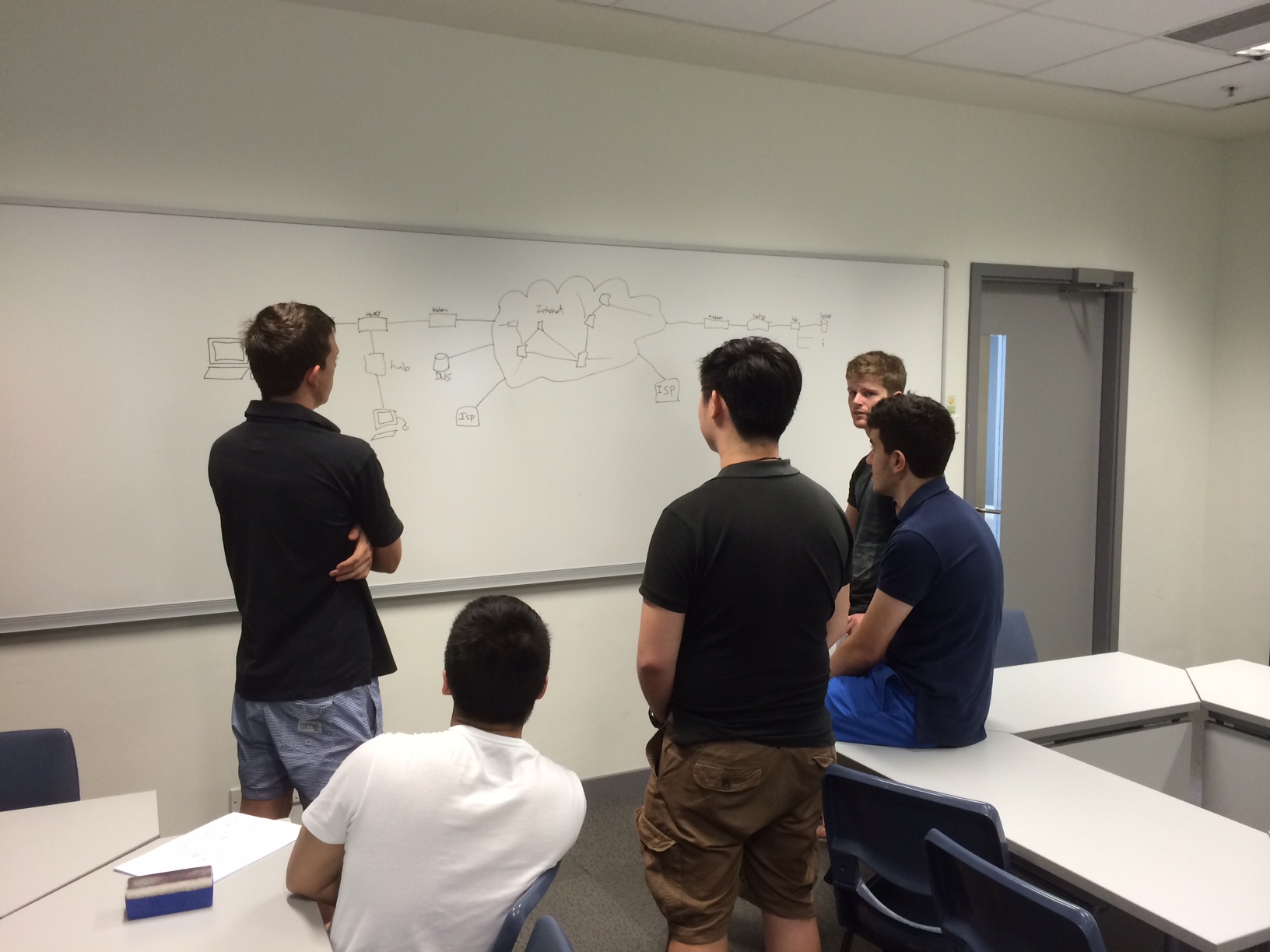
Deep in thought, a team comes up with a description of underlying Internet infrastructure.

Here, the two groups are sketching out what they think happens with Web traffic – BEFORE we do the lesson.

This final picture is here because it catches some of the fun. The team on the left were putting a lot of cat pictures into their diagram and this caught the eye of the team on the right. The Internet is, after all, full of cats.
Tomorrow, we’re off to Central (the island) to take a ferry ride across the Harbour and eat dim sum at Maxim’s City Hall. This will bring most of the students on to Central for the first time (they headed off to Mong Kok on Monday for some quick adventure but they haven’t been further south than that yet on the peninsula). Then, on Thursday, they’ll be presenting some small programs that I asked them to write based on some lecture notes on network programming. Thursday will be a flipped activity – content first, including code production, presentations to the group and then a design lab to go through the points raised and to help them produce a good specification for their first “real” assignment, which is due on Monday. The course is very fast-paced so I’m trying to put in some good staging and scaffolding, but also taking advantage of the good things of the group (distributed problem solving) while still allowing individual demonstration of skill (code production).
Tomorrow is a “rest” day so I may not blog but I’ll definitely tell you how things go on Thursday!
Teaching in Hong Kong, Day 1
Posted: July 7, 2014 Filed under: Education, Opinion | Tags: AsiaBound, CUHK, CUHK campus, education, exchange, higher education, Hong Kong, learning, Lee Woo Sing, Lee Woo Sing College, teaching, the Chinese University of Hong Kong Leave a commentThe School of Computer Science was fortunate enough to secure an AsiaBound scholarship for a student short visit to an Asian country. Given that Australia is (pretty firmly) surrounded by Asia, the Federal Government has been initiating programs to familiarise out students with their world – an approach that makes even more sense in this increasingly Asian century for Oceania.
So, here I am in Hong Kong, with 10 students from our undergraduate programs, for three weeks at the Chinese University of Hong Kong, where we are going to be studying networking. (Well, they’re studying – I’m teaching.) The people at CUHK have been fantastic in helping us to organise this event but they are strongly committed to visiting students and the campus is full of students for the Hong Kong summer. (When I say Summer, I mean it – 80+% humidity and 32C/90F.) The students are staying at the Lee Woo Sing College in twin share rooms – with really good air-conditioning, I’m told. CUHK built a number of new colleges to accommodate planned and future growth so Lee Woo Sing is very new and a good place to put up students for this three week period. I’ve been really helped out by Professor Irwin King, Shally Fan, Louis Wong and Karen Fan and, as this was the first time we’d tried something like this with CUHK, such help is invaluable.
Here are some pictures, first of all the CUHK campus from a vantage point overlooking the University MTR (Mass Transit Railway) station, which is near where I’m staying to be out of the students’ hair. You’ll note that the campus is built on a hill. It’s over 100m uphill and about 30 minutes from the train station to get to the college and I walked it this morning. I got some pitying but friendly looks from people as I trudged up the hill. Locals take the buses, which are free through the campus and run really frequently. I’ll be doing that from now on or I will die before the three weeks are up!

CUHK Campus
This next picture is of the Lee Woo Sing College itself. Everything runs on the Octopus card – an add-value cash replacement that is the bedrock of small-scale Hong Kong commerce. There are also lots of great dining options for the students as well, including lots of places to relax.

Lee Woo Sing Student Hostel
There’s a huge balcony that allows you to look across the harbour to the Bug Buddha so it’s a pretty nice location – AND it’s close to the bus stop and the classroom so my students won’t get too steamed up on their walk to class!
Today we went through administration and started talking about networking. I have lots of great pictures of group discussion but I need to get all of the clearances signed and returned so I can’t show you any pictures yet. Tune in tomorrow for more of the University of Adelaide’s AsiaBound adventures at CUHK.
Joi gin!
Why You Should Care About the Recent Facebook Study in PNAS
Posted: June 30, 2014 Filed under: Education, Opinion | Tags: analysis, data analytics, education, ethics, facebook, higher education, learning, pnas, teaching 2 Comments
The extremely well-respected Proceedings of the National Academy of Science (PNAS) has just published a paper that is causing some controversy in the scientific world. Volume 111, no 24, contains the paper “Experimental evidence of massive-scale emotional contagion through social networks” by Kramer, Guillory and Hancock. The study itself was defined to evaluate if changing the view of Facebook that a user had would affect their mood: in other words, if I fill your feed with sad and nasty stuff, do you get sadder? There are many ways that this could be measured passively, by looking at what people had seen historically and what they then did, but that’s not the approach the researchers took. This paper would be fairly unremarkable in terms of what it sets out, except that the human beings who were experimented upon in this paper, over 600,000 of them, were chosen from Facebook’s citizenry – and were never explicitly notified that they were being experimented on or had the opportunity to give informed consent.
We have a pretty shocking record, as a scientific community, regarding informed consent for a variety of experiments (Tuskegee springs to mind – don’t read that link on a full stomach) and we now have pretty strict guidelines for human experimentation, almost all of which revolve around the notion of informed consent, where a participant is fully aware that they are being experimented upon, what is going to happen and, more importantly, how they could get it to stop.
So how did a large group of people that didn’t know they were being experimented upon become subjects? They used Facebook.
Facebook is pointing to some words in their Terms of Service and arguing along the lines that indicating that your data may be used for research is enough to justify experimenting with your mood.
None of the users who were part of the experiment have been notified. Anyone who uses the platform consents to be part of these types of studies when they check “yes” on the Data Use Policy that is necessary to use the service.
Facebook users consent to have their private information used “for internal operations, including troubleshooting, data analysis, testing, research and service improvement.” The company said no one’s privacy has been violated because researchers were never exposed to the content of the messages, which were rated in terms of positivity and negativity by a software algorithm programmed to read word choices and tone.
Now, the effect size reported in the paper is very small but the researchers note that their experiment worked: they are able to change a person’s mood up or down, or generate a withdrawn effect, through manipulation. To be fair to the researchers and PNAS, apparently an IRB (Internal Review Board) at a University signed off on this as being ethical research based on the existing Terms of Service. An IRB exists to make sure that the researchers are being ethical and, based on the level of risk involved, approve the research or don’t give it approval. Basically, you can’t use or publish research in academia that uses human or animal experimentation unless it has pre-existing ethics approval.
But let’s look at the situation. No-one knew that their mood was being manipulated up – or down. The researchers state this explicitly in their statement of significance:
…leading people to experience the same emotions without their awareness. (emphasis mine)
No-one could opt-out unless they decided to stop using Facebook but, and this is very important, they didn’t know that they had anything to opt out from! Basically, I don’t believe that I would have a snowball’s chance on a hot day of getting this past my ethics board and, I hasten to add, I strongly believe that I shouldn’t. This is unethical.
But what about the results? Given that we have some very valuable science from some very ugly acts (including HeLa’s cell line of course), can we cling to the scoundrel’s retreat that the end justified the means? Well, in a word, no. The effect seen by the researchers is there but it’s really, really small. The techniques that they used are actually mildly questionable in the face of the size of the average Facebook post. It’s not great science. It’s terrible ethics. It shouldn’t have been done and it really shouldn’t have been published.
By publishing this, PNAS are setting a very unpleasant precedent for the future: that we can perform psychological manipulation on anyone if we hide the word ‘research’ somewhere in an agreement that they sign and we make a habit of manipulating their data stream anyway. As an Associate Editor, for a respectable but far less august journal, I can tell you that my first impression on seeing this would be to check with my editor and then suggest that we flick it back as it’s of questionable value and it’s not sufficiently ethical to meet our standards.
So why should you care? I know that a number of you reading this will shrug and say “What’s the big deal?”
Let me draw up an analogy to explain the problem. Let’s say Facebook is like the traffic system: lots of cars (messages) have to get from one place to another and are controlled using traffic lights (FB’s filtering algorithms). Let’s also suppose that on a bad day’s drive, you get frustrated, which shows up by you speeding a little, tailgating and braking late because you’re in a hurry.
Now, the traffic light company wants to work out if it can change your driving style by selecting you at random and altering the lights so that you’re always getting red lights, you get rerouted through the town sewage plant and jamming you on the bridge for an hour. During this time, a week, you get more and more frustrated and Facebook solemnly note that your driving got worse as you got more frustrated. Then the week is over – and magically your frustration disappears because you know it’s over? No. Because you didn’t know what was going on, you didn’t get the right to say “I’m really depressed right now, don’t do this” and you also didn’t get the right to say “Ahh – I’ve had enough. Get me out!”
You have a reasonable expectation that, despite red-light cameras and traffic systems monitoring you non-stop, your journey on a road will not change because of who you are, and it most definitely won’t be unfair just to make you feel bad. You won’t end up driving less safely because someone wondered if they could make you do it. Facebook are, yes, giving away their service for free but this does not give them the right to mess with people’s minds. What they can do is to look at their data to see what happens from the historical record – I’m unsure how, across the size of their user base, they don’t have enough records to be able to put this study together ethically. In fact, if they can’t put this together from their historical record, then their defence that this was “business as usual” falls apart immediately. If it was the same as any other day, they would have had the data already, just from the sheer number of daily transactions.
The big deal is that Facebook messed with people without taking into account whether those people were in a state to be messed with – in order to run a study that, ultimately, will probably be used to sell advertising. This is both unethical and immoral.
But there are two groups at fault here. That study shouldn’t have run. But it also should never have been published because the ethical approval was obviously not quite right – even if PNAS did publish it, I believe it should have been accompanied by a very long discussion of the appropriate ethics. But I don’t think it should have run. It’s neither scientific nor ethical enough to be in the record.
Someone speculated over lunch today that this is the real study: the spread of outrage across the Internet. I doubt it but who knows? They obviously have no issue with mucking around with people so I guess anything goes. There’s an old saying “Just because you can, doesn’t mean you should” and it’s about time that people with their hands on a lot of data worked out they may have to treat people’s data with more decency and respect, if they want to stay in the data business.
ITiCSE 2014, Closing Session, #ITiCSE #ITiCSE2014
Posted: June 26, 2014 Filed under: Education | Tags: advocacy, blogging, community, computer science education, education, higher education, ITiCSE, ITiCSE 2014, ITiCSE2014, learning, teaching, thinking 1 CommentWell, thanks for reading over the last three days, I hope it’s been interesting. I’ve certainly enjoyed it and, tadahh, here we are at the finish line to close off the conference. Mats opened the session and is a bit sad because we’re at the end but reflected on the work that has gone into it with Åsa, his co-chair. Tony and Arnold were thanked for being the Program Chairs and then Arnold insisted upon thanking us as well, which is nice. I have to start writing a paper for next year, apparently. Then there were a lot of thanks, with the occasional interruption of a toy car being dropped. You should go to the web site because there are lots of people mentioned there. (Student volunteers got done twice to reflect their quality and dedication.)
Some words on ITiCSE 2015, which will be held next year in Vilnius, Lithuania from the 6th of July. There are a lot of lakes in Lithuania, apparently, and there’s something about the number of students in Sweden which I didn’t get. So, come to Lithuania because there are lots of students and a number of lakes.
The conference chairs got a standing ovation, which embarrassed me slightly because I had my laptop out so I had to give them a crouching ovation to avoid tipping the machine on to the floor that nearly stripped a muscle off the bone, so kudos, organisers.
That’s it. We’re done. See you later, everyone!
ITiCSE 2014, Day 3, Session 7B, Peer Instruction, #ITiCSE2014 #ITiCSE
Posted: June 25, 2014 Filed under: Education | Tags: community, computer science education, curriculum, design, education, educational problem, educational research, flipped classroom, higher education, in the student's head, inverted classroom, ITiCSE, ITiCSE 2014, learning, peer instruction, teaching, teaching approaches, thinking Leave a commentThe first talk was “Peer Instruction: a Link to the Exam” presented by Daniel Zingaro from University of Toronto. Peer Instruction (PI) is an active learning pedagogy developed for physics and now heavily used in computing. Students complete a reading quiz prior to class and teachers use multiple-choice quizzes to assess knowledge. (You can look this one up in a number of places but I’ve discussed it here before a bit.) There’s a lot of research that shows gains between individual and group vote, with enduring improvements in student learning. (We can use isomorphic questions to reduce the likelihood of copying.) Both students and instructors value the learning.
PI appears to demonstrate improved learning outcomes on the final exam grades, as well as perceived depth of learning. (Couple of studies here from Beth Simon et al, and Daniel himself, checking Beth’s results.) But what leads to this improved outcome? The peer discussion. The class wide discussion? Both? If one part isn’t useful then we can adapt it to make it more useful to Computer Scientists. Daniel is going to use isomorphic questions to investigate relationships between PI components and final exam grades.
The isomorphic questions test the same concept with different questions, where if they get the first one right, we hope that they get the second one right – and if people learn how to do one, then that knowledge flows on to the other. (The example given was of loop complexity in nested loops depending on different variables.)
Daniel has two question modes in this experiment, which are slightly different. Both modes include the PI components, but the location of the isomorphic questions vary between the two approaches in the second question. In the Peer ℗ mode, the isomorphic question comes directly after the group vote and the second mode (Combined – C), the Q2 isomorphic questions occur direct after the instructor has had a chance to influence the class.
Are the questions really isomorphic and of the same difficulty? An external ranker was used to verity this and then the question pairs and mode were randomised. The difficulty of the questions was found to be statistically equivalent, based on the percentage of Q1 that were found to be correct.
Daniel had two hypotheses. Firstly, that peer scores will correlate to final exam scores. Secondly, that combined scores will also correlate with final exam scores, but the correlation should be stronger than for Peer, with the Combined questions representing learning from the full PI cycle. In terms of the final exam, there were three measures of the final exam grades: total exam score, score on the tracing question (similar to PI questions) and score on a code-writing question (very different to PI questions).
The implementation was a CS1 course with 3 lectures/week, with reading quizzes worthy 4% submitted prior to each lecture, clicker responses worth 5%, where the lectures on average contained three PI cycles- one cycle per lecture contained the follow-up isomorphic question. Multiple regression was used to test relationships between PI and final exam scores.
All of the results were statistically significant. For code-tracing, hat students know before exam explains 13% of their scores in the final exam. With the peer questions, it goes up to 16%. With combined as well, it goes up to 19%. Is this practically significant? Daniel raised this question because it doesn’t rise very much.
In terms of code writing, Baseline is 16%, + Peers is 22% and +Combined is 25%, so we’re starting to see more contribution from peers than instructor in this case. Are we measuring the different difficulty of a problem that peers couldn’t correct, which is why the instructor does less?
Overall? Baseline 21%, Peer 30% and then Combined is 34%. (Any questions about the stats, please read the paper. 🙂 )
Maybe adding combined questions to peer questions increases our predictive accuracy, just because we’re adding more data and this being able to produce a better model?
In discussion, PI performance related to final exam scores (as expected). Peer learning alone is important and the instructor-led discussion is important, over and above peer learning. This validates the role of the instructor in a “student-centred” classroom. Given that PI uses MCQs, we might expect it to only correlate with code-tracing but it does appear to correlate with code-writing problems as well – there may be deep conceptual similarities between PI questions and programming skills. But would the students that learned from PI also the students that would have learned from any other form of instruction? Still an open question and there’s a lot of ongoing work still to do.
The next paper was “Comparing Outcomes in Inverted and Traditional CS1” presented by Diane Horton from U Toronto. I’ve been discussing early intervention and student attendance issues in inverted/hybrid courses with Jennifer Campbell and Michelle Craig, also from U Toronto and also on this paper, as part of an attempt to get some good answers so I’d just come straight out of a lunch, discussing inverted classrooms and their outcomes. (Again, this is why we come to conferences – much of the value is in the meetings and discussion that are just so hard to have when you’re doing your day job or fitting a Skype meeting into the wee small hours to bridge the continental time gap.)
As a reminder, in inverted teaching, some or all of the material is delivered outside the classroom. Work typically done as homework is done in the lecture with the help of instructor or TAs. There were three research questions. Would the inverted offerings have better outcomes? Would inverted teaching affect students’ behaviour or experience? Would particular subgroups respond differently, especially English-language learners and beginner programmers?
The CS1 course at Toronto is a 12 week course in Python, objects-early, classes-late, with most students in 1st year and less than half looking to major in CS. The lectures are roughly 200 students, with 5 of these lecture sections.
Before the lecture, students prepared by watching videos, from the instructors, mostly screencasts of live programming with voice over, credit for attempting quizzes embedded in videos is 0.5% per week. (It’s scary how small that fraction has to be and really rather sad, from a behavioural perspective.)
During the lecture, the instructors used a worked example and students worked on worksheet-based exercises for most of the lectures, with assistance, solo or in pairs. This was a responsive teaching approach because the instructor could draw the class together as required. There was no mark reward or penalty that depended on attendance. If you were solid on the material, it was okay to miss the lecture. The mark scheme reflected some marks for lecture preparation with an increased number of online exercises and decreased weighting on labs.
The inverted CS1 course had gone well in the pilot in January 2013, which was published in a peer at SIGCSE ’14, but it was hard to compare this with the previous class as the make-up of the cohort varies from September to January courses. The study was run again in a more similar cohort in September 2014. The data presented here is for a similar cohort with a high overlap of instructors, compared the traditional offering.
For the present study, there were pre- and post-course surveys about attitude and behaviour, competed on-paper in the lecture. Weekly lecture attendance counts were made and standard university course valuations collected. In terms of attendance, the inverted pilot was the lowest, but the inverted class had lower attendance most of the time – an effect that we have also seen under some circumstances and are still thinking about. Interestingly, students thought that the inverted lectures weren’t seen as being as useful as face-to-face lectures but the online support materials were seen to be very helpful. As a package, this seems to be an overall positive experience.
The hypothesis was that students in the inverted offering would self-report a higher quality of learning experience and greater enjoyment but this wasn’t supported in the data, nor was it for beginners in particular. However, when asked if they wanted more inverted courses, there was a very strong positive response to this question.
The authors expected that beginners would benefit more because they need more helps and the gap between beginners and experiences students would reduce – this wasn’t supported by the data. Also, there was no reduction of gaps for English language learners, either.
Would the inverted course help people stay on and pass the course? Well, however success was defined, the pass rate was remarkably consistent, even when the beginners were isolated. However, it does appear that the overall level of knowledge, as measured by the final exam grades, actually improved in the inverted offerings, across two exams of similar difficult, with a jump from an average grade of 66% to 74% between the terms. Is this just due to the inverted teaching?
Maybe students learned more in the inverted offering because they spent more time on task? Based on self-reported student time, this doesn’t appear to be true. Maybe the beginners got killed off early to reduce their numbers and raise the mark? No, the drop rates among beginners were the same. It appears that the 8 percentage point increase may be related to the inverted mode, although, obviously, more work is required.
Is it worth it? They used no additional TA resources but the development time was enormous. You may not be ready for this investment. There are other options, you don’t need to use videos and you can use pre-existing materials to reduce costs.
Future work involves looking at dropping patterns – who drops when – and student who stumble and recover. They’re also looking at a full online CS1 course for course credit.
The final talk was on “Making Group Processes Explicit to Students: A Case for Justice” presented by Ville Isomöttönen. Project courses have a very long history in Computer Science, as capstones, using authentic customer projects, and the intention is to provide a realistic experience. (Editor’s note: It’s worth noting that some of this may be coming from the “We got punished like this so you can be too.”) What do students actually learn from this? Are they learning what we want them to learn or they are learning something very different and, potentially, much darker?
(This sounds like the kind of philosophical paper I’d give, let’s see where it goes! 🙂 )
If we have tertiary students, why can’t we just place them into a workplace for work experience? They’re adults – maybe we can separate this aspect and the pedagogue. The author’s study wants to look at how to promote conceptual learning in the response of realistic course work. Parker (1999) proposes that students are spending their effort of building wiring products, rather than actually learning about and reflecting upon the professional issues we consider important. The conjecture is that just because the situation is realistic doesn’t mean that the conceptual learning is happening as we intended.
The study is based around a fairly straight forward project-based learning structure, but had a Pass/Fail grade, with no distinction grading as far as I could tell. The teaching was baed on weekly group discussions, with self/peer evaluations, also housed in a group situation, and technical supervision offered by teaching assistant. Throughout the course, students are prompted to think about their operation at a conceptual level. Hmm. I’m not sure what the speaker means by this as, without a very detailed description of what is going on, this could have many different implementations.
We then cut to a diagram of justice conceptualised – I may have missed something as I’m not quite sure how this sits with the group work. I can’t find the diagram online but it involves participation, involving and negotiating with others – fused together as the skill of justice. This sits above statuses, norms and roles. Some of the related work deals with fairness (Richards 2009) as a key attribute of successful group work, Clear 2002 uses it in diagnostic technique, and Pieterse and Thompson 2010 mentioned ‘social loafers’ and ‘diligent isolates’.
I’m dreadfully sorry, dear reader, but I’m not following this properly so this may be a bit sketchy. Go and read the paper and I’ll try to get this together. Everyone else in the room appears to be getting this so I may just be tired or struggling with my (not very good) hearing and someone who is speaking rather quietly.
The underlying pedagogy comes from the social realist mindset (Moore,2000, Maton and Moore, 2010) and “avoids the dilemma between constructivist relativism and positivist absolutism”. We should also look at the Integrative Pedagogy (Tynjana (sp)), where the speaker feels that what they are describing is a realist version of this.
The course was surveyed with a preliminary small study (N=21/26, which is curious. Which one is it? Ah, 21 out of 26 enrolled, there we go.). The survey questions were… rather loose and very open to influence, unfortunately, from my quick glance at them but I will have to read the original paper.
Justice is a difficult topic to address, especially where it’s reified as a professional skill that can be developed, and discussing the notion of justice in terms of the ways that a group can work together fairly is very important. I suppose I’m not 100% convinced how much is added in this context through the use of a new term that is an apparent parent to communication and negotiation, with the desired outcome of fairness, because the amalgamation seems to obscure the individual components that would be improved upon to return to a fair state. The very small study, and a small survey, is a valid approach for a case study or phenomenographic approach, but I get the feeling that I was seeing a grounded theory argument. We do have to expose our desired processes to students if we’re going to achieve cognitive apprenticeship and there is a great deal of tension between industrial practice and key concepts, so this is a very interesting area to work in. I completely agree with the speaker that our heavy technical focus often precludes discussions of the empathic, philosophical and intangible, but I’m yet to see how this approach contributes.
The discussions mentioned as important are very important but group reports and discussion are a built-in part of many SE process models so I wonder how the justice theme amplifies this aspects. Again, getting students to engage in a dialogue that they do not expect to have in CS can be very challenging but we could be discussing issues such as critical thinking and ethics, which are often equally alien and orthogonal to the technical, without forming a compound concept that potentially obscures the underlying component mechanisms.
Simon asked a very good question: you didn’t present anything that showed a problem where the students would have needed the concept of justice. Apparently, this is in the writings that are yet to be analysed. The answer to the question ended up as an unlabelled graph on the blackboard which was focused on a skill difference with more experienced peers. I still can’t see how justice ties into this. I have to go and get my hearing checked.

 Nick Falkner