
Talking Ethics with the Terminator: Using Existing Student Experience to Drive Discussion
Posted: September 5, 2014 Filed under: Education | Tags: authenticity, community, curriculum, education, educational problem, ethical issues, ethics, feedback, Generation Why, higher education, in the student's head, learning, principles of design, reflection, resources, student perspective, students, teaching, teaching approaches, thinking Leave a commentOne of the big focuses at our University is the Small-Group Discovery Experience, an initiative from our overall strategy document, the Beacon of Enlightenment. You can read all of the details here, but the essence is that a small group of students and an experienced research academic meet regularly to start the students down the path of research, picking up skills in an active learning environment. In our school, I’ve run it twice as part of the professional ethics program. This second time around, I think it’s worth sharing what we did, as it seems to be working well.
Why ethics? Well, this is first year and it’s not all that easy to do research into Computing if you don’t have much foundation, but professional skills are part of our degree program so we looked at an exploration of ethics to build a foundation. We cover ethics in more detail in second and third year but it’s basically a quick “and this is ethics” lecture in first year that doesn’t give our students much room to explore the detail and, like many of the more intellectual topics we deal with, ethical understanding comes from contemplation and discussion – unless we just want to try to jam a badly fitting moral compass on to everyone and be done.
Ethical issues present the best way to talk about the area as an introduction as much of the formal terminology can be quite intimidating for students who regard themselves as CS majors or Engineers first, and may not even contemplate their role as moral philosophers. But real-world situations where ethical practice is more illuminating are often quite depressing and, from experience, sessions in medical ethics, and similar, rapidly close down discussion because it can be very upsetting. We took a different approach.
The essence of any good narrative is the tension that is generated from the conflict it contains and, in stories that revolve around artificial intelligence, robots and computers, this tension often comes from what are fundamentally ethical issues: the machine kills, the computer goes mad, the AI takes over the world. We decided to ask the students to find two works of fiction, from movies, TV shows, books and games, to look into the ethical situations contained in anything involving computers, AI and robots. Then we provided them with a short suggested list of 20 books and 20 movies to start from and let them go. Further guidance asked them to look into the active ethical agents in the story – who was doing what and what were the ethical issues?
I saw the students after they had submitted their two short paragraphs on this and I was absolutely blown out of the water by their informed, passionate and, above all, thoughtful answers to the questions. Debate kept breaking out on subtle points. The potted summary of ethics that I had given them (follow the rules, aim for good outcomes or be a good person – sorry, ethicists) provided enough detail for the students to identify issues in rule-based approaches, utilitarianism and virtue ethics, but I could then introduce terms to label what they had already done, as they were thinking about them.
I had 13 sessions with a total of 250 students and it was the most enjoyable teaching experience I’ve had all year. As follow-up, I asked the students to enter all of their thoughts on their entities of choice by rating their autonomy (freedom to act), responsibility (how much we could hold them to account) and perceived humanity, using a couple of examples to motivate a ranking system of 0-5. A toddler is completely free to act (5) and completely human (5) but can’t really be held responsible for much (0-1 depending on the toddler). An aircraft autopilot has no humanity or responsibility but it is completely autonomous when actually flying the plane – although it will disengage when things get too hard. A soldier obeying orders has an autonomy around 5. Keanu Reeves in the Matrix has a humanity of 4. At best.
They’ve now filled the database up with their thoughts and next week we’re going to discuss all of their 0-5 ratings as small groups, then place them on a giant timeline of achievements in literature, technology, AI and also listing major events such as wars, to see if we can explain why authors presented the work that they did. When did we start to regard machines as potentially human and what did the world seem like them to people who were there?
This was a lot of fun and, while it’s taken a little bit of setting up, this framework works well because students have seen quite a lot, the trick is just getting to think about with our ethical lens. Highly recommended.

What do you think, Arnold? (Image from moviequotes.me)
Swearing with @cadigan, @gavingsmith & @cstross #worldcon #loncon3 Rat’s Monkey’s Ahem
Posted: September 4, 2014 Filed under: Education, Opinion | Tags: authenticity, Battlestar Galactica, Charles Stross, community, education, Gavin Smith, genre fiction, Harry Harrison, higher education, literature, loncon3, Mihaela Marija Perkovic, Pat Cadigan, peer pressure, reluctant readers, school, science fiction, students, worldcon, young adult literature 2 CommentsOne of the other more interesting panels I went to at WorldCon was “Rat’s Monkey’s Ass”, a panel with Pat Cadigan, Gavin Smith, Mihaela Marija Perkovic, and Charles Stross on the use of swear words in genre fiction. Many pieces of work feature constructed swearing, such as frak in Battlestar Galactica and some of the more farcical attempts at science-oriented swearing in earlier science fiction. (Let’s not even start on Harry Harrison’s bowbidy-bowb.)

Image from tshirtbordello.com. It is a strangely satisfying word, though.
I’ve met Mihaela before, when she visited Australia, and she did a great job on keeping the panel going, as well as contributing some excellent swear words of her own. Of course, the authors present did a great job of swearing like a variety of troopers from a range of different timezones and militaries, but there are important aspects to this, which were also excellently covered.
The blurb for the panel reads:
Swearing in science fiction and fantasy is occasionally a minefield of anachronism, but then, there’s often nothing weirder than hearing someone yell “frak”. Or even worse, a teenage character that refuses to curse at all. This panel will explore swear words in the genres. What purpose does swearing have within a society? What purpose does it serve in fiction, and how important, or not, are profanities to the narrative? When are invented curses more (or less) effective than real (contemporary or historical) examples, and why?
The general feeling was that conveying emotion is important and that swearing is an important part of this. It feels really hollow when a hardened space pirate says something like “Oh, dash” and this matters when you’re trying to convey the sense of reality required to hold up the parachute silk of disbelief.
There is one issue, which I raised in question time. Given that many young people do not have the delightfully proper middle and upper-middle class upbringing we see so often in Young Adult fiction, it’s positively disingenuous to remove swearing from certain works because that is the world those kids are growing up in. When people have fewer words at their disposal, they make use of the ones that they have. We know that children in the US from non-educationally successful backgrounds, with few books, can have a vocabulary deficit measured in the thousands of words and, probably, a lot of their emotional conveyance is going to come from the use of swearwords, whether we like it or not.
When someone picks up a book, they have to have a reason to keep reading, either by seeing themselves in there or just being really interested. When YA is a sterile “Boy’s Own” adventure of “Gosh” and “Golly”, this would seem farcical to a teen who is told to take out the f-ing garbage at night or they’d be in the s*. (Bowdlerised to keep my blog’s general rating, embarrassingly enough.) There’s an important issue in reaching the reluctant reader and we’re already aware of how much certain areas of education, such as Computer Science, have to be hidden from peer groups for not being perceived as “cool” enough.
I’m not recommending that Harry Potter has to start calling Ron an *#&*&#$@ piece of #(*#$ that wouldn’t *&#($ in a (()#$# )()#$, but there is a wider world that swearing can constructively reach, if we’re going to try and engage some of these borderline readers. (Of course, the frequency of pseudo-racist slurs between pure bloods and non- in the Potter world is astoundingly awful when you come to think about it, but I’m not actually as positive on that. There’s a big difference between giving people a voice that sounds like theirs and having a large number of cheerful racists mostly getting away with constant, casual racism.)
Panellists may have a completely different opinion on this so I welcome followups! Thank you!
Memories in Amber: How I possibly mildly embarrassed Christopher Priest by Emphasising the Influence of His Writing. #loncon3 #worldcon
Posted: September 4, 2014 Filed under: Education, Opinion | Tags: an infinite summer, christopher priest, contemplation, education, fiction, higher education, Infinite Summer, loncon3, students, summer, thinking, time travel, worldcon Leave a commentMany, many years ago, I read a short story about a young man and woman who, on an English Summer’s day, are frozen in time by visitors from elsewhere, probably the future. There’s a good story that follows, which I won’t go into here, and I really enjoyed it. The only problem was that I read it when I was about 10 and I was at someone else’s house, flicking through their book collection. After that point, although I remembered the story, I did not remember either the title or the author.
Now, this begin before the age of easy searching, I really had no simple way to find the story, unless someone else had read it and recognised my telling of it. When you tell your version of a story to someone else, it’s much like when you make a map – you put the things that interest you on there and this often reveals how much difference there is in interpretation.
Some years went by, probably about 25 or so, and I had taken to browsing collections of short stories in second hand book stores, looking for the work. It wasn’t a full-time occupation but, if I ran across a new store, I’d duck in and see what they had. I must have looked over about 10 countries, on three continents, idly looking for a story that I (by now) dimly remembered.
One day, I found it. The name of the story was “An Infinite Summer” by Christopher Priest, who was actually someone I had read and enjoyed for his novels, in a collection of the same name. I was so delighted after so many years of searching that the bookseller asked me what was up and, on hearing the story, gave the book to me for free.

This happens to be the version I have now. A simple cover belies a complex set of stories.
And it’s still a great story. Character driven, well-written and with just enough time travel to make it work, without bogging down in the unnecessary mechanics of impossible machines.
Let’s move forward to this year, some 10 years later, and I happen to be at LonCon3, the World Science Fiction Convention for 2014, in the room for the sessions “In Conversation: Naomi Alderman and Christopher Priest”. I’m rather excited as I’d never seen Priest in the flesh before and his story is a part of the unfolding of my life. It wasn’t exactly a Golden Fleece but it was definitely a plank on the ship!
So the conversation unfolds and, delightfully, Priest is fiery, smart, opinionated, unrepentantly definite about things that I also happen to be unapologetic about and then he talks about his writing.
“I don’t believe in aliens, space ships or time travel”, he says, which explains much of his work and its fascination with a very human future, devoid of most of the tricks that are used to bring tension into the narrative. But the time travel thing piqued my curiosity, because “An Infinite Summer” is a glorious tale of time and time lost, told within the mythical context of the endless English Summer.
Question time arrives and I pose a question: “You say you don’t believe in time travel but what about ‘An Infinite Summer’? That’s a fantastic time travel story!”
There’s a pause, some time for recollection, and he says” Well, yes, they stopped people in time.” A pause.
I went on, “But weren’t they people from the future?”
And he pauses again, nods, and there is a bit of a chuckle from the audience as the moderator notes that I appear to know that work better than he does now.
“Yes,” he says, “thank you.” I must be honest that his “thank you” sounded a little… cool but I suspect that this was because I was terribly embarrassed myself for putting him in that position.
And yet, what a testament to the strength of the original work and its concept! There I am, transfixed and frozen in time at a moment where a much younger Christopher Priest is writing this story – this story reaches out to me and holds itself in my memory and it is a part of the mythology of my own life. Yet, he, having set the tableau down, moves on to do other things. This is “An Infinite Summer”, told with new players, and possibly, having written this down, somewhere it will be told again.
You never know how people are going to remember you and, in the short span that I’ve been blogging, it’s come back to me how some of my posts resonate deeply with people (not many) and they remember the contents more than I do. Yet I’m already moving on and looking ahead to other things. I should have known this because, as an educator, I sometimes have a bigger place in someone’s world than they do in mine – which I’m trying to change by getting to know my students better. I’m an okay person but I’m a lousy creature of myth.
I don’t actually think I bothered Mr Priest with this and I still love that story – now it’s helped me to realise and appreciate how your works can be seen over a lifetime but also, before I actually get much older, to realise that what I have done is another set of steps towards what I’m going to do.
Thank you, Christopher Priest, for a wonderful story, an experience that echoed it, and being extremely willing to participate with a community that obviously enjoys your work.
Being Honest About Stress, Challenge and Humanity: R U OK? Day #ruok
Posted: August 26, 2014 Filed under: Education, Opinion | Tags: advocacy, authenticity, blogging, community, depression, education, ethics, higher education, honesty, learning, reflection, robin williams, ruok, students, teaching, thinking Leave a comment

The RUOK™ logo from https://www.ruok.org.au
R U Ok? Day (September the 11th) is coming up soon, with its focus on reaching out and starting conversations with people that you think might not be ok, or might benefit from a friendly conversation. It’s a great initiative and, as someone who has struggled with mental illness, I’m so happy to see us talking openly about this. For me to out myself as having suffered with depression is no big thing, as I discuss it in other parts of the ‘net, but I realise that some of you might now look at what I do and what I say in a different light.
And, if you do, I have to tell you that you need to change the way that you think about these things. A very large number of humans will go through some form of mental issue in their lives, unsurprisingly given the levels of stress that we put ourselves under, the struggle some people have just to survive and the challenges that lie ahead of us as a rather greedy species on a finite globe. So, yes, I’ve suffered from depression but it is an illness. It is treatable and, when it is treated and managed, then you can’t tell that I have problems. In fact, like many people with the problem, even when I’m suffering, you wouldn’t really know. Nobody asks to get mentally ill so stigmatising, isolating and discriminating against people with a treatable mental condition is not just wrong, it’s pretty stupid. So let’s get beyond this and start talking, openly.
That’s where RUOK? is great because it gives you a day and some agency to reach out to someone who seems a little … off and ask them if they’re ok. Trust me when I say that 99% of them will appreciate it. Yes, 1% might give you some grief but if I knew a bet would pay off 99% of the time, I’d take it. The web site has some great tips for starting conversations so please read them if you’re thinking about doing this. (Pro tip: starting a conversation with “You should just cheer up” is not a great way to start. Or finish. In fact, just scratch that and try again.)
I am very open with my students, which I know some people think is potentially unprofessional, and I am a strong believer in cognitive apprenticeship. We are, pretty much, all the same in many respects and me pretending that everything I do comes fully formed and perfect from my amazing brain is a lie. My wisdom, such as it is, is the accumulated memory of the mistakes I’ve made that haven’t killed me yet. My students need to know that the people around them struggle, wonder, stress out and, quite frequently, rise above it all to keep on doing wonderful and beautiful things. I am still professional but I am honest and I am human.
I want to share with all of you something that I wrote on the death of Robin Williams, which I’ve edited slightly for language, but it’s been shared a lot over my other social feeds so it obviously resonates with people. However, many of my students won’t have seen it because I keep my private social life and ‘work’ social media separated. So here it is. I hope that you find it useful and, if you need help, maybe nudges you to help, and if you know someone you’re worried about, it inspires you to ask them “R U OK?”
Mental illness is a poisonous and weird thing. If your eyes changed function, you’d see things differently. When your brain changes function, everything gets weird – and the only impression you have of the perceptual world is suddenly flawed and untrustworthy. But it’s a biochemical issue like diabetes – regulatory systems that aren’t working properly and cannot just be “got over” by thinking happily. Ask a diabetic whether they’ve “really tried” to handle their sugar and see how far that gets you. 🙂
I wrote something, years ago, that I’ve never posted, to try and explain why some people just can’t stay. The nastiest thing about mental illness is that it can show you a world and a way of thinking that makes suicide apparently logical and, even more sadly, necessary. If you saw that world, then maybe you wouldn’t stay either. This doesn’t make it easier on the survivors but it’s important to recognise the role that an actual illness plays here. That f***ing ba***rd, cancer, takes people from us all the time but it at least has the decency to wield the knife itself. Depression puts the knife in the hands of its victim and makes it look like calculated agency, which hurts the people left behind even more.
There is no magic bullet for helping people with mental illness. Some need visible support. Some need solitude. Some need to work. Some drown in it. That’s because mental illness affects people, in all of their variety and their glorious irrationality, and I am no more a poster child for depression than anyone else. I can’t even tell you how to help me and, given how much I communicate, that’s the most irritating thing of all. But I do know that the ongoing support of caring people who are watching and listening makes a big difference and those of you who are aware and supporting, you keep up that good work! (And thank you, on behalf of the people who are still here because other people helped.)
It’s a sad day with Robin WIlliams passing but this is only a part of him. It’s a sad and mad part of him and I wish it hadn’t happened but I won’t let it define him, because his struggles were a part of him and his contribution to laughter and joy were so much greater. The least I can do is to see past his ‘mental diabetes’ to celebrate his actual talent and contribution. And offer my deepest sympathies and condolences to his family and friends.
Rest well, Robin.
Digital Humanities: Reflections on distant reading and why the ability to fly hasn’t stopped us walking.
Posted: August 17, 2014 Filed under: Education | Tags: close reading, colonisation, computer science, cultural colonisation, digital humanities, distant reading, education, higher education, humanities, italian Futurism, Marinetti 4 CommentsOne of the themes explored in the Digital Humanities is often “what exactly do we mean by Digital Humanities” because everyone asks and there are any number of self-described skeptics who seem to have an inability to add any new categories to their knowledge hierarchies. We’re studying the intersection of traditional computing and humanities so we’re asking the old question of “where does the desert end” which is only answered locally and specifically, rather than globally and generally. But a major fear for Humanists that came up during the week I was in Maryland was the threat of a colonising external force that would fundamentally alter what Humanists did until it was unrecognisable. I’m going to talk briefly about my view of digital humanities as a parallel augmentation, rather than a displacing colonisation.
Many areas of Humanities use the notion of close reading, where the text is carefully read and interpreted as part of a sustained effort. While this is exemplary for extracting themes and really getting into the work it doesn’t scale up well. We keep producing things to read and there is a limit as to how many things you can close read. This is where distant reading can come in, because it scans works thematically and syntactically, and provides an aggregate or abstraction to the reader. This is scalable and fast, because we can computerise it, but it risks inaccuracy, shallowness and is guaranteed to have the bias of the analysis software.
Let me step back and talk about travel for a moment. We started (well, by we, I mean bipedal humans) moving around on our feet. Then we did things with animals – in a vehicular sense – then the wheel, then lots of wheels, plus animals, plus betting – and that’s how we got the Colosseum. At some point, we stopped trying to put petrol into animals (who kept exploding) and tried it in cars intend. Suddenly we could zoom around, which widened our stride, but had the downside of enabling Italian Futurism at the start of the 20th century which led to all sorts of odd things and the declaration of war as the “great hygiene” until a lot of them died in the Great War – seriously, Marinetti, what were you thinking? (As a side note, the Futurist Cookbook is worth reading because it’s very Heston Blumenthal, just 90 years beforehand.)

Speed! Car! Vroom! Burn libraries! Vroom! We are the Early Supergrass of Art Philosophy!
Then we developed planes and the journey that took months on foot, weeks on animal and days by car, could take hours. But we never stopped walking, although we could now use our more advanced techniques to walk in new places and ultimately go further.
I feel exactly the same about close and distant reading. There are now (hooray) too many books on most subjects for any person to read in their life, let alone in a span to allow detailed analysis in a timely fashion. But this doesn’t mean we have to stop close reading. It means that we can look into topics and areas, refine our distant reading and visualisation, and then drill down once we’ve landed somewhere. Better still, distant reading allows us to link areas of close reading that may not be apparently connected – we can fly to a new place to explore that will develop the knowledge we already have.
Personally, I’d love it if the Humanities came and did a bit of colonisation in Computer Science, but I can completely understand why the reverse is culturally confronting. And I can also understand the many trad CS people who would also feel threatened by a counter-colonisation – although I probably don’t agree with their reasoning.
Going to a course like this is always good for my thinking as it requires me to switch gears and lens to get things done. I strongly recommend stepping out of the comfort zone of your own discipline when you can as it gives you extra knowledge and some valuable perspective.
Teaching in Hong Kong, Reflections
Posted: July 26, 2014 Filed under: Education | Tags: AsiaBound, Computer Emergency Response Team, computer security, CUHK, CUHK campus, education, evaluation, exams, exchange, higher education, Hong Kong, learning, Lee Woo Sing, Lee Woo Sing College, networking, podcasts, reflections, security, students, teaching, thinking Leave a commentI used to wait for a while before writing my reflections, to give myself time to sort the information and think about things. These days, one amazing thing finishes and then another starts. I’ve had a lot less free time than I thought I would on this course and I have about a day of downtime before starting work again on Monday (I fly back this afternoon) and then I’m off again on another project a week from then. So I’ll try and capture my thoughts now, although I always hope to come back and adjust them later as I think. (I actually have a maxim when I’m travelling to “do it while I’m there” because I’ve discovered that, too often, the way back takes you on a different path, so I may never revisit this but, knowing this, I’ll try to put in as much as I can.)
In talking to the students, and in seeing their marks, this has been a success but, like all pathfinders, the problem now is marking the trail so that other people can find it. How do we do this again? How do we it better? Well, we’re already talking about setting up the administration earlier to get some things going that we wanted the first time around and I’ve got a list of suggestions from the students as to what they think could be better.
But this was a strong validation of guided study groups, blended learning, flipping, collaborative work and giving students some freedom. This also justified putting the effort into industry visits and sharing what we do in our school with our students. This has been an excellent educational experience, with emphasis on both parts of that. The community has made it work, because the students commented that they’d never spent so much time digging into references to understand what was going on, and that discussion was an important part of that. However, their physical proximity allowed them to do it face-to-face, rather than on a forum.
That’s an interesting point – if you look at our electronic footprint, you’d think the course was a failure. Instead, because we spent at least 3-4 hours together every day, issues were resolved quickly and only broadcast when they had to be. You’d be right in assuming that that can be a little wearing on the instructor, because you’re always on, but that’s why I’m here.
The next trick is going to be getting this to work for less crazy instructors – in the last couple of days, I’ve been really tired, because the constant “on” (while doing my normal job back home in the cracks) is not what I’m used to and I don’t have my usual home comforts to settle back in to, in order to unwind. Not a big complaint, as I’ve been very comfortable, but a lot of people would find it hard to leave their families for three weeks, let alone act as mentor, guide and teacher to 10 people across that time. Having said that, the students have been great and I’ve worried more about them as a general principle than I’ve had to deal with as a reaction to problems. But it is still wearing.
Probably, the most important thing to do next time is to go ahead with the pan of integrating local students as well, to maximise the mix. Travel broadens the mind, because the longer you spend in other cultures, the more of your own you can start to see without your own biases. We’ve done very well in exposing students to different areas of HK and Macua, in seeing other communities and industries, and in meeting people – but this would be so much better if they worked side-by-side with students from CUHK. Apart from a learning experience, we could be building working and friendship relationships measured in decades rather than a trip measured in weeks.
In summary, it went well and we managed to combine engaging learning with effective learning – so I’m very happy to call this a successful start, already.
If you’ve been following the course, thanks for reading, and I’m always happy to answer questions in the comments! Ciao!
Take us out, Bruce!

EMBRACE YOUR AWESOMENESS! Don’t make me come over and sing “Blinded by the Light!”
Teaching in Hong Kong, Day 15 (Final Day)
Posted: July 26, 2014 Filed under: Education | Tags: alumni, AsiaBound, Computer Emergency Response Team, computer security, CUHK, CUHK campus, durian, education, exams, exchange, higher education, Hong Kong, learning, Lee Woo Sing, Lee Woo Sing College, networking, podcasts, security, students, teaching Leave a commentThe final day started a little late as we didn’t have as much to do. At 10am we kicked off with a quick end-of-course note from me, thanking the students for their enthusiasm and their participation, and their willingness to go along with the whole scheme. They, in turn, presented me with a very large book about cats (a running theme in the course and my own family contains three cats – where, by contains, I of course mean exists for the service of) which they had all inscribed. It was a delightful way to start the day!
Shally and Louis from the OAL came along and we presented them with gifts to thank them for all of their help and support during the last three weeks: Australian wine and excellent chocolate, in case you’re wondering. They, in turn, presented us with lemon cake, a CUHK dessert speciality, which is a sort of lemony.. frozen.. corn flakey… iced? treat that is deliciously indescribable! Thank you again to everyone at CUHK: Shally, Louis, Phoebe, Daniel and Cora, for all of your help while we’ve been here!

Seconds (and thirds) are had.
After a very pleasant 30 minutes, we got back to the final on-campus business, the quiz and the short-answer exam. With that concluded, I was able to inform the students to check their marks to look at their progress and some students will notice that they already have enough raw marks to pass – although they won’t stop now!
That concluded the course, except for a vegetarian dinner at a Buddhist “mock meat” restaurant in Hung Hom, arranged by David, our Alumni Ambassador for Hong Kong and China. The meal was astounding and we got take a double decker bus ride through Hung Hom from the MTR to get there – adding another experience into the mix! Here are some of the photos and dishes from the meal:

All of this is vegetarian but you can’t tell from the taste or the texture.
Here are two pictures with David serving from the (ample) banquet and the students enjoying themselves:
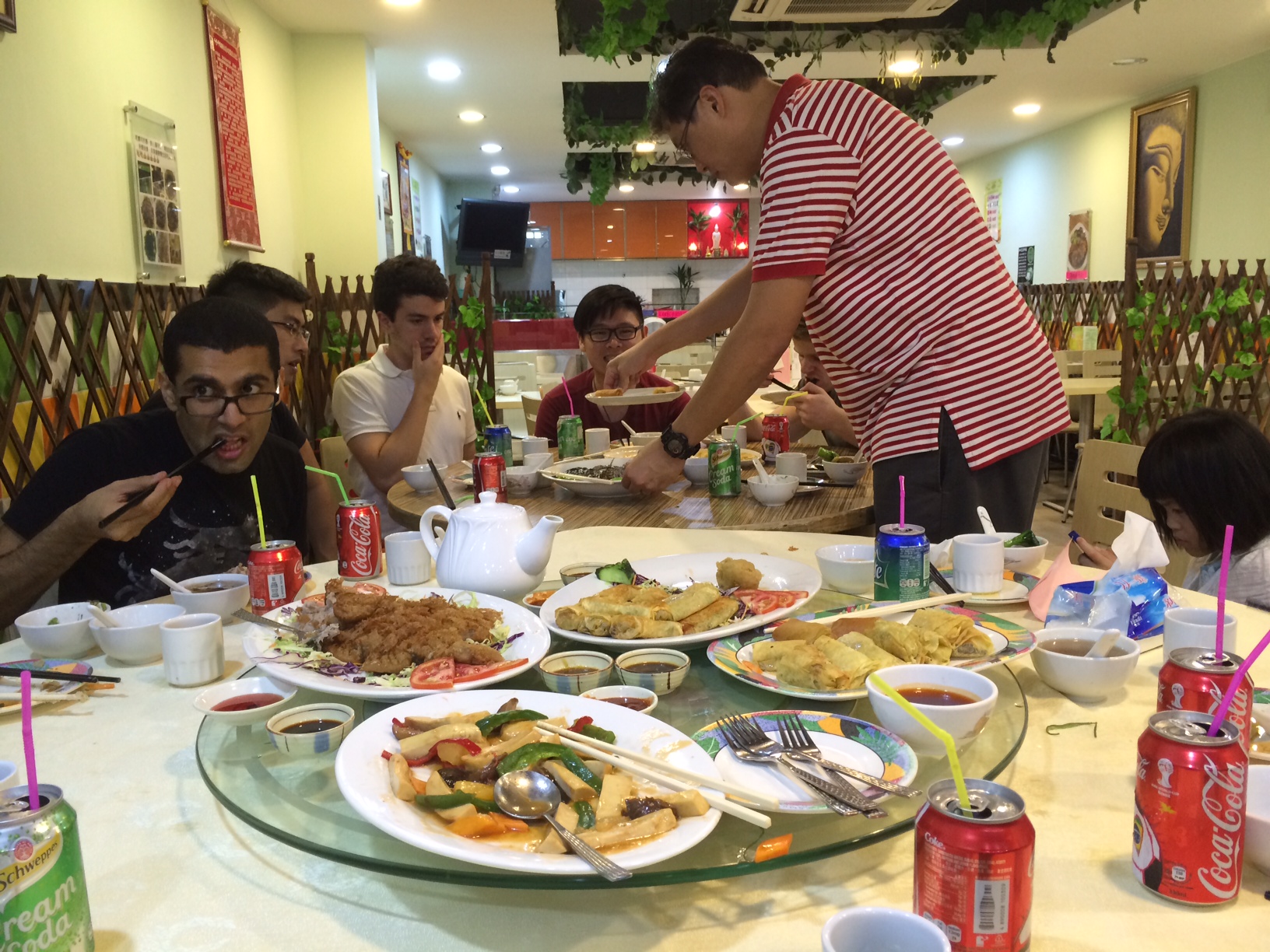

(The very small student is David’s daughter – Ashley.) Those of you with sharp eyes might recognise the fruit on the table as Durian – the King of Fruits and the fruit with one of the most amazing reputations. David went out specially to go and get two beautiful durians for the students to try something new (Kelvin and I needed no convincing as we are both strongly committed to the durian) and most people were very pleasantly surprised that the smell wasn’t as bad as they’d heard and that the taste was very much worth pursuing It is, however, amazingly rich, there’s a lot of the avocado richness concealed in the ultra-mango and (being honest) spring onion flavours of the durian.
Here’s the final picture of the course, standing proud in front of the defeated durian. We came to Hong Kong to learn, to experience and to have a lot of fun. And we did all three. Thank you, Hong Kong!

Thumbs up and mug for the camera!
Teaching in Hong Kong, Day 14
Posted: July 25, 2014 Filed under: Education | Tags: AsiaBound, Computer Emergency Response Team, computer security, CUHK, CUHK campus, education, exams, exchange, heartbleed bug, higher education, Hong Kong, learning, Lee Woo Sing, Lee Woo Sing College, networking, podcasts, security, SSL, students, teaching, xkcd Leave a commentThursday the 24th was a very straightforward day as we were bringing most of the coursework to a close and moving into the evaluation phase – not just for the students but for the course itself. We started with a tutorial on security, where we went through a range of issues and looked into the most commonly occurring problems, as recorded by the Computer Emergency Response Team (CERT) webpage. A lot of the problems we get are caused by:
- Programmers not checking what users type into their programs.
- Programmers not properly limiting what programs send to each other.
- “Back door” exploits where hard-coded usernames and passwords are left in.
We had a chance to discuss white hat and black hat hacking – patching a bug will get you a small cheque and a shout out, reporting an exploit to a criminal syndicate can make you rich. (And hunted or dead, for that matter.) It’s an interesting area – ethically and academically.
I’d asked the students, on Tuesday, to pick an area of security to talk about for 5-10 minutes and this proved to be a really interesting activity, taking longer than the hour I’d allotted for it. Topics included the Stuxnet Worm, and you can imagine we got a lot of interesting discussion out of this one, mobile device problems, the RTM Work from 1988, Botnets, Cross-site scripting issues, and the Heartbleed bug. (Compulsory XKCD comic here.)

XKCD 1354 – Heartbleed explained concisely and accurately.
I like asking the students to go out and find things because, by presenting it to each other, we get infectious enthusiasm and we have people applying their knowledge to reinforce what we’ve learned in class.
Then, for the final hour, we sat down and discussed the course itself. The students are still free to put in anonymous reports on things they don’t feel comfortable discussing with me, but I wanted to get a feel for what we should be improving. Overall, the course has been a great success and, teaching-wise, it’s gone pretty well. We have to smooth out some administration issues on our side but we already knew that and we’re starting the planning process for the next time in the next week.
It’s really great for me to get a sense that the students both enjoyed the course and learned from the course. As we always say, engaging isn’t always effective, but in this case it appears that it has been and, so far, the results I’ve seen reflect that we’ve achieved a great deal in a short time.
Only one day left, which is mostly a final talk from me, some “thank you”s and a dinner. Then we all start our flights home.
Only two more updates for this trip to come – the final Friday and my overall reflections. Hang in there, I’m nearly done!
Teaching in Hong Kong, Day 13 – MACAU!
Posted: July 25, 2014 Filed under: Education | Tags: AsiaBound, Central, CUHK, CUHK campus, education, egg tart, exams, exchange, higher education, Hong Kong, learning, Lee Woo Sing, Lee Woo Sing College, Macao, macau, Mandarin, networking, Ozone Bar, Portuguese, Ritz-Carlton, St Pauls, students, Taxi, teaching Leave a commentWe decided to add some interesting activities on the Wednesdays, to provide a break from the course, and Wednesday the 23rd saw us going to Macau (or Macao), another Special Administrative Region and a former Portuguese colony bordering on China. I picked up the students at the University train station and we headed down to Sheung Wan on Central for the ferry. It turns out that Hong Kong’s MTR system is busy during rush hour:
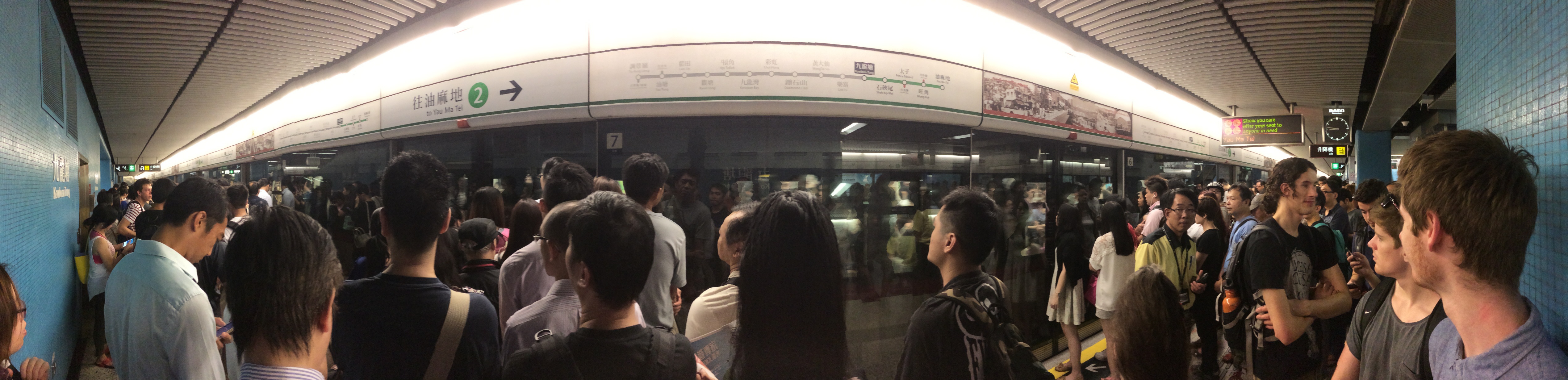
I’m slightly addicted to Panorama, yes, but wow, look at that station.
We went on the TurboJet to get a good ride across to Macau, sitting upstairs for sight-seeing and for a better ride. The students quickly got into the correct mode.

Why, yes, I would like to discuss that issue with you.

No pictures, please.
Landing in Macau itself, which is another country after all, we went through immigration and then outside the ferry terminal. where I had to constantly deflect the attentions of the touts who were all trying to get us onto a bus or a tour or something. One of the reasons to go to Macau was to show the students more of the region, the ecosystem of a casino-driven economy like Macau and the ways that cultures integrate differently, even with a similar group mixing in.
I wanted to start the students off at St Pauls, ruins in the heart of Macau island itself, so this required three cabs … and three languages. The first cab required me to dust off my terrible Mandarin (Qing day wo men qu da san ba pai fang?), the second pretended to understand my Sportuguese (Ruinas de Sao Paulo, por favor?), although it turned out that he tried to take the students for a ‘ride’ so they got out and walked the rest of the way, and the last one listened to my awful linguistics and said “St Paul’s” and away we went.
We (finally) all managed to meet up and, boy , was it hot! While being slightly less humid than Hong Kong, the Macau sun is a killer. I gave the team a potted history of Macau, pointed out some things, exhorted them to eat Macanese egg tarts (one of the finest desserts in the world) and then sent them off to explore, asking them to be back at the Ferry Terminal at 4:30 for a 5pm departure.

The group in front of St Paul’s.
The group split up into pairs and fours. Some went off to the Bungee Platform, and had a fantastic time I hear. Others drifted off to look at the glitz and glamour of Macau. All managed to get right into the movement, lane ways, food and egg tarts of a different culture, right on the doorstep of where they’d been living for the past three weeks.
I drifted off to remind myself of some of the more languid Macau experiences, having lunch at a nice Chinese place and taking pictures of the Macanese obsession with Neon. (Hong Kong and Macau take neon to new heights.)

This is a fairly restrained shopfront. You should see it at night!
I headed back to the ferry terminal early to get some work done (I am actually working on this trip so have to fit marking, planning and course coordination in amongst all of the intensive teaching and events). Come 4:30 we had most of the group back and I put them on to the ferry, while the last two screamed up in a taxi and we got on the boat just in time for a relaxing trip back to Hong Kong. (Pro tip: catching taxis in Macau is harder than it looks but your group leader will probably be understanding if the delay was caused by egg tarts.)
11 of us left for a fun side trip and all of us got back. I called that a success and left the group to make their own way back to the University while I made a side trip of my own up to the Ozone bar at the top of the Ritz-Carlton Hotel in West Kowloon. You can’t go to Hong Kong and not visit the highest bar in the world, now, can you?
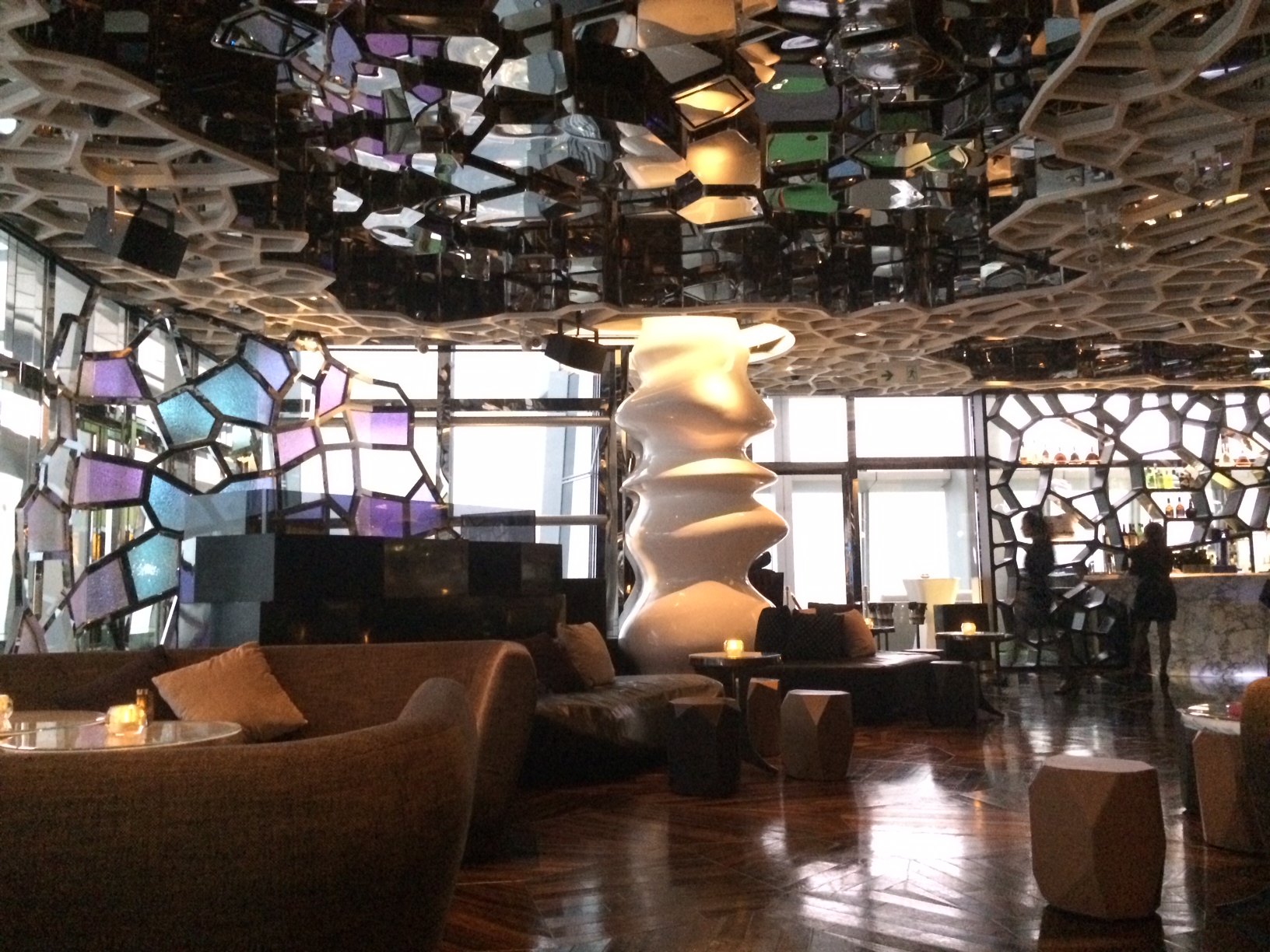
The Ozone bar’s design was ‘organically inspired’ but, fortunately, not in a Gigeresque manner.
Another great day, finished, and only two days left to go in the course!
Teaching in Hong Kong, Day 12
Posted: July 24, 2014 Filed under: Education | Tags: alumni, AsiaBound, Central, CUHK, CUHK campus, education, exams, exchange, higher education, Hong Kong, learning, Lee Woo Sing, Lee Woo Sing College, networking, podcasts, students, teaching, xkcd Leave a commentAfter another busy Monday, we had a discussion of all of the material that had featured in the podcasts and the podcasts themselves. It was quite obvious that the students had picked up the concepts involved and had a good working and application-level understanding of what was going on. (It turned out later that the students had in fact formed a study group for some of the podcast material, watching as a group for discussion. Nice to see that can happen without prompting!) This Tuesday was an important day because it was the last day of formal ‘coursework’ in the sense of new material being discussed in the course.
We covered network security, which is one of my many areas of interest, and went through all of the many ways that horrible things can happen to nice people. I had original wanted to extend this part of the course beyond the base course content but it had quickly become apparent that jamming more into this course wasn’t going to help anyone so I covered some of the material but not in as great a depth.
A vast amount of the stuff that we cover in security is actually really well summarised at XKCD, here’s an example:

XKCD 936 – It’s ok to stop using NVdisdf&Y3 as your password.
The end of the day was a briefing session, as we were off to Macau the next day for, well, getting a sense of the culture around here and seeing how another SAR functions in its new relationship with China. I also reminded the students that passports were required and, armed with excellent local knowledge from Louis Wong at the OAL, we prepared for a Macanese adventure.

 Nick Falkner