
Talk to the duck!
Posted: August 17, 2012 Filed under: Education | Tags: advocacy, authenticity, blogging, collaboration, community, curriculum, education, educational problem, educational research, feedback, grand challenge, higher education, principles of design, student perspective, teaching, teaching approaches, time banking, work/life balance, workload Leave a commentI’ve had a funny day. Some confirmed acceptances for journals and an e-mail from a colleague regarding a collaboration that has stalled. When I set out to readjust my schedule to meet a sustainable pattern, I had a careful look at everything I needed to do but I overlooked one important thing: it’s easier to give the illusion of progress than it is to do certain things. For example, I can send you a ‘working on it’ e-mail every week or so and that takes me about a minute. Actually doing something could take 4-8 hours and that’s a very large amount of time!
So, today was a hard lesson because I’ve managed to keep almost all of the balls in the air, juggling furiously, as I trim down my load but this one hurts. Right now, someone probably thinks that I don’t care about their project – which isn’t true but it fell into the tough category of important things that needs a lot of work to get to the next stage. I’ve sent an apologetic and embarrassed e-mail to try and get this going again – with a high prioritisation of the actual work – but it’s probably too late.
The project in question went to a strange place – I was so concerned about letting the colleague down that I froze up every time I tried to do the work. Weird but true and, ultimately, harmful. But, ultimately, I didn’t do what I said I’d do and I’m not happy.
So how can I turn this difficult and unpleasant situation into something that I can learn from? Something that my students can benefit from?
Well, I can remember that my students, even though they come in at the start of the semester, often come in with overheads and burdens. Even if it’s not explicit course load, it’s things like their jobs, their family commitments, their financial burdens and their relationships. Sometimes it’s our fault because we don’t correctly and clearly specify prerequisites, assumed knowledge and other expectations – which imposes a learning burden on the student to go off and develop their own knowledge on their own time.
Whatever it is, this adds a new dimension to any discussion of time management from a student perspective: the clear identification of everything that has to be dealt with as well as their coursework. I’ve often noticed that, when you get students talking about things, that halfway through the conversation it’s quite likely that their eyes will light up as they realise their own problem while explaining things to other people.
There’s a practice in software engineering that is often referred to as “rubber ducking”. You put a rubber duck on a shelf and, when people are stuck on a problem, they go and talk to the duck and explain their problem. It’s amazing how often that this works – but it has to be encouraged and supported to work. There must be no shame in talking to the duck! (Bet you never thought that I’d say that!)

TELL ME YOUR SECRETS!
I’m still unhappy about the developments of today but, for the purposes of self-regulation and the development of mature time management, I’ve now identified a new phase of goal setting that makes sense in relation to students. The first step is to work out what you have to do before you do anything else, and this will help you to work out when you need to move your timelines backwards and forwards to accommodate your life.
This may actually be one of the best reasons for trying to manage your time better – because talking about what you have to do before you do any other assignments might just make you realise that you are going to struggle without some serious focus on your time.
Or, of course, it may not. But we can try. We can try with personal discussions, group discussions, collaborative goal setting – students sitting around saying “Oh yeah, I have that problem too! It’s going to take me two weeks to deal with that.” Maybe no-one will say anything.
We can but try! (And, if all else fails, I can give everyone a duck to talk to. 🙂 )
Group feedback, fast feedback, good feedback
Posted: August 16, 2012 Filed under: Education | Tags: authenticity, collaboration, curriculum, design, education, educational problem, educational research, ethics, feedback, grand challenge, in the student's head, plagiarism, principles of design, reflection, student perspective, teaching, teaching approaches, vygotsky Leave a commentWe had the “first cut” poster presentation today in my new course. Having had the students present their pitches the previous week, this week was the time to show the first layout – put up your poster and let it speak for itself.
The results were, not all that surprisingly, very, very good. Everyone had something to show, a data story to tell and some images and graphs that told the story. What was most beneficial though was the open feedback environment, where everyone learned something from the comments on their presentation. One of my students, who had barely slept for days and was highly stressed, got some really useful advice that has given him a great way forward – and the ability to go to bed tonight with the knowledge that he has a good path forward for the next two weeks.
Working as a group, we could agree as a group, discuss and disagree, suggest, counter-suggest, develop and enhance. My role in all of this is partially as a ‘semi-expert’ but also as a facilitator. Keep the whole thing moving, keep it to time, make sure that everyone gets a good opportunity to show their work and give and receive feedback.
The students all write down their key feedback, which is scanned as a whole and put on the website so that any good points that went to anyone can now be used by anyone in the group. The feedback is timely, personal and relevant. Everyone feels that these sessions are useful and the work produced reflects the advantages. But everyone talks to everyone else – it’s compulsory. Come to the session, listen and then share your thoughts.
This, of course, reveals one of my key design approaches: collaboration is ok and there is no competitiveness. Read anything about the grand challenges and you keep seeing the word ‘community’ through it. Solid and open communities, where real and effective sharing happens, aren’t formed in highly competitive spaces. Because the students have unique projects, they can share ideas, references and even analysis techniques without plagiarism worries – because they can attribute without the risk of copying. Because there is no curve grading, helping someone else isn’t holding you back.
Because of this, we have already had two informal workshop groups form to address issues of analysis and software, where knowledge passes from person to person. Before today’s first cut presentation, a group was sitting outside, making suggestions and helping each other out – to achieve some excellent first cut results.
Yes, it’s a small group so, being me, now I’m worrying about how I would scale this up, how I would take this out to a large first-year class, how I would get it to a school group. This groups need careful facilitation and the benefit of inter-group communication is derived from everyone in the group having a voice. The number of interactions scale with the square of the group size, so there’s a finite limit to how many people I can have in the group and fit it into a two-hour practical session. If I split a larger class into sub-groups, I lose the advantage of everyone see in everyone else’s work.
But this can be solved, potentially with modern “e-” techniques, or a different approach to preparation, although I can’t quite see it yet. There’s a part of me that thinks “Ask these students how they would approach it”, because they have viewpoints and experience in this which complements mine.
Every week that goes by, I wonder if we will keep improving, and keep rewarding the (to be honest) risk that we’re taking in running a small course like this in leaner times. And, every week, the answer is a resounding “yes”!
Here’s to next week!
Putting it all together – discussing curriculum with students
Posted: August 15, 2012 Filed under: Education, Opinion | Tags: advocacy, authenticity, collaboration, community, curriculum, education, educational problem, educational research, ethics, grand challenge, higher education, in the student's head, popeye, principles of design, reflection, resources, student perspective, teaching, teaching approaches, thinking, tools, wimpy, workload Leave a commentOne of the nice things about my new grand challenges course is that the lecture slots are a pre-reading based discussion of the grand challenges in my discipline (Computer Science), based on the National Science Foundation’s Taskforce report. Talking through this with students allows us to identify the strengths of the document and, perhaps more interestingly, some of its shortfalls. For example, there is much discussion on inter-disciplinary and international collaboration as being vital, followed by statements along the lines of “We must regain the ascendancy in the discipline that we invented!” because the NSF is, first and foremost, a US-funded organisation. There’s talk about providing the funds for sustainability and then identifying the NSF as the organisation giving the money, and hence calling the shots.
The areas of challenge are clearly laid out, as are the often conflicting issues surrounding the administration of these kinds of initiative. Too often, we see people talking about some amazing international initiative – only to see it fail because nobody wants to go first, or no country/government wants to put money up that other people can draw on until everyone does it at the same time.
In essence, this is a timing and trust problem. If we may quote Wimpy from the Popeye cartoons:

Via theawl.com. Click on the link for a very long discussion of Popeye and Wimpy related issues.
The NSF document lays bare the problem we always have: those who have the hamburgers are happy to talk about sharing the meal but there are bills to be paid. The person who owns the hamburger stand is going to have words with you if you give everything away with nothing to show in return except a promise of payment on Tuesday.
Having covered what the NSF considered important in terms of preparing us for the heavily computerised and computational future, my students finished with a discussion of educational issues and virtual organisations. The educational issues were extremely interesting because, having looked at the NSF Taskforce report, we then looked at the ACM/IEEE 2013 Computer Science Strawman curriculum to see how many areas overlapped with the task force report. Then we looked at the current curriculum of our school, which is undergoing review at the moment but was last updated for the 2008 ACM/IEEE Curriculum.
What was pleasing was, rom the range of students, how many of the areas were being addressed throughout our course and how much overlap there was between the highlighted areas of the NSF Report and the Strawman. However, one of the key issues from the task force report was the notion of greater depth and breadth – an incredible challenge in the time-constrained curriculum implementations of the 21st century. Adding a new Knowledge Area (KA) to the Strawman of ‘Platform Dependant Computing’ reflects the rise of the embedded and mobile device yet, as the Strawman authors immediately admit, we start to make it harder and harder to fit everything into one course. Combine this with the NSF requirement for greater breadth, including scientific and mathematical aspects that have traditionally been outside of Computing, and their parallel requirement for the development of depth… and it’s not easy.
The lecture slot where we discussed this had no specific outcomes associated with it – it was a place to discuss the issues arising but also to explain to the students why their curriculum looks the way that it does. Yes, we’d love to bring in Aspect X but where does it fit? My GC students were looking at the Ethics aspects of the Strawman and wondered if we could fit Ethics into its own 3-unit course. (I suspect that’s at least partially my influence although I certainly didn’t suggest anything along these lines.) “That’s fine,” I said, “But what do we lose?”
In my discussions with these students, they’ve identified one of the core reasons that we changed teaching languages, but I’ve also been able to talk to them about how we think as we construct courses – they’ve also started to see the many drivers that we consider, which I believe helps them in working out how to give feedback that is the most useful form for us to turn their needs and wants into improvements or developments in the course. I don’t expect the students to understand the details and practice of pedagogy but, unless I given them a good framework, it’s going to be hard for them to communicate with me in a way that leads most directly to an improved result for both of us.
I’ve really enjoyed this process of discussion and it’s been highly rewarding, again I hope for both sides of the group, to be able to discuss things without the usual level of reactive and (often) selfish thinking that characterises these exchanges. I hope this means that we’re on the right track for this course and this program.
The Key Difference (or so it appears): Do You Love Teaching?
Posted: August 12, 2012 Filed under: Education, Opinion | Tags: advocacy, blogging, collaboration, community, education, educational problem, educational research, ethics, feedback, higher education, teaching, teaching approaches, thinking, workload 3 Comments
Please, any of my students reading this, do not give me an apple. I have sufficient!
I wander around fair bit for work. (I make it sound more impressive than that but the truth is that I end up in lots of different places to work on my many projects and sometimes the movement, although purposeful, is more Brownian than not – due to life.) I’ve had a chance to talk to a lot of people who teach – some of whom are putting vast amounts of effort into it and some of whom aren’t.
The key difference, unsurprisingly, is generally the passion behind it. We see this in our students. They will spend days working on a Minecraft construction to simulate an Arithmetic and Logic Unit, but won’t always put in the two hours to write 20 lines of C++ code. They will write 20,000 words on their blog but can’t give you a 1,000 word summary.
We put effort into the things that we are interested in. Sure, if we’re really responsible and have self-regulation nailed, then we can do things that we’re not interested in, or actively dislike, but it’s never really going to have the same level of effort or commitment.
Passion (or the love of something) is crucial. Some days I have so much to say on the blog that I end up with 4-5 days stocked up in the queue. Some days I struggle to come up with the daily post or, as yesterday, I just run out of time to hit the 4am post cycle because I am doing other things that I am passionate about. Today, of course, the actual deadline timer is running and it seems to have made me think – now I’m passionate and now you’ll get something worth reading. If I’d stayed up until after my guests had left last night, written just anything to meet the deadline? It wouldn’t be anywhere near my best work.
Passion is crucial.
Which brings me to teaching. I know a lot of academics – some who are research/teaching/admin, some research only, some teaching/admin and… well, you get the picture. The majority are the ‘3-in-1’ academics and, in many regards, looking at their student evaluations and performance metrics will not tell you anything about them as a teacher that you can’t learn by sitting down with them and talking about their teaching. It is hard to shut me up about my courses and my students, the things I’m trying, the things I’m thinking of adopting, the other areas I’m looking at, the impact of what other Unis and people are doing, the impact of reports. I am a (junior) scholar in the discipline of learning and teaching and I really, really love teaching. For me, putting effort into it is inevitable, to a great extent.
Then I talk to colleagues who really just want to do their research and be left alone. Everything else is a drag on their research. Administration will get the minimum effort, if it’s done. Teaching is something that you have to do and, if the students don’t get it, then it’s their fault. What is so weird about this is that these people are, in the vast majority, excellent scholars in their own discipline. They research and read heavily, they are aware of what every other researcher is doing in this area, they know if their work has a chance for publication or grants. Having these skills, they then divide the world into ‘places where I have to scholarly’ and ‘places where I can phone it in’. (Not all researchers are like this, I’m talking about the ones who consider anything other than research beneath them.)
What a shame! What a terrible missed opportunity for both these people who should be more aware of the issues of learning and teaching, and for the students who could be learning so much more from them? But when you actually talk to these academics, some of them just don’t liked teaching, they don’t see the point of putting effort into it or (in some cases) they just don’t know what to do and how to improve so they hunker down and try to let it all slide around them.
Part of this is the selective memory that we have of ourselves as students. I’m lucky – I was terrible. I was fortunate enough to be aware and mature enough as I reconstructed myself as a good student to see the transformative process in action. A lot of my peers are happy to apply rules to students that they wouldn’t (or don’t ) apply to themselves now or in the past, such as:
“I’m an academic who doesn’t like teaching, despite being told that it’s part of my job, so I’ll do the minimum required – or less on some occasions. You, however, are a student who doesn’t like the sub-standard learning experiences that my indifference brings you but I’m telling you to do it, so just do it or I’ll fail you.”
This isn’t just asymmetrical, this is bordering on the Stanford Prison Experiment, an arbitrary assignation of roles that leads to destructive power-derived behaviour. But, if course, if you don’t enjoy doing something then there are going to be issues.
Have we actually ever asked people these key questions as a general investigation? “Do you like teaching?” “What do you enjoy about teaching?” “What can we do to make you enjoy teaching more?” Would this muddy the water or clear the air? Would this earth our non-teaching teachers and fire them up?
Even where people run vanity courses (very small scale, research-focused courses design to cherry pick the good students) they are still often disappointed because, even where you can muster the passion to teach, if you don’t really understand how to teach or what you need to do to build a good learning experience, then you end up with these ‘good’ students in this ‘enjoyable’ course failing, complaining, dropping out and, in more analogous terms, kicking your puppy. You will now like teaching even less!
It’s blindingly obvious that some people don’t like teaching but, much as we wouldn’t stand out the front of a class and yell “PASS, IDIOTS!”, I’m looking for other good examples where we start to ask people why they don’t want to do it, what they’re worried about, why they don’t respect it and how we can get them more involved in the L&T community.
Let’s face it, when you love teaching, the worst day with the students is still a pretty good day. It would be nice to share this joy further.
In A Student’s Head – Mine From 26 Years Ago
Posted: August 11, 2012 Filed under: Education | Tags: advocacy, ALTA, blogging, collaboration, community, curriculum, design, education, educational problem, educational research, feedback, games, higher education, in the student's head, principles of design, student perspective, teaching, teaching approaches, thinking Leave a commentI attended an Australian Council of Deans of ICT Learning and Teaching Academy event run by Elena Sitnikova from the University of South Australia. Elena is one of the (my fellow?) Fellows in ALTA and works in Cyber Security and Forensic Computing. Today’s focus was on discussing the issues in ICT education in Australia, based on the many surveys that have been run, presenting some early work on learning and teaching grants and providing workshops on “Improving learning and teaching practice in ICT Education” and “Developing Teamwork that Works!”. The day was great (with lots of familiar faces presenting a range of interesting topics) and the first workshop was run by Sue Wright, graduate school in Education, University of Melbourne. This, as always, was a highly rewarding event because Sue forced me to go back and think about myself as a student.
This is a very powerful technique and I’m going to outline it here, for those who haven’t done it for a while. Drawing on Bordieu’s ideas on social and cultural capital, Sue asked us to list our non-financial social assets and disadvantages when we first came to University. This included things like:
- Access to resources
- Physical appearance
- Educational background
- Life experiences
- Intellect and orientation to study
- Group membership
- Accent
- Anything else!
When you think about yourself in this way, you suddenly have to think about not only what you had, but what you didn’t have. What helped you stay in class?What meant that you didn’t show up? From a personal perspective, I had good friends and a great tan but I had very little life experience, a very poor study ethic, no real sense of consequences and a very poor support network in an academic sense. It really brought home how lucky I was to have a group of friends that kept me coming to University. Of course, in those pre-on-line days, you had to come to Uni to see your friends, so that was a good reason to keep people on campus – it allowed for you to learn things by bumping into a people, which I like to refer to as “Brownian Communication”.

“Hey, Neutrino 3 is trying to put together a Learning and Teaching Grant. Who’s in?”
This exercise made me think about my transition to being a successful student. In my case, it took more than one degree and a great deal more life experience before I was ready to come back and actually succeed. To be honest, if you looked at my base degree, you’d never have thought that I would make it all the way to a PhD and, yet, here I am, on a path where I am making a solid and positive difference.
Sue then reminded people of Hofstede’s work on cultural dimensions – power distance, individualism versus collectivism, and uncertainty avoidance. How do students work – do they need a large ‘respect gap’ between student and teacher? Do they put family before their own study? Do they do anything rather than explore the uncertain? It’s always worth remembering that, where “the other” exists for us, we exist as “the other” reciprocally. While it’s comfortable as white, culturally English and English speaking people to assume that “the other” is transgressing with respect to our ‘dominant’ culture, we may be asking people to do something that is incredibly uncomfortable and goes far beyond learning another language.
One of the workshop participants was born and grew up in Korea and he made the observation that, when he was growing up, the teacher was held at the same level of the King and your father – and you don’t question the King or your father! He also noted that, on occasion, ‘respect’ had to be directed towards teachers that they did not actually respect. He had one bad teacher and, in that class, the students asked no questions and just let the teacher talk. As someone who works within a very small power distance relationship with y students, I have almost never felt disrespected by anything that my students do, unless they are actively trying to be rude and disrespectful. If I have nobody following, or asking questions, then I always start to wonder if I’ve been tuned out and they are listening to the music in their heads. (Or on their iPhones, as it is the 21st Century!)
Australia is a low power distance/high individualism culture with a focus on the short-term in many respects (as evidence by profit and loss quarterly focus and, to be frank, recent political developments). Bringing people from a high PD/high collectivism culture, such as some of those found in South East Asia, will need some sort of management to ensure that we don’t accidentally split the class. It’s not enough to just say “These students do X” because we know that we can, with the right approach, integrate our student body. But it does take work.
As always, working with Sue (you never just listen to Sue, she always gets you working) was a very rewarding and reflective activity. I spent 20 minutes trying to learn enough about a colleague from UniSA, Sang, that I could answer questions about his life. While I was doing this, he was trying to become Nick. What emerged from this was how amazingly similar we actually are – different Unis, different degrees, different focus, one Anglo-origin, one Korean-origin – and it took us quite a while to find things where we were really so different that we could talk about the challenges if we had to take on each other’s lives.
It was great to see most of the Fellows again but, looking around a large room that wasn’t full to the brim, it reminded me that we are often talking to those people who already believe that what we’re doing is the right thing. The people that really needed to be here were the people who weren’t in the room.
I’m still thinking about how we can continue our work to reach out and bring more people into this very, very rewarding community.
Wading In: No Time For Paddling
Posted: July 31, 2012 Filed under: Education | Tags: collaboration, community, curriculum, design, education, educational problem, feedback, Generation Why, grand challenge, grand challenges, higher education, in the student's head, principles of design, reflection, student perspective, teaching, teaching approaches, thinking, universal principles of design, work/life balance 1 CommentI’m up to my neck in books on visualisation and data analysis at the moment. So up to my neck that this post is going to be pretty short – and you know how much I love to talk! I’ve spent most of the evening preparing for tomorrow’s visualising data tutorial for Grand Challenges and one of the things I was looking for was bad visualisations. I took a lot away from Mark’s worked examples posts, and I look forward to seeing the presentation, but visualisation is a particularly rich area for worked ‘bad’ examples. With code, it has to work to a degree or manifest its failure in interesting ways. A graphic can be completely finished and still fail to convey the right information.
(I’ve even thrown in some graphics that I did myself and wasn’t happy with – I’m looking forward to the feedback on those!) (Ssh, don’t tell the students.)
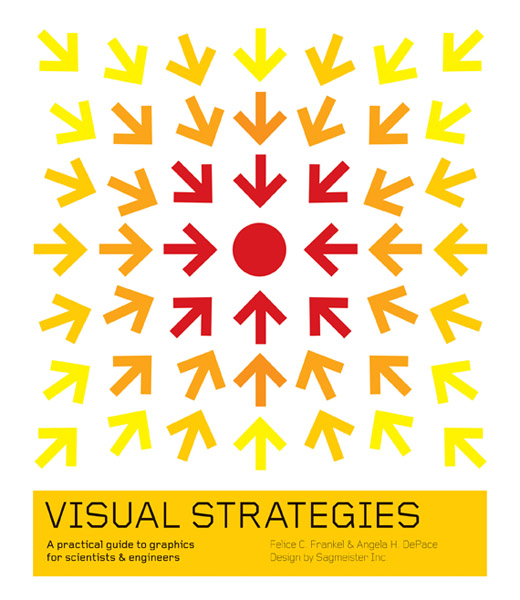
I had the good fortune to be given a copy of Visual Strategies (Frankel and DePace) which was designed by one of the modern heroes of design – the amazing Stefan Sagmeister. This is, without too much hyperbole, pretty much the same as being given a book on painting where Schiele had provided the layout and examples. (I’m a very big fan of Egon Schiele and Hundertwasser for that matter. I may have spent a little too much time in Austria.) The thing I like about this book is that it brings a lot of important talking and thinking points together: which questions should you ask when thinking about your graphic, how do you start, what do you do next, when do you refine, when do you stop?
Thank you, again, Metropolis Bookstore on Swanston Street in Melbourne! You had no real reason to give a stranger a book for free, except that you thought it would be useful for my students. It was, it is, and I thank you again for your generosity.
I really enjoy getting into a new area and I think that the students are enjoying it too, as the entire course is a new area for them. We had an excellent discussion of the four chapters of reading (the NSF CyberInfrastructure report on Grand Challenges), where some of it was a critique of the report itself – don’t write a report saying “community engagement and visualisation are crucial” and (a) make it hard to read, even for people inside the community or (b) make it visually difficult to read.
On the slightly less enthusiastic front, we get to the crux of the course this week – the project selection – and I’m already seeing some hesitancy. Remember that these are all very good students but some of them are not comfortable picking an area to do their analysis in. There could be any number of reasons so, one on one, I’m going to ask them why. If any of them say “Well, I could if I wanted to but…” then I will expect them to go and do it. There’s a lot of scope for feedback in the course so an early decision that doesn’t quite work out is not a death sentence, although I think that waiting for permission to leap is going to reduce the amount of ownership and enjoyment that the student feels when the work is done.
I have no time for paddling in the shallows, personally, and I wade on in. I realise, however, that this is a very challenging stance for many people, especially students, so while I would prefer people to jump in, I recognise my job as life guard in this area and I am happy to help people out.
However, these students are the Distinction/High Distinction crowd, the ones who got 95-100 on leaving secondary school and, as we thought might occur, some of them are at least slightly conditioned to seek my approval, a blessing for their project choice before they have expended any effort. Time to talk to people and work with them to help them move on to a more confident and committed stance – where that confidence is well-placed and the commitment is based on solid fact and thoughtful reasoning!
HERDSA 2012: Final Keynote, “Connecting with the Other: Some ideas on why Black America likes to sing Bob Dylan”, Professor Liz McKinley
Posted: July 7, 2012 Filed under: Education | Tags: advocacy, authenticity, blogging, collaboration, community, design, education, educational problem, educational research, ethics, feedback, Generation Why, herdsa, higher education, identity, in the student's head, measurement, mr tambourine man, principles of design, protest song, reflection, resources, student perspective, teaching, teaching approaches, thinking 2 CommentsI’ve discussed this final talk in outline but it has had such an impact on me that I wanted to share it in its own post. This also marks the end of my blogging from HERDSA, but I’m sure that you’ve seen enough on this so that’s probably a good thing. (As a note, the next conference that I’ll be at is ICER, in September, so expect some more FrenetoBlogging (TM) then.)
Professor Elizabeth (Liz) McKinley has a great deal of experience in looking at issues of otherness, from her professional role in working with Māori students and postgraduates, and because she is of Ngāti Kahungunu ki Wairarapa and Ngāi Tahu descent herself. She began her talk with a long welcome and acknowledgement speech in an indigenous language (I’m not sure which one it was and I haven’t been able to find out), which she then repeated in English, along with an apology to the local indigenous peoples for her bad pronunciation of some of their words.
She began by musing on Bob Dylan, poet, protest song writer, and why his songs, especially “Blowing in the Wind”, were so popular with African Americans. Dylan’s song, released at a turbulent time in US History, asked a key question: “How many roads must a man walk down, before you call him a man?” At a time when African Americans were barely seen as people in some quarters, despite the Constitutional Amendments that had been made so long before, these lyrics captured the frustrations and aspirations of the Black people of the US and it became, in Professor McKinley’s opinion, anthemic in the civil rights movement because of this. She then discussed how many of Bob Dylan’s other songs had been reinterpreted, repurposed, and moved into the Black community, citing “Mr Tambourine Man” as covered by Con Funk Shun as an example of this. (I have been unable to locate this on Youtube or my usual sources but, I’ve been told, it’s not the version that you’re used to and it has an entirely new groove.)
Reinterpretation pays respect to the poet but we rediscover new aspects about the work and the poet and ourselves when we work with another artist. We learn from each other when we share and we see each other’s way of doing things. These are the attributes that we need to adopt if we want to bring in more underrepresented and disadvantaged students from outside of our usual groups – the opportunities to bring their talents to University to share them with us.
She then discussed social justice education in a loose overview: the wide range of pedagogies that are designed to ameliorate the problems caused by unfair practices and marginalisation. Of course, to be marginalised and to be discriminated against, we must have a dominant (or accepted) form, and an other. It is the Other that was a key aspect of the rest of the talk.
The Other can be seen in two very distinct ways. There is the violent Other, the other that we are scared of, that physically repels us, that we hide from and seek to destroy, sideline or ignore. This is drive by social division and inequity. When Gil Scott-Heron sang of the Revolution that wouldn’t be televised, he was speaking to his people who, according to people who look like me, were a violent and terrifying Otherness that lived in the shadows of every city in America. People are excluded when they don’t fit the mainstream thinking, when we’re scared of them – but we can seek to understand the other’s circumstances, which are usually a predicament, to understand their actions and motivations so that we can ameliorate or remedy them.
But there is also the non-violent Other, a philosophical separation, independent of social factors. We often accept this Other, letting it be different and even seeking knowledge from this unknowable other and, rather than classify it as something to be shunned or feared, we defer our categorisation. My interpretation of this non-violent other is perhaps that of those who seek religious orders, at the expense of married life, even small possessions or a personal life within a community that they control. In many regards this is very much an Otherness but we have tolerated and welcomed the religiously Other into our lives for millennia. It has only been reasonably recently that aspects of this, for certain religious orders, has now started to associate a violent Otherness with the mystical and philosophical Otherness that we would usually associate with clerics.
Professor McKinley went on to identify some of the Others in Australia and New Zealand: the disadvantaged, those living in rural or remote areas, the indigenous peoples. Many of the benchmarks for these factors are set against nations like the UK, the US and Canada. She questioned why, given how different our nations are, we benchmarked ourselves against the UK but identified that all of this target setting, regardless of which benchmarks were in use, were set against majority groups that were largely metropolitan/urban and non-indigenous. In New Zealand, the indigenous groups are the Māori and the Pacific Islanders (PI), but there is recognition that there is a large degree of co-location between these peoples and the lower socio-economic status groups – a double whammy as far as Otherness goes compared to affluent white culture.
Professor McKinley has been heavily involved and leading three projects, although she went to great lengths to thank the many people who were making it all work while she was, as she said, running around telling everyone about it. These three projects were the Starpath Project, the Māori and Indigenous (MAI) Doctoral Programme, and the Teaching and Learning in the Supervision of Māori PhD students (TLRI).
The Starpath Project was designed to undertake research and develop and evaluated evidence-based initiatives, designed to improve educational participation and achievement of students from groups currently under-represented in degree level education. This focuses on the 1st decile schools in NZ, those who fall into the bottom 10%, which includes a high proportion of Māori and PI students. The goal was to increase the number of these students who went into Uni out of school, which is contrary to the usual Māori practice of entering University as mature age students when they have a complexity in their life that drives them to seek University (Liz’s phrase, which I really like).
New Zealand is trying to become a knowledge economy, as they have a small population on a relatively small country, and they want more people in University earlier. While the Pākehā, those of European descent, make up most of those who go to Uni, the major population growth is the Māori and PI communities. There are going to be increasingly large economic and social problems if these students don’t start making it to University earlier.
This is a 10-year project, where phase 1 was research to identify choke points and barriers in to find some intervention initiatives, and phase 2 is a systematic implementation, transferable, sustainable, to track students into Uni. This had a strong scientific basis with emphasis on strong partnerships, leading to relationships with nearly 10% of the secondary schools in New Zealand, focused on the low decile groups that are found predominantly around Auckland. The partnerships were considered to be essential here and the good research was picked up and used to form good government policy – a fantastic achievement.
Another key aspect, especially from the indigenous perspective, was to get the families on board. By doing this, involving parents and family, guardian participation in activities shot up from 20% to 80% but it was crucial to think beyond the individual, including writing materials for families – parents and children. Families are the locus of change in these communities. Part of the work here involved transitions support for students to get from school to uni, supported by scholarships to show both the students and the community that they can learn and achieve to the same degree as any other student.
One great approach was that, instead of targeting the disadvantaged kids for support, everyone got the same level of (higher) support which normalised the student support and reduced the Otherness in this context.
The next project, the MAI programme, was a challenge to Māori researchers to develop a doctoral programme and support that didn’t ignore the past while still conforming to the academic needs of the present. (“Decolonizing methodologies: Research and Indigenous Peoples” by Linda Tuhiwai Smith, 1999, was heavily referenced throughout this.) Māori students have cultural connections and associations that can make certain PhD work very difficult: consider a student who is supposed to work with human flesh samples, where handling dead tissue is completely inappropriate in Māori culture. It is profoundly easy, as well as lazy, to map an expectation of conformity over the top of this (Well, if you’re doing our degree then you follow our culture) but this is the worst example of a colonising methodology and this is exactly what MAI was started to address.
MAI works through communities, meeting regularly. Māori academics, students and cultural advisors meet regularly to alleviate the pressures of cross-cultural issues and provide support through meetings and retreats.
The final project, the Māori PhD project, was initiated by MAI (above) to investigate indigenous students, to understand why they were carrying out their PhDs. Students were having problem, as with the tissue example above, so the project also provided advice to institutions and to students, encouraging Pākehā supervisors to work with Māori students, as well as the possibility of Māori supervision if the student needed to feel culturally safe. This was a bicultural project, with five academics across four institutions.
From Smith, 1997, p203, “educational battleground for Māori is spatial. It is about theoretical spaces, pedagogical spaces, structural spaces.” From this project there were differences in what the students were seeking and the associated pedagogies. Some where seeking difference from their own basis, an ancestral Māori basis. Some were Māori but not really seeking that culture. Some, however, were using their own thesis to regain their lost identity as Māori.
The phrase that showed up occasionally was a “colonised history” – even your own identity is threatened by the impact of the colonists on the records, memories and freedoms of your people. We had regularly seen colonists move to diminish and reduce the Other, as a perceived threat, where they classify it as a violent other. The third group of students, above, are trying to rebuild what it meant to be Māori for them, in the face of New Zealand’s present state as a heavily colonised country, where most advantage lies with the Pākehā and Asian communities. They were addressing a sense of loss, in the sense of their loss of what it meant to be Māori. This quest for Māori identity was sometimes a challenge to the institution, hence the importance of this project to facilitate bicultural understanding and allow everyone to be happy with the progress and nature of the study.
At this point in my own notes I wrote “IDENTITY IDENTITY IDENTITY” because it became clearer and clearer to me that this was the key issue that is plaguing us all, and that kept coming up at HERDSA. Who are we? Who is my trusted group? How do I survive? Who am I? While this issues, associated with Otherness in the indigenous community, are particularly significant for low SES groups and the indigenous, they affect all of us in this times of great change.
An issue of identity that I have touched on, and that Professor McKinley brought up in her talk, was how we establish the identity of the teacher, in order to identify who should be teaching. In Māori culture, there are three important aspects: Matauranga (Knowledge), Whakapapa (ancestral links) and Tikanga (cultural protocols and customs). But this raises pedagogical issues, especially when two or more of these clash. Who is the teacher and how can we recognise them? There are significant cultural issues if we seek certain types of knowledge from the outside, because we run headlong into Tikanga. These knowledge barriers may not be flexible at all, which is confronting to western culture (except for all of the secret barriers that we choose not to acknowledge). The teachers may be parents, elders, grandparents – recognising this requires knowledge, time and understanding. And, of course, respect.
Another important aspect is the importance of the community. If you, as a Māori PhD student, go to a community and ask them to answer some questions, at some stage in the future, they’ll expect you back to help out with something else. So, time management becomes an issue because there is a spirit of reciprocity that requires the returned action – this is at odds with restricted time for PhDs and the desire for timely completion if you have to disappear for 2 weeks to help build or facilitate something.
Professor McKinley showed a great picture. A student, graduating with PhD gown surmounted by the sacred cloak of the Māori people. They have to have a separate graduation ceremony, as well as the small ‘two tickets maximum’ one in the hall, because community and family pride is strong – two tickets maximum won’t accommodate the two busloads of people who showed up to see this particular student graduate.
The summary of the Other was that we have two views:
- The Other as a consequence of social, economic and/or political disaffiliation (Don’t pathologise the learning by diagnosing it as a problem and trying to prescribe a remedy.)
- As an alterity that is independent of social force. (Welcoming the other on their own terms. A more generous form but a scarier form for the dominant culture.)
What can we learn from the other? My difference matters to my institution. We need to ensure that we have placed our ethics into social justice education – this stance allows us how to frame ethics across the often imposed barriers of difference.
Professor McKinley then concluded by calling up some of her New Zealand colleagues to the stage, to close the talk with a song. An unusual (for me) end to an inspiring and extremely thought-provoking talk. (Sadly, it wasn’t Bob Dylan, but it was in Māori so it may have secretly been so!)
HERDSA 2012: Final general session – connecting with the community.
Posted: July 5, 2012 Filed under: Education | Tags: blogging, collaboration, community, curriculum, education, herdsa, higher education, mentor, outreach, principles of design, reflection, teaching approaches Leave a commentToday I’m sitting in a session whose theme is engagement and connection, with the community, with Vocational Education and Training (VET) and the university-school relationship. All of this goes to our greater role in the community, as knowledge leaders, as mentors and in giving value to the community as a whole. This post is the first of a couple that I want to make about this session.
It would be fairly easy to only think about the students who are already in your class and, given that they’ve got in, that it is up to the student to do all of the heavy lifting to stay there but it’s becoming increasingly obvious that there are many students who, for reasons beyond their control, will have difficulty even making it to University, let alone staying there.
The first talk discussed the issues from the rural Canberra perspective. For those who don’t know, Australia is heavily urbanised with a coastal major city focus. There is still a rural community but with 201o numbers of rural population estimated at less than 2.5 million and steadily declining, Australia’s population heart is its cities. The declining rural employment sector and the movement of population, jobs and resources to the cities is leading to a drop in standards of living and rising unemployment. This is accompanied by a low percentage of families who have engaged in higher education and a very low level of attainment of the final years of secondary education. These low engagement rates with high secondary and higher ed make perfect sense when lifetime jobs are there without much further training, or with low levels of VET assistance, but become a trap once unskilled or traditionally apprenticed roles start to dry up.
The Commonwealth Government (that’s the Australian Federal Government for those who don’t know that we’re a commonwealth) has identified that they want to see a lot more low socio-economic status (SES) participants in higher ed by 2020 as they are largely unrepresented in the existing higher ed community. As people who did not traditionally attend University, this is a rich source of new students – assuming that we can solve some of the key problems in engaging, preparing and retaining these students.
Barbara Cram presented a paper on “Establishing a regional enabling pilot programme through uni-community engagement” which deals with the rural catchment area around the University of Canberra. Canberra, Australia’s capital city, is situated in the middle of a rural area and U Canberra sees itself as the University of the surrounding district. (The Australian National University is also in Canberra but, I believe, tends to focus on urban students from around Australia.) In the areas surrounding Canberra, roughly 8% of people have Bachelors’ degrees, well below the national levels, and, more depressingly, up to 50% of students who finish their schooling do not go on to either employment or further study. The social implications of this are profound – a community steadily heading towards disengagement and multi-generational unemployment, reducing opportunities further.
University of Canberra’s goal was to enhance regional participation in higher education in a thin market but what does it take to establish a new program in a regional town using a community-based participatory approach? The strategy is to use a community-based partnership strategy to develop community trust and to ensure that the community sees the value of the offering. Two course styles were offered: a community capacity development course (volunteer training and Certificate IV courses), or an enabling (university preparation) course. The community that U Can were working with, the town of Merimbula, decided that an enabling course was the best way forward.
The UCanReach program ran over 14 weeks, 2 evenings a week, and allowed participants to study three units: Learning at University, Communicating for Professional Futures (analysis of, and practice in, the range of text types of u/grad study), and Understanding Community (critical analysis, active participation, independent learning, primary and secondary research and academic literacy). The support provided here was considered critical to the success of the program, including in-house tutoring if students had particular difficulties and taxi vouchers to get people to the course if required. The support, from library resources to putting books into local bookshops, was based on the principle that all barriers to attendance should be reduced.
The overall results were very promising. From the 16 students who started, 14 stayed to the end of the course and, in an equivalence test to assess their University entrance rank, scored in the band 74-89 (out of 100). The benefits identified, through surveying, included the obvious educational benefits, economic and financial benefits, employment prospects, personal/family benefits and the community/social benefits. Ultimately, the last should be no great surprise, because there is less need to give support to these people and this reverses the overall trend of decline.
The major lessons learned here were that communities do place high value on university-community engagement but they need long lead times to ensure broad community-based promotion and ensures sustainable class sizes. Localisation into the community is important. You need to train local tutors in overall resources, keep links between the university and the students to maintain motivation, but relationship with other universities in the region is also important as enabled students may move to other Universities. However, support can’t finish at the end of the course. The presenter identified that there is still a need to provide scholarships for graduates wanting to study in Canberra.
The risks for the future, given how fragile this engagement is and that ongoing support is required, include the increasing costs for the students. When first run, the only cost was $40 for the textbook. Now, student amenities fees are going to add $200 for this. It is, of course, the mistake of privilege to make such statements as “well, if it’s important, then it’s only $200” and pick something that we perceive as a luxury for the target group to forgo. I found this talk interesting from many perspectives and also went up to thank the presenter for their efforts in trying to make a positive change to their region which, ultimately, will have great benefits for the community.
HERDSA 2012: What is the New Academy?
Posted: July 4, 2012 Filed under: Education, Opinion | Tags: advocacy, authenticity, blogging, collaboration, education, educational research, ethics, herdsa, higher education, reflection, resources, teaching approaches, thinking, vygotsky, workload Leave a commentI attended some (more) interesting talks today on building research capacity, how we build the connection between education and research (the dreaded research-teaching nexus) and how we identify ourselves as academics. If I were going to summarise all three of these talks, it would be as:
How are we defining the Academy of the 21st Century?
There is no doubt that research is a crucial component of what we do – you can’t even be registered as a University in Australia unless you pursue research – but it often seems to be the favoured child in any discussion of importance for promotion and allocation of serious resources. Now I realise that a lot of work is going into fixing this but research has, for many years, counted for more.
So it’s interesting that, as Winthrop Professor Shelda Debowski, UWA, observed after returning from her Churchill Fellowship, we don’t really bother to do as much training as we should for research. Research success doesn’t automatically flow from finishing a PhD, any more than a PhD is an indication of readiness or aptitude to teach – yet many early researchers don’t get a great deal of development assistance. This leads, in some cases, to what Debowski refers to as middlescence: a great PhD but after 5+ years it all dies.
Succesful research requires many capabilities and ongoing learning and, while our universities try to support this, we’re not often sure what the best way is to support this. Staff are seeking guidance – research leaders are keen to help. How can we connect them usefully and efficiently? For me, I rephrase the question as:
How are we defining the Research Academy of the 21st Century?
Research is a simple world with a complex set of concepts behind it. Are we looking at the basis of inputs, outputs, strategy and impact? Are we looking at industrial interaction with collaboration, engagement and support? Are we being productive and effective, innovative and creative? There is, for many people’s careers, not much room for failure.
The PhD used to be all that was needed, in theory, because we had the time to make some mistakes, to find our feet, and to iterate towards a better model. Not any more.
My take on this, to go on from what I was saying in the last post, is that we can define the New Research Academy in terms of its environment. Like any species, the New Research Academic must adapt to the environment that they are in or they will perish. Climate change is a threat to the world, similarly Academy Change is a threat to the old inhabitants. The New Academy is fast, hungry, competitive, resource starved, commoditised, industry linked and, above all, heavily dependent on the perception of our efforts. The speed of change makes a difference here because if you were raised in the gentler environment of the Old Academy, but have been around for 20 years, then you have probably achieved enough success to survive. If I may take another biological example, you have accumulated enough resources that you can survive the lean years or the harsher years. The New Academy has frosts and only so many places available for the tribe. You build your resources quickly or it’s over.
Unless, of course, you can find a group to support you. Returning to Debowski’s material, she points out why development of researchers is so critical:
- Start with PhD – used to be the only thing that you needed to do.
- Now you have to understand how it fits into strategic research areas and areas of strength (broader sphere of understanding)
- Need to hook in with a research community (this is your resource sharing group)
- ECRs need to have to develop: communication skills, team and collaborative skills, project management, track record/profile, time, priority, career management, and grant seeking behaviour
- Research managers and leaders need to take a professional stance to support this: induction, culture setting, human resource management practices, strategic management, financial management, relationship building, mentoring and sponsorship, project management, risk management, media/promotion.
But, looking at that final list, do some of those look like the behaviours of a professional research academic? I’ll come back to this.
Debowski finished by emphasising the role of mentors and, in the Old/New Academy framework, this makes even more sense. A new PhD student has only a limited amount of time before poor performance effectively removes them from the appointment and job pool – they don’t have time to waste taking false paths. A mid-career researcher needs to work out which path to take and then has to optimise for it – do I continue teaching, do I focus on research, should I take that Associate Deans position? This is where a mentor is vital because the New Academy has a cold wind blowing through it. Huddled together, we’ll see Summer again – but, of course, you have to huddle with the right people.
This brings me to the next talk, on How Universities Connect Education and Research, presented by Professor Lawrence Cram. This was a very interesting talk, dealing with complexity theory to explain the small-scale chaotic relationships in trying to explain which actions get people promoted these days. This is a very mechanistic approach to life in the New Academy. Which X do I need to maximise to achieve Y? Cram, however, very nicely identifies that X is in fact a set of things, Y is a different set of things, and the connections between them operate at different levels at different times.
Cram identified the outputs of Universities as experience goods, where the product is hard to observe in advance, in terms of characteristics such as quality or price, but you’re quickly aware of how good they are once consumed. This generally requires you to sell your product on reputation but once this reputation is established, your pricing model (market position) tends to stay fairly stable. (Amusingly, dropping the price of experience goods, because we’re unsure of how the goods are created, may result in uncertainty because people will make up reasons for the price drop that generally include drop in quality, rather than efficiency of delivery or something positive.)
This makes mapping inputs to outputs difficult and explains why such measurable outputs as number of students, pass rates and research publications are far more likely to form the basis of any funding. Cram is looking across a very large area with a very large number of questions: does research success generate a corresponding success ‘buzz’ in the student body? Does research discovery parallel or assist the student with their own voyage of discovery through their courses?
Ultimately, directives from senior management drive a functional and idealistic approach that produces graduates and intellectual property, but most universities are struggling to unify this with directives and government funding, compared to what students want. Linking this back to the roles that we are expecting research managers to take, we start to see a managerial focus that is starting to dominate our professional academic staff. I rephrase this, and segue to the next talk, as:
How are we defining the Professional Academic in the 21st Century?
The final talk used identity theory to examine the different work ideologies that academics espouse. Wayne O’Donohue presented his and Richard Winter’s paper on “Understanding academic identity conflicts in the public university: Importance of work ideologies” and it was both an interesting presentation, as well as being a full paper that I hope to finish reading this evening.
Fundamentally, managerial and professional ideological beliefs differ on how academic work should be organised. As I have mention throughout this post, we are seeing more and more evidence of creeping requirement to become managers. Managerialism, according to Winter and O’Donohue, has moved us into market-driven entities that regard students as commodities. Consumers need to be swayed by branding and pandering to preferences – we risk basing the reputation of our experience good upon a good marketing campaign rather than a solid academic reputation.
The conceptual framework for this work is that the two identities are, effectively, at odds with each other. Academics who are forced to be managerial find themselves at odds with their idea of what it means to be an academic – they are not being who they want to be and are at odds with what their University wants them to be. If we are to be good managerial entities then we focus on competition and consumer preferences for allocating resources. If we are to be good academics, then we focus on economic and social welfare of all members, stressing normative goals and beliefs. It is hard to think of two more opposing points within this sphere and it is no wonder that the people surveyed by Winter and O’Donohue had to be censored to remove obscene language that reflected their frustration at their own perception of their role.
We know that the market is not all that good at managing public good items. We know the benefits of the educational system in breaking the poverty cycle, reducing crime and violence, improving families, but the market would have to change its short-term benefit model in order to factor this in. We are looking at the substantial differences of short term economic focus versus long term social welfare focus.
Ultimately, the dissonance generated by people doing things that they were asked to do, but didn’t want to do, causes dissatisfaction and cynicism. Dispirited academics leave. Leaving, of course, those who are willing to adapt to the more managerial focus to then rise through the ranks, take positions of power and then impose more managerial focuses.
So what is the New Academy? Is it really a world of bottoms on seats, feudalist in its enforced fealty to existing barons to see you through the lean years, unconnected to funding models and overly metricated in strange ways?
If you want my honest answer, I would say “Not yet.”
Yes, we are heavily measured, but we still have the freedom to challenge and correct those measurements. A great deal of work is being done to produce instruments that give us useful and applicable information, as well as ‘handy’ numbers.
Yes, it helps to be in a research group, but informal communities of practice, faculty and university initiatives, external funding sources such as OLT, ALTA and the ARC do not require you to sign your swords over to a baron or a King.
Yes, we are measured as to our student intakes but we are still, in many important ways, academically free. We can still maintain quality and be true to our academic heritage.
You don’t have to take me word for it. Read everything that I (and katrinafalkner) have been blogging about. You can see all of the work being done, that we have seen at this conference, to draw us all together, to make us remember that we are strong as group, to provide useful metrics, to collaborate, to mentor out of the desire to help rather than the desire to control and the work being down to find and advertise our identity and the way that we can achieve our goals.
Yes, the idea of the New Academy is intimidating, and I write as one who was lucky enough to ride the wave of the new expectations, but in the same way that we bring our students together to learn and explore the benefits of collaboration and social interaction, I am convinced that the best rebirthing of the Academy will occur as we continue to share our work, and meet to discuss it, and go back home and be active and build upon everything that we’ve discussed.
And, being honest, sometimes it just takes sticking to our point, when we’re right, and not doing something that we know is wrong. I know that these are times when people are scared for their jobs, and I’m certainly not immune to that either, but the question comes down to “how much will you put with?” Let me finish with two final questions, which are also, I’m afraid, a call-to-arms:
What have you done today to define the Academy of the 21st Century in a way that matches your ideals and intentions?
What will you do tomorrow?
HERDSA 2012: Informal Communities of Practice: What are the advantages?
Posted: July 4, 2012 Filed under: Education | Tags: advocacy, authenticity, blogging, collaboration, community building, community of practice, education, educational problem, herdsa, higher education, new academy, reflection, teaching, teaching approaches, teamwork 3 CommentsOne of the talks I went to today was on “Money, Mountains and the Law, The powerful process of interdisciplinary collaboration”. I’m afraid that I can’t give you all of the names of the presenters as there were two physical and three virtual (Edit: The speakers were Leslie Almberg and Judy McGowan – thanks, Leslie!)- and the paper was submitted by Symons (spelling corrected!), Almberg, Goh and McGowan, from Curtin in Western Australia.
The academics in question all came from different disciplines, and different generations and cultures of academia, and found that they had a key thing in common: they considered themselves to be “constructive dissenters”, people who are not happy with how things are in their own patch but rather than just grumbling, they’re looking to make positive change. In this case, these academics had to stop outside of their own discipline, looking in a framework for embedding language elements into their courses, and their similarities were identified by a facilitator who said, effectively, “You’re all saying the same thing from your own discipline.”
The language expert, in this case, worked as interdisciplinary hub – a meeting point for the other three academics. For me, what was most interesting here was how the community of practice was defined between people with similar ideas, rather than people from similar disciplines.
One of the academics, who self-described themselves as an end-of-life academic, was musing on the difference in the modern academy from the one that she had originally entered. The new academy is competitive, full of Roosters (in the strutting sense, rather than the sitting on eggs sense [ Edit: Roosters don’t sit on eggs, do they?]), and requires you to be constantly advertising your excellence. (I’ll speak more on this in another post.) This makes it harder to form an in-discipline community of practice, because there’s always the chance that you will think about the person across from you as a competitor first and a collaborator second.

I have a blog!
The advantages of the interdisciplinary community of practice, as outlined in the talk, is that it is outside of your traditional hierarchies, formality and established space for competition. It doesn’t matter if you tell someone your amazing teaching secret – you won’t be competing against them for promotion. Better still, telling someone something good doesn’t have to make them (if they’re keyed this way) feel bad because you’re outperforming them on their home turf.
In the words of the speakers: these interdisciplinary communities of practice are “organic, outside of hierarchies and silos, provide support mechanism, remove the undercurrent of competitiveness and liberate”.
This forced me to carry out some reflection because I am, to a great extent, someone who would be easy to describe as a rooster. I am a very visible, and mildly successful, early career academic who has a number of things to talk about. (Long time readers will know that an absence of content hasn’t actually slowed me down yet, either.) I try very hard to be inclusive, to help, to be a mentor in the small circle of expertise where that would apply, and to shut up when I can’t help. I work with just about anyone who wants to work with me, but I do expect people to work. I collaborate inside my school, outside of my discipline and outside of my University and, to be honest, the feeling of liberation of working with someone else who has the same problems is fantastic – it makes you feel less alone. The fact that I can share ideas with someone and know that we’re building bridges, not being boastful or accidentally (but implicitly) belittling people who haven’t achieved the same things, is one of the best reasons to work ex discipline.
But I realise that I would not be some people’s first choice to work with because I am still, to many interpretations, a rooster. Obviously, I have a lot of personal reflection left to do on this to work out how I can still achieve and maintain a position as a positive role model, while being fairly sure that I don’t end up as a point of division or someone that is seen as a glory hound. I would be slightly surprised if the last were felt widely but it’s a good time to step back and think about my dealings with the people who are more successful than me (have I been resentful or subordinate?) and the people who are on my level (are we helping each other?) and those people who might benefit from my help (am I helping them or am I being unapproachable)?

 Nick Falkner