
What’s a Prof?
Posted: May 1, 2012 Filed under: Education | Tags: advocacy, education, higher education, identity, reflection 1 CommentHave a look at this picture – it’s a grab of one of the Google Image search pages for Professors:
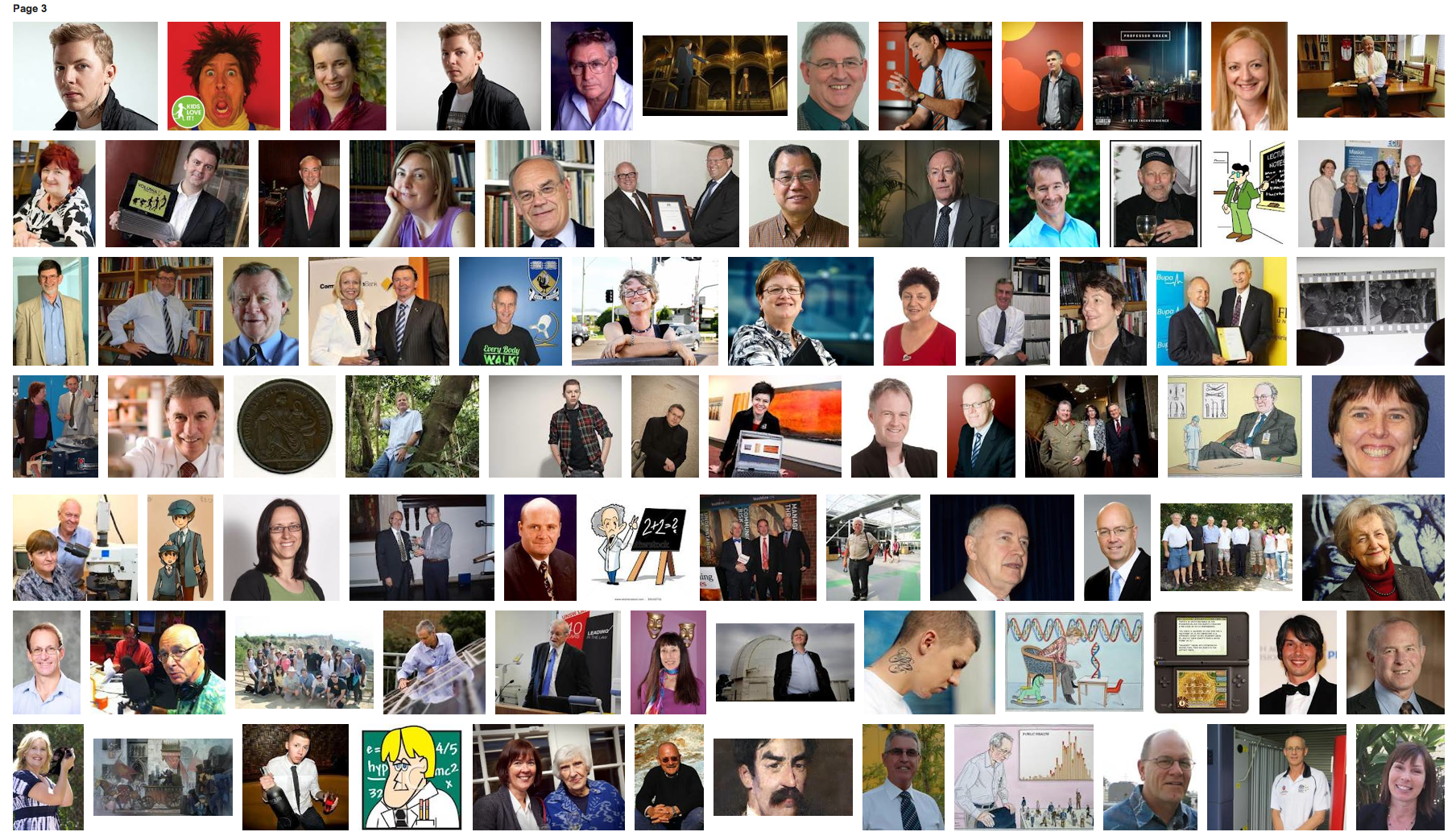
If you look at the cartoons on the page, page 3 of the search, you’ll see lab coats and blackboards. While there are a lot of (obviously) portrait shots, searching across the images for yourself will reveal a lot of ‘action shots’ – talking, teaching and, in some cases, just plain thinking. However, what really sticks out on the first images you find, which I haven’t shown here, is the number of Professor Frink (Simpsons) and Professor Farnsworth (Futurama) images – characters who are ubernerds, with strange speaking patterns, a cavalier disregard for the human condition and a fundamental disconnect from the people around them.
Looking at Google Image Search, you’ll see pictures of young professors and old professors. Women and men. The range of races. Nary a white coat in sight unless they are actively involved in research that requires a white coat and are undertaking said research at the point of photography! (I should note that I subscribe to John Birmingham’s fundamental model of suitability of ethnic dress: one should only wear a Greek fisherman’s cap if one is Greek, and a fisherman. I extend it to scientific or trade garb, including military or paramilitary uniform, in that one should then only wear the dress while engaged in the activity. I wore a lab coat when I was studying wine making and in the lab. I think it’s become cleaning cloths now.)
This is all rather light-hearted, except for the slight problem that a number of people’s only interaction with the notion of a professor will be from widely available media sources – and, even though Futurama in particular is heavily ironic in its use, ironic use has a subtle aspect that can easily be lost in communication. It’s already obvious that the scientific community has an uphill battle sometimes and add to this an assumption that we are all bizarre anti-social, uselessly pontificating grey beards who have no understanding of real people and we start any discussion on the back foot.
I like the new image of science that is coming through the media – scientists and professors can be active, have relationships, do cool things, basically being just like everyone else except that they have a title of some sort that reflects what they are good at doing. We do, of course, have a sizeable chunk of the community who did come in during a time when a very different professorial model was encouraged and probably feel at least slightly under assault from the changes in role, respect and expectation that are now spreading across our Universities. But we’re still all just people, whether we look like professors or not.
We don’t have to define what a professor is but it’s always worth reminding people that we are people first, always, before you start trying to photoshop us into white coats, sticking-up white hair and Coke-bottle glasses.
Oh, Perry. (Our Representation of Intellectual Development, Holds On, Holds on.)
Posted: April 30, 2012 Filed under: Education | Tags: advocacy, authenticity, dualism, education, higher education, learning, measurement, multiplicity, perry, reflection, research, resources, teaching, teaching approaches 1 CommentI’ve spent the weekend working on papers, strategy documents, promotion stuff and trying to deal with the knowledge that we’ve had some major success in one of our research contracts – which means we have to employ something like four staff in the next few months to do all of the work. Interesting times.
One of the things I love about working on papers is that I really get a chance to read other papers and books and digest what people are trying to say. It would be fantastic if I could do this all the time but I’m usually too busy to tear things apart unless I’m on sabbatical or reading into a new area for a research focus or paper. We do a lot of reading – it’s nice to have a focus for it that temporarily trumps other more mundane matters like converting PowerPoint slides.
It’s one thing to say “Students want you to give them answers”, it’s something else to say “Students want an authority figure to identify knowledge for them and tell them which parts are right or wrong because they’re dualists – they tend to think in these terms unless we extend them or provide a pathway for intellectual development (see Perry 70).” One of these statements identifies the problem, the other identifies the reason behind it and gives you a pathway. Let’s go into Perry’s classification because, for me, one of the big benefits of knowing about this is that it stops you thinking that people are stupid because they want a right/wrong answer – that’s just the way that they think and it is potentially possible to change this mechanism or help people to change it for themselves. I’m staying at the very high level here – Perry has 9 stages and I’m giving you the broad categories. If it interests you, please look it up!

(Image from geniustypes.com.)
We start with dualism – the idea that there are right/wrong answers, known to an authority. In basic duality, the idea is that all problems can be solved and hence the student’s task is to find the right authority and learn the right answer. In full dualism, there may be right solutions but teachers may be in contention over this – so a student has to learn the right solution and tune out the others.
If this sounds familiar, in political discourse and a lot of questionable scientific debate, that’s because it is. A large amount of scientific confusion is being caused by people who are functioning as dualists. That’s why ‘it depends’ or ‘with qualification’ doesn’t work on these people – there is no right answer and fixed authority. Most of the time, you can be dismissed as having an incorrect view, hence tuned out.
As people progress intellectually, under direction or through exposure (or both), they can move to multiplicity. We accept that there can be conflicting answers, and that there may be no true authority, hence our interpretation starts to become important. At this stage, we begin to accept that there may be problems for which no solutions exist – we move into a more active role as knowledge seekers rather than knowledge receivers.
Then, we move into relativism, where we have to support our solutions with reasons that may be contextually dependant. Now we accept that viewpoint and context may make which solution is better a mutable idea. By the end of this category, students should be able to understand the importance of making choices and also sticking by a choice that they’ve made, despite opposition.
This leads us into the final stage: commitment, where students become responsible for the implications of their decisions and, ultimately, realise that every decision that they make, every choice that they are involved in, has effects that will continue over time, changing and developing.
I don’t want to harp on this too much but this indicates one of the clearest divides between people: those who repeat the words of an authority, while accepting no responsibility or ownership, hence can change allegiance instantly; and those who have thought about everything and have committed to a stand, knowing the impact of it. If you don’t understand that you are functioning at very different levels, you may think that the other person is (a) talking down to you or (b) arguing with you under the same expectation of personal responsibility.
Interesting way to think about some of the intractable arguments we’re having at the moment, isn’t it?
Apparently We’re Doing It Wrong: Jeffrey McManus Thinks We Should Shut Down More CS Courses
Posted: April 29, 2012 Filed under: Education | Tags: education, higher education, identity, identity crisis, reflection, teaching Leave a commentI ran across a blog post by Jeffrey McManus, who runs a for-profit training organisation called CodeLesson. You can find his post here. Jeffrey’s thoughts appear to be (my summary):
- Most students want to learn applied software engineering, not computer science.
- Undergrads don’t know if courses are good or bad, therefore they are captive consumers, therefore all universities are slow to adapt and reform.
- Two universities in commuting distance shouldn’t have the same academic departments because more courses encourages mediocrity. (Does this apply to internet providers like, for example, Jeffrey’s?)
- We should be using good online courses instead of mediocre or outdated (implicitly not on-line) ones.
- Most university courses aren’t that good if you want applied software engineering, because PhD graduates are out of data by about 5-10 years and have apparently never updated their skills. But, that’s ok, because it’s not the academic’s fault, it’s the fault of a crusty old dean somewhere.
- Our academic departments should be reorganised frequently.
I’ve tried to be pretty fair in my summary but you should go and have a look at the site for yourself because (a) I work at a Uni so I might be biassed and (b) I wasn’t very impressed so I may have filtered him a bit, for which I apologise but I am human. I agree with a few of his points, or parts of his points to varying degrees, but I suspect that he’s got too many interacting issues jammed together – there are any number of business people whose hair will turn white if you say that constant reorganisation is the path to success.
I hear arguments like this occasionally but it makes me sound like I’ve trapped these students in my evil cave and I won’t let them out until they graduate. Far from it! When I start in first year, I tell them that if they just want to program they should leave and go and do a tech course somewhere. They can be a successful programmer in 3-6 months. If they want to innovate, lead, and be ready for the challenges of the future, including writing the languages and systems that everyone else can learn to use in those courses, then they probably want to hang around. (Yes, yes, famous college dropout counter-example – who mysteriously employs a vast number of people with CS or ICT degrees. Moving on.)
Points 2, 4 and 5 don’t really hold up, to me. Point 2 is either irrelevant or universal – therefore irrelevant. Lack of discernment can’t just be limited to undergrads so this ‘inability to detect rubbish’ skill should lead to everyone being slow to adapt and reform. If you’re in any awful program then wouldn’t know it until you developed enough knowledge. Yes, college courses are longer but we have all sorts of industry placement, outreach and practical programming exercises to try and deal with the problem of transition to industry. Apart from anything else, our students are developing other skills as well as coding. Coding doesn’t equal computer science. Point 4 assumes that because applied software engineering can be taught online it should be taught online. The entire point is based on the assumption that face-to-face is mediocre. Point 5 is actually pretty offensive. Are we all sitting around pulling on our grey beards and contemplating our navels, having looked at nothing else for 10 years?
Once again, we’ve got this terrible issue with our identity and the way that we are regarded. Once again, we have a case for building up perceptions of our community and getting rid of this farcical representation of our profession and our Universities.
There is a rebuttal on the post, which isn’t really necessary as he’s walking his comments list and shooting down pretty much all opposition. It’s worth reading the comments to remind yourself how many people think that we produce graduates to produce professors to produce graduates (rinse/repeat). Someone discussed the idea that a CS degree is only partially about what you need next year and what we may need to have to do in 10,20 or 40 years. Jeffrey’s response?
I will probably be dead in 40 years time. Anyway, who says they can’t provide education that’s relevant both today and in decades hence? Virtually every other technical discipline seems to be able to do that.
Now, I’d argue that a lot of us are doing that but maybe we come back to that issue of ICT identity. Here’s a guy who is actively making money running on-line courses that are built on technologies developed by people who have the degrees that he doesn’t think are necessary – and he doesn’t seem to realise the issue with that. Or, he does, because he’s a businessman, but not enough other people do. We’ve still got an identity crisis to address.
Should we aiming to maintain (or develop) excellence? Yes. Should we balance industry and academic requirement? Yes. Should we be using on-line effectively? Yes. That, however, is not what I believe Jeffrey is saying – I think that he’s saying that we are intrinsically unworthy and, to an extent, providing a mechanism to waste a student’s time when they could be learning pertinent information at a reasonable price in an on-line manner.
He seems to be pretty keen on addressing posts that disagree with him so I’ll wait to see if he shows up here. In the meantime, read the post, especially the last line where his entire business case is based upon people believing everything else that he wrote in that post.
More on our image – and the need for a revamp.
Posted: April 28, 2012 Filed under: Education | Tags: ALTA, curriculum, design, education, higher education, reflection, teaching, teaching approaches 4 CommentsToday, in between meetings with people about forming a cohesive ICT community and defining our identity, I saw a billboard as I walked along the streets of the Melbourne CBD.
A picture of a woman’s torso, naked except for a bra, with the slogan “Who said engineering was boring?”
Says it all, really, doesn’t it? I’ve long said that associating a verb in a sentence with a negative is the best way to get people to think about the verb rather than the more complex semantics of the negated verb. Now, for a whole lot of people, a vaguely leery billboard is going to put the words “engineering” and “boring” together.
Some of these people will be young people in our target recruitment group – mid to late school – and this kind of stuff sticks.
The building the billboard was on was built by civil engineers, using systems designed by mechanical and electronic/electrical engineers, the pictures were produced on machines constructed by computer systems engineers and elecs, images constructed and edited through digital cameras by tech-savvy photographers and processed on systems built by software engineers, computer scientists, electronic artists and many, many other people who are all being insulted by the same poster they helped to support and create. (My apologies because I didn’t list everybody, but the sheer scale of the number of people who contributed to that is quite large!)
Today, on my way home, a giant hunk of steel, powered by two big balls of spinning flame, climbed up into the sky and, in an hour, crossed a distance that used to take weeks to traverse. Right now, I am communicating with you around the world using a machine built of metal, burnt oil residue and sand, that is sending information to you at nearly the speed of light, wherever you happen to be.
How, in anyone’s perverted lexicon, can that be anything other than exciting?
Identity and Community – Addressing the ICT Education Community
Posted: April 27, 2012 Filed under: Education | Tags: advocacy, ALTA, education, feedback, higher education, reflection, teaching, teaching approaches Leave a commentHad a great meeting at Swinburne University, (Melbourne, Victoria, Australia), today as part of my ALTA Fellowship role. I brought the talk and early outcomes from the ALTA Forum in Queensland into (sunny-ish?) Melbourne and shared it with a new group of participants.
I haven’t had time to write my notes up yet but the overall sentiment was pretty close to what was expressed at the ALTA Forum initially:
- We don’t have an “ICT is…” identity that we can point to. Dentists do teeth. Doctors heal the sick. Lawyers do law. ICT does… what?
- We need a common dissemination point for IT, CS, IS, ICT, CS-EE… etc. rather than the piecemeal framework we currently have that is strongly aligned with subdivision of the discipline.
- We need professionalism in learning and teaching, where people dedicate time to improve their L&T – no more stagnant courses!
- We need to have enough time to be professional! L&T must be seen as valuable and be allocated enough time to be undertaken properly.
- It would be great to have a Field of Research Code for Education within the Discipline of ICT – as distinct from general education coding – to make sure that CS Ed/ICT Ed is seen as educational research in the discipline, rather than a non-specific investigation.
- We need to identify and foster a community of practice to get out of the silos. Let’s all agree that we want to do this properly and ignore school and University boundaries.
- We need to stop talking about the lack of national community and start addressing the lack of a national community.
So a good validation for the early work at the Forum and I’m really looking forward to my meeting at RMIT tomorrow. Thanks, Graham and Catherine, for being so keen to host the first official ALTA engagement and dissemination event!
Big Data, Big Problems
Posted: April 26, 2012 Filed under: Education | Tags: education, higher education, learning, PhD, reflection, teaching, teaching approaches Leave a commentMy new PhD student joined our research group on Monday last week (Hi, T) and we’ve already tried to explode his brain by discussing every possible idea that we’ve had about his project area – that we’ve developed over the last year, but that we’ve presented to him in the past week.
He’s still coming to meetings, which is good, because it means that he’s not dead yet. The ideas that we’re dealing with are fairly interesting and build upon some work that I’ve spoken about earlier, where we’ve looked at student data that we happen to have to see if we can determine other behaviours, predict GPA, or get an idea of the likelihood of the student completing their studies.
Our pilot research study is almost written up for submission this Sunday but, like all studies that are conducted after the collection time, we only have the data that was collected rather than the ideal set of data that we would like to collect. That’s one of the things that we’ve given T to think about – what is the complete set of student data that we could collect if we could collect everything?
If we could collect everything, what would be useful? What is duplicated within the collection set? Which of these factors has an impact on things that we care about, like student participation, engagement, level of achievement and development of discipline skills? How can I collect them and store them so that I not only can look at the data in light of today’s thinking but that, twenty years from now, I can completely re-evaluate the data set in different frameworks?
There’s a lot of data out there, there are many ways of collecting, and there are lots of projects in operation. But there are also lots and lots of problems: correlations to find, factors to exclude, privacy and ethical considerations to take into account, storage systems to wrestle with and, at the end of the day, a giant validation issue to make sure that what we’re doing is fundamentally accurate and useful.
I’ve written before about the data deluge but, even when we restrict our data crawling to one small area, it’s sometimes easy to lose track of how complicated our world is and how many pieces of data we can collect.
Fortunately, or unfortunately, for T, there are many good and bad examples to look at, many studies that didn’t quite achieve what was wanted, and a lot of space for him to explore and define his own research. Now if I could only put aside that much time for my own research.
Got Vygotsky?
Posted: April 25, 2012 Filed under: Education | Tags: Csíkszentmihályi, curriculum, design, education, flow, games, higher education, learning, principles of design, resources, teaching, teaching approaches, tools, vygotsky, Zone of proximal development, ZPD 4 CommentsOne of my colleagues drew my attention to an article in a recent Communications of the ACM, May 2012, vol 55, no 5, (Education: “Programming Goes to School” by Alexander Repenning) discussing how we can broaden participation of women and minorities in CS by integrating game design into middle school curricula (Thanks, Jocelyn!). The article itself is really interesting because it draws on a number of important theories in education and CS education but puts it together with a strong practical framework.
There’s a great diagram in it that shows Challenge versus Skills, and clearly illustrates that if you don’t get the challenge high enough, you get boredom. Set it too high, you get anxiety. In between the two, you have Flow (from Csíkszentmihályi’ s definition, where this indicates being fully immersed, feeling involved and successful) and the zone of proximal development (ZPD).

Extract of Figure from A. Repenning, "Programming Goes to School", CACM, 55, 5, May, 2012.
Which brings me to Vygotsky. Vgotsky’s conceptualisation of the zone of proximal development is designed to capture that continuum between the things that a learner can do with help, and the things that a learner can do without help. Looking at the diagram above, we can now see how learners can move from bored (when their skills exceed their challenges) into the Flow zone (where everything is in balance) but are can easily move into a space where they will need some help.
Most importantly, if we move upwards and out of the ZPD by increasing the challenge too soon, we reach the point where students start to realise that they are well beyond their comfort zone. What I like about the diagram above is that transition arrow from A to B that indicates the increase of skill and challenge that naturally traverses the ZPD but under control and in the expectation that we will return to the Flow zone again. Look at the red arrows – if we wait too long to give challenge on top of a dry skills base, the students get bored. It’s a nice way of putting together the knowledge that most of us already have – let’s do cool things sooner!
That’s one of the key aspects of educational activities – not they are all described in terms educational psychology but they show clear evidence of good design, with the clear vision of keeping students in an acceptably tolerable zone, even as we ramp up the challenges.
One the key quotes from the paper is:
The ability to create a playable game is essential if students are to reach a profound, personally changing “Wow, I can do this” realization.
If we’re looking to make our students think “I can do this”, then it’s essential to avoid the zone of anxiety where their positivity collapses under the weight of “I have no idea how anyone can even begin to help me to do this.” I like this short article and I really like the diagram – because it makes it very clear when we overburden with challenge, rather than building up skill and challenge in a matched way.
The Unhappiest Bartender in Australia
Posted: April 24, 2012 Filed under: Education | Tags: advocacy, authenticity, education, higher education, reflection, teaching, teaching approaches Leave a comment
I’m not talking about students for this one, I’m talking about the scientific community. On reading yet more articles about the growing rate of retraction, on top of the inability to replicate key studies, it appears that we are at risk of losing our way. I need to be able to train my students for the world that they will work in – so I’m going to briefly discuss my beliefs and interview myself to talk about my fears of what happens when scientific integrity is trumped by mercenary and short-sighted values.
The executive summary is “Do science properly or do something else.” If you’re already practising science at a high level, with integrity, please leave work early and enjoy a beverage of your choice, at your own expense. I salute you! Come back and read this once you are refreshed. (This is a bit more opinionated than usual, so if you want to focus on my Learning and Teaching posts, you might want to read some of my previous posts or come back tomorrow. I welcome you to stay, however.)
I understand, to an extent, why people are taking questionable approaches to their work in order to achieve publication in the same that I understand why students cheat sometimes. But comprehending the rationalisation does not mean that I condone the actions – far from it. In another blog I commented on the fact that some people change their behaviour when they drink. If they are aware that this is going to happen, then the excuse “I was drunk” is not an excuse. Getting drunk was an enabling step. If your choices, as a scientist, are leading you down dark paths then you have to look at the end of that path to see where you’re going. “That was where my path naturally led” isn’t valid when you know that you’re on the wrong road.
I’m pretty worried by some of the behaviour that people are practising to get ahead. But don’t think that I’m in a strong enough position that I’m immune to the lure of the dark path – I want to keep my job, make good progress, get promoted, get grants, have an impact. Like everyone else, I want to change the world. The question is “What are you prepared to compromise in order to get to that stage?”
Do I feel pressure to publish? Yes! Am I willing to fabricate data to do so? No. Am I willing to cite ‘suggested papers’ that all appear to be from the editor of the special edition or a select group of friends? No. Am I willing to run an experiment 100 times and write up the single time it worked as if this was a general case? No!
But, wait, if you don’t meet your publication targets, doesn’t that have an impact on your career? Yes, possibly. I’m expected to publish at a very high level on a regular basis.
And if you don’t? Well, I can demonstrate my worth in other ways but research turns into publications, publications support grants, grants bring in people, people do research. Not publishing will have a serious impact on my ability to produce research.
So you’d bend a little because it’s in the greater interest for your work to be published because your research is valuable. Nice try, but no. I’d prefer to leave my job than compromise my principles in this regard.
Well, it’s really nice that you’ve got that level of agency but, hey, your wife has a stable income and the wolf isn’t at your door. Aren’t you just making an argument from privilege? Hmmm.
Well, that’s a good question. My response would normally be that there are many, many jobs that use some of what I have that don’t require me to have a strong set of scientific and personal ethics. I could teach computing courses and never have to worry about research ethics. I could write code as a small cog in a large company and not have to worry as much about experimental replication. I could tend bar, I guess, or maybe work in a shop, if jobs like that still exist in 10 years time and they’ll hire a 50 year old. But, again, this assumes a level of skill transferability and agency that does presume a basis of privilege if I’m going to walk away from science and do something else.
But this assumes that you went in to be a scientist thinking that this kind of bad behaviour is just what scientists did, that ethics were optional, that publication by any means was acceptable – that reality was mutable when deadlines were tight. Let’s break this thinking now because I don’t want any students to come to my program thinking like that.
I believe that if you want to be a scientist, you have to accept that this comes with a package of ethical behaviours that are not optional.
Science has impact! Building on bad science gives you more bad science. This bad behaviour in science could be, and probably is, killing people. We’re potentially setting back scientific progress because of time wasted trying to build on experiments that don’t work. We are in the middle of a data deluge and picking from the many correct things is hard enough, without adding deceitful or misleading publications as well.
What concerns me, reading about increasing retraction rates and dodgy surveys, is that the questionable path to success may become the norm. People are already questioning perfectly good science, because of a growing mistrust fuelled by bad scientific behaviour, and “Well, I don’t know” is a de rigeur rejoinder in certain parts of the blogosphere.
I always talk about authenticity because it’s the backbone of my teaching. I have to believe it, or know it, or it just won’t work with the students. The day I think that our community is lost, I’ll no longer be able to train students to go to the fantasy land that I naively thought was reality and I’ll quit.
Come and find me, if I do, I’ll probably be working in a bar – and looking really unhappy.
Let’s get out of the geek box – professional pride is what we’re after.
Posted: April 23, 2012 Filed under: Education, Opinion | Tags: advocacy, education, educational problem, Generation Why, higher education, teaching, teaching approaches Leave a commentAs a member of the Information and Communication Technology (ICT) education community, I deal with a lot of students and, believe me, they come in all shapes, sizes and types. Could I pick one of my students out of a crowd by type alone? No. Could I pick a Science, Technology, Engineering and Mathematics (STEM) class from looking at who is sitting in the seats? Sadly, yes, but probably more from gender representation than anything else – and that is something that we’re very much trying to change.

Can you spot the ICT student?
I’m not a big fan of ‘Geek pride’ or attempting to ‘reclaim’ pejorative terms such as dork or nerd. I don’t see why we have to try and turn these terms around, much less put up with them. I have lots of interests – if I paint in oil, I’m an artist, if I sketch on an iPad, I’m a nerd? What? If I can discuss David Foster Wallace or Margaret Atwood’s books at length I’m educated but if I do the same thing with Science Fiction, I’m a geek? Huh? I work a lot in information classification so you can understand that (a) this doesn’t make much sense to me and (b) highlights the problem that accepting the term, in any sense, might eventually give us ownership but it still allows people to put us in the geek box. Let’s get out of the geek box and reclaim a far more useful form of identify – professional pride in doing a job well, with a job that is worth doing.
Let me be more blunt – being good at my job and the interests I have outside of my job may have some relationship but it’s never going to be an ironclad correlation. Stereotypes aren’t useful in any area and, despite the popular stereotype of ICT and scientists on television and in other media, my community is made up many, many different kinds of people. Like any other community.
Forcing us to identify as geeks, dorks or nerds; requiring people to have an all-consuming love of certain TV shows; resorting to a ‘geek shibboleth’ of unpopular or obscure information to confirm membership? This are ways to create a fragmented set of sub-communities that are divided, diminished and able to be ignored. It also provides a barrier to entry because people assume that they must pass these membership tests to join the community when this is not true at all. I don’t want people to ignore our stream of education and the profession because of their incorrect perception of what is required to be a member.
(If you want to watch Buffy, watch Buffy! But don’t feel that you can’t be a programmer because you prefer Ginsberg to Giles.)
I am not a geek. Or a dork. Or a nerd. I am interested in everything – like so many of my students and like so many other people! I want to communicate to my students that they don’t need to be in a box to play in the world. And they shouldn’t put other people in there, either.
Here are my rather loose thoughts but I’d really like to get some dialogue going in the comments if possible, to help me get a handle on it so that I can communicate these things with my students.
- My interests and my job have some connection but one does not completely define the other.
I am an educator, a computer scientist, a programmer, a systems designer – none of these need to be apologised for, tolerated by other people or somehow seen as beneath any other discipline. (This applies to all lines of work – a job done well is a matter of pride and should be respected, assuming that the job in question isn’t inherently unethical or evil.) I can do these jobs well. I also happen to be a painter, a writer, a singer, a guitar player and an amateur long distance runner. If I had listed these terms first, how would you have classed me? What are my job interests and what are my real interests? As it happens, I enjoy the works of Borges, Singer, and Stoppard – but I also enjoy le Guin, Banks, Dick, Moorcock, Tiptree and Steven King.
If I take professional pride in doing my job well, and I then do perform it well, my interests, or the stereotypes associated with my interests, are irrelevant. Feel free to question my taste, but don’t use it to tell me who I am, what I can do and how my work should be appreciated. - All professions have jargon or, more precisely, all professions have a specific set of terms that are used to precisely convey information between practitioners. This is not cause for mockery or derision.
Watched “House” recently? When was the last time you went to the Doctor and called him or her a geek, even out of earshot, for referring to the abdomen instead of tummy? We’re all exposed to tech jargon because the tech is everywhere – when I use certain terms, I’m doing so to make sure that I’m referring to the right thing. We don’t want to turn tech talk into a shibboleth (a means of identifying the same religious group) but we want it to remain an accurate and concise way of discussing things in a professional sense. But, as a profession, this comes with an obligation… - As a profession, communication with other people is worthy of attention because it is important.
When the pilots are flying your plane, they’ll try and communicate with you in a combination of pilot-specific language and normal human communication. ICT people have to do that all the time and, admittedly, sometimes we succeed more than others. Some people in my profession try to confound other people when speaking for a whole lot of reasons that aren’t really that important – please don’t do it. It’s divisive and it’s unnecessary. If people don’t know what you’re talking about, educate them. Use the right words to do your job and the right words to communicate with other people. We don’t want to turn ourselves into some kind of exclusive club because, ultimately, it’s going to work against us. And it is working against us. - It’s time to grow up
Sometimes this all seems so… schoolyard. People called other people names and it caused group formation and division. Now, in an ongoing battle of “geek” versus “anti-geek” we revisit the playground and try and put people into boxes. It’s time to move away from that and accept that stereotypes are often untrue, although convenient, and that we don’t need to put people into these boxes. That applies to people outside the ICT community and to people inside the community. Every community has a range of people – you will always find people to support loose stereotypes but, look carefully, and you’ll always find people who don’t fit. - We’re not smarter and our field isn’t so hard that only amazing people can do it
When some people go and talk to students they say things like “It’s hard but you get so much out of it”. What students hear is “It’s hard.” That saying “It’s hard” is worn like a badge of honour – that you have to be worthy enough to do somethings because they’re difficult.Rubbish.There are as many degrees of work difficulty as there are pieces of work and challenges range from easy to impossible – like any other discipline. It’s nice to feel smart, it’s nice to think you’ve conquered something but, being honest, you don’t need to be really smart to do these things although you do need to dedicate some time and thought to most of the activities. Yes, at the top end, there are scarily smart people. I’m not one of them but I admire those who have those skills and use them well. The really bright people are often some of the nicest and most humble. It’s another division that we don’t need.I’m a great believer that we should tell students the truth, in the context of other professions. We have less memorisation than medicine but more freedom to create and innovate. In ICT we have fewer theorems than maths but more large programs where we try to string things together. We have fewer people pass out from fumes than Organic Chemistry but that’s a positive and a negative (Yes, I’m joking). We get to do amazing things but, like all amazing things, this requires study and work. It is completely achievable by the vast majority of students who qualify for University. We don’t need to be exclusive and divided – we want more people and we want our community to grow.
We have some seriously difficult challenges to solve in the coming decades. We’re not going to get anywhere by splintering communities, making false barriers to entry and trying to pretend that our schoolyard view is even vaguely indicative of reality.
This Is What You Want, This Is What You Get
Posted: April 22, 2012 Filed under: Education | Tags: curriculum, education, higher education, learning, reflection, teaching, teaching approaches Leave a comment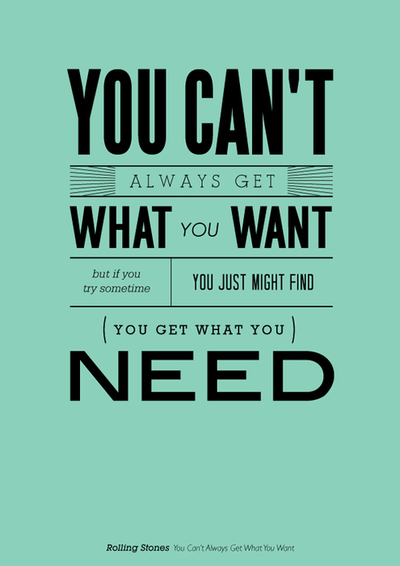
Midnight Mojo
One of the discussions that we seem to be having a lot is how the University will change in response to what students want, as we gain more flexibility in delivery and move away from face-to-face (bricks and mortar) to more blended approaches, possibly over distance learning. I’ve blogged a lot about this recently as I think about it but it’s always a lot more interesting to see what my colleagues think about it.
Some of my colleagues are, much like me, expecting things to be relatively similar after everything settles down. Books didn’t destroy academia, libraries didn’t remove the need for the lecturer, the tape recorder only goes so far. Yes, things may change, but we expect something familiar to remain. We’ll be able to reach more people because our learning offerings will accommodate more people.
Then there are people who seem to think that meeting student desire immediately means throwing all standards out the window. Somehow, there’s no halfway point between ‘no choice’ and ‘please take a degree as you leave’.
Of course, I’m presenting a straw man to discuss a straw man, but it’s a straw man that looks a lot like some that I’ve seen on campus. People who are designing their courses and systems to deal with the 0.1% of trouble makers rather than the vast majority of willing and able students.
There’s a point at which student desire can’t override our requirement for academic rigour and integrity. Frankly, there are many institutions out there that will sell you a degree but, of course, few people buy them expecting anything from them because everyone knows what kind of institutions they are. It boggles the mind that the few bad apples who show up at an accredited and ethical academy think that, somehow, only they will get the special treatment that they want and institutional quality will persist.
I have to work out what my students need from me and my University – based on what we told them we could do, what we can actually do (which is usually more than that) and what the student has the potential to do (which is usually more than they think they can do, once we’ve made them think about things a bit). There are many things that a student might want us to do, and we’ll have more flexibility for doing that in the future, but what they want isn’t always what they get. Sometimes, you get what you need.
(If you don’t have the Stones in your head right now, it’s time to go and buy some records.)

 Nick Falkner