
Let’s stop subsidising education! (Andrew Norton, Grattan Institute)
Posted: August 7, 2012 Filed under: Education | Tags: blogging, education, educational problem, ethics, higher education 4 CommentsThis article was published in the Australian, Australia’s national (and conservatively inclined) newspaper. This is the lead quote:
“Tuition subsidies merely redistribute income to students and graduates. The general public, particularly those who do not go to university, are worse off. They forgo other government benefits or pay higher taxes while receiving nothing additional in return,” Andrew Norton.
This quote comes from a report from the Grattan Institute, written by Andrew Norton, entitled “Graduate Winners”. His thesis is that, counter-intuitively, subsidising education doesn’t level the playing field, rather it robs non-University educated Australians of their fair share.
Basically, Australia runs a deferred payment scheme that is also government subsidised. Norton’s point is, effectively, that having put everything into a loan scheme, the amount doesn’t matter and it therefore wouldn’t disadvantage people to pay more. We’ve seen this before, of course, where people remove subsidies and let the market fix a price: as the article says, in New Zealand this led to a tripling and Britain is in the middle of major hikes. We’ve also seen the US where students never get out from under their debt load.
Here, in Australia, people do actually clear their debt. Not quickly, admittedly, but it’s possible. You can get out and clear of your debt under the current scheme. It’s relatively embarrassing for Norton that he wasn’t (apparently) present at HERDSA when speakers talked about the socially disadvantaged being more acutely debt averse than other sectors – and increasing the debt is not going to help that problem.
I must be honest, I always have a suspicion of schemes that, from whatever basis of argument, seem to end up with ‘the rich kids get places’, but this is a personal bias. Perhaps this report contains the convincing argument that will sway me, finally? (To be honest, the whole document has this weird aroma of capitalism wrapped up in a central planning framework, running on the sniff of the invisible hand.)
What I find fascinating is that, in the middle of an Australian federal sector that is increasingly focussing on the wealth creators, there appears to be no connection between the Universities and their contribution to a society, the report is focused on personal salaries and assumes that everyone goes out to maximise their income. The section of the report that discussed public benefits talks about increased tax benefit, tolerance and things like that – but what seems to be missing (I did read it at speed so that might be fault) is a discussion of the benefit of having well-trained professionals in your society.
It’s as if the students of Universities have never turned into the professionals that have done small things like design our roads, keep our air fleets running, stop disease from killing the population – you know, little things. Is it seriously contended that the people who have graduated from University have never done anything at all except take extra salary at the expense of other people?
I won’t say any more on this as I need to digest it in more detail but I thought you might be interested in a completely different view on how to handle a public educational system.
Silk Purses and Pig’s Ears
Posted: August 6, 2012 Filed under: Education | Tags: advocacy, authenticity, community, curriculum, design, education, educational problem, educational research, ethics, feedback, grand challenge, higher education, in the student's head, learning, principles of design, resources, student perspective, teaching, teaching approaches, thinking, winemaking 2 CommentsThere’s an old saying “You can’t make a silk purse out of a pig’s (or sow’s) ear”. It’s the old chestnut that you can’t make something good out of something bad and, when you’re talking about bad grapes or rotten wood, then it has some validity (but even then, not much, as I’ll note later). When it’s applied to people, for any of a large range of reasons, it tends to become an excuse to give up on people or a reason why a lack of success on somebody’s part cannot be traced back to you.
I’m doing a lot of reading in the medical and general ethics as part of my preparation for one of the Grand Challenge lectures. The usual names and experiments show up, of course, when you start looking at questionable or non-existent ethics: Milgram, the Nazis, Stanford Prison Experiment, Unit 731, Tuskegee Syphilis Experiment, Little Albert and David Reimer. What starts to come through from this study is that, in many of these cases, the people being experimented upon have reached a point in the experimenter’s eyes where they are not people, but merely ‘subjects’ – and all too often in the feudal sense as serfs, without rights or ability to challenge what is happening.
But even where the intention is, ostensibly, therapeutic, there is always the question of who is at fault when a therapeutic procedure fails to succeed. In the case of surgical malpractice or negligence, the cause is clear – the surgeon or a member of her or his team at some point made a poor decision or acted incorrectly and thus the fault lies with them. I have been reading up on early psychiatric techniques, as these are full of stories of questionable approaches that have been later discredited, and it is interesting in how easy it is for some practitioners to wash their hands of their subject because they had a lack of “good previous personality” – you can’t make a silk purse out of a pig’s ear. In many cases, with this damning judgement, people with psychiatric problems would often be shunted off to the wards of mental hospitals.
I refer, in this case, to William Sargant (1907-1988), a British psychiatrist who had an ‘evangelical zeal’ for psychosurgery, deep sleep treatment, electroconvulsive therapy (ECT) and insulin shock therapy. Sargant used narcosis extensively, drug induced deep sleep, as he could then carry out a range of procedures on the semi- and unconscious patients that they would have possibly learned to dread if they have received them while conscious. Sargant believed that anyone with psychological problems should be treated early and intensively with all available methods and, where possible, all these methods should be combined and applied as necessary. I am not a psychiatrist and I leave it to the psychiatric and psychotherapy community to assess the efficacy and suitability of Sargant’s methods (they disavow them, for the most part, for what it’s worth) but I mention him here because he did not regard failures as being his fault. It is his words that I am quoting in the previous paragraph. People for whom his radical, often discredited, zealous and occasionally lethal experimentation did not work were their own problem because they lacked a “good previous personality”. You cannot, as he was often quoted to have said, make a silk purse out of a pig’s ear.
How often I have heard similar ideas being expressed within the halls of academia and the corridors of schools. How easy a thing it is to say. Well, one might say, we’ve done all that we can with this particular pupil, but… They’re just not very bright. They daydream in class rather than filling out their worksheets. They sleep at their desks. They never do the reading. They show up too late. They won’t hang around after class. They ask too many questions. They don’t ask enough questions. They won’t use a pencil. They only use a pencil. They talk back. They don’t talk. They think they’re so special. Their kind never amounts to anything. They’re just like their parents. They’re just like the rest of them.
“We’ve done all we can but you can’t make a silk purse out of a sow’s ear.”
As always, we can look at each and every one of those problems and ask “Why?” and, maybe, we’ll get an answer that we can do something about. I realise that resources and time are both scarce commodities but, even if we can’t offer these students the pastoral care that they need (and most of those issues listed above are more likely to be social/behavioural than academic anyway), let us stop pretending that we can walk away, blameless, as Sargant did because these students are fundamentally unsalvageable.
Yeah, sorry, I know that I go on about this but it’s really important to keep on hammering away at this point, every time that I see how my own students could be exposed to it. They need to know that the man that they’re working with expects them to do things but that he understands how much of his job is turning complex things into knowledge forms that they can work with – even if all he does is start the process and then he hands it to them to finish.
Do you want to know how to make great wine? Start with really, really good grapes and then don’t mess it up. Want to know how to make good wine? Well, as someone who used to be a reasonable wine maker, you can give me just about anything – good fruit, ok fruit, bad fruit, mouldy fruit – and I could turn it into wine that you would happily drink. I hasten to point out that I worked for good wineries and the vast quantity of what I did was making good wine from good grapes, but there were always the moments where you had something that, from someone else’s lack of care or inattention, had got into a difficult spot. Understanding the chemical processes, the nature of wine and working out how we could recover the wine? That is a challenge. It’s time consuming, it takes effort, it takes a great deal of scholarly knowledge and you have to try things to see if they work.
In the case of wine, while I could produce perfectly reasonable wine from bad grapes, simple chemistry prevents me from leaving in enough of the components that could make a wine great. That is because wine recovery is all about taking bad things out. I see our challenge in education as very different. When we find someone who is need of our help, it is what we can put in that changes them. Because we are adding, mentoring, assisting and developing, we are not under the same restrictions as we are with wine – starting from anywhere, I should be able to help someone to become a great someone.
The pig’s ears are safe because I think that we can make silk purses out of just about anything that we set our minds to.
Withdrawal is Not Running Away
Posted: August 5, 2012 Filed under: Education | Tags: advocacy, education, educational problem, higher education, restructuring, workload 2 CommentsOne of the actions that armies take that is least understood (outside) is that of the strategic withdrawal. Rather than the (very appealing) notion that it’s all knights with coconuts turning around and yelling “run away!”, a correctly conducted withdrawal is far more organised than a rout. We must be honest – if you’re withdrawing then it’s because you cannot hold the ground that you are on but, by conducting a strategic and controlled movement to move into a better position, you are in a better place to fight again another day. If you just fall apart and run around like headless chickens, then your forces are lost and you can be picked off. Make it back to a place that you can defend, with enough of your forces left, you are much harder to beat.
Right now, Australia is going through a period of academic restructuring: cuts and changes being made to reduce headcount, to shrink budgets and to keep things running. We are, effectively, in withdrawal. If we were looking to shut schools and Universities down, then this should have been our first action. If we are trimming, it is because we are trying to move to a place where we can hold our ground, in theory. The problem I have is that, from my observations, we look more as if we are in rout. The Australian Army has sets of principles and considerations for every possible phase of war, including the Withdrawal. I shall list them here, with some explanation. (I am not discussing the rightness or necessity of the restructurings themselves at the moment, that is a post for another day.)
Key Principles
- Co-operation – everything has to work together effectively. Teamwork is crucial. You share the dangers, risks, burdens and the opportunities.
- Security – people must be able to be free enough to act, if people aren’t doing their jobs because they’re trying to keep themselves safe the whole thing can fail.
- Offensive Action – there is a surprisingly large amount of trying to stay in control of the situation. You want to seize the initiative, be in control and keep things going your way. Yes, you’re going the other way but under your terms and heading towards a definite objective.
- Surprise – the enemy should be the last to know when you are moving and should be stunned when they overrun your old position and fund you gone.
- Maintenance of Morale – everyone has to think that this is a survivable situation. Group cohesion must be high and everyone should feel valuable and believe in what is going on.
Basic Considerations
- Timings – you need to have a really good idea of how long everything takes so that you can plan. How long will it take to get to the new position? Who has to move first? How long is it before you can go back onto the offensive?
- Reconnaissance – you need to go and look at the pathways that you’re taking to work out if it will work. You don’t want to be surprised by someone else on the way back. Your recon elements will tell you what is going on and help you to plan.
- Sequence of withdrawal – you need to have a clear, well-defined and clearly disseminated sequence of withdrawal. Everyone knows who moves next and when their turn is. This is essential to the maintenance of morale.
- Clean break – at some point, you need to get away from the people who are chasing you. While your elements are in position and dealing with the enemy, they cannot move. When you have broken free, you can move faster and further. If you’ve staged it properly, your final elements will move into the new, defensible position and everyone will have some small time before the next wave hits your new position.
- Firm Bases – you need well-defined points along the way so that you can regroup and regain your control. This is vital to keeping things moving and under clear command, as well as giving a place where you can cause problems for your enemy.
Of course, the army has it easy in some respects, because they are moving to a new physical location while maintaining their headcount, not moving to a new mode of operation and trying to shed jobs along the way. But, looking at those lists, is it any wonder that there are concerns in those Universities as to how and where the cuts are coming?
How can you stress co-operation and maintenance of morale when you are sending the message that some staff are now surplus to requirement? Do we feel secure enough in our areas to be able to work to our fullest? (I don’t think that surprise quite works in this context, unless you make your school such a powerhouse of success that your administrators are surprised into leaving you alone!) Our ‘offensive action’ is our learning and teaching, and research. Will we be doing the best work if we’re worried about a divided and judging environment? How do we work with other people if we know that the least successful may become targets?
Who, in this case, is actually the enemy?
I suspect that people going through this process would really like to know how long they’ll be going through this process and what the rest points are along the way. How would you feel if someone said “Well, we’ve got to do something over the next three years.” Can you even sensibly think in that kind of time frame? Where are the steps along the way? What happens first? What happens next? How long for?
How long will it be before everything gets back to normal? When will be firm and ready to go forward again?
As I said, I’m not seeing much in the way of systematic and bold planning across most of the Universities I’ve looked at. I’ve seen ‘encouragement’ schemes and offers of redundancy – that sweaty, across the table staring contest between management and worker. How can you build the semi-random loss of staff that will occur under this approach into your scheme of withdrawal, your timings to recovery, unless you talk about it openly and honestly?
The difference between a withdrawal and a rout is that, at the end of a withdrawal, you are in a sound position, ready to fight again. At the end of a rout, you are not. You are a splintered group of individuals who can be easily overrun and defeated.
I realise that we are talking about people’s careers, their lives, their families, and that the chances of a free and frank exchange of views is unlikely, but that makes it even more important for us to be clear on what is intended so that we can make decisions based on an overall vision and a sound plan that takes all of the characteristics into account.
No doubt, with a new Vice Chancellor and a new Executive Dean, our time is not far away to at least consider what we will do in this space. I await the outcome with interest.
And not a little trepidation.
(ultimately) Racism: Vivian Chum Writes About Her Seventh Grade Experience
Posted: August 5, 2012 Filed under: Education, Opinion | Tags: authenticity, community, education, educational problem, ethics, higher education, in the student's head, racism, smith magazine, student perspective, teaching, teaching approaches, the moment, thinking, vivian chum 3 CommentsI’m reading a book called “The Moment”, which claims to contain “Wild, Poignant, Life-Changing Stories” and, you’ll be relieved to hear, this book is delivering what it promises on the cover. It’s put out by Smith Magazine and is 125 of the pivotal life moments of “famous & obscure” writers and artists. Each story is short, pithy and (so far) worth reading.

Fair warning, this is a post about one person’s account of an event that may never have happened – but here is my reaction to it. One of my definitions of a writer is that they can react to an event that may never have happened and show you something interesting, perhaps even useful.
Today, I am writing in reaction to Vivian Chum’s ‘moment’ about the time that she, and all other non-white students in her Texas public school, were called to a meeting with the public address announcement “All seventh-grade minority students, report to the cafeteria.” There is no date on this story but, given that (according to the bio I’ve found) Chum graduated from Rice in 2002, we can work backwards and put this in the late 80s to early 90s – not the 50s or 60s. So we’ll start from the fact that a segregated announcement drew all of the non-whites to the cafeteria – African-American, Hispanic, Asian-American.
The point of the assembly was to instruct the students in the importance of reducing their underperformance on the Texas Assessment of Academic Skills set, compared to white students. It is, of course, bar graphs on a screen time because nothing shows students how to achieve more than a dry PowerPoint presentation of underperformance and an exhortation to work harder, study more, be more focused. After all, school funding is tied to performance in this test – here is a battery of graphs showing African-American and Hispanic student performance. For some reason, Asian-Americans aren’t on these particular underperformance graphs.
Chum, looking around the room, notices that some of the best performers in the seventh-grade are sitting here – but because they are non-white, they are here regardless of their actual achievement. She’s thinking about the lessons they’ve learned about racism, and the KKK and the Nazis, about the slave trade and she’s uncomfortable being here and, increasingly, angry, but she’s 11 or 12 and she’s not sure why she’s feeling this way.
No-one is in chains.
No one has thrown a rope over a tree branch.
No-one is even explicitly calling anyone a bad word.
And, yet, she knows that this is wrong. This is unfair. She wants to tear up every award or recognition that she’s ever been given because, of course, today the truth is finally out. She’s not the same. She’s a statistic in terms of test compliance and her race is more important than her individuality.
The (positive) lesson that Chum takes away from this is that this is the last time that she will ever take anything like this without speaking up, without walking out or not even going to things like this.
But, if her account is to be believed, then this is a tale of ignorance, racism, wrongheadedness and unthinking compliance with imposed test standards that is shocking enough, but frankly appalling when we place it into the last 20 years.
When I was at HERDSA, a speaker talked about providing support for those students who were struggling, or were having trouble adapting because of family background, and stressed the importance of making time to talk to every student. Instead of forcing the under-achievers to make more time in their schedule to fit in pastoral care and to drag themselves out of classes to go to ‘under achiever’ events, every student had a scheduled time to talk about things. Yes, this is a large investment of time but this addresses all of the arguments about ‘ignoring the big achievers’ or ‘focusing on the outliers’ and allow a much greater sense of community and ‘wholeness’ across the class.
When I was at school, we had an active remedial mathematics and english program run, very discreetly, across all of the years of secondary school. At the same we had a very active extension and stretch program, too. To be honest, to this day, I would not know how many (or who) of my classmates were in either. It was an accepted fact that across all of the boys (yes, single sex) in the school, there would be a range and it was up to the school, which was full fee-paying (thanks, Mum), to provide support to lift up those who were struggling and to provide interest and extension for those who could go further.
This, of course, has had a major impact upon me and this is what I expect of education: for everyone, regardless of their background and abilities, and according to their needs. Reading Chum’s account of how stupid we can be on occasion, it only drives home how lucky I was to be at such a school and the overall responsibility of educators to look at some of the things that we are asked to do and, where appropriate, say “No” so that we don’t force 12 year olds to have to stand up to protect their own rights as individuals, rather than indistinguishable pawns of a race.
Whackademia: Anectopia, More Like. (A Rather Opinionated Review)
Posted: August 4, 2012 Filed under: Education, Opinion | Tags: blogging, education, ethics, higher education, richard hil, thinking, whackademia, work/life balance, workload 5 CommentsI recently posted about some of the issues that we face in Academia and, being honest, they aren’t small problems and they aren’t limited to one locale or country. You may also recall that I wrote a summary of a radio interview with Richard Hil, the author of Whackademia and I said that I’d write more on Richard’s thoughts when I finished the book.
Hmm. Be careful what you commit to. This book is long on moan but short on solution. But, to explain this, I must be long on moan – please forgive me. I realise that some of you may feel that I am a heavily corporatised shill, who the book is targeted against, and therefore unworthy to comment on this so caustically. Believe me when I say that I believe that my role is to hold my integrity in my job while trying to achieve a better environment in which all of us can perform our jobs – and I believe that anyone who knows me and what I do would agree with that. If I am a shill, then I am the shill that you want on your side because it would be harder to find anyone more committed to the purity of learning and teaching and the world enriching nature of research. Yes, I am an idealist who walks with the devil sometimes, but my soul is still my own.
There were a couple of points in the original radio interview when I would have preferred that Hil go into more detail, or provide some more supporting evidence. I can honestly say that my desire for some more substance has still not been met.
There is no doubt that there are problems, that rampant managerialism is not helping, that a review of the sector in the light of a reduced commitment to funding from the government is important. But what is presented in Hil’s book is a stream of unattributed complaint, whinging and, above all, a constant litany of admissions of unethical behaviour from Hil’s interview participants – with the defence that they were told to comply so, of course, they did. Rather than interpreting this as a group of noble warriors being forced to bend their heads before a cruel and unjust overlord, I read this as the words of people who, having one of the most important jobs in the world, took the easier path.
Do I think that I’ve ever assigned a mark to a student that they didn’t earn?
No. No, I don’t. This is at odds with any number of Hil’s interviewees who freely admitted to fixing marks when asked to, bending over in the face of the administrative wind and, then, having the hide to complain about slipping standards and lack of freedom. I don’t interpret the monitoring levels of academic progress and student progressions rates as a requirement to pass people, I regard it as a way of ensuring that we fairly advertise what is required to pass our courses, that we provide opportunities for students to display their ability and that we focus on education – taking difficult things and conveying them to students.
Show me someone who is proud that their course is so tough that 90% of students fail it and, frankly, I think that they can call themselves anything they like, as long as the word teacher or educator isn’t used. I could fail 100% of students who take my course – gaze upon my works, for there are none as smart as I! This isn’t academic integrity, this is hubris.
Why am I so disappointed in this work? Because I agree with a number of Hil’s points but he presents the weakest, anecdotal means for supporting it. “Whackademia” is eminently dismissible and this is a terrible thing, as it makes the genuine problems that are raised easier to dismiss.
I am still desperately searching for a solution, a proposal from Hil that is more tangible than a fragmented wish list and anything other than his journey through a poisonous and frustrated Anectopia – light on fact but dripping with salacious, unsubstantiated detail. I really shouldn’t be surprised. If you read the contents page, you’ll see that Chapter 7 is entitled “Enough Complaint: now what?” on page 193. Given that the book is over by page 230, that’s a lot of complaint to solution! (Note to self, check the ratio in this post…)
Let me give you some quotes:
“Additionally, older interviewees argued that younger academics were far more likely to have adopted today’s regulatory rationalities, in contrast to more seasoned academics who are perhaps more resistant to the new order. Whether or not this is true is less important than the fact that, to survive and thrive in the current tertiary culture, certain compromises may have to be made – even if this feels at times like putting one’s soul out to tender.” p91
Whether or not this is true? Hang on, truth is optional in this sentence?
Let me put that quote back together with the qualifiers and questionable modifiers highlighted.
“Additionally, older interviewees argued that younger academics were far more likely to have adopted today’s regulatory rationalities, in contrast to more seasoned academics who are perhaps more resistant to the new order. Whether or not this is true is less important than the fact that, to survive and thrive in the current tertiary culture, certain compromises may have to be made – even if this feels at times like putting one’s soul out to tender.”
“faculties – sometimes referred to as ‘corporate silos'” p87
“These sorts of observations might be dismissed out of hand by today’s university managers as elitist, sentimental drivel, born of resentment of the new corporate reality. Well, if indeed these reflections are drivel then they are shared by all but one of the ten or so older professors I interviewed for this book.”
Hil’s book is identified on the cover as a searing exposé from an insider but, as someone who is also on the inside, it appears that the insides that we inhabit are distinctly different. No doubt, there are people inside my own institution who would read Hil’s words and shiver with the rightness of his words: “Yes, I am being pushed around!”, “Yes, I have to take shortcuts because big bad Admin makes me!”, “Yes, students are just sometimes too stupid for my wonderful course and I should be allowed to fail 80% of them!” But I’d disagree with them as much as I disagree with Hil.
The greatest disappointment I ever feel is when someone squanders their opportunities and their gifts, especially when they destroy opportunities for other people. In this case, not only has Hil wasted his spot in the sun, he has made it harder for a more thoughtful and constructive book to be written as his work, writ large in the media and read widely, will control and shape the debate for some time to come.
Again, for shame, sir.
Long post ahead!
Posted: August 3, 2012 Filed under: Education | Tags: blogging, higher education blogging, whackademia 3 CommentsA brief note that the next post, due for scheduled release at 4am Central Australian Daylight Time (GMT+9.5), is about 2,000 words long because I got rather heated while reviewing Richard Hil’s “Whackademia.” You might want to save the next post for a short flight, such as that from Sydney to Los Angeles. If you are Richard Hil, you might want to skip it.
Have a great weekend or Friday, depending on your time zone!
All That Glisters Is Not Gold
Posted: August 3, 2012 Filed under: Education, Opinion | Tags: blogging, community, education, educational problem, higher education, identity, in the student's head, learning, olympics, reflection, thinking 1 Comment
We’ve seen some disgraceful behaviour in the local media regarding “underperformance” at the Olympic Games. Australia fancies itself in a couple of sports – swimming is definitely one of them. It would be, sadly, an overstatement to say that we are good winners and bad losers – we’re smug winners, as a media scrum (the athletes are generally quite humble), and we’re absolutely vile losers. If someone from another nation (which isn’t Britain or the US) happens to beat us, then out come the accusations of doping, or sly comments. A young man who has achieved Olympic Silver and has missed out by 1/100th of a second is confronted, just out of the pool, by an ex-swimmer who should know better asking if he’s feeling shattered. What does it achieve? Do we need it? Do we care?
Why should he feel shattered? Did he stop for a drink half-way? Did he throw the comp (as some athletes who have already been expelled did)? No? Then let it go.
I was watching the kayaking (I was trapped in an airport lounge) and the guy who came third was absolutely stoked – a Bronze for Czechoslovakia! Why? Because he did his best and it happened to get him a medal. The lone male Australian athletics competitor came 19th but it was the best result for mens athletics for Oz in decades, I believe, so that was a good thing and he got some brief praise on the television. Sadly, and I’m sorry, athletics people, I think that’s because nobody expected him to do that much and, being very honest, very few people give two hoots about Australia’s performance in this area. (I will be surprised if he’s ever mentioned again – which is terrible after his achievement.)
Here’s what everyone sitting on a couch, remote in hand, beer in the other, criticising these athletes for getting Silver (woo), Bronze (gasp!) or (hushed silence) no medal (no hoper!) is secretly reciting to themselves.
“We’re sun-bronzed Aussies! We’re cut out of the same rock and leather as the outback heroes who became ANZACs and went off to war, larger than life and twice as tall! We own the pool! We rule the velodrome! We occasionally shoot things with guns and bows! We’ll remember who you are for a few minutes in another sport if you win a medal – we’ll make you a natural treasure if you’re cute, you win through an amazing series of people falling over or if you get us unexpected medals in a Winter Olympics. We might even remember your name.
For a while.
Of course, run into a pommel horse and break your jaw and we’ll play that on the TV for 20 years because nothing appeals to us more than the humiliating failure of people that we would praise if they won.”
(Note that this is not everyone who watches the Olympics but it’s certainly everyone who walked around for the last day or so giving our swimmers a hard time or accusing the Chinese swimmers of doping. Seriously, that’s your first reaction?)
What a curse of expectation lies over all of this – the sport you pick, the way you do it, people sitting in armchairs judging professional athletes as to how much over their PB they should have achieved. You know what I’m drawing to here. This is exactly what happens to people who come to Uni as well. If you’re first-in-family and not well supported, then you’ll be listening to people telling you that you’re wasting your time. If you’re getting distinctions, why not HDs? (Hey, if you’re offering constructive assistance and support, I have much less problem. If you’re saying ‘Wow, 98, what happened to the other 2’ and even vaguely mean it? Shame on you.) Everyone else did better than you? Why not drag up a racial or cultural stereotype, or accuse the staff of favouritism, or come up with any excuse other than “I didn’t do anything”. I still have a lot of sympathies for these students because I think that a lot of this rubbish comes in from around you. If you’re not excelling, then why bother?
This kind of culture is pervasive – you win, or you’re nothing. If someone else wins, they cheated, or (somehow) it wasn’t fair. It’s impossible to construct a sound learning framework out of rubbish like this. What’s worse is that if you start to think that everyone else is winning by cheating or by being ‘lucky’, then suddenly little switches go off in your head as your rationalisation engine starts shutting down the ethical cut-outs.
I generally try not to watch sports or commentary around Olympics time because, for all of the amazing athletic effort, there’s always far too much hype, nonsense and unpleasantness for me to able to appreciate it. It’s no wonder a lot of my students can barely think sometimes as they stress themselves into careers that they don’t want, degrees they don’t need, or towards goals that they aren’t yet ready to achieve, when we have such a ferocious media scrum hanging around the necks of our best sportspeople. You tell people that’s what winning looks like and, be careful, they might believe you.
Grand Challenges Course: Great (early) progress on the project work.
Posted: August 2, 2012 Filed under: Education | Tags: Csíkszentmihályi, curriculum, education, educational problem, educational research, flow, grand challenge, higher education, in the student's head, learning, resources, teaching, teaching approaches, thinking, vygotsky, Zone of proximal development Leave a commentWhile I’ve been talking about the project work in my new “Grand Challenge”-based course a lot, I’ve also identified a degree of, for want of a better word, fearfulness on the part of the students. Given that their first project is a large poster with a visualisation of some interesting data, which they have to locate and analyse, and that these are mostly Computer Science students with no visualisation experience, they are understandably slightly concerned. We’ve been having great discussions and lots of contributions but next week is their first pitch and, suddenly, they need a project theme.
I’ve provided a fair bit of guidance for the project pitch, and I reproduce it here in case you’re interested:
Project 1: First Deliverable, the Pitch
Due 2pm, Wednesday, the 8th of August Because group feedback is such an important part of this project, you must have your pitch ready to present for this session and have the best pitch ready that you can. Allocate at least 10 hours to give you enough time to do a good job.
What is the pitch?
A pitch is generally an introduction of a product or service to an audience who knows nothing about it but is often used to expand knowledge and provide a detailed description of something that the audience is already partially familiar with. The key idea is that you wish to engage your audience and convince them that what you are proposing is worth pursuing. In film-making, it’s used to convey an idea to people who need to agree to support it from a financial or authority perspective.
One of the most successful pitches in Hollywood history is (reputedly) the four word pitch used to convince a studio to fund the movie “Twins”. The pitch was “Schwarzenegger. De Vito. Twins.”
You are not trying to sell anything but you are trying to familiarise a group of people with your project idea and communicate enough information that the group can give you useful feedback to improve your project. You need to think carefully about how you will do this and I strongly suggest that you rehearse before presenting. Trust me when I say that very few people are any good at presentation without rehearsal and I will generally be able to tell the amount of effort that you’ve expended. An indifferent presentation says that you don’t care – and then you have to ask why anyone else would be that motivated to help you.
If you like the way I lecture, then you should know that I still rehearse and practice regularly, despite having been teaching for over 20 years.
How will it work?
You will have 10 minutes to present your project outline. During this time you will:
- Identify, in one short and concise sentence, what your poster is about.
- Clearly state the purpose.
- Identify your data source.
- Answer all of the key questions raised in the tutorial.
- Identify your starting strategy, based on the tools given in the tutorial, with a rough outline of a timeline.
- Outline your analysis methodology.
- Summarise the benefits of this selection of data and presentation – why is it important/useful?
- Show a rough prototype layout on an A3 format.
We will then take up to 10 minutes to provide you with constructive feedback regarding any of these aspects. Participants will be assessed both on the pitch that they present and the quality of their feedback and critique. Critique guides will be available for this session.
How do I present it?
This is up to you but I would suggest that you summarise the first seven points as a handout, and provide a copy of your A3 sketch, for reference during critique. You may also use presentations (PowerPoint, Keynote or PDF) if you wish, or the whiteboard. As a guideline, I would suggest no more than four slides, not including title, or your poster sketch. You may use paper and just sketch on that – the idea and your ability to communicate it are paramount at this stage, not the artfulness of the rough sketch.
Important Notes
Some people haven’t been getting all of their work ready on time and, up until now, this has had no impact on your marks or your ability to continue working with the group. If you don’t have your project ready, then I cannot give you any marks for your project and you miss out on the opportunity for group critique and response – this will significantly reduce your maximum possible mark for this project.
I am interested in you presenting something that you find interesting or that you feel will benefit from working with – or that you think is important. The entire point of this course is to give you the chance to do something that is genuinely interesting and to challenge yourself. Please think carefully about your data and your approach and make sure that you give yourself the opportunity to make something that you’d be happy to show other people, as a reflection of yourself, your work and what you are capable of.
END OF THE PITCH DESCRIPTION
We then had a session where we discussed ideas, looked at sources and started to think about how we could get some ideas to build a pitch on. I used small group formation and a bit of role switching and, completely unsurprisingly to the rest of you social constructivists, not only did we gain benefit from the group work but it started to head towards a self-sustaining activity. We went from “I’m not really sure what to do” to something very close to “flow” for the majority of the class. To me it was obvious that the major benefit was that the ice had been broken and, through careful identification of what to happen with the ideas and a deliberate use of Snow’s Cholera diagram as an example of how powerful a good (but fundamentally) simple visualisation could be, the group was much better primed to work on the activity.
The acid test will be next week but, right now, I’m a lot more confident that I will get a good set of first pitches. Given how much I was holding my breath, without realising it, that’s quite a good thing!

No Bricks Without Clay
Posted: August 1, 2012 Filed under: Education | Tags: education, educational problem, higher education, outreach, reflection, teaching, teaching approaches, thinking, tools 5 Comments“Data! Data! Data!” he cried impatiently. “I can’t make bricks without clay.” (Sherlock Holmes in The Adventure of the Copper Beeches, Sir Arthur Conan Doyle)
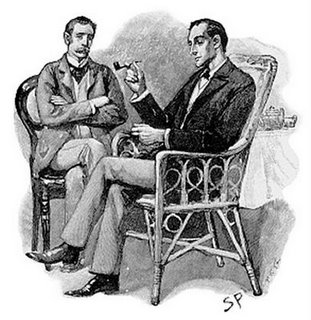
“And while we’re on the subject, Watson, you also can’t make those terrible ashtrays beloved of amateur potters, so it’s not all bad.”
I’ve used this quote before but, in this case, I’m talking about students. I cannot produce graduates without first year students, and I have no first year students unless interested students come in from the schools.I’ve just returned from a school visit to years 10-12 and, regrettably, I don’t have many bricks. Last night I attended a careers night that was a joint event between two fee-paying secondary schools, one all-girls, one co-educational. There were three presentation slots allocated across the night and, because of space limitations, the more interest you had, the more slots you got.
Medicine had all three slots filled, law had all three and teaching had all three – all with standing room only. Journalism had all three slots filled. Media studies had two, sports studies had two. Information technology had one – right at the end of the night – and I only had eight people scheduled to attend. Of these, seven were male and one was female. And that is the total number of bricks that I have from two prominent, highly academic and well-resourced schools in my primary catchment. What puzzles me the most is that one of these schools has one of the richest IT environments in the state and these students are surrounded, every day, by the fruits of the labours of my students. But, as I’ve discussed before, Computing/IT/CS/ICT/IS has a loosely defined identity and doesn’t have the best image to start with.
I’m disappointed by the level of interest but I’m not surprised. The attendees were almost all from Year 10 – the peak of interest in our school body, with one Year 12 signed up to attend but, I believe, who didn’t show up. Regrettably, it because obvious that my placement at the end of the night put me into the burnout zone for several of the students. One attended, put their head down on the table before I’d started speaking and only raised it to leave at the end of the talk. Even the parents looked a little glazed over at the start and it took a lot of showmanship to bring people back into the activity. However, I think that we had a good showing for those people who were there. As always, the problem is that vast number of people who weren’t there.
Tomorrow, I disrupt my schedule completely to fly to Sydney to discuss a systematic, sponsored outreach activity into schools to try and fix this. What I would like to see, in 2-3 years time, is full sessions and standing room only for Computing and ICT sessions, with a strong showing from both genders and under-represented groups. It was useful to be on the ground to see the problem face-to-face but I’d be lying if I said that today wasn’t starting on a demoralised note.
Tomorrow, we try again to fix the problem.
Wading In: No Time For Paddling
Posted: July 31, 2012 Filed under: Education | Tags: collaboration, community, curriculum, design, education, educational problem, feedback, Generation Why, grand challenge, grand challenges, higher education, in the student's head, principles of design, reflection, student perspective, teaching, teaching approaches, thinking, universal principles of design, work/life balance 1 CommentI’m up to my neck in books on visualisation and data analysis at the moment. So up to my neck that this post is going to be pretty short – and you know how much I love to talk! I’ve spent most of the evening preparing for tomorrow’s visualising data tutorial for Grand Challenges and one of the things I was looking for was bad visualisations. I took a lot away from Mark’s worked examples posts, and I look forward to seeing the presentation, but visualisation is a particularly rich area for worked ‘bad’ examples. With code, it has to work to a degree or manifest its failure in interesting ways. A graphic can be completely finished and still fail to convey the right information.
(I’ve even thrown in some graphics that I did myself and wasn’t happy with – I’m looking forward to the feedback on those!) (Ssh, don’t tell the students.)
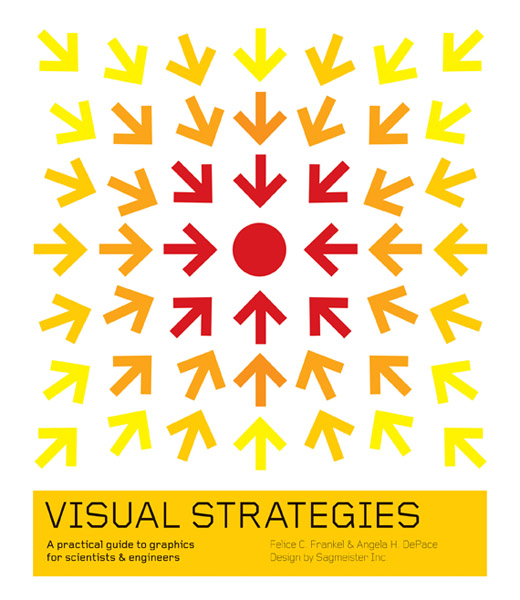
I had the good fortune to be given a copy of Visual Strategies (Frankel and DePace) which was designed by one of the modern heroes of design – the amazing Stefan Sagmeister. This is, without too much hyperbole, pretty much the same as being given a book on painting where Schiele had provided the layout and examples. (I’m a very big fan of Egon Schiele and Hundertwasser for that matter. I may have spent a little too much time in Austria.) The thing I like about this book is that it brings a lot of important talking and thinking points together: which questions should you ask when thinking about your graphic, how do you start, what do you do next, when do you refine, when do you stop?
Thank you, again, Metropolis Bookstore on Swanston Street in Melbourne! You had no real reason to give a stranger a book for free, except that you thought it would be useful for my students. It was, it is, and I thank you again for your generosity.
I really enjoy getting into a new area and I think that the students are enjoying it too, as the entire course is a new area for them. We had an excellent discussion of the four chapters of reading (the NSF CyberInfrastructure report on Grand Challenges), where some of it was a critique of the report itself – don’t write a report saying “community engagement and visualisation are crucial” and (a) make it hard to read, even for people inside the community or (b) make it visually difficult to read.
On the slightly less enthusiastic front, we get to the crux of the course this week – the project selection – and I’m already seeing some hesitancy. Remember that these are all very good students but some of them are not comfortable picking an area to do their analysis in. There could be any number of reasons so, one on one, I’m going to ask them why. If any of them say “Well, I could if I wanted to but…” then I will expect them to go and do it. There’s a lot of scope for feedback in the course so an early decision that doesn’t quite work out is not a death sentence, although I think that waiting for permission to leap is going to reduce the amount of ownership and enjoyment that the student feels when the work is done.
I have no time for paddling in the shallows, personally, and I wade on in. I realise, however, that this is a very challenging stance for many people, especially students, so while I would prefer people to jump in, I recognise my job as life guard in this area and I am happy to help people out.
However, these students are the Distinction/High Distinction crowd, the ones who got 95-100 on leaving secondary school and, as we thought might occur, some of them are at least slightly conditioned to seek my approval, a blessing for their project choice before they have expended any effort. Time to talk to people and work with them to help them move on to a more confident and committed stance – where that confidence is well-placed and the commitment is based on solid fact and thoughtful reasoning!

 Nick Falkner