
Getting Into the Student’s Head: Representing the Student Perspective
Posted: May 16, 2012 Filed under: Education | Tags: authenticity, education, higher education, in the student's head, learning, student perspective, teaching, teaching approaches, thinking, universal principles of design Leave a commentI’ve spent a lot of time on the road this year – sometimes talking about my own work, sometimes talking about that of a research group, sometimes talking about national initiatives in ICT and, quite often, trying to talk about how my students are reacting to all of this.
That’s hard because, to do that, I have to have a fairly good idea of how my students see what I’m doing, that they understand why I’m doing what I’m doing and I have to be honest with myself if I can’t get into their heads.

Apart from this kind of writing, I write a lot of fiction and this requires that you can get into someone else’s head so that you can write about their experience , allowing someone else to read about it. This is good practice for trying to understand students because it requires you to take that step back, make your head fit a different brain and be honest about how authentically you’re capturing that other perspective.
Of course, this is going to be hard to do with the ‘average’ student because, by many definitions, I’m not. I am one of the ones who passed their Bachelors, a Masters and then a PhD. Even making it through first year sets me apart from some of my students.
Rather than talk about my Uni, which most you wouldn’t know at all, I’ll talk about Stanford. Rough figures indicate that Stanford matriculates about 7000 undergraduates a year. They produce roughly 700 PhD students a year as well. So let’s assume (simplistically and inaccurately) that Stanford has a conversion rate of undergrad to PhD of 1 in 10 (I know, I know, transfers, but let’s ignore that.) (At the same time, 34,000 students apply to Stanford and only 2,400 get admitted – about 7%. We’ve already got some fiendish filtering going on.)
So someone who has graduated with a PhD and goes out to teach is, at most, similar in process and end point to 10% of the people who managed to get all the way through. And that’s the best case.
So whenever those of us who have PhDs and are teaching try to think of the student perspective, thinking of our own is not going to really help us, especially for first year, as it is those students who don’t think like us, who may not see our end point and who may not be at the right point yet, who need us to understand them the most.
Grand Challenges – A New Course and a New Program
Posted: May 4, 2012 Filed under: Education | Tags: advocacy, challenge, curriculum, design, education, educational problem, equality, grand challenges, higher education, learning, reflection, teaching, universal principles of design Leave a comment
Oh, the poor students that I spoke to today. We have a new degree program starting, the Bachelor of Computer Science (Advanced), and it’s been given to me to coordinate and set up the first course: Grand Challenges in Computer Science, a first-year offering. This program (and all of its unique components) are aimed at students who have already demonstrated that they have got their academics sorted – a current GPA of 6 or higher (out of 7, that’s A equivalent or Distinctions for those who speak Australian), or an ATAR (Australian Tertiary Admission Rank) of 95+ out of 100. We identified some students who met the criteria and might want to be in the degree, and also sent out a general advertisement as some people were close and might make the criteria with a nudge.
These students know how to do their work and pass their courses. Because of this, we can assume some things and then build to a more advanced level.
Now, Nick, you might be saying, we all know that you’re (not so secretly) all about equality and accessibility. Why are you running this course that seems so… stratified?
Ah, well. Remember when I said you should probably feel sorry for them? I talked to these students about the current NSF Grand Challenges in CS, as I’ve already discussed, and pointed out that, given that the students in question had already displayed a degree of academic mastery, they could go further. In fact, they should be looking to go further. I told them that the course would be hard and that I would expect them to go further, challenge themselves and, as a reward, they’d do amazing things that they could add to their portfolios and their experience bucket.
I showed them that Cholera map and told them how smart data use saved lives. I showed them We Feel Fine and, after a slightly dud demo where everyone I clicked on had drug issues, I got them thinking about the sheer volume of data that is out there, waiting to be analysed, waiting to tell us important stories that will change the world. I pretty much asked them what they wanted to be, given that they’d already shown us what they were capable of. Did they want to go further?
There are so many things that we need, so many problems to solve, so much work to do. If I can get some good students interested in these problems early and provide a coursework system to help them to develop their solutions, then I can help them to make a difference. Do they have to? No, course entry is optional. But it’s so tempting. Small classes with a project-based assessment focus based on data visualisation: analysis, summarisation and visualisation in both static and dynamic areas. Introduction to relevant philosophy, cognitive fallacies, useful front-line analytics, and display languages like R and Processing (and maybe Julia). A chance to present to their colleagues, work with research groups, do student outreach – a chance to be creative and productive.
I, of course, will take as much of the course as I can, having worked on it with these students, and feed parts of it into outreach into schools, send other parts in different levels of our other degrees. Next year, I’ll write a brand new grand challenges course and do it all again. So this course is part of forming a new community core, a group of creative and accomplished leaders, to an extent, but it is also about making this infectious knowledge, a striving point for someone who now knows that a good mark will get them into a fascinating program. But I want all of it to be useful elsewhere, because if it’s good here, then (with enough scaffolding) it will be good elsewhere. Yes, I may have to slow it down elsewhere but that means that the work done here can help many courses in many ways.
I hope to get a good core of students and I’m really looking forward to seeing what they do. Are they up for the challenge? I guess we’ll find out at the end of second semester.
But, so you know, I think that they might be. Am I up for it?
I certainly hope so! 🙂
Beautiful Posters and Complicated Concepts Don’t Always Work – But That’s OK.
Posted: April 1, 2012 Filed under: Education | Tags: education, higher education, principles of design, reflection, resources, teaching, teaching approaches, universal principles of design Leave a commentI was recently reading Metafilter, a content aggregator, when I came upon a set of labels that came from the Information is Beautiful site and described a number of logical fallacies. Unfortunately, while these were quite nice to look at, the fallacy descriptions are at times inaccurate, and the diagrams don’t really convey the core idea sometimes. (There was an example of applying these labels to a speech and it was a bit of a stretch in many regards.) What disappointed me in the ensuing discussion on Metafilter was how overwhelmingly negative people were about this. There was a lot of “well, this is terrible logic” (and that statement was at times true) and “the application of labels simplistically leads to trouble” (which is also true) but let’s step back for a moment and look at the core idea.
Would it be helpful to use strong visual cues that students can attach to text for a subset of logical fallacies or rhetorical tricks to help in them marking up essays? How about the ability to click an ‘Ad Hominem’ button on Wikipedia when you’ve selected a box of text that contains an attack upon the person rather than their ideas?
While the original labels certainly need refinement and work, taking this as a starting point would have been both useful and constructive. Attacking it, deriding it and rejecting it because it isn’t perfect seems a wasted opportunity to me. It’s very easy to be dismissive but I’m not sure that there’s much long-term benefit in burning everything that’s not perfect. I much prefer a constructive approach – is there anything I can use from here? Can I take this and make it better? How can I achieve this and make it awesome? The Information is Beautiful site has lots of good stuff but there is the occasional miss, but you’re bound to learn something interesting anyway, or pick up a new way of seeing. Would I teach directly from it? No! Of course not. (Look at some of the labels, especially for Novelty and Design and tell me if this is all serious.)

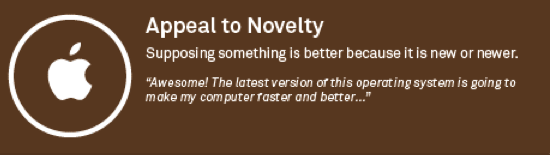
I should note that Metafilter user asavage, who some of you will know from burning off his eyebrows on Mythbusters, also noted that the IIB link wasn’t great but suggested an excellent alternative – A Visual Guide to Cognitive Biases.

Yes, asavage doesn’t much like what he read in the original links, and there’s good reason for it to be modified, but he provides a constructive suggestion. Now, fair warning, it’s a scribd link to get the slide pack, which is big and requires you to log in to the site or use a Facebook login, but if you teach any kind of logical thinking at all, it’s an essential resource. It’s the Cognitive Bias Wikipedia page with good graphics and it’s a great deal of fun.
Are either of these approaches the equivalent of a full lecture course on logic, reasoning and rhetoric? No. With thought, could you use elements from both in your teaching? I think the answer is a resounding yes and I hope that you have fun reading through them.
Nice Suit! Why My Improved Taste In Clothes Helps Me Teach.
Posted: March 12, 2012 Filed under: Education, Opinion | Tags: barney stinson, design, education, educational problem, higher education, neil patrick harris, reflection, teaching, teaching approaches, tools, universal principles of design 2 Comments
Graduation day can be one of the really big days for my students, as is the first day that they go off for job interviews, or placement interviews – the first day that they have some skills, a matching qualification and have put on the clothes and trappings of business. As Barney would say, “Suit up!”
I’m not intending to start a discussion here on the utility of the suit (because for anyone who has to do tech support, there is none), the assumption that the suit is practical wear in all climates (because in Australia in high summer it most certainly is not) but I do want to talk about the comfort of the suit.
Now, one of the weirdest things about suits is the number of people who wear uncomfortable or even dangerously constricting business attire. It would be hard to imagine a more consistently uncomfortable group of people than a large group of graduating students, sitting in a packed, hot hall, waiting to graduate, necks chafing if they’re wearing ties, sweating because of the layers, possibly risking ankle damage or a fall if they’re in unfamiliar heels and, overall, being ultimately miserable while waiting for the moment when we give them the big piece of paper and say “Go off and be legen…”
Wait for it.
“…dary”.
These days, I have very simple requirements of my clothes. Everything I wear has to be as comfortable as my long-distance running gear. When you run over 20 miles/ 32 km, you don’t have the ability to carry too much spare clothing. What you wear has to be comfortable, suitable and, above all, not chafe regardless of sun, wind and rain. This is clothing to achieve things in – and all of my clothing should do this!
People told me that suits meant business. But suits only mean business because business people wear suits. This kind of dogma is subtly and explicitly divisive – explicitly because if you can’t afford a suit, then you’re on the back foot; subtly because if you can’t afford a good suit, you’re sending a message of either impecunity or ignorance. Now, yes, for special presentations, funerals and where everyone else will be wearing a suit, I will still suit up. But, whenever possible, I wear a nice shirt and trousers – or good jeans. Or shorts, in summer. This is far more practical for what I do and allows me to still walk the 3 miles/5 km from home to work and get my thinking time in. There’s neat, there’s well-dressed and then there’s some of the nightmares passed off as business attire. There is a wealth of secret knowledge, affluence barriers, expectations and, above all, hidden pitfalls in this whole business attire thing that really makes me wonder whether we’re focusing on the right things. I can’t tell my students not to wear business clothing, because the reality is that some people just won’t hire them, but I should be able to help them to develop a mental framework where they can analyse what is being asked of them and then work out if they are happy to pay the price to achieve a goal.
I don’t pretend to be wise but I can now appreciate that I have done enough things, and failed at a sufficient number, that I’ve learned right and wrong ways to approach problems and find solutions. My students need me to share this with them because, although some of the lessons won’t sink in until they do it themselves, any proto-wisdom that I can pass on may save them time. If I tell them what dogma looks like, get them focused on the right things, then I help them to identify some of the things that they will hit once they leave us. I don’t feel more or less of a teacher if I wear shorts or a suit, but, in so many ways, the way that I expose my students to knowledge, discuss it with them and reinforce it will determine how their brain is dressed when they step out into the world. It will also strongly affect how will they improve upon what we’ve taught them and how they accumulate more information into the future. Basically, if I get across to my students the idea that we are giving them a foundation, which will be solid, and show them how to build – then sometime down the line, they’re on the way to something special and rewarding.
And being confident, skilled and competent at what you do, that’s probably the best thing that you can ever wear.
SIGCSE, Why Can’t I Implement Everything?
Posted: March 5, 2012 Filed under: Education | Tags: curriculum, education, higher education, MIKE, reflection, sigcse, universal principles of design Leave a commentI was going to blog about Mike Richards’ excellent paper on ubicomp, but Katrina did a much better job so I recommend that you go and look over there.
My observation on this session are more feeling based, in that I’ve seen many things at this conference and almost every time, I’ve wanted to tell more people about it, or adopt the mechanism. As Katrina said to me, when we were discussing it over lunch, you can’t do everything because we only have so many people and not every idea has to be implemented at every University.
But it’s such a shame! I want small home-rolled mobile computing platforms and fascinating programming environments! Everything good I saw, I want to bring home and share with people. However, the hard part is that I want them to be as fascinated and as excited as I am – and they’re getting it from me second-hand.
The other things that I have to remember is that whatever we do, we have to commit to and do well, we can’t just bring stuff in, try it and throw it away in case there’s a possibility of our ad-hoc approach hurting our students. We have to work out what we want to improve, measure it, try the change and then measure it again to see what has changed.
You’ll see a few more SIGCSE posts, because there’s still some very interesting things to report and comment on, but an apparent movement away from the content here isn’t a sign that I’ve stopped thinking about – it’s a sign that I’m thinking about which bits I can implement and which bits I have to put into the ‘long term’ box to bring up at a strategy level down the track.
I’ve met a lot of great people and heard many wonderful things – thanks to everyone at SIGCSE!
SIGCSE Wrap-up 2012
Posted: March 4, 2012 Filed under: Education | Tags: education, higher education, sigcse, teaching, teaching approaches, tools, universal principles of design Leave a commentAnd SIGCSE is over! Raja and I presented the infamous puzzle-based learning (PBL) workshop. It took three years to get into a form where it was accepted – but it was worth it. ALl of the participants seemed to have a good time but, more importantly, seemed to get something useful. The workshop about 12 hours of information jammed into 3 hours but it’s a start.
Today’s lunch was pretty good but, despite the keynote being two really interesting people (Fernanda Viégas and Martin Wattenberg, from Google’s Big Picture visualisation in Cambridge, MA) and the content being interesting – there wasn’t much room for us to take it further beyond contributing our datasets to the Many Eyes project and letting it go to the world. I suspect that, if this talk had preceded Hal’s yesterday, it would have been much better but, after the walled garden talk, the discussion of what a small group of very clever people had done was both interesting and inspirational – but where was the generative content as a general principle?
I’m probably being too harsh – it’s not as if Fernanda and Martin didn’t give us a great and interesting talk. I suspect that Hal’s talk may just have made me a lot more aware of the many extended fingers in the data pies that I work with on a regular basis.
So let me step back and say that the current focus on presenting data in easily understood ways is important and exciting. It would be fantastic if all of the platforms available were open, extensible and generative. There we go – a nice positive message. Fernanda and Martin are doing great stuff and I’d love to see all of it in the public domain sometime. 🙂
Following the lunch, Raja and I had to set-up for our workshop, and that meant that our audience was going to be the last SIGCSE people we’d see as everyone else was leaving or heading off to another workshop. We think it went well but I guess we’ll see. I’ll try to put a PBL post in the queue before I start jumping on planes again.
Bye, SIGCSE, it’s been fun. See you… next year?
SIGCSE: Scratching Alice – What Do Students Learn About Programming From Game, Music Video, And Storytelling Projects?
Posted: March 4, 2012 Filed under: Education | Tags: ALICE, education, gender issues, higher education, Scratch, sigcse, teaching, teaching approaches, tools, universal principles of design 1 CommentI went to a fascinating talk that drew data from 11-14 year olds at a programming camp. Students used a 3D programming language called Alice or a visual programming language called Scratch, to tell stories, produce music videos and write games. The faculty running the program noticed that there appeared to be a difference in the style of programming that students mastered depending on whether they used Alice or Scratch. At first glance, these languages both provide graphical programming environments and can be very similarly used. They both offer loops, the ability to display text, can produce graphics and you can assign values to locations in memory – not surprising, given that these are what we would hope to find in any modern high-level programming language. For many years, students produced programs in Alice, with a strong storytelling focus, but from 2008, the camp switched to Scratch, and a game-writing and music-video focus.
And the questions that students asked started to change.
Students started to ask questions about selection statements and conditional expressions – choosing which piece of code to run at a given point and calculating true and false conditions. This was a large departure from the storytelling time when students, apparently, didn’t need this knowledge.
The paper is called “What Do Students Learn About Programming From Game, Music Video, And Storytelling Projects?“, Adams and Webster, and they show a large number of interesting figures determined by data mining the code produced from all of the years of the camp. Unsurprisingly, the game programming required students to do a lot more of what we would generally recognise as programming – choosing between different pathways in the code, determining if a condition has been met – and this turns out to be statistically significant for this study. Yes, Scratch games use more if statements and conditionals than Alice storytelling activities and this is a clear change in the nature and level of the concepts that the students have been exposed to.
Students tended to write longer programs as they got older, regardless of language, games were longer than other programs, IF statements were used 100 times more often in games than stories and LOOPS were used 100 times more often in games and videos than stories.
Some other, interesting, results include data on gender differences in the data:
- Boys put, on average, 3.2 animations of fire into all of their games, compared to the girl’s rather dull 0.8. Come on, girls, why isn’t everything on fire?
- Boys use infinite loops far more frequently than girls. (I’d love to see if there’s an age-adjusted pattern to this as well.)
- Girls appear to construct more conditional statements. This would usually indicate a higher level of utility with the concepts.
We generally have two things that we try to do when we carry out outreach – amuse/engage the audience and educate the audience. There’s not doubt that the choice of language and the exercise are important and this paper highlights it. They’re not saying that Alice is better or worse than Scratch but that, depending on what you want, your choice of activity is going to make students think in a certain way. If all you’re after is engagement then you don’t need students practising these higher-level programming skills – but if you’re trying to start out proto-programmers, maybe a storytelling approach isn’t what you’re after.
SIGCSE, Birds of a Feather (BOF) Session “eTextbooks”
Posted: March 4, 2012 Filed under: Education | Tags: curriculum, design, education, higher education, learning, sigcse, teaching, teaching approaches, universal principles of design Leave a commentMy blogging of these events is getting later and later but another BOF session from Thursday night, hosted by Professor Cliff Schaffer from Virginia Tech. As always, my words may not quite match those of noted speakers.
Overall, a really thought-provoking panel – we all want to write but we ant to get all of the new features, without necessarily really knowing what the features available are or what the cost will be. The fear of wasting time is a constant spectre over the eBooks market. If I make it, I want it to be useful and feature-rich for some time.
What does the term eText even mean? Is it a type of text, the platform, the concept – some intersection? The virtues are obvious: portability, additional features like hypertext and search – but is this it? What are the educational benefits?
Cliff’s main idea was that, for our educational purposes, eBooks support interactivity and, hence assessment. There are projects like OpenDSA, a data structures and algorithms course in the creative commons. They’ve got content, texts, visualisations and assessment. Once a student has finished, they appear to be confident that they have understood the material.
Looking at Khan Academy it’s easy to focus on the videos, when the assessment exercises and awards system is an equally important part. But this is for Maths which is (notionally) easier to generate problem variations for and assess the result, to allow exercise in variations.
When students interact correctly with this progress determination activities, they answer the question, get told of their mark and given feedback and can then go again. Why do we mean by interactivity? (NF note, I’ll blog on this some more, later.)
There are a lot of solutions in this space, including algorithm simulation environment – how can we go beyond the textbook? Do we need to abandon the idea of the textbook as a closed container – does it make any sense any more?
The Open University in the UK has split their material between paper and electronic – electronic because of all the features and paper because students feel ripped off without a paper copy! The electronic materials have three levels of response to assessment-based interaction: firstly mark and just note where errors occurred, on the second pass, mark and suggest materials, on the third pass, if still under performing, direct student to read the material again. This is a bespoke system, producing Flash, but they hope to move to HTML5 at some stage.
Other tools mentioned included CTAT (Cognitive Tutoring Authoring Tools), AlgoViz and the amazing interactive textbook system written in Python, thinkcspy.appspot.com. If we’re going to have systems like Khan Academy, we need them to decomposable and re-usable but it would be nice if their grading system (badges) could work with us.
On the thinkcspy.appspot.com site, Brad and David’s book (Luther college), customised by Christine Alvarado, contains mid-term grades, log files and then end of term survey. CodeLens, visualisation was most correlated with results. However, outside of class time, students did not use most of interactive elements. The night before a test they flipped through the book. To learn this content, they have to change behaviour. Had assessment items already built in to drive knowledge boundary forward but students chose not to engage with the book.
Mark mentioned a new NSF project in October – building CS books for HS students to allow them to learn CS. Can’t use apprenticeship model because HS students don’t have time to mentor or be mentored because of an already full curriculum. The curse of outreach is that we have to take the time to produce and try to jam this into a heavily prescribed and full curriculum, to interest students in something – we need a mechanism that people will consult outside but it’s obvious that people won’t (according to the above).
SIGCSE, Birds of a Feather (BOF) Session “CS Unplugged”
Posted: March 3, 2012 Filed under: Education | Tags: curriculum, design, education, higher education, principles of design, puzzles, reflection, sigcse, teaching, teaching approaches, tools, universal principles of design, unplugged Leave a commentPoor Tim Bell. He must think I’m stalking him. I attended the BOF session for CS Unplugged, which quickly turned into the BOF on ‘Energising your Outreach to Schools” (my words). Once again Lynn Lambert and Tim shared their experiences with CS Unplugged to help us frame what was wrong with our outreach (or the problems that we had) in order to try and fix them.
The main issues were:
- How do we get into the curriculum?
- Bad/old equipment.
- Creating a meaningful activity in a very short time.
- Persistence – how we do we stay in their minds or their environment?
- Priming – how we prepare them for our visit?
- Time – how do we fit it all in and, more importantly, how does the teacher?
- Pick the right time to come in and interact with students, when teachers are happy to have you. Teachers don’t get a reward for dealing with students at elementary level.
- CS BIts and Bytes is a good newsletter
- cs4fn got another mention as a good website
- One amusing quote from a parent, after finding out what we did, was “I had no idea that CS had any application.” To our credit, nobody cried when this was told to the group.
- Involve people in discussing useful, relevant problems and how CS is used to help: suggestions included global warming and genomic sequencing.
Overall, another fun discussion with a lot of actively concerned people trying to make things better. Please leap in for corrections if I missed something important or got something wrong. I’m also happy to edit to add credits if required. 🙂
Fred Brooks: Building Student Projects That Work For Us, For Them and For Their Clients
Posted: March 3, 2012 Filed under: Education | Tags: authenticity, curriculum, design, education, fred brooks, higher education, mythical man month, principles of design, project, reflection, resources, software engineering, teaching, teaching approaches, universal principles of design 3 CommentsIn the Thursday keynote, Professor Brooks discussed a couple of project approaches that he thought were useful, based on his extensive experience. Once again, if you’re not in ICT, don’t switch off – I’m sure that there’s something that you can use if you want to put projects into your courses. Long-term group projects are very challenging and, while you find them everywhere, that’s no guarantee that they’re being managed properly. I’ll introduce Professor Brooks points and then finish with a brief discussion on the use of projects in the curriculum.
Firstly, Brooks described a course that you might find in a computer architecture course. The key aspect of this project is that modern computer architecture is very complex and, in many ways, fully realistic general purpose machines are well beyond the scope of time and ability that we have until very late undergraduate study. Brooks works with a special-purpose unit but this drives other requirements, as we’ll see. Fred’s guidelines for this kind of project are:
- Have milestones with early delivery.
Application Description
Students must provide a detailed application description which is the most precise statement that the students can manage. A precise guess is considered better here than a vague fact, because the explicit assumption can be questioned and corrected, where handwaving may leave holes in the specification that will need to be fixed later. Students should be aware of how sensitive the application is to each assumption – this allows people to invest effort accordingly. The special-purpose nature of the architecture that they’re constructing means that the application description has to be very, very accurate or you risk building the wrong machine.Programming Manual (End of the first month as a draft)
Another early deliverable is a programming manual – for a piece of software that hasn’t been written yet. Students are encouraged to put something specific down because, even if it’s wrong, it encourages thought and an early precision of thought. - Then the manual is intensely critiqued – students get the chance to re-do it.
- The actual project is then handed in well before the final days of semester.
- Once again the complete project goes through a very intense critique.
- Students get the chance to incorporate the changes from the critique. Students will pay attention to the critique because it is criticism on a live document where they can act to improve their performance.
The next project described is a classic Software Engineering project – team-based software production using strong SE principles. This is a typical project found in CS at the University level but is time-intensive to manage and easy to get wrong. Fred shared his ideas on how it could be done well, based on running it over 22 years since 1966. Here are his thoughts:
- You should have real projects for real clients.
Advertise on the web for software that can be achieved by 3-5 people during a single semester, which would be useful BUT (and it’s an important BUT) you can live without. There must be the possibility that the students can fail, which means that clients have to be ready to get nothing, after having invested meeting time throughout the project.
- Teams should be 3-5, ideally 4.
With 3 people you tend to get two against one. With five, things can get too diffuse in terms of role allocation. Four is, according to Fred, just right.
- There should be lots of project choices, to allow teams choice and they can provide a selection of those that they want.
- Teams must be allowed to fail.
Not every team will fail, or needs to fail, but students need to know that it’s possible.
- Roles should be separated.
Get clear role separations and stick to them. One will look after the schedule, using the pitchfork of motivation, obtaining resources and handling management one level up. One will be chief designer of technical content. Other jobs will be split out but it should be considered a full-time job.
- Get the client requirements and get them right.
The client generally doesn’t really know what they want. You need to talk to them and refine their requirements over time. Build a prototype because it allows someone to say “That’s not what I want!” Invest time early to get these requirements right!
- Meet the teams weekly.
Weekly coaching is labour intensive and is mostly made up of listening, coaching and offering suggestions – but it takes time. Meeting each week makes something happen each week. When a student explains – they are going to have to think.
- Early deliverable to clients, with feedback.
Deadlines make things happen.
- Get something (anything) running early.
The joy of getting anything running is a spur to further success. It boosts morale and increases effort. Whatever you build can be simple but it should have built-in stubs or points where the extension to complexity can easily occur . You don’t want to have to completely reengineer at every iteration!
- Make the students present publicly.
Software Engineers have to be able to communicate what they are doing, what they have done and what they are planning to do – to their bosses, to their clients, to their staff. It’s a vital skill in the industry.
- Final grade is composed of a Team Grade (relatively easy to assess) AND an Individual Grade (harder)
Don’t multiple one by the other! If effort has been expended, some sort of mark should result. The Team Grade can come from the documentation, the presentation and an assessment of functionality – time consuming but relatively easy. The Individual Grade has to be fair to everyone and either you or the group may give a false indication of a person’s value. Have an idea of how you think everyone is going and then compare that to the group’s impression – they’ll often be the same. Fred suggested giving everyone 10 points that they allocated to everyone ELSE in the group. In his experience, these tallies usually agreed with his impression – except on the rare occasion when he had been fooled by a “mighty fast talker”
This is a pretty demanding list. How do you do tasks for people at the risk of wasting their time for six months? If failure is possible, then failure is inevitable at some stage and it’s always going to hurt to some extent. A project is going to be a deep drilling exercise and, by its nature, cannot be the only thing that students do because they’ll miss out on essential breadth. But the above suggestions will help to make sure that, when the students do go drilling, they have a reasonable chance of striking oil.

 Nick Falkner