
Let’s Turn Down the Stupid (Ignorance is Our Enemy)
Posted: June 11, 2012 Filed under: Education, Opinion | Tags: education, educational problem, Generation Why, in the student's head, learning, student perspective, thinking 1 Comment(This is a longish opinion piece that has very little educational discussion. I leave it you as to whether you wish to read it or not.)
I realise that a number of you may read my blog posts and think “Well, how nice for him. He has tenure in a ‘good’ University, has none of his own kids to worry about and is obviously socially mobile and affluent.” Some of you may even have looked up my public record salary when I talk about underpaying teachers and wondered why I don’t just shut up and enjoy my life, rather than blathering on here. It would be easy to cast me as some kind of Mr Happy/Pollyanna figure, always seeing the positive and rushing out onto the sports field with a rousing “We’re all winners, children” attitude.
Nothing could be further from the truth. I get up every day knowing that the chances are that I will not make a difference, that all of my work will be undone by a scare campaign in a newspaper, that I may catch a completely preventable disease because too few people got vaccinated, that I and my family may not have enough food or lose my house because people ignore science, that anti-scientific behaviour is clawing back many of the victories that we have already achieved.
I’m no Pollyanna. I get up every day ready to fight ignorance and try to bring knowledge to places where ignorance reigns. Sometimes I manage it – those are good days. But I can’t just talk to my own students, I have to reach out into the community because I see such a small percentage of a small percentage as my students. If I want lasting change, and I believe that most educators are all trying to change the world for the better, then I have to deal with the fact that my message, and my students, have to be able to be seen outside of our very small and isolated community.
This morning, while out running, we had gone a bit over 14 kilometres (about 9 miles) when I saw a cyclist up ahead off us, stopped on a little wooden ramp that went under one of the bridges. He heard us coming and waved us down, very quickly.
Someone had strung fishing line across the path, carefully anchored on both sides, at around mid-chest height for adult runners and walkers, or neck/head height for children.
Of course, the moment we realised this we looked around for the utter idiots who were no doubt waiting to film this or watch it but they showed a modicum of sense in that we couldn’t see them. (Of course, what could we have done even if we had seen them. They were most likely children and the police aren’t likely to get involved for a ‘fishing line’ related incident.) What irritated me most about this was that I was running with someone who was worried about the future and I was solemnly telling her that I had great hope for the future, that the problems could be solved if we worked at it and this is what I always tried to get across to my students.
And then we nearly got garrotted by an utterly thoughtless act of stupidity. Even a second’s thought would lead you to the understanding that this was more than a joke, it was potentially deadly. And yet, the people who put this up, who I have no doubt waited to watch or film it, were incapable of doing this. I can only hope that they were too young, or too mentally incapacitated, to know better. Because when someone knowingly does this, it takes them from ignorance to evil. Fortunately, the number of truly evil people, people who do these things in full knowledge and delight, are small. At least, that’s what I tell myself to get myself to sleep at night. We must always be watchful for evil but in the same way that we watch for the infrequently bad storm – when we see the signs, we batten down, but we don’t live our lives in the storm cellar. Ignorance, for me, is far more prevalent and influential than evil – and often has very similar effects as it can take people from us, by killing or injuring them or by placing them into so much mental or physical pain that they can no longer do what they could have done with their lives.
The biggest obstacle we face is ignorance and acts taken in ignorance, whether accidentally or wilfully so. There’s no point me training up the greatest mind in the history of the world, only for that person to be killed by someone throwing a rock off a bridge for fun. Today, I could easily have been seriously injured because someone thought it was funny to watch people run into an obstacle at speed. Yes, the line probably would have broken and I was unlikely to have suffered too much harm. Unless it didn’t. Unless it took out an eye.
But I’m not giving up. I say, mostly joking, when I run across things like this “This is why we fight.” and I mean it. This is exactly why education is important. This is why teachers are important. This is why knowledge is important. Because, without all of these, ignorance will win and it will eventually kill us.
I am sick of stupid, ignorant and evil people. I’m sick of grown men getting away with disgraceful behaviour because “boys will be boys”. I’m sick of any ignorant or thoughtless act being tolerated with “Oh well, these things happen”. However, me being sick of this does nothing unless I act to stop it. Me acting to stop it may do nothing. Me doing nothing to stop it definitely does nothing.
Today, As I Was Crawling Across the Floor…
Posted: June 10, 2012 Filed under: Education | Tags: authenticity, education, educational problem, games, higher education, principles of design, puzzles, resources, teaching, teaching approaches, thinking, tools, zombies 3 CommentsAs I believe I’ve already mentioned, I play a number of board games but, before you think “Oh no, not Monopoly!”, these are along the lines of the German-style board games, games that place some emphasis on strategy, don’t depend too heavily on luck, may have collaborative elements (or an entirely collaborative theme), tend not to be straight war games and manage to keep all the players in the game until the end. Notably, German-style board games don’t have to be German! While some of the ones that I enjoy (Settlers of Cataan, Ticket to Ride and Shadows Over Camelot) are European, a number are not (Arkham Horror, Battlestar Galactica and Lords of Waterdeep). A number of these require cooperative and collaborative play to succeed – some have a traitor within.
I have discussed these games with students on a number of occasions as many students have no idea that such games exist. The idea of players working together against a common enemy (Arkham Horror) appeals to a lot of people, especially as it allows you to share success. One of the best things about games that are well-designed to reward player action and keep everyone in the game is that the tension builds to a point a final victory gives everyone fiero – that powerful surge of joy.
Now, while there are many games out there, I decided to go through the full game design process to get my head around the components required to achieve a playable game. I’ve designed some games before and, after a brief time spent playing them, I’ve left most of them back on the shelf. Why? Poor game design, generally. As a writer, I have a tendency to think of stories and to run narrative in my head – in game terms, this is only one possible passage through the game. One of the strengths of computer games such as Deus Ex is the ability to play multiple times and get something new out: to shake up the events and run it in your order, forming a new narrative. (In DE, technically, you were on rails the whole time, the strength of the game is in the illusion of free will.)
Why is it important for me to try and design a good game? Because it requires a sound assessment of what is required, reflection upon how I can model a situation in a game, good design, solid prototyping, testing, feedback, revision, modification, re-testing, thought, evaluation and then more and more refinement. From a methodological point of view, my question to myself is “Can I build a game that is worth playing based on a general sketch of the problem, a few good ideas and then a solid process to allow me to build game features in the way that I would build code features?”
Right now I’m in the requirements gathering phase and this is proving to be very interesting. I’m working on a Zombie game (oh no, not another one) but I want to have a three-stage game where the options available to players, resources and freedom of action, change dramatically during each stage. I want it to be based in London. I want to allow for players to develop their characters as they play through a given game. I want player actions to have a lasting impact in the game, for decisions to matter. I want the game to generate a different board and base scenario set every time, to prevent players learning a default strategy. I want the whole thing to run, as a board game, in the German style. I want the instructions to fit onto 8 A4 pages – with pictures.
(I should note that I’ve been playing games for a long time and made a lot of notes about rules and mechanics that I like, so this has all formed part of my requirements gathering, but I’m not trying to put a new skin on an old game – I’m trying to create something interesting that is also not a blatant rip-off. Also, yes, I know that there are already a lot of zombie games out there. That isn’t the point.)
I’ve been crawling the web for pictures of London, layouts, property values, building types and other things to get London into my head. Because the board has to change every time, and I can’t use computer generation, I need a modular board structure. That, of course, requires that the modules make sense and feel like London, and that the composition of these modules also makes sense. I need the size of the board to make the players work for their victories and not make victory too easy or too hard to attain. (So, I’m building bounds into the modularity and composition that I can tune based on what happens in play testing.)
I knew this but my research nailed it as a requirement: London is about as far away from being a grid layout as you can get, with a river snaking through it. Because of this, and my randomisation and modularity requirements, I had to think about a system that allowed me to put the elements together but that didn’t make London look like New York. Instead, I’ve opted for a tiled layout based on hexagons. They tesselate nicely, you can’t run in straight lines, and you can’t see further than the side of one hex, which reflects the problems of working in London without having to force someone to copy out a section of the London map with all of its terrible twists and turns.
The other thing I really wanted to know was “How fast do zombies move?” and, rather than just look it up, I’ve spent a bit of this afternoon shambling around the house and timing myself to see what the traditional “slow” zombie does. Standard walking and running are easy (I have a good feel for those figures) but then I thought about that stalwart of zombie movies – the legless crawler. So, in the interests of research, I measured off a 10m course and dragged myself across the floor only using my arms. Then I added a fudge factor to account for the smoothness of the floor and, voila, a range of speeds that tell me how long zombies will take to move across my maps.
Why do I need to do this? Because I’ve never done it before. From now on, if someone asks me what the estimated speed of a legless zombie is on a level surface, I can say “Oh, about 0.25m/s” and really stop the conversation at the Vice Chancellor’s cocktail party.
Requirements gathering, around a problem specification, is a vital activity because if it’s done properly then you gain more and more understanding of the problem and, even though initially the questions seem to explode, you can move to a point that you have answered most of the important questions. By the time I’ve finished this stage, I should have refined my problem statement into a form that allows me to write the proper design and then build the first prototype without too many further questions. I should have the base rules down in a form that I can give to somebody and see what they do.
By doing this, I’m practising my own Software Engineering skills in a very different way, which makes me think about them outside of the comfortable framework of a programming language. Students often head off to start writing code because it’s easier to sit and write code that might work, instead of spending the time doing the far more difficulty activities of problem specification, requirements gathering, specification refinement and full design. I don’t get much of a chance to work on commercial software these days, so a zombie game on the weekends is an unusual, if rewarding, way to practice these skills.
Sliding across the floor is murder on the knees, though…
What are the Fiction and Non-Fiction Equivalents of Computer Science?
Posted: June 9, 2012 Filed under: Education, Opinion | Tags: data visualisation, design, education, educational problem, herdsa, higher education, icer, learning, principles of design, reflection, student perspective, teaching, teaching approaches, thinking, universal principles of design 2 CommentsI commented yesterday that I wanted to talk about something covered in Mark’s blog, namely if it was possible to create an analogy between Common Core standards in different disciplines with English Language Arts and CS as the two exemplars. In particular, Mark pondered, and I quote him verbatim:
”Students should read as much nonfiction as fiction.” What does that mean in terms of the notations of computing? Students should read as many program proofs as programs? Students should read as much code as comments?
This a great question and I’m not sure that I have much of an answer but I’ve been enjoying thinking about it. We bandy the terms syntax and semantics around in Computer Science a lot: the legal structures of the programs we write and the meanings of the components and the programs. Is it even meaningful to talk about fiction and non-fiction in these terms and where do these fit? I’ve gone in a slightly different direction from Mark but I hope to bring it back to his suggestions later on.
I’m not an English specialist, so please forgive me or provide constructive guidance as you need to, but both fiction and non-fiction rely upon the same syntactic elements and the same semantic elements in linguistic terms – so the fact that we must have legal programs with well-defined syntax and semantics pose no obstacle to a fictional/non-fictional interpretation.
Forgive me as I go to Wikipedia for definitions for fiction and non-fiction for a moment:
“Non-fiction (or nonfiction) is the form of any narrative, account, or other communicative work whose assertions and descriptions are understood to be factual.” (Warning, embedded Wikipedia links)
“Fiction is the form of any narrative or informative work that deals, in part or in whole, with information or events that are not factual, but rather, imaginary—that is, invented by the author” (Again, beware Wikipedia).
Now here we can start to see something that we can get our teeth into. Many computer programs model reality and are computerised representation of concrete systems, while others may have no physical analogue at all or model a system that has never or may never exist. Are our simulations and emulations of large-scale system non-fiction? If so, is a virtual reality fictional because it has never existed or non-fictional because we are simulating realistic gravity? (But, of course, fiction is often written in a real world setting but with imaginary elements.)
From a software engineering perspective, I can see an advantage to making statements regarding abstract representations and concrete analogues, much as I can see a separation in graphics and game design between narrative/event engine construction and the physics engine underneath.
Is this enough of a separation? Mark’s comments on proof versus program is an interesting one: if we had an idea (an author’s creation) then it is a fiction until we can determine that it exists, but proof or implementation provides this proof of existence. In my mind, a proof and a program are both non-fiction in terms of their reification, but the idea that they span may still be fictional. Comments versus code is also very interesting – comments do not change the behaviour of code but explain, from the author’s mind, what has happened. (Given some student code and comment combinations, I can happily see a code as non-fiction, comment as fiction modality – or even comment as magical reality!)
Of course, this is all an enjoyable mental exercise, but what can I take from this and use in my teaching. Is there a particular set of code or comments that students should read for maximum benefit and can we make a separation that, even if not partitioned so neatly across two sets, gives us the idea of what constitutes a balanced diet of the products of our discipline?
I’d love to see some discussion on this but, if nothing here, then I’m happy to buy the first round of drinks at HERDSA or ICER to start a really good conversation going!
It is an amazing day.
Posted: June 2, 2012 Filed under: Education | Tags: alone in the crowd, amazing day, authenticity, blogging, education, higher education, learning, reflection, resources, teaching, teaching approaches, thinking Leave a commentToday marks the start of my sixth month of blogging. It is also the day after my largest number of hits, my most ‘viewed’ month and my my most ‘viewed’ week. Thank you to everyone who has visited and all of those of you who have taken the time to comment! It is amazing, in many ways, how ordinary a day this is to me, given how much is going on. But, of course, every day is amazing because every day is a new day. There is always the chance to do something new, something different, something wonderful.

Someone else thought that this was what an amazing day looked like. I agree!
I have tried to share my own progress in terms of understanding key concepts of learning and teaching, as a student, as a practitioner, and as a person. I can only hope that some of the people who have stumbled across this blog have found something useful here. (Sorry to the people who were looking for Page 3 girls.)
Analysing the searches that brought people here has, as I’ve previously noted, been somewhat sad as “alone in the crowd” is still the biggest draw. I worry because if you are looking for words to live by, this may not be the place to find the words that keep you alive. So, if your searches bring you here as well, I can only hope that you find what you need.
The word ‘hope’ springs up a lot in my writing. It’s a standard English form (I hope that you are well) but, for me, it is more than that. I have a great hope for the future – I would have difficulty doing my job if I did not. Every semester, I get to see a new group of students, some of whom I may know, and we start again. Knowledge, learning, hope.
For no other reason than that, the hope of something better, the hope of something brighter, and the hope that I may be helping to illuminate the way ahead – it is an amazing day.
Getting Into the Student’s Head: Representing the Student Perspective
Posted: May 16, 2012 Filed under: Education | Tags: authenticity, education, higher education, in the student's head, learning, student perspective, teaching, teaching approaches, thinking, universal principles of design Leave a commentI’ve spent a lot of time on the road this year – sometimes talking about my own work, sometimes talking about that of a research group, sometimes talking about national initiatives in ICT and, quite often, trying to talk about how my students are reacting to all of this.
That’s hard because, to do that, I have to have a fairly good idea of how my students see what I’m doing, that they understand why I’m doing what I’m doing and I have to be honest with myself if I can’t get into their heads.

Apart from this kind of writing, I write a lot of fiction and this requires that you can get into someone else’s head so that you can write about their experience , allowing someone else to read about it. This is good practice for trying to understand students because it requires you to take that step back, make your head fit a different brain and be honest about how authentically you’re capturing that other perspective.
Of course, this is going to be hard to do with the ‘average’ student because, by many definitions, I’m not. I am one of the ones who passed their Bachelors, a Masters and then a PhD. Even making it through first year sets me apart from some of my students.
Rather than talk about my Uni, which most you wouldn’t know at all, I’ll talk about Stanford. Rough figures indicate that Stanford matriculates about 7000 undergraduates a year. They produce roughly 700 PhD students a year as well. So let’s assume (simplistically and inaccurately) that Stanford has a conversion rate of undergrad to PhD of 1 in 10 (I know, I know, transfers, but let’s ignore that.) (At the same time, 34,000 students apply to Stanford and only 2,400 get admitted – about 7%. We’ve already got some fiendish filtering going on.)
So someone who has graduated with a PhD and goes out to teach is, at most, similar in process and end point to 10% of the people who managed to get all the way through. And that’s the best case.
So whenever those of us who have PhDs and are teaching try to think of the student perspective, thinking of our own is not going to really help us, especially for first year, as it is those students who don’t think like us, who may not see our end point and who may not be at the right point yet, who need us to understand them the most.
The Student as Creator – Making Patterns, Not Just Following Patterns
Posted: May 10, 2012 Filed under: Education | Tags: design, education, higher education, maze, modes of thinking, teaching, teaching approaches, thinking Leave a commentWe talk a lot about what we want students to achieve. Sometimes the students hear the details and sometimes they hear “Do your work, pass your courses, get your degree, wave paper in air, throw hat, profit.” Now, of course, sometimes they hear that because that’s what we say – or that’s what their environment, the people around them, even the employers say.
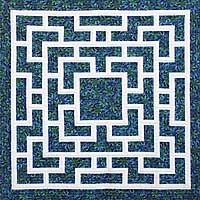
The image above is a Chinese-inspired maze pattern. Composed of simple elements, it can become complex quickly. If you built a hedge maze along these lines you could probably keep a lot of people lost for some time, simply because they wouldn’t necessarily be able to decompose the maze to the simple patterns, work out the composition and then solve the problem.
I can teach someone to follow a maze easily. In fact, this is probably done by the time they’ve finished school. Jump on the track, do your work, stay inside the lines, keep walking until you find the goal. Teaching someone to be able to step back, observe the patterns and then arrive at the goal more efficiently can also be taught, or it can arrive with experience. But, going further, being able to look at the maze and construct a brand new maze, potentially with new patterns or composition techniques, requires inspiration. You can reach this point with a fantastic brain and a lifetime of experience (we must have been able to do this) but, these days, we can also teach students abstraction, thinking, the right way to go about a problem so that they move beyond following the hedges or being able to build exactly the same kind of maze again.
This brings the student into a new mode of thinking: as a creator, rather than a pattern matcher or a follower. It is, by far, the hardest things to teach as it requires you to concentrate on providing an environment that supports and encourages creativity, as well as making sure that no-one is trying to build mazes that defy gravity, or where you can walk through concrete walls. (I note that these initial grounding constraints may relax later on – once people have a good grasp of the basics, creativity can take them to places where you can walk through walls.)
Of course, focussing on the mechanics of getting the piece of paper at the end of the degree, as if this was the objective, doesn’t lead to the right way of thinking. Getting into the right space requires us to focus on what should really be happening: the successful transfer of knowledge, the building of frameworks for knowledge development and a robust basis for creative and critical thought. This can, and does, occur spontaneously – but trying to make it happen more often results in a much larger group of people who can, potentially, change the world.

 Nick Falkner