
Teaching CS in the 21st Century: CS as a fundamental skill.
Posted: April 2, 2012 Filed under: Education, Opinion | Tags: advocacy, education, higher education, reflection, resources, teaching, teaching approaches 1 CommentToday’s Guardian has a feature in their Computer Science and IT section that includes a lot of very interesting pieces, ranging from what’s scaring girls away from coding, to why we need to be able to program and, John Naughton’s proposal for rebooting the computing curriculum – as an open letter to the Education Minister for the UK. Feel free not to read the rest of my piece if you’re pressed for time – the links on the first page will keep you busy for quite a while.
For those who are still reading, here’s a picture of ubiquitous access to computers in the developing world – giving people the possibility of doing anything with their lives. (Image is from this World Food Programme page, the food aid branch of the UN, showing the Nepalese deployment of the XO Laptop, with a programme focused on bringing young people into education, combined with a cooking oil-based incentive scheme if daughters attend at least 80% of the time.)

What I took away from reading the Guardian feature is the overwhelming message that we should teach programming and computer awareness for the same reason that we teach maths and science to all students, regardless of where they’ll end up – because that’s the world in which they live. To quote Naughton’s article:
We teach elementary physics to every child, not primarily to train physicists but because each of them lives in a world governed by physical systems. In the same way, every child should learn some computer science from an early age because they live in a world in which computation is ubiquitous. (Item 3, A Manifesto for Teaching CS in the 21st Century.)
I’ve read too many articles about various government programs that try to raise standards but do so in a way that concentrates effort on some areas in a way that starves all of the other areas, or sidelines them at the least. If we don’t see Information Communication and Technology (ICT) skills as vital, then we won’t assign priority to them. They’ll get shunted out of the way for other topics, like Maths, Language skills and Science. ICT is not more important than these but, in the world that our students will have to occupy, ICT needs a seat at the table. As many other, and better, commentators have noted, the transformation of the workforce continues apace and programming and computer use is now a vital skill in many jobs.
We need the focus in schools, because then we can hire the teachers, which drives the job market, which causes the teacher training, which improves the quality, which improves the number of competent graduates, and ultimately leads to knowledgable and fully-participating members of our civilised democracies where those little boxes on desks aren’t a mystery or intimidating. I can’t take more people into my Uni-level courses than are being produced by schools – and, sadly, not everyone who has the skill or training at school goes on to use it. I can’t wave a wand and turn the “less than 20%” of women who start my degree into 50% by the end. (Well, yes, I can, but I can’t do it fairly or ethically.) I can do the best I can with the people I get but I’d really love to get a lot more people with the skills!
We all know this is a challenge because we have so many acronyms that might mean ‘Computer training’ – are we teaching ICT, IS, IT, CS, CSE? To step back from the acronyms, and their deliberate placement for emphasis, are we teaching computational or algorithmic thinking (problem solving and solution design), are we teaching computer usage at a fundamental level, are we teaching people how to use certain packages, certain techniques – where does programming fit into all of this?
All of us are need at least a subset of these skills now, in the 21st century. On a daily basis, I download more software updates and modifications and program more items around my house, than I ever did in the years before 1995.
As always, time and resource budgets are tight and, because of this, this is not a problem we can solve at one college, one school or even one state. This is why governments have to make this a national priority if initiatives like this will succeed. This doesn’t have to mean standardised testing or fixed curricula – it means incentive to provide quality education in certain areas, with supportive high-level goals and curriculum consideration, as well as allocated money for training and community building. Of course, there are many existing initiatives like the UK revamp of the high school curriculum and available on-line resources but, here in Australia, we still don’t seem to have strong linkage between a senior school course and University entry and it must make it hard to direct students into a certain path if there is no benefit for them. There are some excellent starting points, however, such as the Australian Government’s Digital Education Revolution, so there is certainly some hope for the future, but we need long-term vision and bipartisan support for these initiatives if they’re going to continue and make real change over time.
Beautiful Posters and Complicated Concepts Don’t Always Work – But That’s OK.
Posted: April 1, 2012 Filed under: Education | Tags: education, higher education, principles of design, reflection, resources, teaching, teaching approaches, universal principles of design Leave a commentI was recently reading Metafilter, a content aggregator, when I came upon a set of labels that came from the Information is Beautiful site and described a number of logical fallacies. Unfortunately, while these were quite nice to look at, the fallacy descriptions are at times inaccurate, and the diagrams don’t really convey the core idea sometimes. (There was an example of applying these labels to a speech and it was a bit of a stretch in many regards.) What disappointed me in the ensuing discussion on Metafilter was how overwhelmingly negative people were about this. There was a lot of “well, this is terrible logic” (and that statement was at times true) and “the application of labels simplistically leads to trouble” (which is also true) but let’s step back for a moment and look at the core idea.
Would it be helpful to use strong visual cues that students can attach to text for a subset of logical fallacies or rhetorical tricks to help in them marking up essays? How about the ability to click an ‘Ad Hominem’ button on Wikipedia when you’ve selected a box of text that contains an attack upon the person rather than their ideas?
While the original labels certainly need refinement and work, taking this as a starting point would have been both useful and constructive. Attacking it, deriding it and rejecting it because it isn’t perfect seems a wasted opportunity to me. It’s very easy to be dismissive but I’m not sure that there’s much long-term benefit in burning everything that’s not perfect. I much prefer a constructive approach – is there anything I can use from here? Can I take this and make it better? How can I achieve this and make it awesome? The Information is Beautiful site has lots of good stuff but there is the occasional miss, but you’re bound to learn something interesting anyway, or pick up a new way of seeing. Would I teach directly from it? No! Of course not. (Look at some of the labels, especially for Novelty and Design and tell me if this is all serious.)

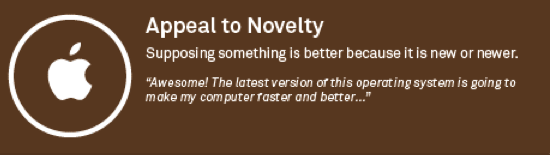
I should note that Metafilter user asavage, who some of you will know from burning off his eyebrows on Mythbusters, also noted that the IIB link wasn’t great but suggested an excellent alternative – A Visual Guide to Cognitive Biases.

Yes, asavage doesn’t much like what he read in the original links, and there’s good reason for it to be modified, but he provides a constructive suggestion. Now, fair warning, it’s a scribd link to get the slide pack, which is big and requires you to log in to the site or use a Facebook login, but if you teach any kind of logical thinking at all, it’s an essential resource. It’s the Cognitive Bias Wikipedia page with good graphics and it’s a great deal of fun.
Are either of these approaches the equivalent of a full lecture course on logic, reasoning and rhetoric? No. With thought, could you use elements from both in your teaching? I think the answer is a resounding yes and I hope that you have fun reading through them.
Grand Challenges in Education – When we say grand, we mean GRAND!
Posted: March 31, 2012 Filed under: Education | Tags: education, educational problem, grand challenge, higher education, reflection, teaching, teaching approaches, tools 2 Comments
Some time ago, Mark Guzdial posted on the Grand Challenges in the US National Educational Technology Plan. If I may summarise the four, huge, challenges, they were:
- A real-time, self-optimising difficulty-adjusting, interactive learning experience delivery system.
- A similarly high-end system for assessment of cross-discipline complex aspects of expertise and competencies.
- Integrated capture, aggregation, mining and sharing of content, learning and financial data across all platforms in near real-time.
- Identify the most effective principles of online learning systems and on/offline systems that produce equal or better results than conventional instruction in half the time and half the cost.
Wow. That’s one heck of a list. Compare that with the list of grand challenges from the March, 2011, report of National Science Foundation Advisory Committee for Cyberinfrastructure Task Force on Grand Challenges, which defines the grand challenge problems for my discipline, Computer (Cyber) Science and Engineering. By looking at some very complex problems, they arrived at the following list of areas in which great strides can, and should, be made:
- Advanced Computational Methods and Algorithms
- High Performance Computing
- Software Infrastructure
- Data and Visualisation
- Education, Training and Workforce Development
- Grand Challenge Communities.
Let me rewrite this last list in simpler, discipline free, terms:
- Better methods for solving hard problems.
- Big machines for solving hard problems.
- Good systems to run on the big machines, to support the better methods.
- Ways to see what results we have – people can see the results to make better decisions.
- Training people to make steps 1-4 work.
- Bring people together to make 1-5 work better with greater efficiency.
Now, lets look back at the four USNETP educational grand challenges to see if we can as easily form such a cohesive flow – we want to be able to see how it all works together.
- Smart learning systems.
- Smart assessment systems.
- Data and Visualisation. (Nick note: get into data and visualisation! 🙂 )
- Fusing the best of the old and the best of the new.
Now, the USNETP focus is on useful R&D and these challenges are part of their overall view of “they all combine to form the ultimate grand challenge problem in education: establishing an integrated, end-to-end real-time system for managing learning outcomes and costs across our entire education system at all levels. ” but what immediately leaps out at me are the steps 5 and 6 from the previous list. Rather than embed the training and community aspects somewhere in the rest of a document, why not embrace this at the same level if we’re talking about grand challenges in Education? That would give us:
- Training educators to make steps 1-4 work.
- Forming communities of practice to make 1-5 work better with greater efficiency.
Now these last two steps, of course, are what we’re doing with the conferences, the journals, the meetings and blogs like this but it makes a lot of sense when we see it inside my discipline, so it seems to make sense in the general field of education. There’s no doubt that these two last steps are easily as hard to manage at scale as the other projects, even interoperating with them. In fact, by making them huge challenges we increase their worth, justify effort and validate the research community built up around them. These are financially-sensitive times, where academics have to provide a value for their work. Allocating these important tasks to the grand challenge level recognises the difficulty, the uncertainty of being able to solve the problem and the sheer amount of work that may be involved.
These are, of course, only my thoughts and I have a great deal to learn in this space. I’m still searching for answers but if there’s a nice convenient report that says “Well, duh, Nick, we’re doing that right here, right now” I look forward to correction and enlightenment.
But, if it’s not already part of the USNETP grand challenges – what do you think? Should it be?
Teaching Tools (again): Balancing Price, Need and Accessibility.
Posted: March 30, 2012 Filed under: Education | Tags: education, higher education, reflection, resources, teaching, teaching approaches, tools 4 CommentsI’ve spoken before on open source and teaching tools but I’ve been reviewing some interesting data on textbook purchasing. As some of you may know, book purchases are dropping in many areas because students feel that they don’t need to (or can’t afford to) buy the text. Some of the price burden of textbooks is the size, printing and shipping costs associated, so eBooks, which can be and often are, cheaper should be addressing this problem.

Is that our experience? Well, we’re still collecting data but, anecdotally, no. Despite eBooks being substantially cheaper, students aren’t buying them in any greater numbers. (Early indications are that it may actually be less.)
Price is always going to be an issue. 60-70% of a large number is still a large number (to a student).
Need is an issue – do students need the book as a text or a reference? Will they be able to get by on lecture notes? How is the course structured? There are important equity issues associated with forcing a student to buy a book as you don’t know what they’ve had to give up to do that, and the resale market for secondhand books is not what it once was.
But one of the big concerns of my students is accessibility. They are well aware that buying an electronic book may give it to them in a very constrained form – a book that can only be read on one machine and may not survive upgrades, a book that may not have a useful search mechanism, a book where you can’t easily highlight the text. Worse, it may be a book that, sometime in the future, just stops working and can never be read again.
Yes, publishing companies are pouring millions of dollars into solving this problem but books are special in a very important way. Books enable knowledge transfer, they don’t own or restrict the knowledge transfer. When you produce a physical book, people can expend effort to do what they like. Make a house out of it, read it, re-index it, tear out the pages and put them together in print density order. None of this is possible with an eBook unless someone lets you. (Ok, you can build a house but it will use your laptop or tablet.)
I can’t help thinking that most of the effort seems to be going into providing the experience that publishing companies want us to have, in terms of usage, ownership and access – focusing on controlling us rather than enabling us. Perhaps this is the point we should address first?
(If you haven’t read my post on Hal Abelson’s talk, you might want to get to that after this.He talks a lot about the problems with the walled garden and his terminology,including the very useful term generative, is a very interesting read.)
Making Time, Taking Time: 70, 10, 10, 10
Posted: March 29, 2012 Filed under: Education | Tags: education, higher education, measurement, mythical man month, principles of design, teaching approaches, work/life balance Leave a commentI just finished reading Katrina’s post on students who are scared to interrupt us because we look so busy and it made a lot of sense. It’s certainly something I’ve struggled with and anyone who has come into my office in the past few months has seen that I am really trying to give everyone as much time as possible – but I’m obviously balancing a lot of things.
I’ve been toying with some new models for setting up my time for the day and something I’m finding that works is 70/10/10/10 time. I can lose up to 70% of my day with pre-scheduled appointments, lectures, tutes, meetings and things like that, but the remaining 30% is broken down like this:
- 10% time reserved for the unforeseen – things like the opportunity to put a proposal in to attend an important meeting in California, that lobbed onto my desk yesterday and needed about 3 hours of work to get to fruition – completed by this Friday. I seem to get things like this every day!
- 10% time reserved for me to do things like go to the bathroom, eat lunch and enjoy a coffee. I need time to get from point A to point B – and sitting the whole day hungry, thirsty or … anything else will not produce my best work.
- 10% time, reserved in my head and on my calendar, for students who drop in to ask questions or who send me e-mail with questions (or post them on the forum). I should be making time. Yes, I have drop-in times normally but my students have a range of timetables and, after all, I am here to help. If I’m genuinely busy and out of time then I may have to use this time as well, but setting aside this time will help me to think about my students.
I look at the blog as an example. Every day, I put aside 20-30 minutes to write a post and, every day, I think of things that help me, or look for things to share, or go and do some research on CS Ed, or write up something interesting. (Some days I manage all of this!) Putting time aside for something gives you the mental ability to think “Yes, this is important and I should do this.”
Thanks, Katrina!
The Facts of Undergraduates
Posted: March 28, 2012 Filed under: Education | Tags: education, higher education, reflection, teaching, teaching approaches Leave a commentIf you’re driving through the city and you’re in a hurry, you’re probably going to arrive at your destination and be under the impression that every light was red. You notice the red lights because they get in your way – worse, you may have convinced yourself that you need greens all the way and anytime that this situation doesn’t occur you have to deal with your expectations being thwarted.
Some of you, reading this, are getting angry or frustrated just reading this.
Setting up false expectations is the best way to get disappointed, frustrated and angry. I always set myself up with a positive mindset before lecturing or student contact, because starting a lecture or a meeting angry or frustrated is just going to set you up so that every negative interaction makes it worse. But, throughout an entire course, there are certain things that some people are going to do, we can’t just prepare for a course full of quiet, always attentive, highly intelligent, well-prepared and engaged students. Let’s look at a short list of other behaviours and my list of positive preparation for it.
- Students may not show up to lectures. Some students will stop coming and won’t come back – a lot of students will come back if the lecture is useful, interesting AND you have things like recordings or notes to let people catch up with missed lectures. Unless 100% attendance is required (and the question there is always “Why? Where is the educational value?”), giving people a mechanism to get back in is probably going to work better than holding a hard line. Recordings, and podcasts, let you collect your thoughts and review what you said – these help you as much as they help students.
- Students may not prepare. Once you start requiring preparation and you give students some value for that (participation, marked quizzes, things like that) students tend to re-optimise and prepare. This is a great opportunity to add some formative or small summative exercises in that can get great discussion or participation going.
- Students aren’t always focused on your lecture. There are many things going on for our students and they’re trying to work out where to spend their effort. This is a challenge, sure, but what a great opportunity to invest enthusiasm, talk to people and try to bring out the passion that brought at least some of your students in. Getting students talking to each other gives you a huge scaling factor and a communications network where your students can’t hide.
- Students just don’t do assignments sometime. I’m a great believer in giving a clear indication of what is required at the start of the course. This isn’t just me being prescriptive, this is a fantastic opportunity for me to review my expectations, my thoughts, my grading schemes, review changes, integrate new content. My course profile is not just a way to let students know what will happen if they don’t do things, it lets me frame the whole course to lead students into the necessity of the assignments and integrate that knowledge from lecture to tutorial to assignment to final exam.
Accepting that some things will not match your vision of the ideal student doesn’t mean that we have to walk into every lecture under a thundercloud. Yes, there’s effort involved, but there almost always is to achieve a good outcome.
Thinking About Students: What a Student DOES Rather Than What a Student IS.
Posted: March 27, 2012 Filed under: Education | Tags: education, higher education, reflection, teaching, teaching approaches 1 CommentYesterday’s post briefly discussed Alfred Korzybski and, today, I wanted to talk a bit more about some of his ideas, applied as a method for describing students.
“Why do I need a new way to describe students?” you might well ask. After all, we all know that there are good students, bad students, hard-working students, lazy students…
Or do we?
I only have read a relatively small amount of Korzybski but what struck me was his discussion of the verb ‘to be’ and the way that it could be used in a way that confused someone’s actions with their fundamental identity. For example, if I do something foolish, you could say “Nick is a fool” but what you really mean is “I am calling Nick a fool because he did something foolish.” (There is an old, and obscene, joke along these lines that I shall say no more on.) Committing one foolish act no more makes me a fool than the word “Nick” actually reflects the entirety of my identity.
Similarly, let us consider the movie “Green Lantern”. If I say “the movie is bad”, what I am really saying is “I did not enjoy the movie Green Lantern and would not watch it again, even for free on a plane.” The latter is a fact, based on a subjective opinion, but it is clearly identified as such. Anyone else sharing the longer form would clearly be saying that “I heard Green Lantern was not enjoyable to Nick and, given that I have similar tastes, I believe that I would not enjoy it either.”
How does this apply to students?
It’s easy to talk about good, bad, hard-working and lazy students but this often confuses the facts of a student’s actions with the student themselves. How do we characterise a good student? Michael hands up all of his work on time, has never cheated and achieves high marks. Does that make him a good student? These are all characteristics of a good student, certainly, but by listing these actions in full I make it clear how other students can achieve this aim. If I tell someone to be a good student – or to work harder (to be hard-working effectively) – I don’t actually tell them what to so, I ask them to match an identity or fulfil a predicate, rather than clearly showing them what I expect them to achieve. Of course, there is no guarantee that Michael is a ‘good’ student – but by listing our perceptions of his actions we explain why we might apply such a categorisation.
Referring to a student with ‘This student is…’ risks hiding a factual statement inside a statement that appears much stronger and has much wider impact, but without qualification. Now this goes beyond identity and simple statements and extends to the way that we interact with students as well.
“The student is responsible for handing up their work on time” – sounds good, but just saying it is an assertion of what you want to occur. What I mean when I think this is “We expect students to read the deadlines for submission, allow enough time to complete the assignments and submit their work on time, to the correct locations, in the correct format. If you don’t do this, then you will lose some or all of the marks for the assignment and may not be allowed to continue with the course.”
This is, by definition, a discussion of semantics and it is a little bit of me thinking aloud. As a mental exercise, I find it very useful because whenever I want to classify a student as ‘this student is…’ I force myself to think about what the student has done to make me think that way. Quite often, in review, I find terms like ‘bad, lazy, hard-working, good, indifferent, difficult’ dropping away because such simple classifications are beyond me – although not always. You’ll note that a recent post of mine dealt with the ‘rude student’, although I went on to describe why this may or may not be a fair description. Sometimes, for brevity or ease of reference, we may use this form to describe a group or a type, especially where people know what we mean. The problem arises when we make absolute statements about someone from smaller, and occasionally ephemeral, information. Extrapolating to a strong statement when we do not have enough information to do so. And some of these labels will stick – and stick hard – throughout a student’s life.
I suppose that the benefit for me lies in considering everything, good and bad, that a given student has done because it makes me regard them as a person, rather than a simple “is a…” – a being who has taken a number of actions, and may take any of the other possibilities in the future. Somebody that DOES rather than somebody that just IS. Someone with a great deal of unrealised potential and untapped energy. Someone who could do anything rather than being stuck in a box from the misapplication of a strong label somewhere back in their past.
The Map is not the Territory.
Posted: March 26, 2012 Filed under: Education | Tags: education, higher education, Korzybski, measurement, reflection, teaching, teaching approaches 4 CommentsI’m writing a paper on visualising Internet network topologies with my PhD student and some colleagues at the moment and an old friend, who is one of the student’s other supervisors, looked at some of the work we’d been doing and mentioned a great quote from Alfred Korzybski in 1931:
“The map is not the territory.”
Korzybski was a philosopher and scientist who developed the theory of general semantics, which I’m not going to talk more about here, but a lot of his work revolved around the idea that all we have access to is perceptions and beliefs, which we confuse with a knowledge of actual reality. This is a simple quote and a powerful concept: one of my favourite combinations.
What brought me to this was that, as part of our paper, we were looking at the London Underground map – the famous Tube Map.

The focus of the Tube map is getting around London by Tube. Designed in 1931 by Harry Beck, a draughtsman with experience in laying out electrical circuits, it replaced a large number of incomplete and more geographically focused maps. What is most interesting about this map is that some licence is taken with the geography in order to make this the simplest map to use for Tube travel. Above ground, this map is not only not as useful, in some areas it’s completely wrong. (Suburbs on the opposite side shown, distances completely inaccurately represented for ease of reading.)
This has had an effect on the way that people travel around London – making decisions above ground that make sense on the Tube map but are downright silly when on foot on the streets. To combat this, Transport for London have developed the Legible London project with above-ground signage to assist the navigation of London Above, with signs and images showing you directions and landmarks.
Whether it’s maps of networks, maps of London or course pre-requisite diagrams, maps are only useful if you design them correctly for their primary use. Looking at the work on prerequisites that I’ve been talking about recently, it’s becoming more apparent that my desire for a good visualisation of pathways stems from my desire for a map that correctly reflects what we want students to do, reinforces the correct behaviour and is also going to be fit for purpose. Rather than using one diagram for many things, I need to check to make sure if I have the best diagram for a given situation.
Sometimes I need to release my grip on the accuracy of geography (precise location) to focus on the detail of topology (arrangement and connectivity). Sometimes it’s the other way around. Particularly when I insert a temporal aspect, I need to make sure that this “fourth dimension” doesn’t make my maps so complex that they’re useless. However, I always need a reason to relax a requirement: I’m certainly not saying that you can scribble randomly on a piece of paper and call it the NYC Subway map!
But, taking this concept further, how many pieces of work are out there that confuse a good diagram or a flowchart with the real thing? Is this just our confirmation of our perceptions and, as as result, it’s strongly sensible only when viewed from within our context? Or are we producing transferrable and shareable maps, focused on the right detail, showing the correct view of the terrain for the purpose, and accepting that there are an almost infinite set of views of the true territory?
A good map helps us to navigate territory but it can never replace it. What I always need to remember is that if I produce a map from a map, I can add no more detail than was in the original and I cannot correct mistakes in the original, without reference to the territory itself. And that’s something I think that is always worth remembering.
Beautiful, Interesting and Good: Information Storage for a New Age
Posted: March 25, 2012 Filed under: Education | Tags: education, higher education, mcny, reflection, teaching approaches, truman capote 1 CommentI have just received some information from the Museum of the City of New York. I had been searching for some information on Truman Capote in 1966 and, after being unsuccessful in my original web search, located a reference to it in one of the blogs of the researchers of the Museum of the City of New York. I sent a query about the possible availability of what I was looking for, received more information on who to contact and, just after midnight on the 24th of March, I received not only what I was after but also the accompanying information that was the obvious companion piece. Of course, not knowing until I received one that I needed the other, this saved me time but, as well, left me slightly awestruck that I am roughly 24 hours away from almost the entire visual, social and literary history of New York. I have, at the other end of my e-mail, someone who will not only give me answers but fill in the holes in my knowledge to give me the answers to questions that I should have asked!
This is, quite frankly, amazing. The sheer amount of work, technology, indexing, curation, information management and money that has gone into making this happen is slightly terrifying – yet, here we are.
Ten years ago, I might have been able to find out the name of the librarian, who probably would have had e-mail but perhaps not the knowledge or the ability to send me an upload link to a temporary file holding server. I probably would have had to use a fax to request information, to provide follow-up to e-mail and assert which organisation was my umbrella, and then negotiate access to file transfer services to get the files across. I don’t think that I would have been able to read a blog, follow-up with a post, get the right e-mail by automated reply and then, in less than 18 hours, be downloading from a cloud-based share site!
Twenty years ago, it may have been a personal visit or a fax – and, even then, we may have had to be part of an ongoing formal or financial arrangement for me to waste the time of remote staff searching the stacks for a particular card in a given box. (Roughly 11 years ago, I couldn’t even look inside the NY Public Library without a library card and had to content myself with looking at lions.)
Thirty years ago, this would have been just too hard.
(Yes, the decade boundaries are a little fuzzy and I am aware that Library Science and Information Science have been doing a lot that most people are unaware of, yet perception is important here and not knowing whether something is available, or not knowing how to get to it, are almost as bad as it not being there or available in the first place.)
The fact that this is now available every day doesn’t make it any less amazing – it just means that every day we stay in this technologically advanced place, where beautiful, interesting and good things are stored, index, curated and watched over by a combination of people and… of course, machines of loving grace… is amazing.
When I talk to my students about what it is we do as Computer Scientists, I talk about handling scale, solving problems, developing algorithms and doing amazing things. My students have grown up with things like this and, if I don’t point out some of the amazing things that today just happen, then they miss out on some of the rich heritage of computing – the world before the Internet, the frontier of the early Internet, before the Web, before the Commercial Web, before mobile computing, before you could wonder something in Australia and have an answer from America with no special training or knowledge beyond how to type and send an e-mail.
I don’t focus on good old days – I have to talk and live in the amazing now, training students for the unimaginable future. Today, I have another example of something that is amazing now, and I look forward to an opportunity to teach about it, sometime soon.
I Ran Out Of Time! (Why Are Software Estimates So Bad?)
Posted: March 24, 2012 Filed under: Education | Tags: curriculum, design, education, higher education, reflection, resources, teaching approaches Leave a commentI read an interesting question on Quora regarding task estimation. The question, “Engineering Management: Why are software development task estimations regularly off by a factor of 2-3?“, had an answer wiki attached to it and then some quite long and specific answers. There is a lot there for anyone who works with students, and I’ll summarise some of them here that I like to talk about with my students:
- The idea that if we plan hard enough, we can control everything: Planning gives us the illusion of control in many regards. If we are unrealistic in assessment of our own abilities or we don’t account for the unexpected, then we are almost bound for failure. Making big plans doesn’t work if we never come up with concrete milestones, allocate resources that we have and do something other than plan.
- Poor discovery work: If you don’t look into what is actually required then you can’t achieve it. Doing any kind of task assessment without working out what you’re being asked to do, how long you have, what else you have to do and how you will know when you’re done is wasted effort.
- Failure to assess previous projects: Learn from your successes and your failures! How much time did you allocate last time? Was it enough? No? ADD MORE TIME! How closely related are the two projects – if one is a subset of another what does this say for the time involved? Can you re-use elements from the previous project? Be critical of your previous work. What did you learn? What could you improve? What can you re-use? What do you need to never do again?
- Big hands, little maps: There’s a great answer on the linked web page of drawing a broad line on Google maps at a high-level view and estimating the walking time for a trip. The devil is in the details! If you wave your hands in a broad way across a map it makes the task look simple. You need to get down to the appropriate level to make a good estimate – too far down, you get caught up in minutiae, too far up, you get a false impression of plain sailing.
I found it to be an interesting question with lots of informative answers and a delightful thought experiment of walking the California coast. I hope you like it too!

 Nick Falkner