
I did… what?
Posted: January 25, 2012 Filed under: Education | Tags: education, higher education, learning, reflection, teaching Leave a commentLast year I set an assignment where I asked students to reflect on their semester of assignments and tell me about their software development process. As I believe I’ve already mentioned, the assignment was answered with thoughtful and generally well written answers. One student’s response stood out and I reproduce it, anonymously and in part, here:
“I assessed the difficulty of the pracs each week by reading through the instructions and taking a guess [at] how difficult it would be and how long it would take. I was actually pretty accurate with these guesses (except for a few unforseen bugs that didn’t set me back much). I even did an okay job assessing the time it would take me to do the library prac. And then I ignored that assessment and skimped on the design and didn’t start it until a few days before it was due. [My bolding] I’m not entirely sure what I was thinking there, I was probably just dreading the prospect of doing such a large prac.”
I find this comment fascinating because we are currently listening to one of the top students of the class going through a thought process that is, effectively, “I did… what?” The library prac was the hardest programming assignment of the semester. Two weeks duration rather than one, complex dependencies, detailed design required to get it right and an assignment where your testing framework was either good enough or next to useless. We’d spent a lot of time building up their coding muscles to handle this but, obviously, we’ve still got a way to go.
One of the best students, who actually scoped the problem properly, looked at the task, worked out what was required – and didn’t do it. In the same assignment where this quote comes from was a question “If you could give one piece of advice to a student starting [this course] next semester, who wants to do well in the [coding assignments], what would it be?” The student in question made a lot of good comments, as he wrestled with the question and tried to pick the best piece of advice.
“Good design (or in fact any design) reduces the chances of making mistakes and creating bugs to begin with, but breaking up code and testing it bit by bit catches the bugs early, before they become a big problem and are harder to find and fix.”
Again, his awareness of his own mistakes appears to be driving his thinking and his writing. He’s move on beyond the “I did… what?” and is now finishing that phrase with “but this is how I’ll avoid doing it again!” He’s explaining to his peers how, from a similar basis, he made mistakes but he’s making fewer now and this is something that they can learn. Yes, he didn’t explicitly address the fear issue that he raises as a possibility, but he does advocate divide-and-conquer, one of the best techniques for conquering something large and scary, so I think he’s addressing the issue anyway.
There’s nothing intrinsically wrong with someone staring aghast at their early coding errors, as long as it’s quickly accompanied by a well-learnt lesson, a scribbled reminder and a silent promise to catch it next time before it becomes a problem!
Ready to roll (or teach)
Posted: January 24, 2012 Filed under: Education | Tags: education, higher education, resources, teaching, teaching approaches, workload Leave a commentYesterday I mentioned CS Unplugged. Today I’m helping out, somewhat last minute, at a CS Unplugged event that I didn’t even know about yesterday! Perhaps I should write a post about “Nick gets lots of free money given to him” and keep my fingers crossed?
This does actually segue into something semi-useful and blogworthy in that my general principle in my career is “always be ready to seize a new opportunity”. I stick my hand up for a lot of things but I never stick my hand up if I don’t think that I would do a good job. The price to pay here is that you must always know what you can do, what you have time to do and, harder, have a good enough vision of the future to have the right skills.
I don’t pretend to be an expert here but I have a short list of things that I do that help me to do this:
- I prepare myself for the idea that opportunities could come along and think about how and why I should accept them.
- I talk to lots of people. I attend events, talk shop, listen, contribute, write several blogs, read just about everything I get sent, send a lot of things on and, generally, try and stay as connected as possible. Why? Because then I know what is happening in my own discipline, in my own Uni and in my own country. Very few announcements are surprises to me because the (much more informed) people I’ve been speaking to have seen it in the wind and suggested it as a possibility. Other people think that I may be able to help them, which means that they may get in touch with me later.
- I write down my ideas and what it would take to make them happen. When I have a good idea, I generally discuss it or write it up as a possible funding opportunity – or just sketch out a plan for it. If you came to me tomorrow and said “Nick, I have 10K/30K/100K/1M for a project” I can have an outline to you in about 10 minutes. Wow, that seems a bit… creepy. Why are you planning for money you don’t have? Aha, it’s because…
- I have a long term focus. Research this year turns into papers next year turns into grant applications the year after that. Teaching plans for next year have to start now. I don’t naturally have a long term focus! I like to work day-to-day like normal people but I kept finding that I ran out of time because I never really knew what to do next. I referred before to the joys of the pipeline and admitted that I’m naturally not good at this. But that leads me to point 4.
- Not being good at something isn’t an excuse. It’s not an excuse for our students (there’s a lot of difference between ‘not enough practice’ and ‘zero aptitude’) so it’s not an excuse for us. This is especially true if it’s part of the job. It’s a hard job. It’s a great job. It’s being responsible for the provision of knowledge to the next generation of scientists, teachers, educators, people, parents, children – it’s the whole human race that we’re working with here. Not being good at something is an opportunity to get better.
- I work out when I should say no. I am a hopeless overcommitter but I have now reached a level where I can’t fit any more in so I say ‘No’ more often. I have no kids and my wife is another academic so she has the same time pressures – I have a great deal of time flexibility at home. But I still need to hang out, relax, eat and sleep or I will go mad. But some things are time critical. While I was writing this a mail came in asking if I could have something (that didn’t have a solid deadline) ready in a week. I thought about it and decided to say ‘Yes’. If I work on this tonight, I can do it. It’s definitely worth it to do this and I want to do this project so I can spend a couple of hours in front of the computer instead of watching Doctor Who re-runs. It’s a delicate balancing act but some of the best opportunities have no initial load or money associated with them – they are overtime eaters until they pay off. If they pay off…
- Not everything pays off but take enough opportunities and one probably will. This is the big one so I’ll finish with it. The more things you try (which you have any chance at success with) the more likely you are to succeed. This is often demoralising, time consuming and, until something does pay off, it often makes you feel that you’re wasting your time. Look at this blog. It’s eating at least half an hour a day and for what? This has no pay off associated with it!
Or does it?
Well, it does. It forces me to focus for at least one part of a day that could be filled with admin and research on my teaching! On thinking about how I teach, how I learn, how I think my students learn and what I want to share with the world on this. Every post I write makes me a better writer. Gives me more ideas. Focuses me on teaching as I lead back in to first semester. No-one’s going to give me any cash for this, or load relief, and none of my jobs require this – but working here helps me think about how to manage other opportunities. Something here may one day head off into a seed grant idea. Some of your feedback may make me think about things in a different way.
Working on this blog prepares me for other opportunities and makes me open to share and receive new knowledge. It’s like a workout for my opportunity muscle.
What do you think? What are the best ways to prepare for an opportunity?
Teaching without technology: CS Unplugged
Posted: January 23, 2012 Filed under: Education | Tags: education, higher education, teaching, teaching approaches 3 Comments“Computer science is no more about computers than astronomy is about telescopes.” Edsger Dijkstra
“Here we are, in a school with no electricity, and no computers, trying to teach ICT. I get Charles to ask the class how many of them have seen a computer. (Answer: about a third). Then I get him to ask them how many have used a computer. Answer – none. They laugh nervously at the very thought that any of them might have had a chance to use a machine.” Bruce’s Rwanderings: the ups and downs of life as an education adviser in Rwanda.
There are some really interesting and clever projects that deal with teaching parts of information and communications technology without using any technology. You may have heard of the CS Unplugged website. If not, check it out because it has a whole lot of fun and interesting CS projects that don’t require a computer or any other supporting technology. Well, ok, some projects do require string. I’ll concede the point.

It always bothers me when I end up doing something that has an implicit price barrier on it. There’s a world of difference between “not having enough knowledge to proceed” and “not having the resources to even be able to get to the knowledge, so don’t proceed”. I don’t want to set up a resource constraint that limits my students to “only those people who can afford technology x”. What I often forget is the level of privilege that I enjoy which gives me a choice of technologies in the first place. That’s why things like CS unplugged are great because they remind you that Computer Science is often implemented on computers but, as the quote implies, they’re just tools. Knowledge can be transferred in many ways and the lessons learned through enjoyable activities away from the computer can be more meaningful and far less confrontational than staring at the vast unfriendliness of a blank screen.
CS unplugged is active, it doesn’t need a big box of computers, it can be done anywhere, it works when the power is out. It’s free. A lot of the activities are what I refer to as contagious knowledge – you show someone, they like it, they someone else. It’s like an amusing picture of cats with a caption in Impact, except, well, useful.

Every so often, rarely these days, a student transfers in who has a degree from a place where they studied Computer Science without any computers at all. There wasn’t one in the school or, if there was, it was so valuable that the students weren’t allowed near it! It’s obvious when another teacher has taken the wrong approach: depending on memorisation of algorithms or characteristics as an indication of knowledge, rather than trying to come up with techniques to apply and extend knowledge. Why didn’t the previous teacher do something better? The science of computation and algorithms should always be more than just a tool course.
But that is so easy for me to say, with all of the resources that I have. It’s ignorant and arrogant for me to try and apply intention to the outcomes that I perceive. The right thing for me to do is, as always, think “How can I fix this?” Increasing knowledge reduces ignorance. How can I help people who may not have access to some of the resources I take for granted?
How did I find out about CS Unplugged? Someone told me about it, then explained how it was being used in places like small schools, or in underfunded districts, or where student numbers had grown but labs hadn’t, or where people thought that it was a great way to teach Computer Science without having to worry about “Ok, now right click on the third tile on the left hand side of the second screen.” Imagine that, teaching CS without having to worry about whether all the logins have been created, the network is up, if all the patches have been applied. Teaching CS without wondering who is secretly Facebooking or IMing in the middle of your lessons.
As always, this approach is part of your tool box. You look at the problem, think about it and then pull out an appropriate tool. Sometimes, of course, we have to wander off and forge a new tool – exciting, arduous and rewarding all at the same time. If you haven’t heard about CS Unplugged, welcome to a new tool. If you have, but you haven’t used it, maybe it’s time to trot it out somewhere to see how it could work for you. If you like it, pass it on!
Fiero! The joy that makes you want to punch the air.
Posted: January 22, 2012 Filed under: Education | Tags: education, fiero, games, higher education, reflection, teaching, teaching approaches Leave a commentAfter a fun couple of hours writing the previous post, I’ve decided to hunker down and read some more books on data visualisation. However, I wanted to update you on my Summer Research Scholarship student – the one who was developing the game. Well, he demo’d the basic computerised version on Friday and, simply, it works, it’s fun, and he’s got a simple text display going. Next week it’s GUI + networking design and build, then two more weeks of coding and wrapping it up for week 6 with API documentation, extensible framework and a plan for porting it to Android and iPhone.
Let me remind you that he started two weeks ago, was given some books, a brief, and a lot of access to me and my time, as well as my planning skills and overall management. In that time, he has learnt about an entirely new way of presenting information, come up with six ideas, found the best one and chased it with an amazing passion. In two weeks he has a simple working game that could be played right now. The more I work with students, the more I realise that my fears about what they can’t achieve often become constraints on what I allow them to achieve. I (implicitly or explicitly) tell people that This is enough when it sets a false level of achievement for the struggling and it bores the gifted. Yes, there are varying levels of ability and we must educate all of our students, but I’ve seen so many people soar when I’ve given them open skies and a jet pack, that I can spend the time to help those who are still walking, or have fallen once or twice. My belief is that most, if not all, will fly one day. If I don’t believe that, then what am I doing?
It’s the weekend and I’m blogging this because I want you to know how much we can do, as educators, as people, as mentors and, sometimes, as the ones who stand back and let people try. We have to build our world in a way that it’s possible to fly but it’s not fatal to fall.
It’s an enormous challenge and I love it. Fiero is a word that we use for that feeling of achievement and joy that makes you raise your fists into the air and punch out to the sky because you can’t contain how good you feel. My student had such a moment when he worked out one of the core design issues that turned his game from dull to fun. He told me about it, using terminology he’d picked up on this project to describe that joy. Now, I have that feeling because I think that good things are happen. What more can any of us ask for in our jobs, once the mundane issues are settled?
Have a great weekend! Find the joy! Punch the air!
Bad Summaries Ruin Good Reports: Generation Why?
Posted: January 21, 2012 Filed under: Education, Opinion | Tags: education, Generation Why, higher education, measurement, MIKE, reflection 2 CommentsA media release came around on Friday from Universities Australia called “Generation WhY? (sic) Students question point of science and maths“. You can read the media release, key findings and the associated report here. The key findings, for students who are both STEM and non-STEM, are published with a series of pull quotes and explanations underneath them. For my own purposes, I’ve removed those because I want you to read the key findings in the raw:
- More than 40% of students surveyed did not feel encouraged to do well in maths and science by their teachers at high school
- 1 in 3 students were influenced by past teachers in their university choices
- 1 in 5 STEM students somewhat or totally engage in the stereotype that science is for nerds.
- Students sometimes felt (that) STEM subjects do not align with other interests and abilities.
- Some students interviewed saw no positive value from pursuing STEM as a career.
- An inability to understand or work with the precise black-and-white nature of science, as opposed to less structured processes, turned some students away.
The report itself is 144 pages long but from page 88 it’s an appendix containing the survey so it’s not too long a read. However, those 6 statements above are, well, in the politest way possible, not very precise. Finding 2., for example, has accompanying text that implies the influence was negative – that 1 in 3 students were discouraged, rather than influenced. Finding 3 is interesting but how many non-STEM students feel the same way? Finding 4 – sometimes? Let’s look at the questions to get an idea of how the survey was framed. The initial questions are all basic demography, then we get to the meat.
Question 19. As a person are you primarily?
- More socially outgoing and like being the centre of attention
- More a quiet and private person and like being with your own thoughts
- Not sure/can’t answer
Urm. I’m socially outgoing but I like time alone with my thoughts. I’m sure of that, however. But this is a quibble. Not many people will have a problem with this. Let’s look at another one.
Question 21. As a person do you primarily?
- Go with your gut instincts
- Focus on cold hard facts
- Not sure/Can’t answer
Urm, again. COLD HARD FACTS. M’lud, I think that we’re leading the witness a tad. How about “Go with your instincts/Focus on the facts”? (Still lots of room for improvement)
You can read the rest of the survey yourself – because I don’t want you all to die of boredom. First thing is that, yes, of course, survey design is hard and I’m sure that a lot of thought went into this survey. However, the press release that came out from this survey makes some claims that, if true, mean that we in the higher edu sector are pretty much stuffed in some ways, because we just won’t get the students here to work with in the first place. Once a student gets into STEM, I can work with them. If, as the survey suggests, I’m losing 33% to teacher discouragement, or 40% to not doing well, or 20% to the nerd factor, I’ve lost a vast number of potential students.
Reading the survey, rather than the keypoints, is far more illuminating. It turns out that teacher influence can be either way, which should have been obvious in the summary. It paints teachers in a much fairer manner. That whole ‘science is for nerds’ is in the middle of a question with lots of opinion options and a 5 point rating scale for agreement. So 20% of STEM students ticked the Totally or Somewhat agree box.
Hang on. That means that 80% of the people in STEM either can’t answer or don’t think it’s for nerds. Page 69 of the report talks on this. I quote: “A higher proportion of STEM respondents somewhat agreed with the statement science is for nerds than did non-STEM respondents.”
They then show the results table. 1364 students in total, 730 non-STEM, 634 STEM. 96 of non-STEM thought it was for nerds, 124 of STEM thought it was for nerds. All other results were disagreers. They’ve already removed the can’t answer people from the survey. That’s 13% of outside STEM people and 19.6% of STEM. Now all of these students are currently enrolled, at University, so the people who are more likely to think science is for nerds are already inside our borders. So, the actual finding is:
“Around 1 in 10 students outside of STEM have a negative image of science as being for nerds, and the number increases slightly to just under 1 in 5 for students inside STEM. Overall, roughly 1 in 6 first-year students surveyed have a perception of science as nerdy.”
That’s surprisingly positive to me. I’d always thought that everyone thought we were enormous dorks. Hooray! Checking the figures, only 5% of STEM students totally agree anyway, compared with 3% of non-STEM, but we have a lot more ‘somewhat agrees’ which really drives the numbers up in STEM.
Here’s the quote that was underneath the 1 in 5 figure in finding 3: “Also if you see scientists on the news like, there’s kind of a stereotype that you will see… Like kind of wearing glasses… They never dress well.” That seems pretty damning. Not only do people think we’re nerds, they took the time to write this down.
But that quote doesn’t come from the survey. That pull quote is not from the same source as the survey data, it’s an anonymous student comment from the Phase 1 pre-survey focus group. In fact, there is no text box associated with that question (Question 80) – Question 81 is a question with a text box, but it’s for comments about the survey itself. Associating that quote with that finding makes a very strong implied linkage that is very. simply. not. there. The initial focus group at University of Sydney was composed of 8 people, a 5/3 male/female split, all first-year, with five B.Sc and three B.A. students. What they admitted that they felt about stereotyping was used to build the survey question at the end. But putting their pre-survey thoughts together with a post-survey result is something that, well, ok, maybe it’s done all the time, but I wouldn’t do it myself.
Those two entities have no linkage – unless it is to say “Hey, the focus group thought everyone would think that science was for nerds but they turned out to be wrong – it’s less than 20% on average and we’re harder on ourselves in STEM, about being cool, than other people think we should be. Woo!” because that recognises the data origin and what the result means. The way that it is presented in the key findings is misleading.
Finding 4 is a curious one (Students sometimes felt (that) STEM subjects do not align with other interests and abilities.) because there is a question, Q50, that asks about why you chose a particular degree. However, the report does not clearly show the detail of the responses and the question just lists ‘Best fit for my interests and abilities’ as one of the options for “What are the reasons for your choice of University degree/course/program”. Searching for the words “interests” or “abilities” in the text brings up some earlier quotes and I must be missing something because I couldn’t find anything to support finding 4, beyond a brief quote from the pre-focus group again. The word ‘align’ doesn’t occur in the report. I’ve read all the questions and can’t see where that finding could be derived. I must be missing something because I can’t find a single solid point in the report, or a summary, that supports this key finding. So, dear reader, if you can find it, please help me out and show me where it is! (I’m a bit tired, so forgive me if I’ve missed the obvious.)
I can’t help but feel that this media release, focusing on negative interpretation and using contextualising quotes that reinforce that interpretation, is doing a disservice to the interesting data contained within the report. Check it out for yourself to see how else things have been reported one way in the actual report and then projected out through the media release. If nothing else, it’s a teaching example in itself of how you can present data accurately but in a way that will very definitely channel someone’s interpretation – especially if they don’t bother to read the original article. If you read the report, you can see that the writers are concerned about the statistical validity because only 12% of their target group responded.
It’s a reminder that all the work you put into your survey design and data analysis process is nothing if that message is lost or adulterated in the search for an easy message. The message matters more than the medium. Once again, the medium is important, but the message is paramount.
Finally, it’s a reminder that we always must read the primary source, to at least calibrate the secondary and tertiary reports.
Your cheating heart will do you wrong
Posted: January 21, 2012 Filed under: Education | Tags: education, higher education, teaching, teaching approaches 3 CommentsOne of the most unpleasant things I have to do is dealing with students who cheat. We have a pretty thorough and fair process for handling this and, most of the time, we catch someone once for basically being lazy or stupid, they lose the marks for the assignment and they never do it again. Even so, the number of people who write “this lecturer is the worst person in the Universe” on their end-of-semester assessment forms is generally the same number of people as I caught cheating – it has an impact on both of us.
When I see someone again, or someone comes up for a second or third offence, that’s sad. It’s sad for so many reasons. It’s sad because, this time, they risk a penalty of getting zero for the course. Or getting kicked out of Uni. It’s sad because they haven’t taken in what I was telling them about knowledge being more important than cramming or copying. But, for me, it’s sad because now I feel that I’ve failed the student. Somewhere along the line, they got the message that 75/100 cheating is somehow better than 50/100 fairly earned.
That a pass by any means is better than a fail.
Of course, pragmatically, it is. Student are paying, directly or indirectly, to study and they want to be in the workforce as soon as they can, with the best marks possible. But what that means is all those talks on ethics, on professional practice, on honesty, on integrity, have missed these students entirely. Students aren’t buying a degree, they have an opportunity to earn a degree. (Ideally, I’d like everyone to have the opportunity to go to the college and course of their choice. Real world factors jump on my head really quickly there.)
Even if a student sneaks through with undetected cheating, they still have a problem, because their lack of knowledge will probably get found out once they hit the job market. They may get one job, or two, but once it becomes obvious that they don’t know what they’re supposed to, people’s estimation of them will drop. People’s ideas of what our degrees our and what our school does will drop. Everyone loses.
I’m up front about my dislike of cheating. But I’m also fair in my reaction. When it’s dealt with, that’s it. Records leave me to go elsewhere and I try my hardest to forget the details so that I don’t stare at that student for the rest of their time and wonder what they’re doing. Give me 6 months and I’ve achieved it. The student is back in the pack and, if it doesn’t happen again, it never gets mentioned again. It’s a trap to immediately scrutinise everything as if the student is cheating again. Has action been taken? Yes? Is it over? Yes? Move on. Ok, they might do it again but that’s what you have Turnitin and MOSS for. If they do it again then, yes, it may be systematic and more action has to be taken but, while cheating is not anything that should be condoned or excused, I can almost understand why a confused, rushed 17-year old might thing it was not the worst idea in the world to save themselves some effort.
But it is the worst idea in the world, because it can damage the learner-teacher relationship and risk a student’s entire career. In a harsh school, it can be an inescapable sentence for the rest of someone’s career.
This is a G-rated blog, so I can’t tell the joke about “I kiss one goat” here but those of you who know the joke know that the punchline is that the teller is a man of great merit, has done many things, but he kissed one goat and he is henceforth known as Henri the Goat Kisser. So, yes, I don’t like cheating, and I wish people would stop, but I try not to categorise someone by actions that they may only take once in their life, and regret for the rest of it, because part of my job is making new and better people. Well, that’s over-stating it really. Part of my job is helping people to make themselves new and better.
When I’m teaching, I’m often thinking about how I can structure assignments to reduce the temptation and opportunity to cheat. I think about how I can make students interested enough to take part, to be involved – this often involves other students, using neighbour techniques. But, when cheating happens, I try to be as understanding as I can – while still having a firm line that cheating doesn’t fly here. It’s hard and I welcome comments from other people who’ve had to deal with this.
I’m giving you positive feedback, you idiots.
Posted: January 20, 2012 Filed under: Education | Tags: education, higher education, reflection, teaching, teaching approaches Leave a commentWhen I posted my last message, I had, without realising it, posted 20 messages. WordPress gives you positive visual reinforcement when you hit certain milestones, which many of you will know. You also get little quotes along the way. Here is an example of what I would consider to be questionable positive feedback.
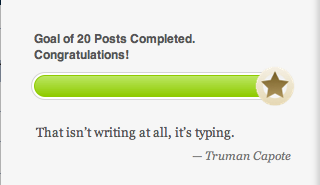
Look at all of the positive imagery there: “Goal completed”, “Congratulations”, a big green line that is completed and a gold star!
And then look at the quote. For those who don’t know, that was Capote’s response to Kerouac’s production of “On The Road”, which was written up in a very short time on a giant roll of paper that Kerouac assembled so that he could just keep typing without having to change paper. Now, I know this quote and I’ve even embraced this quote for my personal (art/writing) blog which has the title “This Is Not Art, This Is Typing”. I’ve embraced it for projects such as NaNoWriDay – 50,000 words in 24 hours, which I did for charity. I’m (strangely) proud of my ability to write quickly.
But this response took the wind out of my sails a bit. I’d been mostly ignoring the ‘goal’ messages because I schedule my posts for publication, rather than hitting publish immediately, and this means that I haven’t seen one for a while. I happened to hit the update and got this – my initial thought of “wow, 20 posts, I’m sticking to my plan” was a nice bit of positive reinforcement.
But what is that quote doing there? The automated system has counted my posts and thinks this is the best thing that should come up? Is it a joke? Is it supposed to be a gentle ribbing or something?
I pretty much write for a living. I’m used to people criticising my work. I guarantee you that someone is going to be ruder than this to me today – and it will be personal, rather than just randomly allocated. Imagine what happened if someone had spent a year pouring their heart out into their blog and, on post 20, *ding* well, ok, 20 posts, but, just so you know, it was all just typing.
Now my point here is not that I’m under psychic assault but it is a fantastic example of how, with the best intentions, one careless piece of assembly can completely undermine everything that you’ve tried to achieve with well-designed courseware and attractive, positive messages.
I would suggest that the Capote quote should never show up on WordPress. To be frank, the quote has never really contributed anything anyway – just another Capote quote, somewhat clever, very snide, generally nasty. It’s the kind of thing people say when they want to diminish the value of what you’ve done. In the education business, we do not get paid to make people feel bad about how much smarter we are than they.
Sadly, too many educators still take that path. We’re dealing with forming minds – intellectual embryos – we have to choose our words carefully, our materials even more carefully and always be aware that accidental juxtaposition risks being seen as deliberate when people are sensitive or looking for reasons to doubt themselves.
This quote, which I know and I’ve integrated into other places, in this context, made me question the value of what I’m doing here. It’s a valuable reminder of the power of reinforcement and feedback – positive and negative.
Why you can still read this blog during the blackout
Posted: January 19, 2012 Filed under: Opinion | Tags: PIPA, reflection, SOPA Leave a commentThis is an ‘out of sequence’ post, to explain why my blog is still available during the SOPA/PIPA blackout. You’ll note that the blog is sporting the “STOP CENSORSHIP” ribbon because I don’t want any censors to have hips. More seriously, both bills will fail to achieve their (purported) primary aims, do not take into account a number of key technology issues and can easily be exploited to censor content, for any reason, at any time. The main thing that must be said is that these bills will not usefully stop piracy, any more than DVD regionalisation stopped dodgy copying.
However, I haven’t gone to the WordPress blackout option because it links to information on how you can influence your representatives and, while SOPA and PIPA would (if passed) affect me, I am not an American citizen, permanent resident or resident of any kind. Yes, I hope these bills die but I am not comfortable with directing people to vote or contact their representatives in a specific and certain way when I am (legitimately) not entitled to vote in their country.
I support a free and open internet, where illegal activity is dealt with by established legal precedent and the forging of technically sound, fair and suitable agreements between countries to deal with the difficult problem of international boundaries. I do not support a system where a rumour of misconduct can wipe out a site in seconds. But, note carefully, I do not support piracy. I do not support theft. I also do not support bad tech, political posturing and the false dichotomy that to be against SOPA/PIPA is to be pro-piracy.
It is up to the American people, and their elected representatives, as to what they do with this. I’ll just keep my fingers crossed.
Can you read what I see?
Posted: January 19, 2012 Filed under: Education | Tags: education, higher education, resources, teaching, teaching approaches Leave a commentI’m going to touch on an area that I don’t have a great deal of experience with but that I’ve thought about a lot: making teaching material available to students who are visually challenged. My terminology here is important because I don’t want to ‘deal with’ these students, mainly because I think that it sets my mind into the wrong framework. You ‘deal with’ parking tickets. You ‘deal with’ onerous problems. What I want to do is to make teaching material available to everyone but, if I’m using a visual focus, I have to consider alternative delivery mechanisms for people who don’t have that capability.
(I should note that, when I first wrote that paragraph, autocorrect decided that I wanted to make material available to students who were visually challengING. Proof reading is really your friend, sometimes.)
Let’s talk about one of the first issues you might encounter: people who are, to some degree, colour-blind. How many people do you think are colour-blind?
1 in a million?
1 in a thousand?
1 in a hundred?
8 in a 100 men are colourblind, compared to 1 in 200 women. Get 64 men in a class, you are 99% likely to have someone who is colour-blind. Most of these people will have red/green discrimination issues. The most extreme will see no colour at all.
So how do we deal with that? Well, a number of products have modes that allow you to simulate colour-blindness to see what your work will look like. Turn off the colour or print it in black and white – how easy is it to discriminate based on the contrast of the work stripped of colour. Given those numbers, you may have a friend or colleague who can look at your work and tell you how it works for them.
Does this mean that you can’t use colour? No! What it means is that you can’t depend upon colour alone for contrast and separation. Do you have a complicated pie chart with 27 segments, using colour to separate them. (Firstly, why? Too much fine detail can distract people from your core point.) What happens if you outline the segments in black and switch off the colour? Does it look like a bicycle wheel? In motion?
Colour as a highlight or attention grabber will work for the vast majority of the population. It is, however, always helpful to think about those 8 in a 100 who will not get your message if you have depended too much upon colour contrast or a particular shade mix. (As always, keep trying, find what works, learn, evolve, start over from step 1!)
The more severely visually impaired, where part of the field of vision is lost, will have different techniques for managing things. Some will need pre-printed blown-up notes. Some will use telescopes. In my experience, most people are very straight forward about their requirements.
The one challenge, I find, is where I have a diagram that I wish to explain to someone who has no sight or has never had any sight. There’s my L&T diagram on the first and second posts of this blog (Jan 1 and 2). The text for this should be:
“A diagram showing the relationship between learning, teaching and the flow of knowledge. Two circles are placed, horizontally, so that they overlap with a small intersection. The left-most circle contains a capital L character, the intersection contains an ampersand character and the right-most circle contains a capital R character. Lines with arrows on their ends are placed around the diagram to indicate information flow. Two arrows, starting from outside the left most circle, pierce the left-most circle’s left boundary, terminating inside, with their arrow heads pointing towards the intersection to indicate the knowledge flows into the Learner. A similar pair of arrows start inside the right most circle and cross the boundary, with the arrow heads outside and pointing away from the intersection to indicate that the flow of knowledge is from the Teacher to the teacher’s environment.”
Now, even then, I’m not all that happy with this description. I don’t know what it is to not have any visual information – does right most or left most make any sense? Should I be more abstract? Am I depending too much on visual cues, still?
However, thinking about it makes me think about what my diagram stands for, how I would explain it and, to be honest, any description is better than none if it’s honest and accurate.
As always, don’t make this an excuse NOT to try this out. Think of this as one more small piece of information that can make it easier when you do decide to give it a try.
If you happen to have personal experience on this, from addressing this or living this, please throw in a comment. I’d love to hear from you, even if you are going to tell me that I’ve got it all wrong – it’s the only way I’m going to learn.
Who told you that you couldn’t?
Posted: January 18, 2012 Filed under: Education | Tags: education, higher education, reflection, teaching, teaching approaches 3 CommentsOne thing I often encounter when talking to people about designing teaching materials is that a lot of highly-qualified, sensible, smart and otherwise perfectly reasonable educators are adamant that, somehow, even a skerrick of visual design is beyond them. There are lots of good reasons why certain approaches work in certain areas, and, to be honest, sometimes black on white and simple is the way to go (like here), but I sometimes sense a resistance. This always makes me wonder “who told you that you couldn’t do this”, and then, almost immediately, “and why are you still listening to them?”
We are an amazing species. We live in so many different places, adapt so quickly and are very, very hard to stop. But, somehow, after you’ve made it through a degree or two, teaching qualifications, maybe a PhD (or two, you keen devil, you), secured a teaching spot and managed enough time to read this rant… you can’t sit back for five minutes and see which colours, typefaces and layouts make the key points stand out in your presentations?
I was having lunch with a friend and was ranting on about design, I am so much fun to have lunch with, and when I said that I thought it was an important thing for everyone to think about, he said “We can’t do everything.”
I completely agree to an extent – if we never try anything, we certainly can’t achieve it. Of course, there are degrees of all of this. Much in the same way that my oil paintings are more likely to serve as paintball targets than hang in National Galleries, there are people who have more or less talent in using visual representation to present knowledge. But zero ability? I think that there are surprisingly few of those.
But this is where you support network comes in. They aren’t a cheer squad – if something is bad they should tell you. If something is bad, and someone tells you, then you either fix it or remove it. But if something is good, or has any merit, then these external voices can help you to overcome that whole “I’m a scientist, not a graphic designer, Jim!” thing.
You don’t have to be a graphic designer. There are many tools around that, with a little thought, will help you make some interesting choices that won’t break people’s eyes. Keynote and PowerPoint have quite sensible defaults and well-designed templates. Using one of these and not jamming three million lines on to the screen will generally result in a tolerable outcome. Using the notes feature in either and printing out take away handouts for students will deal with the ‘presentation versus notes’ problem. Look at other presentations that you’ve liked and, respectfully, adopt the features that work. Learn and use some of the simplest techniques for making things look better. Things like the Golden ratio for working out relative text sizes – simple but effective. Things like checking your work for its black and white contrast or what happens if the colours change… (more on this later) Some of the big companies have spent a lot of money to hire designers to make your job easier. Don’t fight it – use it!
Ok, some of you can’t do this. I get that. If you’ve tried, and all you get is TimeCube (NOT SAFE FOR WORK IN SO MANY WAYS), then step away from the keyboard. 🙂 But if you haven’t really tried because you’re scared of getting it wrong, or because, years ago, someone put you in the box of “No, you can’t”, then try again. Get an honest mirror to look in and try again.
True confessions time: Are all of my materials at a level where I’m proud of them and think that I’ve done as much as I can? No, not yet. But I am working on them and converting them, consistently and maintaining the integrity of the course, as much as I can and as fast as I can. I am on the same path that you are and I still have a lot of work to do but sharing with my local, extended and network community makes me value my efforts in this direction more. And all my student feedback says “Not only do we like it, but we seem to learn better from it.” Maybe it’s because I like it more – maybe the materials are better. For once, an outcome will suffice.
Today’s homework, which you are so free to ignore, is to consolidate an entire lecture’s key points into one slide – at the presentation systems’s default font size (no shrinking!). Can you? Should you? Why or why not? If this slide, assuming it exists, was up the front, would it make the entire lecture easier to understand? If at the end, does it tell everyone what they should know? How has it made you think about the lecture? What would a student learn if you set this to them as an assignment?

 Nick Falkner