
Flow, Happiness and the Pursuit of Significance
Posted: June 22, 2012 Filed under: Education | Tags: Csíkszentmihályi, curriculum, education, educational research, flow, higher education, learning, measurement, MIKE, reflection, resources, student perspective, teaching, teaching approaches, time banking, tools, universal principles of design, vygotsky, Zone of proximal development Leave a commentI’ve just been reading Deirdre McCloskey’s article on “Happyism” in The New Republic. While there are a number of points I could pick at in the article, I question her specific example of statistical significance and I think she’s oversimplified a number of the philosophical points, there are a lot of interesting thoughts and arguments within the article.
One of my challenges in connecting with my students is that of making them understand what the benefit is to them of adopting, or accepting, suggestions from me as to how to become better as discipline practitioners, as students and, to some extent, as people. It would be nice if doing the right thing in this regard could give the students a tangible and measurable benefit that they could accumulate on some sort of meter – I have performed well, my “success” meter has gone up by three units. As McCloskey points out, this effectively requires us to have a meter for something that we could call happiness, but it is then tied directly to events that give us pleasure, rather than a sequence of events that could give us happiness. Workflows (chains of actions that lead to an eventual outcome) can be assessed for accuracy and then the outcome measured, but it is only when the workflow is complete that we can assess the ‘success’ of the workflow and then derive pleasure, and hence happiness, from the completion of the workflow. Yes, we can compose a workflow from sub-workflows but we will hit the same problem if we focus on an outcome-based model – at some stage, we are likely to be carrying out an action that can lead to an event from which we can derive a notion of success, but this requires us to be foresighted and see the events as a chain that results in this outcome.
And this is very hard to meter and display in a way that says anything other than “Keep going!” Unsurprisingly, this is not really the best way to provide useful feedback, reward or fodder for self-actualisation.
I have a standing joke that, as a runner, I go to a sports doctor because if I go to a General Practitioner and say “My leg hurts after I run”, the GP will just say “Stop running.” I am enough of a doctor to say that to myself – so I seek someone who is trained to deal with my specific problems and who can give me a range of feedback that may include “stop running” because my injuries are serious or chronic, but can provide me with far more useful information from which I can make an informed choice. The happiness meter must be able to work with workflow in some way that is useful – keep going is not enough. We therefore need to look at the happiness meter.
McCloskey identifies Bentham, founder of utilitarianism, as the original “pleasure meter” proponent and implicitly addressed the beneficial calculus as subverting our assessment of “happiness units” (utils) into a form that assumes that we can reasonably compare utils between different people and that we can assemble all of our life’s experiences in a meaningful way in terms of utils in the first place!
To address the issue of workflow itself, McCloskey refers to the work of Mihály Csíkszentmihályi on flow: “the absorption in a task just within our competence”. I have talked about this before, in terms of Vygotsky’s zone of proximal development and the use of a group to assist people who are just outside of the zone of flow. The string of activities can now be measured in terms of satisfaction or immersion, as well as the outcomes of this process. Of course, we have the outcomes of the process in terms of direct products and we have outcomes in terms of personal achievement at producing those products. Which of these go onto the until meter, given that they are utterly self-assessed, subjective and, arguably, orthogonal in some cases. (If you have ever done your best, been proud of what you did, but failed in your objective, you know what I’m talking about.)
My reading of McCloskey is probably a little generous because I find her overall argument appealing. I believe that her argument may be distilled are:
- If we are going to measure, we must measure sensibly and be very clear in our context and the interpretation of significance.
- If we are going to base any activity on our measurement, then the activity we create or change must be related to the field of measurement.
Looking at the student experience in this light, asking students if they are happy with something is, ultimately, a pointless activity unless I either provide well-defined training in my measurement system and scale, or I am looking for a measurement of better or worse. This is confounded by simple cognitive biasses including, but not limited to, the Hawthorne Effect and confirmation bias. However, measuring what my students are doing, as Csíkszentmihályi did in the flow experiments, will show me if they are so engaged with their activities that they are staying in the flow zone. Similarly, looking at participation and measuring outputs in collaborative activities where I would expect the zone of proximal development to be in effect is going to be far more revealing than asking students if they liked something or not.
As McCloskey discusses, there is a point at which we don’t seem to get any happier but it is very hard to tell if this is a fault in our measurement and our presumption of a three-point non-interval scale and it then often degenerates into a form of intellectual snobbery that, unsurprisingly, favours the elites who will be studying the non-elites. (As an aside, I learnt a new word. Clerisy: “A distinct class of learned or literary people” If you’re going to talk about the literate elites, it’s nice to have a single word to do so!) In student terms, does this mean that there is a point at which even the most keen of our best and brightest will not try some of our new approaches? The question, of course, is whether the pursuit of happiness is paralleling the quest for knowledge, or whether this is all one long endured workflow that results in a pleasure quantum labelled ‘graduation’.
As I said, I found it to be an interesting and thoughtful piece, despite some problems and I recommend it to you, even if we must then start an large debate in the comments on how much I misled you!
Time Banking II: We Are a Team
Posted: June 12, 2012 Filed under: Education | Tags: curriculum, design, education, educational problem, educational research, feedback, higher education, learning, measurement, reflection, resources, teaching, teaching approaches, time banking, tools, vygotsky Leave a commentIn between getting my camera ready copy together for ICER, and I’m still pumped that our paper got into ICER, I’ve been delving deep into the literature and the psychological and pedagogical background that I need to confirm before I go too much further with Time Banking. (I first mentioned this concept here. The term is already used in a general sense to talk about an exchange of services based on time as a currency. I use it here within the framework of student assignment submission.) I’m not just reading in CS Ed, of course, but across Ed, sociology, psychology and just about anywhere else where people have started to consider time as a manageable or tradable asset. I thought I’d take this post to outline some of the most important concepts behind it and provide some rationale for decisions that have already been made. I’ve already posted the guidelines for this, which can be distilled down to “not all events can be banked”, “additional load must be low”, “pragmatic limits apply”, “bad (cheating or gaming) behaviour is actively discouraged” and “it must integrate with our existing systems”.
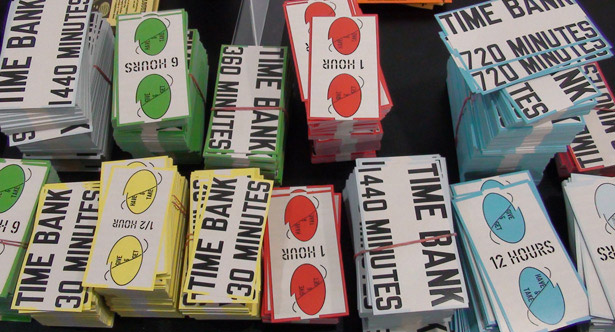
Time/Bank currency design by Lawrence Weiner. Photo by Julieta Aranda. (Question for Nick – do I need something like this for my students?)
Our goal, of course, is to get students to think about their time management in a more holistic fashion and to start thinking about their future activities sometime sooner the 24 hours before the due date. Rather than students being receivers and storers of deadline, can we allow them to construct their own timelines, within a set of limits? (Ben-Ari, 1998, “Constructivism in Computer Science Education”, SIGCSE, although Ben-Ari referred to knowledge in this context and I’m adapting it to a knowledge of temporal requirements, which depends upon a mature assessment of the work involved and a sound knowledge of your own skill level.) The model that I am working with is effectively a team-based model, drawing on Dickinson and McIntyre’s 1997 work “Team Performance Assessment and Measurement: Theory, Methods and Applications.”, but where the team consists of a given student, my marking team and me. Ultimately our product is the submitted artefact and we are all trying to facilitate its timely production, but if I want students to be constructive and participative, rather than merely compliant and receptive, I have to involve them in the process. Dickinson and McIntyre identified seven roles in their model: orientation, leadership, monitoring, feedback, back-up (assisting/supporting), coordination and communication. Some of these roles are obviously mine, as the lecturer, such as orientation (establishing norms and keeping the group cohesive) and monitoring (observing performance and recognising correct contribution). However, a number of these can easily be shared between lecturer and student, although we must be clear as to who holds each role at a given time. In particular, if I hold onto deadlines and make them completely immutable then I have take the coordination role and handed over a very small fragment of that to the student. By holding onto that authority, whether it makes sense or not, I’m forcing the student into an authority-dependent mode.
(We could, of course, get into quite a discussion as to whether the benefit is primarily Piagiatien because we are connecting new experiences with established ideas, or Vygotskian because of the contact with the More Knowledgable Other and time spent in the Zone of Proximal Development. Let’s just say that either approach supports the importance of me working with a student in a more fluid and interactive manner than a more rigid and authoritarian relationship.)
Yes, I know, some deadlines are actually fixed and I accept that. I’m not saying that we abandon all deadlines or notion of immutability. What I am, however, saying is that we want our students to function in working teams, to collaborate, to produce good work, to know when to work harder earlier to make it easier for themselves later on. Rather than give them a tiny sandpit in which to play, I propose that we give them a larger space to work with. It’s still a space with edges, limits, defined acceptable behaviour – our monitoring and feedback roles are one of our most important contributions to our students after all – but it is a space in which a student can have more freedom of action and, for certain roles including coordination, start to construct their own successful framework for achievement.
Much as reading Vygotsky gives you useful information and theoretical background, without necessarily telling you how to teach, reading through all of these ideas doesn’t immediately give me a fully-formed implementation. This is why the guidelines were the first things I developed once I had some grip on the ideas, because I needed to place some pragmatic limits that would allow me to think about this within a teaching framework. The goal is to get students to use the process to improve their time management and process awareness and we need to set limits on possible behaviour to make sure that they are meeting the goal. “Hacks” to their own production process, such as those that allow them to legitimately reduce their development time (such as starting the work early, or going through an early prototype design) are the point of the exercise. “Hacks” that allow them to artificially generate extra hours in the time bank are not the point at all. So this places a requirement on the design to be robust and not susceptible to gaming, and on the orientation, leadership and monitoring roles as practiced by me and my staff. But it also requires the participants to enter into the spirit of it or choose not to participate, rather than attempting to undermine it or act to spite it.
The spontaneous generation of hours was something that I really wanted to avoid. When I sketched out my first solution, I realised that I had made the system far too complex by granting time credits immediately, when a ‘qualifying’ submission was made, and that later submissions required retraction of the original grant, followed by a subsequent addition operation. In fact, I had set up a potential race condition that made it much more difficult to guarantee that a student was using genuine extension credit time. The current solution? Students don’t get credit added to their account until a fixed point has passed, beyond which no further submissions can take place. This was the first of the pragmatic limits – there does exist a ‘no more submissions’ point but we are relatively elastic to that point. (It also stops students trying to use obtained credit for assignment X to try and hand up an improved version of X after the due date. We’re not being picky here but this isn’t the behaviour we want – we want students to think more than a week in advance because that is the skill that, if practised correctly, will really improve their time management.)
My first and my most immediate concern was that students may adapt to this ‘last hand-in barrier’ but our collected data doesn’t support this hypothesis, although there are some concerning subgroups that we are currently tearing apart to see if we can get more evidence on the small group of students who do seem to go to a final marks barrier that occurs after the main submission date.
I hope to write more on this over the next few days, discussing in more detail my support for requiring a ‘no more submissions’ point at all. As always, discussion is very welcome!
Picking Your Posts Carefully
Posted: May 18, 2012 Filed under: Education | Tags: blogging, education, higher education, reflection, vygotsky Leave a commentOf course, when you’re attending an important meeting where people will find out about your blog, it generally helps if the top blog post is not a semi-humorous post about learning teaching lessons from your cats.
Time your Vygotsky posts correctly!
Got Vygotsky?
Posted: April 25, 2012 Filed under: Education | Tags: Csíkszentmihályi, curriculum, design, education, flow, games, higher education, learning, principles of design, resources, teaching, teaching approaches, tools, vygotsky, Zone of proximal development, ZPD 4 CommentsOne of my colleagues drew my attention to an article in a recent Communications of the ACM, May 2012, vol 55, no 5, (Education: “Programming Goes to School” by Alexander Repenning) discussing how we can broaden participation of women and minorities in CS by integrating game design into middle school curricula (Thanks, Jocelyn!). The article itself is really interesting because it draws on a number of important theories in education and CS education but puts it together with a strong practical framework.
There’s a great diagram in it that shows Challenge versus Skills, and clearly illustrates that if you don’t get the challenge high enough, you get boredom. Set it too high, you get anxiety. In between the two, you have Flow (from Csíkszentmihályi’ s definition, where this indicates being fully immersed, feeling involved and successful) and the zone of proximal development (ZPD).

Extract of Figure from A. Repenning, "Programming Goes to School", CACM, 55, 5, May, 2012.
Which brings me to Vygotsky. Vgotsky’s conceptualisation of the zone of proximal development is designed to capture that continuum between the things that a learner can do with help, and the things that a learner can do without help. Looking at the diagram above, we can now see how learners can move from bored (when their skills exceed their challenges) into the Flow zone (where everything is in balance) but are can easily move into a space where they will need some help.
Most importantly, if we move upwards and out of the ZPD by increasing the challenge too soon, we reach the point where students start to realise that they are well beyond their comfort zone. What I like about the diagram above is that transition arrow from A to B that indicates the increase of skill and challenge that naturally traverses the ZPD but under control and in the expectation that we will return to the Flow zone again. Look at the red arrows – if we wait too long to give challenge on top of a dry skills base, the students get bored. It’s a nice way of putting together the knowledge that most of us already have – let’s do cool things sooner!
That’s one of the key aspects of educational activities – not they are all described in terms educational psychology but they show clear evidence of good design, with the clear vision of keeping students in an acceptably tolerable zone, even as we ramp up the challenges.
One the key quotes from the paper is:
The ability to create a playable game is essential if students are to reach a profound, personally changing “Wow, I can do this” realization.
If we’re looking to make our students think “I can do this”, then it’s essential to avoid the zone of anxiety where their positivity collapses under the weight of “I have no idea how anyone can even begin to help me to do this.” I like this short article and I really like the diagram – because it makes it very clear when we overburden with challenge, rather than building up skill and challenge in a matched way.

 Nick Falkner