
False praise but I love your journal (random number)
Posted: February 4, 2012 Filed under: Education, Opinion | Tags: education, higher education, reflection, teaching, teaching approaches 1 CommentYou’ll excuse me writing a post that is reaction to my comment spam but a recent spate of spam reminded me of something important.
False or insincere praise is worse than no praise at all.
I use WordPress’s ARMY OF AUTOMATION to detect and corral my spam comments into an area where I can inspect them and delete them, without all of you having to read about false Google page rank updates, or notes saying things like “Wow, I loved this, keep it up 782346”. Things designed to take you to trap blogs or URLs to give some person somewhere some money. But I still manually review the spam to ensure that some poor ‘fan’ hasn’t written something that tipped the false positive scale. What this all reminded me of was my disappointment when I realised that something that I thought was personalised praise was actually automated nonsense, designed to suck me in. It’s deflating.
Some years ago, when I was just starting out, I received an e-mail from the chair of a relatively highly ranked conference inviting me to be on the program committee. Given that I’d published a bit in the area, I thought it was personal recognition and was really chuffed until my wife, very, VERY delicately, pointed out that it had gone to a giant mailing list called DBWORLD. (Yes, I should have noticed, but in those days I read the content before author and subject. These days, I do a lot more pre-filtering.) Every single person on that list had received that e-mail. This was a not a personal e-mail in recognition of any achievement on my part, it was a seat-filling exercise that had hit me as part of a wave.
There is a big difference between addressing small groups of people within the large, while openly admitting that you’re speaking in the large, and sending something that appears to be personal, but is secretly in the large. If you’re sending out messages of congratulations to the top performers in your class, why not spend the extra effort to send each person a message? They probably are going to talk about it and may notice how similar your message is – some may not care, of course, but some might. People who aren’t showing up? You can probably use blind carbon copy to send out the initial reminder, because it’s not SUCH a personalised message, and then personalise as they respond, or you can start personal, if you can manage it.
If you have a group of top students, but each one has nailed down a specific aspect of the course, noting the specific achievement as part of genuine and personal praise is, I suspect, going to have a far greater effect than a blanket e-mail saying “You’ve all done well”. “You’ve all done well” means I sorted the marks, selected the top 5 and pasted their e-mail into a mail merger. Specific praise, to reinforce that you have read it, you do know it, and you know at least some of that student’s mind, is going to reinforce the reality that you did mark it, what was submitted was noted, the work that went into it mattered.
This is what we’re saying when we produce genuine praise: “what you did mattered and it was good”
That’s why all feedback should be genuine and grounded in the work. Even if you’re giving general feedback to a class, I think it’s really helpful to find as much ‘resonant truth’ as possible – the feedback that everyone nods along to and goes ‘yes’. I could talk about authenticity and the importance of being genuine for hours but, once again, that’s another post.
Don’t get me wrong. Genuine praise and follow-up on the mass scale is better than none at all. If you have the time and resources, then we can probably all agree that personalised is better than general.
However, false praise, or insincere or misdirected praise, is counter-productive and really doesn’t have much place in our practices. It’s false and, ultimately, we’re about truth.
You Can’t Believe You Did So Badly?
Posted: February 3, 2012 Filed under: Education, Opinion | Tags: education, higher education, reflection, teaching, teaching approaches 1 CommentA common e-mail comment I’ve had from students who didn’t get the mark that they were expecting is often “I can’t believe I did so badly” or words to that effect. “I knew I did well in the exam.” “I answered all of the questions correctly.” All of these are the same and, expect for the rare occasion when we have made an administrative error in assembling the mark, it usually indicates one thing.
The student doesn’t have enough knowledge to be able to assess their level of knowledge.
It would be glib to talk about Dunning-Kruger here, so I suspect it would be even more glib to mention it in passing and not discuss it! The Dunning-Kruger effect is a bias in your thinking that leads people with lower skill level to have an artificially high assessment of their own skills. The converse is that the highly skilled often underrate their ability.
When these students look at their exam scripts or assessments again, as I encourage them to do, the illusory has to confront reality. They see where I drew a red line across a page to indicate that they didn’t answer, say, question 2 at all, which cost them up to 30 marks. They see the places where I asked them to explain an unlabelled diagram, or to give me the detail underneath their broad brush statements. Sometimes, it’s seeing where I’ve written ‘sorry, no’ beside where they’ve answered both true and false to the same question. Without explanation. Then again, some students look at what I’ve said and try to find any possible wriggle room to get extra marks. Where it’s trying it on, it won’t get them anywhere, but I understand it. Where it’s a genuine lack of understanding as to why what they’ve provided is not a complete answer? That’s sadder, because they’re now functioning at a level where, until they advance, they will fail and not understand why they’re failing.
Worse, they may not realise even that they need help, or what kind it will take, to improve their skills. They’re fine – it’s the rest of the world, including me, that’s wrong.
You only have to speak to some students who have been around a little too long, or who left without their degrees, to realise that among those who have genuine problems, but are aware of them and striving to fix them, there are those who have equally genuine problems but assume that it’s nothing they can fix because it’s not their fault.
Does anyone out there have suggestions as to how we can help or approach these students, dealing with the delicate matter of their feelings as well as the cognitive bias? Please share them!
Who’s better, who’s best?
Posted: February 1, 2012 Filed under: Education | Tags: education, higher education, measurement, MIKE, teaching, teaching approaches Leave a commentI’ve mentioned earlier that I assemble my final grades out of a number of assignments, all designed to test different areas, where a range of marks are possible. There are very few 0 or 1 situations in the assignments, with the possible exception of participation marks (and these never make up a big percentage of anything). Now the natural spread of marks across all of these assignments contributes to a slightly noisy final mark. As a general indicator of performance, the band into which your final mark falls is going to be pretty reliable. If you get 50-64 in one of my classes then you know enough to move on from the course. You have enough knowledge. If you get 45-49… well, then we offer you a chance to sit the exam again or, sometimes, do more assignment work, because we’re sitting in a slightly noisy zone and giving you another chance might get you over the edge.
But what is the real difference between a student who gets 50 and one who gets 60? 64 and 65? 98 and 99? Which of these leap out to you and say “Well, obviously, this student is better!” What do we even mean by better in this case? In my opinion, if a course is designed correctly, and the students are properly prepared, then a pass mark is available for everyone if they do the work and apply themselves. The higher grades are only open to people who move on to synthesis, or can demonstrate deeper understanding, or can communicate their ideas more clearly, or… you get the idea. It’s often a sign of increased effort, to a large extent, than greater ability. (I’m sure we all have very smart students who are mildly bemused as they fail again because they just didn’t hand enough up or actually read a book.) In terms of general bracketing, a student who achieves a credit has probably done more than one who has a pass.
Okay, yes, the borders are tricky but with enough assessment work and opportunity, sometimes people just don’t make it over the line. If we have the ability to fail people, then we can apply some sort of higher level banding to higher level concepts. (There’s lots to say here and I’m trying to keep this short and on point, but I’ll try to return to this later.)
When it comes to numerical marks, though, inside the bands, that’s a bit shakier for me. Yes, there’s a difference between 100 and 85 (do we need a VHD?), but 99 and 98? No, they’re pretty much the same. It’s a shame, therefore, that we often rank students in our heads on these numbers rather than their grades. Or we average the grades and come up with a number that is as accurate and as useful as an average can be. Should we be using the average? Mode? Median? Harmonic mean? What makes sense in the face of what these students have done?
It’s a shame then that values like these, or averages of these, or GPAs, have so much weight in the community. It’s not as if most people dig down, or have the ability to dig down, into the underlying courses to see what these things actually mean. Perhaps we should be awarding marks for mastery of core materials, a separate mark for performance in projects and yet another mark for advanced or extension work, tying it into industry practices and terminology? Then you could look at the numbers, as they are, and having isolated the components that have been jammed together before, get an idea of what that number means.
Imagine that a student has a perfect GPA for a set of courses that, as it turns out, have nothing to do with what your company does – except that the name sounds about right. Another student with a slightly worse GPA has perfect marks for core, including the language and techniques you want, and is fantastic on projects. You may find this out at interview or in the application but, if you only take perfect GPAs and ditch everything else, you’ll never even see number 2.
I’m not saying that our current system is unworkable, because it obviously works, but I have started to wonder what else we could do – in an ideal world. There’s no solution here, this is not amazingly pragmatic thinking, which doesn’t take into account the fact that so many people who take our students want that number. But that doesn’t mean we can’t talk about it and think about it. Maybe there’s something better? The first step is to work out what it is.
I ric, you ric, we all ric for… rubric?
Posted: January 31, 2012 Filed under: Education | Tags: education, educational problem, higher education, teaching, teaching approaches 1 CommentIn teaching, we use rubrics to let students know what our expectations of quality are. I can set an assignment, list my expectations in order to achieve a certain grade and, better still, I can then mark against the same statements. Clear, fair, transparent. Here’s an example for, say, an essay on developments in distributed systems in the early 21st Century. I don’t have access to some of my previous rubrics at the moment so this is a little ‘off the top of my head’. Please focus on the intent (conveying a specific requirement to the student) rather than and/or arrangement of clauses.
References:
- An unsatisfactory grade will be awarded for references if you have fewer than 5 relevant references or the references are not primary sources or high quality peer-reviewed publications. You should not include unreviewed work, Wikipedia entries (unless to illustrate a specific technical point that deals with Wikipedia or Wikipedia policy) or Personal Communications (unless you clear these with me first). To determine the ‘ranking’ or ‘quality’ of a publication, you may use Impact Factors or CORE/ERA rankings. If in doubt as to the nature of the publications or the quality of your references, check your references with me by posting to the main forum’s Student Questions section.
- To achieve a satisfactory mark, you must provide clear and accurate citations, at least 5 as described above, for all external material included in your work (see (web page reference) for University citation standards and avoiding accidental plagiarism).
- To achieve a mark in the range of credit or distinction, your clear and accurate citations should include at least 10 relevant references from A or A* journals and conferences.
- To achieve the best mark, your references should also reflect a thorough reading of the area, with at least 20 relevant references, 10 derived from A* journals and the remainder A/A* publications.
It’s fairly easy for a student to work out what they need to do in order to pass, do better and excel. It’s also fairly easy for me to mark because I know where the core reference should be coming from and, if one appears out of left field, then the worst case situation is that I learn about a new venue.
I would usually arrange this in tabular fashion so that all of the requirements for the essay were arranged along the left column and, as you moved across the row, you could look up to column top and see Unsatisfactory, Satisfactory and look in the intersection of row and column to find out what you have to achieve in aspect X to achieve outcome Y. There is still a great deal of room for movement in marking this but, as a framework, I find it useful.
Let me compare this with something I received once for an assignment.
References: Your references should be good, with enough to support your argument. Remember to cite correctly. We take plagiarism very seriously.
I leave it to the reader to decide which of these tell them what they have to do in a more useful way, and which they think would probably be easier to mark in a fair and consistent manner.
Those Dang Kids and Their Phones, Computers and iPads.
Posted: January 30, 2012 Filed under: Education, Opinion | Tags: education, higher education, reflection, teaching, teaching approaches 1 CommentSome my students use computers in my lectures and, while I’m sure that a number of them are writing notes or looking at the notes, I’m sure that many are ‘multi-tasking’ with social media or the like. They’re not playing games, because I know what they looks and sounds like (wwwwwwwddaaaaa*click**click*wwww *DAMN*) but these mobile platforms are more powerful and more pervasive so this will happen a lot. Now, despite the presence of computers, I can usually get the students with gadgets to participate, answer questions and do all of those good things. If I have a question, I don’t have to repeat the previous 5 minutes of speaking to get an answer. They’re mostly listening. But, whenever the gadgets are out, there’s always a worry that those dang kids are surfing the internet rather than listening to you.
Now, I’m sure that some of you have very strong opinions about this. Why do students do this given they’ve bothered to show up?
I have, in recent experience, attended meetings which had an obligatory nature to them and, among my colleagues, seen a lot of iPads, notebooks, laptops and phones in use during these meetings. Now you’d expect that someone would be most active on this mobile reference and presentation platform when it was their turn to talk or be talked to, but generally it seemed to be when the person in question wasn’t required to do anything. In fact, these gadgets get the most workout when the person holding them hasn’t done anything in the meeting nor is expected to. Armed with a gadget, these people (who may have been colleagues) had tuned out because the major reason that they were in the meeting was because someone had told them that they had to be. If they didn’t have gadgets they’d probably be sleeping (quietly), doodling or talking to the person next to them.
Every time someone complains about students who focus on the gadgets rather than the lecture, I think about those meetings where I’ve checked my mail during a dull patch in a meeting. Or done some other (useful and real) work that had nothing to do with the event that I was in.
I know, I’m a terrible human being with a short atten… what? But the thing is, give me a reason that I should be somewhere and a reason to participate, interact and listen? I’ll be there, armed with my knowledge and my supporting fleet of tech. THEN, the gadgets are only used as they should be. I don’t doodle. I stay focused. No doubt everyone reading this has a better attention span than I do and has never, ever been bored in a compulsory meeting on new OH&S standards for refrigerator cleanliness or has tuned out while trying to listen to someone reading tiny-font info-dense slides to you, regarding new research standards.
Hmmm.
We want our students to be like us. In many ways they already are. Yes, some students are very hard to engage but, for most of them, if they have a reason to be there and a reason to listen and take part, chances are they will.
Never Put The Roof Up First
Posted: January 29, 2012 Filed under: Education, Opinion | Tags: education, higher education, reflection, teaching, teaching approaches 1 CommentI had a great coffee meeting on Friday with a friend and colleague (who will be feeling self-conscious if he’s reading this now) and we were talking about a number of things, some education related, some research, some relating to the fact that the coffee shop was closing early. He reminded me, however, of some of the most important lessons I learned last year when I finally got the chance to produce a new Computer Science course from the ground-up, with no previous offerings at our Uni. So, with thanks to Jono, here are the things I learned about how to build a course, in a building metaphor to allow me to draw pretty pictures:
- Buildings Don’t Just Happen
Fortunately for the building industry, bricks do not spontaneous leap together to form load-bearing structures. Resources need to be identified, plans need to be drawn, tasks need to be allocated. The fundamental requirement is that you know what kind of building you’re trying to construct!
Similarly, for my course, I had to work out what I wanted to teach by looking at the curriculum to determine the scope and area. I had to figure out what students already knew by looking at previous courses and performance. I had to work out what people expected my students to know in terms of overall degree, courses that used mine as assumed knowledge and pre-requisites, and in terms of how much more each area would be taught. Once I knew that, I had my overall goal in my head and I had a much better idea of what I was supposed to be doing.
Yes, I could have just put together a course on advanced C++ programming with some data structures but any meeting of the goals I was supposed to have been achieving would have been accidental. You don’t ask a builder just to build you ‘a house’.
- Never Put The Roof Up First
You can’t put the roof on a building until there are enough supporting structures. Same process in a course. You can’t build to advanced concepts without fundamentals. You can’t generalise in a meaningful manner without knowing when to use specifics. For me, having determined my goals, sketching out all of the concepts in turn allowed me to think about how I was going to relate them. How I would move from one to the other. We can generally all agree on what the key concepts are but there are some ways of ordering them which are better than others. Ultimately, don’t start with the capstones! Things without support fall down.
- Think About The Occupant
A well-designed and well-built building is a fantastic thing. Everything is in the right place, everything works. When all of the resources and plans have been assembled and used in a way that the final realisation is optimal for the occupant, happiness ensues. We’ve already talked about our goals and concept building – is this now set up in a way that works for your students? Are you building for one cohort or all of them? Is there space for different academic levels in the student body (because they will be there) or will people pass “if they’re smart enough”. Who will be in your course? Are your course features going to be appreciated as features? Are they even, being brutally honest with yourself, features… or rationalisations?
- Get It In Writing
The builder does not pass on instructions via psychic powers. Apart from anything else, there are too many people to talk to, some of whom may not even be on site. Your carpenters, plumbers, brick layers, electricians, inspectors… the list goes on and, if you had to constantly check every little thing every time, your building will never get built. Good, and large-scale, builders not only have plans, they have specific plans for specific jobs so that everyone who works for them knows what they need to do as part of the bigger picture, with the spotlight on their area of expertise. Once you know concepts, relationships and targets, you can put together a plan that anyone can follow, assuming that they have the skills, to build you the house (or the course) of your dreams.
Your overall plan could include your examination scheme (what’s in it? what form does it take? how long is it?) which assesses all of your target concepts. Built around these are the details of examinations, assessments, exercises and the lectures and content required to pass all of this on. Do you need a course provided in Blackboard or Moodle? Any special requirements? You can spin off a sub-section and get it to the right person so that, instead of waiting until the beginning of term and doing it in a flat panic WHEN they can find you, the relevant people can create what you want from your plan. Got TAs? A good design and plan will show them what they are lecturing, when and what you expect them to highlight. Yes, you’ll still need management meetings along the way most likely, but this will save you a heap of work later.
Time spent now will almost always save you more time later and make your life easier.
Think about it. What happens if you get really sick and someone needs to sub in? What would you prefer? A phone call during your prostate surgery that screams “Your course is on C++, what do they know?” or an e-mail that says “I’ve got all of your notes and plan. I’ll run that in-class quiz from the scratchies you prepared. Did you want me to cover anything else?” (Hey, I know, chances are you’re going to get called anyway because people are people but good preparation and planning will make the call shorter. 🙂 )
- Sometimes Things Go Wrong
Builders are lovely people but, from my experience, if one told me that the work was going to be done tomorrow, I still wouldn’t buy the champagne until a week from now. Complex assemblies of things are prone to interruption – whether big builds or entire semesters of new content. You can’t expect everything to go to plan. You have to allow yourself some flexibility to cover those situations that will occur in a new course. You won’t necessarily pitch the course at exactly the right speed. Do you have additional activities if you get through lectures more quickly? Do you have a disposable slot in case you need to extend a lecture. Or you get sick. Knowing what your core material is allows you to quickly refactor the course and keep the good stuff in (which you’ve already identified and is already in the exam, maybe) and get rid of some fluff.
What? No fluff? It’s ALL core? It’s going to be a long exam then! More seriously, can you move lecture content to tutorial, or extend an assignment a little, or put up a podcast, or arrange an extra session? If the answer to all of these is ‘No’ then you want to know this before you waste days of your time trying to make it happen. Sometimes things go wrong. A plan can help.



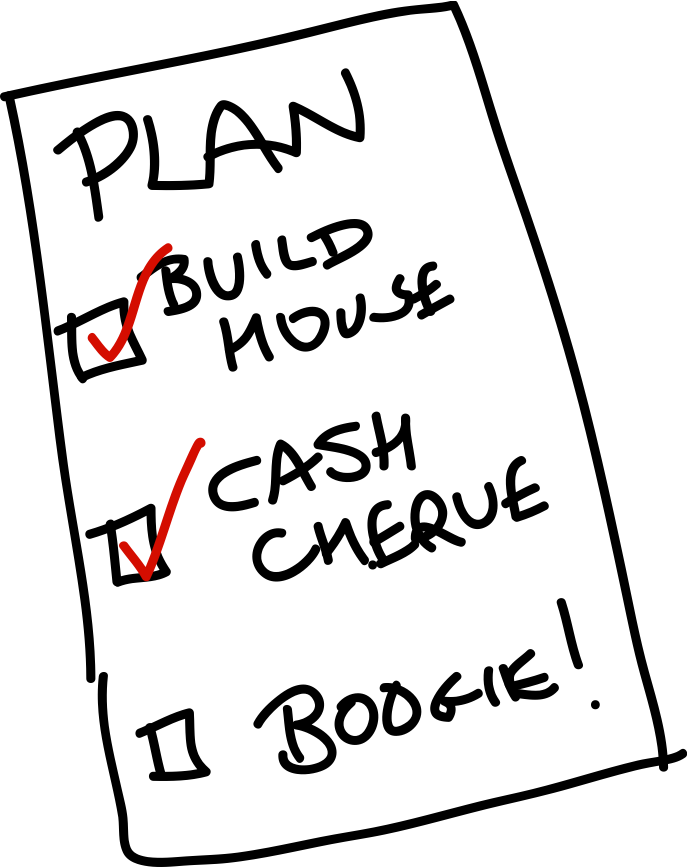

This is, most definitely, not the definitive list of things you should know but it’s certainly at least some of them! It was a fascinating process to go through. Next time I hope to make my attempts to live up to my own goals even better. Fingers crossed. 🙂
Dead man’s curve: Adventures in overdriving.
Posted: January 28, 2012 Filed under: Education | Tags: education, higher education, reflection, teaching, teaching approaches 6 CommentsLooking at my previous posts, you’ll know that I have a strong message for my students: do the work, do it yourself, get the knowledge and you’ll most likely (at least) pass. Part of my commitment to my side of the bargain is that a student almost exclusively controls the input that controls his or her own mark. Yes, very occasionally, we will scale a bit if we think that students are being disadvantaged but I have never seen a situation where we have increased the number of students who fail. (To be honest, our scaling is really lightweight.)
In particular, I do not fit grades to a curve. I rarely have so many students that such an approach would be even approaching statistical validity and, more interestingly, I tend to get an approximately normal distribution anyway, without any curve fitting. My position on this is more than mathematical, however, as it doesn’t sit well with me to fail someone because someone else did better.
Because we try very hard to not have to shift marks, we have an implicit obligation to manage the courses so that a pass mark represents a sufficient level of effort in assimilating knowledge, completing assignments, participating in individual and group interactive activities and the exam. Based on that, if everyone has done enough work to pass, then I can pass everyone. The trickier bit is managing the difficulty of the course so that the following conditions hold:
- A pass mark represents a level of effort and demonstrated knowledge that means that a student has achieved the required level of knowledge.
- A fail mark represents a level that, over a number of opportunities for improvement, indicates a combination of insufficient knowledge and/or effort.
- There is scope in every activity for students to demonstrate excellence. These excellence marks go ON TOP of the ‘core’ marks.
- The mark distribution is not bimodal around 0%/100% but has a range of possible values.
To avoid having to manually redistribute the buckets using curve grading, I have to build the course so that the final mark is built from assignments that meet all of those criteria and in a way that the aggregate of these marks will also produce marks that meet the final criteria. This, of course, means that I advertise assignment weightings, combinations and criteria as early as possible to allow students allocate their effort and then I have to incur the marking burden of applying a marking scheme that, once again, gives me this range.
One of the reasons that I believe this is important is because we risk overdriving one of our key student characteristics if we create an artificial curved-based separation. My students have all been through a fairly rigorous selection system by the time they reach me – the numbers dwindle through to final year of high school and the number who go to Uni are less than a quarter of those who start school. The ‘range’ of these students is the ‘not only passed but made it to a Uni course’. This automatically bands them relatively closely. If 100 students sit a course and half get 60 and half get 65 then, assuming I’ve done my job correctly in the design, they all deserve to pass because they are quite close in in-coming ability and they have achieved similar results. More importantly, the half who got 60 don’t deserve to fail because the other half get 65. If you overdrive noise then all you get is loud noise, not some sort of ‘better’ signal.
I’m not opposed to adaptation in teaching – in fact, I’m a huge fan of using challenge and extension questions to allow people other opportunities to excel, to refine their knowledge or to get a chance to be more specific. However, I support it from an additive approach, where marks are added for success, rather than a subtractive approach, where not managing to add more marks is treated as a mark removal exercise if a sufficiently large group of other people manage to add marks. This requires me to design courses carefully, give enough assignment opportunities for people to demonstrate their skills and provide a lot of feedback.
I note that I use almost no standardised testing and, where I do use multiple choice questions, I either require an accompanying explanation or the component is worth a small number of marks. As a result, I have a lot of flexibility in my marking.
I am not saying that we need to dumb down our material – far from it. If we design our courses with ‘acceptance level = pass, extension achievement = distinction’ we can isolate the core material and then put the ‘next stages’ in as well. As I’ve said before, letting a student know that there’s somewhere else to go and something else to do can be a spur to higher achievement.
Coincidentally, I had a meeting today with a colleague who has done some very interesting work on identifying and assessing the amount of ‘core’ material a student gets right from the ‘advanced’ material. From his early figures, there is very little variation in core material achievement level, as you would expect from all of this explanation that I’ve put up, but there was a vast range of achievement in the advanced material. More investigation required!
Two Slides Enter an Alleyway – Only One Returns!
Posted: January 27, 2012 Filed under: Education | Tags: education, higher education, resources, teaching, teaching approaches 6 CommentsOne of the commenters asked for examples of what I thought were examples of (relatively) poor material design and (relatively) better design. I’m not trying to weasel out here by using (relatively). These things are relative. Both slides I’m going to show you have good and bad points. From my experience, one is less well-received than the other and I can list some reasons for it.
Both slides are from first year courses, one taught in 2006 and one taught in 2011. The first is Powerpoint, the second is Keynote. (All copyright and page number data has been removed.)
Here’s number 1, which is a ‘not so great’ example.

And here’s number 2, which is probably better:

So, what are the major differences? To me:
- Slide 1 is cramped and hard to read. Following the long yellow lines, despite the fiendishly good contrast, is difficult.
- Slide 2 is simple and pretty easy to read. To be honest, it’s also covering much less ground but its intention is clear. The little node structure, which graphically links this slide to all previous work on linked lists.
- Slide 1 is not a relaxing slide to look at – imagine that dominating a darkened lecture theatre.
- Slide 2 has clear separation between English and not-English, very easy on the eye.
Slide 1 is a multi-stage proof, an extended working piece that takes multiple slides. Slide 2 is a revision slide and summarises the core of a previous concept in one slide, allowing the lecturer to add information, question the class and embellish. The class will have read Slide 2 in a short time and then be able to concentrate. People will be starting at Slide 1 for some time, trying to follow the lines and work things out.
So there are, as promised, some examples for you. Do you agree with my assessment? There are many other things to say about both. What do you think?
Hey! You! Write your learning and teaching blog more often!
Posted: January 27, 2012 Filed under: Education, Opinion | Tags: education, higher education, reflection, teaching 1 CommentSorry to shout but I’m now convinced that a regular blog post is beneficial to you and your learning and teaching. I’ve found that committing to a daily blog means that every day I have to set aside 30 minutes to think as a teacher. To think about what I’ve done and reflect on it, learning lessons, communicating them and trying to share my knowledge.
Isn’t that what we’re always trying to get our students to do? Now I’m making myself analyse my previous actions, assess my plans and be ready to explain it in a way that even the most patient co-lecturer would start to find tiresome.
Now a daily blog is demanding and I speak from a small authority as I’ve been doing this for the better part of a month and, sometimes, I stare at the screen for 5-10 minutes before the words come. But when the words do come, I often get more than I need for the next day. I’m writing this on my Wednesday night, and you’ll see this on Friday 0400 (ACDT +9.5) (Thursday on US time), a day after another post that I just stopped writing. Right now, I’m putting some time and effort into my learning and teaching. They (well, Gladwell) say it takes 10,000 hours doing something to become an expert. Less than three solid years of blogging to go before I become an expert in… uhh… blogging?
But I digress (for comedic value). I’ve got some posts up my sleeve and every time I blog, I think about my teaching rather than my admin or my research.
What are the benefits? Well, every day I’m thinking about what I’ve done and how I can get better. I’m open to new ideas. I seek out new information. I actively look for things to tell you. By committing, I’ve made you a part of my own community and, in at least a small way, I don’t want to let you down by not posting.
If all of us did it, maybe not daily but weekly, we’d have a flood of good teaching advice, experience and lessons that we could all draw from. Of course, then, we’d need a really good search engine to find what we’re after in a giant sea of useful information.
You know? I don’t think that’s too high a price to pay. I’d rather have so much good information I was spoilt for choice, than so little that I had to take what I could get. Right now we’re in a good place because so many inspirational and motivated people are blogging – but everyone’s stories matter. Tell us your stories! Tell us your view of the world we all share! I’ll try to read as much of it as I can.
Farewell, Distributed Systems Class of 2011.
Posted: January 26, 2012 Filed under: Education | Tags: education, higher education, reflection, teaching, teaching approaches 1 CommentHere is the message that I wrote on the forums, after my final lecture to my third year Distributed Systems class. I demand a lot of my students. Most of all, when they leave us to go out into the world, I expect them to have some knowledge. All of us, everywhere, who educate, know how precious knowledge is and how special it is when someone finally gets it. I’ve said a lot of this in lectures, and to individuals, but I always like to say one last thing before we turn off the lights and go in our separate directions.
Sometimes, for some people, what let them down was their ability to tell me what they knew. My advice is that you should always be working on the way in which you can describe and share your knowledge. The majority of marks in the examination were lost for loose descriptions, confusion of concepts and, in some cases, blatant and desperate attempts to arrive at the correct solution by writing everything you can think of. Focus on telling me what you know to be right and spend less time on trying to fool me.
A number of you will hit the workforce next year – you will need to be able to communicate your knowledge and convince people that you know what you’re doing. Maybe your excuse to yourself is that you’re not that interested in DS. Well, fine, but don’t expect everything in the work world to be fascinating and amazing.
(I love teaching but marking exams is one of the least enjoyable jobs ever – but it has to be done, done well and done in a way that supports all of the other activities that lead to it. A lot of things are like this.)
Alan Noble put it really well when he described what the Google Engineers did. They don’t just sit in their offices and code, they go out and talk to their colleagues and other business people. They communicate. They share ideas. They can put their knowledge into practice as coders and as communicators.
Let’s finish on a positive note. When you check your marks, if you’ve passed this course then you can rest assured that you’ve demonstrated enough knowledge to have earned your pass. You know enough about distributed systems that you can work in an industry where these concepts become more important by the day, towards a future that will make extensive use of the underlying principles that you learned here.
If you did pass, how did you do it? What can you learn from it that will increase your chances of success in the future? People say that they learn the most from failure, and I think that’s true, but unless anyone got 100% for everything, you can still improve. Was there something I said that can help you improve that in the future? I hope that at least some of it has been useful.
Now, if you didn’t pass, why was that? Were you doing too much? If you could get into this course then you have the aptitude to pass but we know for a fact that life often gets in the way. You need to allow yourself enough time to study for these courses and put enough work into the assignments and examination preparation. If you have a supp, study as hard as you can and try and get through it. If you come back next year, start from scratch and do everything again, as if it’s for the first time.
We are, above all, scientists. If have a set of possible actions and a set of possible outcomes, how do we select our actions to select our desired outcome?
We have covered an introductory set of knowledge in a fascinating, growing, active and exciting area of research and practice. It’s now up to you to make use of that knowledge.
I’m not teaching third year in 2012, as I’m working on a new degree program, so I may not see many of you again. If I don’t, I wish you the very best of luck in the future, wherever you go and whatever you do.


 Nick Falkner