
Teaching Ethics: No Shortage of Examples
Posted: April 16, 2012 Filed under: Education | Tags: education, ethics, higher education, reflection, teaching, teaching approaches 1 CommentI’m giving a lecture on Ethics today, which I always enjoy. Before any professional ethicists get nervous, it’s an introductory lecture that talk about the concepts, ethics, morals, different approaches and introduces utilitarianism and the categorical imperative. I also show a picture of a monkey wearing an eye patch and a pirate bandanna because, well, that’s just me. One of the great things about this lecture is that some of my students have never really thought about what it means to live in a reasonably safe society before – and what that must mean in terms of social contracts, expectations of behaviour and ethical systems. The other great thing is that there is no shortage of examples.
Today, I’ll probably refer to the recent ruling from the US 2nd Circuit Appeals Court that “since computer code cannot be physically obtained, it doesn’t fit the legal description of a stolen good“. (There are lots of links on this but I’ve chosen the Australian Gizmodo link.) An ex-Goldman Sachs programmer spent a year in jail after downloading some source code from his ex-employer and was charged with theft. The Appeals Court ruling now says that he didn’t assume physical control and, as a result, never deprived anyone of the use of the software – which are the two requirements that should have been met for the charge to stick. (Here’s the full ruling.)
The reason that I will be bringing this is up is to start discussion on codes of behaviour, the ability to commit ‘crimes’, and the legal system and how it reacts to all of this. The summary of this case is not whether the employee did anything wrong, it’s whether the acts were illegal. The programmer, Mr Aleynikov, has been arguing since 2010 that his acts didn’t constitute a crime since and, with regard to the laws under which he was charged, he now turns out to be right and he has been released from custody, with his conviction reversed.
Now, the question can be put to the class from an ethical and moral perspective – under which circumstances would this be a correct act? Forget the criminality because it’s no longer relevant. Should this always be allowed to happen? How can we evolve laws to deal with this situation when it’s malicious and not over prosecute it? Can we use laws for this? Are we now in the area of compacts and contracts? If Mr Aleynikov had signed a document stating that he would not undertake this act, then he could be pursued for breach of contract. Depending on the penalty/reward ratio, however, given that the software that was alleged to have been stolen was valuable, it is fairly easy to see why a charge carrying a custodial sentence was pursued.
Much in the same way that the RIAA has an interesting mechanism for determining value of downloaded music, it appears that heavy prosecution is actively pursued in order “to discourage the others”. The ethical framework for the determination of how prosecution should be brought is also a very interesting area.
I will be watching with interest to see what happens in the light of this, especially if new codes are brought in to deal with it, or old codes are specifically adapted to ensure that this doesn’t happen again.
For those not in Australia, there has been an anti-piracy campaign that makes statements like “You wouldn’t steal a car. You wouldn’t steal a DVD. Downloading is theft.” and so on. Almost all of the students I have spoken to have come to the same conclusion: they’re not the same because the ‘theft’ of the electronic version does not take total control of the artefact and deny someone else the use of it. It appears that the 2nd Circuit Appeals Court sides with them – the analogy is weak, at best. This, of course, does not make the deprivation of artists’, producers’ or distributors’ income a moral act – criminal laws do not have a one-to-one relationship with moral codes. This does illustrate that, in a world of easy and error-free duplication, we have to think of exactly what has occurred and be very careful that we don’t apply poor classifications and outdated codes to a new world.
And in the class, as always, discussion will ensue. The trick is to keep it flowing and avoid anyone getting too invested or ending up in a slanging match based on perceived immorality. That’s why I have the pirate monkey in there because it keeps it light. I’ll drop this example in and pull it out, for later discussion, at a hint of an increase in temperature. No doubt, there will be any number of students who will want to talk to me about this later.
I always enjoy teaching ethics!
The Community Lessons of In-Flight Entertainment
Posted: April 15, 2012 Filed under: Education | Tags: community, community building, education, feedback, higher education, reflection, teaching, teaching approaches 2 CommentsNow, this post isn’t just a reason to reuse that picture of the world’s most worrying looking pilot.

How YOU doin'?
It carries on from the discussion of blended learning that I started yesterday. These days we tend to mix face-to-face, on-line and mobile learning methods in order to deal with the varied nature of students who take part in our classes. It’s partly driven by accessibility, by geography, by the market and lots of other factor. My question yesterday was ‘What will the classroom look like in 2020?’ – my concern today is what will happen to our student communities if we don’t properly manage the transition to 2020.
Let me take you back to when I was much younger, flying from the UK to Australia on a 747. Back then, planes had smoking and non-smoking sections (with no real divider, apparently the smoke just knew), and the in-flight entertainment was some dodgy music channels on stethoscope-like headphones and one (or two) films played on big screens at low resolution. This was the norm for long haul (except for the smoking) up until the mid-late 90s. (Except for Business Class, I’m told, where the advances came in much earlier)

It's always better in business, even in the '70s.
What did this heavily synchronised central resource focus mean to the planes and their passengers?
- Individual requirements were ignored
If you needed to get up to go the bathroom, you missed part of the film. If the stewards asked you a question, you missed part of the film. If you fell asleep, you missed part of the film. The film was never replayed. Worse, films on planes were shown well in advance of their release into Australia (still happens occasionally) so it would be potentially months until you could see the rest of the film. Interestingly, and I remember this because I was very young, they showed films that would appeal to the majority of their paying passengers – grown-ups. One I remember was “The Drowning Pool”, rated PG, being shown. Violence, some blood, intense scenes and some swearing. Or so I found out after the fact because (a) I was 7 and couldn’t see over the seats and (b) I fell asleep. But you can probably imagine that a number of parents would have preferred that children not be exposed to a long and rather dull movie that nearly kills Paul Newman with a fairly intense drowning scene. (Sorry, spoilers, but it’s from 1975. And not very good. Watch Harper instead, the original movie about the character.) - It created an artificial scarcity
There are never enough bathrooms on a plane. Force people to sit down for 2 hours to watch a movie where they can’t pause it, stop watching or do anything else and you’ll cause a rush for the bathrooms at the end of the film. - People were still part of the plane ‘community’
If turbulence happened, as it does, or the pilot needed to make any other announcement, the fact that we were all wired into the same dissemination mechanisms meant that we could all still be reached. There was only one game in town, such as it was, and you were watching it, reading to ignore it (in which case the intercom would reach you) or asleep (but still reachable if the intercom pings are loud enough.)
Of course, this meant that a lot of people weren’t happy but they were all in one contactable community. Lots of conversation happened before the movies, while people queued in those big groups, and, depending on when the movie stopped, after the movie. Ideal? No. Frustrating? Yes, occasionally. Isolating? No, not really.
Then, of course, we moved to individual screens in the backs of seats (for most long haul carriers across the European Singapore to UK run and the trans-Pacific run) and, initially, this allowed you choice of title, but all synchronised to a repeating loop. Now you could have some control and, if you missed something for any reason, if you waited a couple of hours you could see it again. So point 1 was a little better. Point 2 still held because the end of movie times still ran into each other and bathroom queues were huge. We were, however, all hooked into the one entertainment system and still part of the plane community.
Next we got true video on demand – you could watch what you wanted, when you wanted (even from the moment you sat in your seat until the plane pulled up, recently). Now point 1 is dealt with. You can pause films, lock out the bad channels for your kids, rewind, flick, change your mind – and the queues for the toilets are way, way down. Point 2 is dealt with. What’s weird here is the change in community. Back when movies were synchronised, stewards would know roughly where everyone was in their movies and could, if they wanted to, work around it. With movies being personalised, any contact from a steward may force you to interrupt your activity – minor point, not too bad, but a change in the role of the steward. You are, however, still on the main information distribution mechanism, which is the intercom. I can still be reached.
You know where I’m going, I imagine. Last night I jumped on a plane that was only a 2.5 hour flight. Sometimes they have seat-back VOD, and I watched Tom Cruise on the way over on that system, and sometimes they don’t. I packed my iPad with lots of legally downloaded BBC goodies and, when I discovered that the plane only had an old AV system, I watched Dr Who episodes all the way home. Isolated. So disconnected from the plane community that a steward had to tap me on the shoulder to let me know that the announcement had gone through to tell me to switch off the iPad as I hadn’t heard it.
Right now I can completely meet my own individual requirements, without using the plane’s, and because so many other people around me were doing the same thing, we never got the synchronisation going to the point that we created artificial scarcity. Only one problem – we were completely divorced from the ‘official’ distribution systems of the plane, such as the intercom announcements, seat belt signs (why look up?) and dings. Sufficiently immersed in my personalised viewing that aircraft attitude changes, which I usually notice, passed me by.
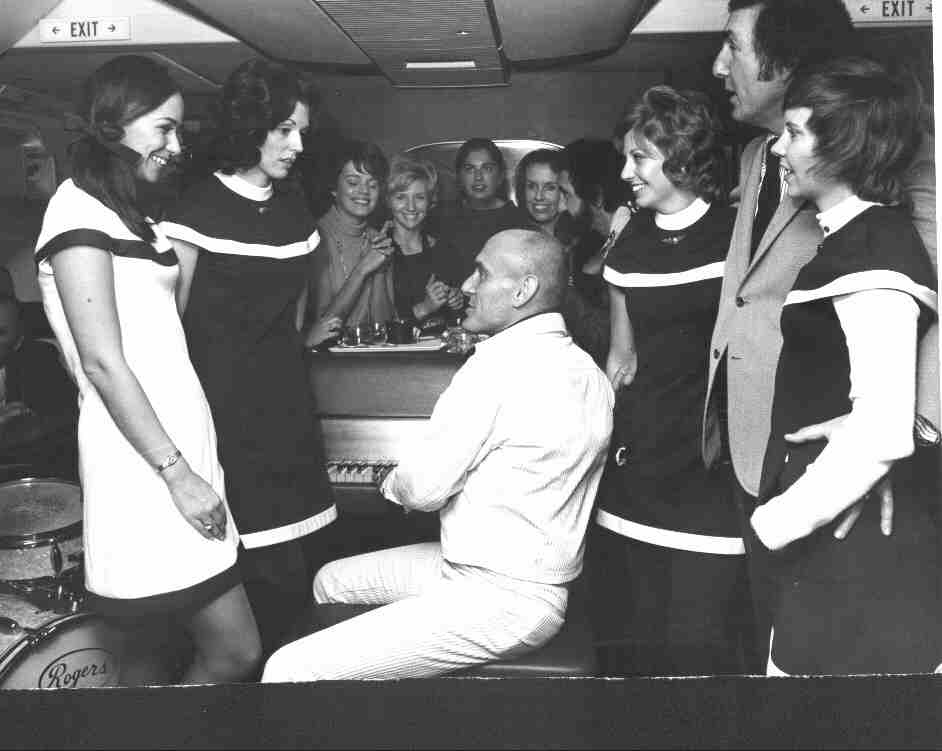
Excuse me, Sir, we need you to close the keyboard for landing.
As we develop the electronic communities of the future we have to remember that while allowing customisation and adaptation to individual needs is usually highly desirable, and that artificial restrictions, choke points and other points of failure are highly undesirable, that we have to juggle these with the requirement to be able to create a community. Lots of good research shows the value of a strong student community but, without the ability to oversee, suggest, guide and mentor that community, we end up with a separate community that may take directions that are not the ones that they should. Our challenge, as we work towards the classroom of 2020, is to work out which kinds of communities we want to build and how we construct systems around these that keep all the good things we want, while keeping educators and students connected.
Your Mission, Should You…
Posted: April 14, 2012 Filed under: Education, Opinion | Tags: advocacy, ALTA, education, educational problem, higher education, improving perception, learning, perception, reflection, teaching Leave a commentThe ALTA meeting of the last two days has been really interesting. My role as an ALTA Fellow has been much better defined after a lot of discussions between the Fellows, the executive and the membership of ALTA. Effectively, if you’re at a University in Australia and reading this, and you’re interested in finding out about what’s going on in our planning for Information and Communications Technology (ICT) Learning and Teaching, contact me and I’ll come out to talk to your school, faculty or University. I’m concentrating on engagement and dissemination – trying to bring the diverse groups in ICT education in Australia (38 organisations, 686 separate ICT-related programs) into a more cohesive group so that we can achieve great things.
To say that this is going to be exciting is an understatement. To omit the words ‘challenging’ and ‘slightly frightening’ would also be an understatement. But I always love a slightly frightening and exciting challenge – that’s why I eat durian.
ICT education in Australia does not have the best image at the moment. That information is already out there. A lot of people have no idea what we even mean by ICT. But let’s be inclusive. It’s Computer Science, Computing, Information Systems, Information Science, Communications Science, Information Technology… everything else where we would be stronger standing together than apart.
There are important questions to be answered. Are we a profession or professions? Are we like engineering (core competencies with school-based variation) or more like science (core concepts and very different disciplines)? How do we improve the way that people see us? How do we make 13 year olds realise that they are suited for our profession – and that our profession is more than typing on a keyboard?
How do we change the world’s perception so that the first picture that people put on an article about computing does not feature someone who is supposed to be perceived as unattractive, socially inept, badly dressed and generally socially unacceptable?
If you are at an Australian University and want to talk about this, get in touch with me. My e-mail address is available by looking for my name at The University of Adelaide – sorry, spambots. If you’re from overseas and would like to offer suggestions or ask questions, our community can be global and, in many respects, it should be global. I learn so much from my brief meetings with overseas experts. As an example, I’ll link you off to Mark Guzdial’s blog here because he’s a good writer, an inspiring academic and educator, and he links to lots of other interesting stuff. I welcome the chance to work with other people whenever I can because, yes, my focus is Australia but my primary focus is “Excellence in ICT education”. That’s a global concern. My dream is that we get so many students interested in this that we look at ways to link up and get synergies for dealing with the vast numbers that we have.
The world is running on computers, generates vast quantities of data, and needs our profession more than ever. Its time to accept the mission and try to raise educational standards, perceptions and expectations across the bar so that ICT Education (or whatever we end up calling it) becomes associated with the terms ‘world-leading’, ‘innovative’, ‘inspiring’ and ‘successful’. And our students don’t have to hide between their brave adoption of semi-pejorative isolating terms or put up with people being proud that they don’t know anything about computers, as if that knowledge is something to be ashamed of.
We need change. Helping to make that happen is now part of my mission. I’m looking for people to help me.
The Classroom of 2020
Posted: April 14, 2012 Filed under: Education | Tags: ALTA, education, higher education, reflection, teaching, teaching approaches Leave a commentThere were many lively debates at yesterday’s ALTA forum. (ALTA is the Australian Council of Deans of ICT’s Learning and Teaching Academy and is concerned with raising the quality and perception of ICT higher ed courses across the country. No pressure. 🙂 ) When you get 40 or so academics in a room then, if they’re even vaguely engaged, you’re going to have a pretty free and frank exchange of views. And one of the great things about ALTA is that we are all very engaged!
There was a lot of discussion on the rise in on-line learning and what impact it would have on the physical presence of students on campus. What does the classroom of 2020 look like?
Is it a room full of computers with students lined up facing them? (If so, how? Rows? Islands? Back to back? Face to face? Suspended from the ceiling? Embedded in desks?)
Is it a room full of people without a computer in sight? (If so, how is that room set up? Traditionally? For collaboration? Random group formation?)
Is it somewhere between the two, much as it is now?
Or is the bricks-and-mortar University a ghost town? Giant empty lecture theatres repurposed as server rooms, cooling conduits snaking through the old desks and chairs, with the students sitting, by themselves, wherever they happen to be, hooked into our remote on-line systems?
(I found it too depressing a thought to put a picture of this in here. The coming together of our students has so many benefits that I really hope it never goes away.)
As always, rather than adapting education to space, our best bet is to look at what we want to achieve and adjust the space accordingly. A linear layout computer lab is great for getting code written but lousy for group formation and collaboration. A low density island style suite is great for groups and collab but doesn’t support a more tutorial style with only one lecturer because of line-of-sight and group focus issues. A traditional lecture theatre is often unsuited to heavy computerisation because of simple things like power requirements. Getting above the space, what is a classroom? What will the mix be of classrooms, between physical, virtual, ad hoc and all of the other subtleties? Delivery, content, methodology – so many variables and so much room for passionate debate to try and share what works and make things better across all of our students.
I think we already have a good idea of what works for at least some of this and it’s pretty obvious that the mix of mobile, on-line and traditional learning, which we refer to as blended learning, is becoming increasingly popular and providing some excellent results, as well as a number of challenges. The debate continues on what the proportions of the blend will be – does this mean that we have accepted blended learning or is there a fourth, or fifth, component that will appear and change everything by 2020?
So, We Have to Have the Talk?
Posted: April 13, 2012 Filed under: Education | Tags: education, hierarchy of terms, higher education, parent term, reflection, taxonomy, teaching, teaching approaches Leave a commentI’m currently at the Australian Council of Deans of ICT’s Learning and Teaching Academy forum meeting and, across the group, we span Computer Science, Information Systems, Information Technology, Informatics, Computing, Computing and Information Systems – and several other areas besides. It’s great that we’re all together because, face to face, we discover how much we have in common across all of our diverse universities and schools.
But, after this, when we all go back to our schools of one name or another – will we all be working together or will the old boundaries creep in?
Is it time that we had the talk? The one that reminds us all that computers are the tools of our trade, and not our trade? The one that reminds us that IT, IS, CS, CIS, I, C all have more in common than they have differences?
If we, inside the discipline, can’t work out what we’re called and create artificial divisions then we can’t stand together to fight for the important things – the recognition as education inside our discipline as a field that is actually discipline research. Does that matter? Yes, in these days of metrics and contributions to research centres, it matters because that is how we are measured.
If we don’t know what to call ourselves, as a group of professions, who else will know? The student who plays a lot of World of Warcraft – hey, that’s computer use… well, no, it’s not for most of our purposes. That’s part of the talk – working out what goes where and being honest about it. Computers are the tool of computer science, the platform for applications, an implementation point for information systems – but they are never the whole of any of these disciplines.
If we’re going to have the talk, what are the questions? I think we should be asking what our parent field is called – what is the container for all of our names? How can we clearly state which schools do what? How can we tell students what they should know, what they should expect, what they’ll be doing and where they might be working?
Where do we go? Who do we talk to? What do we ask? How do we clarify what it is that we do, how people can join us, and – importantly – what it is that we don’t do.
Managing Failure, Avoiding Failure: Learning From Our Mistakes.
Posted: April 12, 2012 Filed under: Education | Tags: education, failure, handling failure, higher education, reflection, teaching, teaching approaches 3 CommentsOne thing that really identifies the best of my students is their willingness to try – they’ll take what they’ve learnt and throw themselves into unknown situations and see what happens.
Of course, to be willing to do this you either know what it is to fail and have learned not to be scared of it – or you’ve never failed before. I don’t think anyone’s defined by their first reaction to failure. Or their second…or their third… of course, all of this assuming that they were genuinely trying and preparing and (with any luck) learning and improving.
Let’s be honest – failure sucks. It’s more than the absence of success, because it’s the fact that you actually tried to succeed. Right now, I am failing in my attempt to be the first man to walk on Mars, but I’m really not all that upset because I haven’t spent all that much time on it. It’s not really a goal for me so I’m not invested in it. I’ve got some stuff that I am invested in and, if I fail at that, then that is going to suck but I’ll try to learn as much as I can from it.
I’m lucky, I’ve failed a lot but at times and in ways that haven’t wiped me out. It took me a long time to learn how to manage failure and an even longer time to work out how lucky I was that the nature of failure I experienced was so benign. So, reading this, keep in mind that I’m talking about academic marks, not ‘making a bad decision, killing two people and ending up in jail for the rest of my life’. It’s important to keep this in perspective, sometimes.
A lot of my students have a pretty good run on their way to my class. Top of their school classes, relatively comfortable background, low-crime environment, nice weather. Some of my students will encounter their first major failure while they’re with me. For some students, this is going to be shattering. This isn’t a matter of “it’s a bad report card”, it could be ‘your degree will take another 12 months.” The worst case is “you can’t study with us anymore” – but that’s a very serious proposition that’s only reached after years of underperformance.
I understand this because my first major failures happened when I hit Uni. Suddenly I had to study, I had to do things, I couldn’t get by. It took me a while to get my head around it but, in doing so, I really learnt the difference between those lecturers who could help me and those who couldn’t. I went on to succeed but I also went on to keep trying, even when I was reaching higher and my risk of failure became more severe. Here’s a sort list of the things that I try to pass on but there’s a lot more I could say on this:
- Don’t just say “I should have done more” identify what you should have done.
“I will work harder” is meaningless – you’ll work harder at what? “I will start my assignments 1 week earlier” is a clear statement of what you need to do but is secretly composed of so many other assumptions. “I will review my assignments on the day I get them and add them to my assignment plan (see point 2)” starts the process but, well, it’s a rabbit hole that varies from person to person in its depth. Don’t know what you should have done? Find someone you trust, ask them and then listen to the answer (see point 4). A clear statement of what you need to do will help you to focus and, with work and luck, achieve a better result next time. It also gives you something to direct your energies towards – work out those negative vibes! - Not all tasks are equal in importance, opportunity or consequence.
Want a degree? Then, at times, your coursework is more important that anything else. Want good marks? Then you’re going to have to move other tasks aside to make time to study for the exam. To do this, you’re going to need to plan and get stuff sorted out far enough in advance that you’re not wasting all of your spare time (that you’re trying to make) running around trying to free up the spare time (that you now don’t have). There are many platitudes around planning, and its importance, but planning properly is generally the first requirement for success. Practice it, get good at it – it almost always makes things better. - Sleep isn’t optional.
Caffeine is amazing but sleep is the real thing. Very few of us can get by with little sleep and high-level mental activity generally needs the right amount of sleep, on a regular basis. Not sleeping for ages and taking caffeine tablets just makes you jittery and stupid. Believe me, I know. Sleep makes you less grumpy, more mentally agile, happier and lets you see your real problems in their proper size. Why, I’m sleeping as I type this! - Find the right person to ask about how you can improve.
Everyone has an opinion. Some people have the right opinion. You have to work out the right people to speak to, who have the knowledge you need and can present it in a way that you can then absorb. This combination of message+medium will vary from person to person. Some people who have never failed have great empathy and can help you anyway. Some people, well, let’s just say that some people will look at you like you’re some kind of alien and how on Earth could you fail something but I guess I could suggest that you work harder because it’s important – seriously? Forget them. Mentors, role models and guides are real people with real lessons to share – find someone authentic. Not everyone has to have feet of clay – but a little dust on their wings won’t go amiss. - Be firm but fair with yourself.
Yes, you failed something. Did you actually try? No? Why not? Don’t say “It’s ok because I didn’t try” – if you don’t want to try, don’t play. Do something else that you really care about. Being magnificent somewhere else is always a good option! If you did try – what happened? (See point 1) Yes, you failed – don’t beat yourself but, at the same time, don’t forget it straight away either. Remember what it was that tripped you up and try to stop it from happening again. If you find yourself waking up at night, sweating, thinking about it: you’re not being fair to yourself. Obsession isn’t fair to yourself. At the same time, saying “Meh” and going round in unproductive cycles isn’t that fair either – unless that’s what makes you happy and you have the money to burn. In which case, well, have fun but try not to drag anyone else down with you because most people in your course want to pass and I’d rather that they didn’t pick up those habits from you. Nothing personal but passing students is what I try to do. 🙂
So much more I could write here but I don’t want to go on too much. Hope that this is interesting for you.
A Dangerous Precedent: Am I Expecting Too Much of My Students?
Posted: April 11, 2012 Filed under: Education | Tags: advocacy, education, educational problem, higher education, learning, reflection, teaching, teaching approaches 2 CommentsAnyone with a pulse is aware that there is a lot of discussion at the moment in some important areas of Science. If we scratch the surface of the climate and vaccination debates, we find a roiling frenzy of claim and counter-claim – facts, fallacies and fury all locked in a seething ball. We appear to have reached a point where there is little point in trying to hold a discussion because we have reached a point of dogmatic separation of the parties – where no discussion can bridge the divide. This is the dangerous precedent I’m worried about – not that we have contentious issues, but that we have contentious issues where we build a divide that cannot be bridged by reasonable people with similar backgrounds and training. This is a sad state of affairs, given the degree to which we all observe the same universe.
I don’t teach politics in the classroom and I try not to let my own politics show but I do feel free to discuss good science with my students. Good science is built on good science and, ultimately, begets more good science. Regrettably, a lot of external interest has crept in and it’s easy to see places where good science has been led astray, or published too early, or taken out of context. It’s also easy to see where bad science has crept in under the rug disguised as good science. Sometimes, bad science is just labelled good science and we’re supposed to accept it.
I’m worried that doubt is seen as weakness, when questioning is one of the fundamental starting points for science. I’m worried that a glib (and questionable) certainty is preferred to a complex and multi-valued possibility, even where the latter is correct. I’m worried that reassessment of a theory in light of new evidence is seen as a retrograde step.
I have always said that I expect a lot of my students and that’s true. I tell my research students that will work hard when they’re with me, and that I expect a lot, but that I will work just as hard and that I will try to help them achieve great things. But, along with this, I expect them to be good scientists. I expect them to read a lot across the field and at least be able to make a stab at separating good, replicable results from cherry-picking and interest-influenced studies. That’s really hard, of course, especially when you read things like 47 of the most significant 53 cancer studies can’t be replicated. We can, of course, raise standards to try and address this but, if we’re talking about this in 2012, it’s more than a little embarrassing for the scientific community.
What I try to get across to my students is that, in case of pressure, I expect them to be ethical. I try to convey that a genuine poor (or null) submission is preferable to an excellent piece of plagiarised work, while tracking and encouraging them to try and stay out of that falsely dichotomous zone. But, my goodness, look at the world and look at some of the things we’ve done in the name of Science. Let’s look at some of those in the 20th century with something approaching (semi)informed consent. The Tuskegee Syphilis Experiment. Milgram’s experiment. The Stanford Prison Experiment. I discuss all of these with my students and a number of them think I’m making it up. Until they go looking.
Now, as well as unethical behaviour to contend with, we have divisive behaviour – people trying to split the community for their own purposes. We always had it, of course, but the ease of self-publishing and the speed with which information can be delivered means that it takes days to spread information that used to percolate through doubt filters and peer review. Bad science can often travel faster than good science because it bypasses the peer review process – which has been unfairly portrayed in certain circles as an impediment to innovation or a tool of ‘Big Science’. The appeal to authority is always dangerous, because there is no guarantee that peer review is flawless, but as we have seen with the recent “Faster than the speed of light/ oh, wait, no it’s not” the more appropriately trained eyes you have on your work, the more chance we have of picking up mistakes.
So I expect my students to be well-read, selective, ethical, inclusive and open to constructive criticism as they work towards good or great things.
I still believe that there is a strong and like-minded community out there for them to join – but some days, reading the news, that’s harder to believe than others.
The Student of 2040
Posted: April 10, 2012 Filed under: Education | Tags: education, educational problem, higher education, learning, reflection, teaching, teaching approaches 1 CommentOn occasion, I wonder about where students and teachers will be towards the end of my teaching career. Let us be optimistic and say that I’ll still be teaching in 2040 – what will my students look like? (I’m not sure that teaching at that age is considered optimistic but bear with me!)

Right now we’re having to adapt to students who can sit in lectures and, easily and without any effort, look things up on wireless or 3G connections to the Internet – searching taking the role of remembering. Of course, this isn’t (and shouldn’t be) a problem because we’re far more than recitation and memorisation factories. There are many things that Wikipedia can’t do. (Contrary to what at least a few of my students believe!)
But what of the future? What of implanted connections that can map entire processes and skills into the brain? What of video overlays that are invisibly laid over the eye? Very little of what we use today to drive thinking, retrieval, model formation and testing will survive this kind of access.
It would be tempting to think that constant access to the data caucus would remove the need for education but, of course, it only gives you answers to questions that have already been asked and answers that have already been given – a lot of what we do is designed to encourage students to ask questions in new areas and find new answers, including questioning old ones. Much like the smooth page of Wikipedia gives the illusion of a singularity of intent over a sea of chaos and argument, the presence of many answers gives the illusion of no un-answered questions. The constant integration of information into the brain will no more remove the need for education than a library, or the Internet, has already done. In fact, it allows us to focus more on the important matters because it’s easier to see what it is that we actually need to do.
And so, we come back to the fundamentals of our profession – giving students a reason to listen to us, something valuable when they do listen and a strong connection between teaching and the professional world. If I am still teaching by the time I’m in my 70s then I can only hope that I’ve worked out how to do this.
Sitting Alone in a Crowd Just Like You: The Isolated Student
Posted: April 9, 2012 Filed under: Education | Tags: education, higher education, isolation, reflection, resources, teaching, teaching approaches, transition 6 CommentsI’ve posted a number of things about the importance of training people to use all the techniques and technologies that we have – which applies to us teaching as much as it ever applies to the student. The best way to training and education to happen is, unsurprisingly, provide the best environment in which this can happen – resources, buildings, rooms and, above all, community. One of the big benefits of the traditional lecture is that we get the whole student community for a course into the one room, several times a week. What isn’t guaranteed is that we will actually get a proper community forming – we may just have a big room full of people, none talking to each other, no-one interacting. At that stage, of course, we have the traditional lecture at it’s potential worst.

I’m writing a series of short stories at the moment around the theme of isolation and there are many excellent examples in literature of the notion of being alone while in the company of others. Whether it’s the isolation of the protagonist in Bashevis Singer’s The Slave, separated from the community by his religion and status, or the isolation of the reader from the world and characters from Philip K. Dick, a wonderful example of umwelt, we see the same notion over and over again – the presence of other people, even like-minded people, does not guarantee any protection from isolation because of issues with perception, background and expectations.
There are many reasons that a student can feel that they can’t reach out to their community and handling this is one of the big issues that we have in dealing with the transition into a new course of studies. We spend a lot of time with (very useful) mentoring schemes, networking among our students with supporting BBQs and meet-ups – but the things we actually do in lectures are also very helpful. If you have a group activity, or a talk-to-your-neighbour, exercise in the first week, you can be setting up small communities and networks that will survive for the rest of the student’s career. If the lecture space is also a community space, a meeting place and something that people look forward to, then we start to work on the many possible issues that can lead to isolation.
If someone isn’t making progress then, rather than focus on what they’re not doing and giving them a relatively tired lecture on keeping up effort and putting in the hours, it can sometimes help to ask who they’re working with, whether they have any friends in the course and, if not, direct the student to your support system. For students who have more serious problems, at our University we have a Transitions Service who provide a shopfront to the other services we have, ranging from friendly chats over tea to introductions to our counselling service. This is, however, a little bit of overkill in most cases – a chat, some activity in lectures and a BBQ or two can address at least some of the problems.
Educational Software Systems: What are our requirements?
Posted: April 8, 2012 Filed under: Education | Tags: education, higher education, learning, learning management systems, LMS, reflection, resources, teaching, teaching approaches, tools 1 CommentMy recent evaluation of strategic IT issues in my faculty brought one thing very clearly to my attention. If we assume that the content that I (or a student or any other academic) creates should continue to be available to me, unless I assign my rights to someone else, then we have a problem if the storage mechanism used is closed and fee-based. If it’s closed (proprietary formats possibly with deliberate obfuscation or encryption, or remote storage with access controls) then I can’t easily get it out of the system unless the software provider lets me. If this whole arrangement (licensing or access) is based on a fee, the the worst possible situation is that, in order to access old materials/data/whatever, I have to continue to pay largish sums on money to keep using something that I created. So that got me thinking – what else do I expect (naively or not) of the systems that we use for education? I’m talking mostly about Learning Management Systems (LMS) here because that’s my current focus. Here are some cut down versions of my current thoughts.
- Modular: Not all schools, even in the same college, are the same. Some are big, some are small. Some need essays checked for plagiarism when submitted. Some just need a place to drop the assignments. Some need interactive quizzes! Some just need web pages. If we have a system that’s built out of modules then I can get the modules that I need and (if money is involved) match investment to requirement. Even in the open source community, there are issues of performance, management burden and complexity in the modules that you choose so customisation here is useful. Modularity also isolates the impact of faults. Well-designed modules are like water-tight doors on a ship – one module failing doesn’t sink the ship.
- Extensible: There are always going to be requirements particular to your school or college. If your system can be extended then you can adjust the system to meet your specific needs. If not, then you have to work around it. (You could also call this mutable but I prefer the improvement implicit in extensible). Now I’m not saying who should be doing these changes because that’s a whole other argument – the fact that it can be done is what’s important here.
- Open Storage: Whatever I create, I should be able to get to, export, import it back from other systems and hang onto – especially if we migrate to a different system and shut the old one down. I’m a great believer in keeping formats open and then, if your product is excellent, I’ll happily use it. If, at the start of our relationship, you say “Well, you give me your data and you’re going to have to pay us if you want to get it out, and pay us every year you want access to it.” then you are pretty much going to have to be the only game in town because I have no power or control in that relationship – and I’m the one who should be in control here. (Most people are getting really good about this now, which is good to see, but there are far too many examples of software where the same producer couldn’t maintain compatibility across two versions.)
- Efficient: Using these kinds of systems should save you time. Something I’ve created should be able to be re-used easily, live or die as quickly as I want and survive between upgrades. There should be a definite advantage to doing this – if not, why are we using this system?
- Robust: It should be strong. Students attack in waves and I have beautiful graphs to show that the day before an assignment is due it’s “STOP, Hammer time”, and weak or delicate systems will fail under this kind of load. Any system designer who has assumed an average and hardened the system up to 70% concurrent usage had better step back and add about 40% to that number to count for multiple accesses, dangling connections, staff use… Even more importantly, if I make a change to something (add an assignment, undertake an assignment, change a mark) it needs to stay CHANGED. Finally, I need to be able to undo things when and if they go wrong. Because things go wrong.
- Invisible: Ultimately, I shouldn’t notice the system, and nor should my students. I use it to create things but I focus on creation, not your system. My students use it to access things and perform actions but they should never notice the system itself. If you look out a window, you should never notice cracked panes, dirty glass, rotting wood or the accidental sandwiching of a bird between the double-glazed panes.
I realise that there is a lot of debate on Open versus Proprietary systems in the community and I have no wish to open that can of worms – for myself, I use a Mac (mostly on the FreeBSD side) and do my analysis work in R, not S, but then I use Illustrator, not the Gimp, for final touch-ups. I’m the poster boy for using stuff that works so I have no wish to force people to choose open or closed, or ‘whatever is in between’. But I’d be really interested to see what else belongs (or what doesn’t belong) on this list – what do you think?

 Nick Falkner