
Dead man’s curve: Adventures in overdriving.
Posted: January 28, 2012 Filed under: Education | Tags: education, higher education, reflection, teaching, teaching approaches 6 CommentsLooking at my previous posts, you’ll know that I have a strong message for my students: do the work, do it yourself, get the knowledge and you’ll most likely (at least) pass. Part of my commitment to my side of the bargain is that a student almost exclusively controls the input that controls his or her own mark. Yes, very occasionally, we will scale a bit if we think that students are being disadvantaged but I have never seen a situation where we have increased the number of students who fail. (To be honest, our scaling is really lightweight.)
In particular, I do not fit grades to a curve. I rarely have so many students that such an approach would be even approaching statistical validity and, more interestingly, I tend to get an approximately normal distribution anyway, without any curve fitting. My position on this is more than mathematical, however, as it doesn’t sit well with me to fail someone because someone else did better.
Because we try very hard to not have to shift marks, we have an implicit obligation to manage the courses so that a pass mark represents a sufficient level of effort in assimilating knowledge, completing assignments, participating in individual and group interactive activities and the exam. Based on that, if everyone has done enough work to pass, then I can pass everyone. The trickier bit is managing the difficulty of the course so that the following conditions hold:
- A pass mark represents a level of effort and demonstrated knowledge that means that a student has achieved the required level of knowledge.
- A fail mark represents a level that, over a number of opportunities for improvement, indicates a combination of insufficient knowledge and/or effort.
- There is scope in every activity for students to demonstrate excellence. These excellence marks go ON TOP of the ‘core’ marks.
- The mark distribution is not bimodal around 0%/100% but has a range of possible values.
To avoid having to manually redistribute the buckets using curve grading, I have to build the course so that the final mark is built from assignments that meet all of those criteria and in a way that the aggregate of these marks will also produce marks that meet the final criteria. This, of course, means that I advertise assignment weightings, combinations and criteria as early as possible to allow students allocate their effort and then I have to incur the marking burden of applying a marking scheme that, once again, gives me this range.
One of the reasons that I believe this is important is because we risk overdriving one of our key student characteristics if we create an artificial curved-based separation. My students have all been through a fairly rigorous selection system by the time they reach me – the numbers dwindle through to final year of high school and the number who go to Uni are less than a quarter of those who start school. The ‘range’ of these students is the ‘not only passed but made it to a Uni course’. This automatically bands them relatively closely. If 100 students sit a course and half get 60 and half get 65 then, assuming I’ve done my job correctly in the design, they all deserve to pass because they are quite close in in-coming ability and they have achieved similar results. More importantly, the half who got 60 don’t deserve to fail because the other half get 65. If you overdrive noise then all you get is loud noise, not some sort of ‘better’ signal.
I’m not opposed to adaptation in teaching – in fact, I’m a huge fan of using challenge and extension questions to allow people other opportunities to excel, to refine their knowledge or to get a chance to be more specific. However, I support it from an additive approach, where marks are added for success, rather than a subtractive approach, where not managing to add more marks is treated as a mark removal exercise if a sufficiently large group of other people manage to add marks. This requires me to design courses carefully, give enough assignment opportunities for people to demonstrate their skills and provide a lot of feedback.
I note that I use almost no standardised testing and, where I do use multiple choice questions, I either require an accompanying explanation or the component is worth a small number of marks. As a result, I have a lot of flexibility in my marking.
I am not saying that we need to dumb down our material – far from it. If we design our courses with ‘acceptance level = pass, extension achievement = distinction’ we can isolate the core material and then put the ‘next stages’ in as well. As I’ve said before, letting a student know that there’s somewhere else to go and something else to do can be a spur to higher achievement.
Coincidentally, I had a meeting today with a colleague who has done some very interesting work on identifying and assessing the amount of ‘core’ material a student gets right from the ‘advanced’ material. From his early figures, there is very little variation in core material achievement level, as you would expect from all of this explanation that I’ve put up, but there was a vast range of achievement in the advanced material. More investigation required!
Hey! You! Write your learning and teaching blog more often!
Posted: January 27, 2012 Filed under: Education, Opinion | Tags: education, higher education, reflection, teaching 1 CommentSorry to shout but I’m now convinced that a regular blog post is beneficial to you and your learning and teaching. I’ve found that committing to a daily blog means that every day I have to set aside 30 minutes to think as a teacher. To think about what I’ve done and reflect on it, learning lessons, communicating them and trying to share my knowledge.
Isn’t that what we’re always trying to get our students to do? Now I’m making myself analyse my previous actions, assess my plans and be ready to explain it in a way that even the most patient co-lecturer would start to find tiresome.
Now a daily blog is demanding and I speak from a small authority as I’ve been doing this for the better part of a month and, sometimes, I stare at the screen for 5-10 minutes before the words come. But when the words do come, I often get more than I need for the next day. I’m writing this on my Wednesday night, and you’ll see this on Friday 0400 (ACDT +9.5) (Thursday on US time), a day after another post that I just stopped writing. Right now, I’m putting some time and effort into my learning and teaching. They (well, Gladwell) say it takes 10,000 hours doing something to become an expert. Less than three solid years of blogging to go before I become an expert in… uhh… blogging?
But I digress (for comedic value). I’ve got some posts up my sleeve and every time I blog, I think about my teaching rather than my admin or my research.
What are the benefits? Well, every day I’m thinking about what I’ve done and how I can get better. I’m open to new ideas. I seek out new information. I actively look for things to tell you. By committing, I’ve made you a part of my own community and, in at least a small way, I don’t want to let you down by not posting.
If all of us did it, maybe not daily but weekly, we’d have a flood of good teaching advice, experience and lessons that we could all draw from. Of course, then, we’d need a really good search engine to find what we’re after in a giant sea of useful information.
You know? I don’t think that’s too high a price to pay. I’d rather have so much good information I was spoilt for choice, than so little that I had to take what I could get. Right now we’re in a good place because so many inspirational and motivated people are blogging – but everyone’s stories matter. Tell us your stories! Tell us your view of the world we all share! I’ll try to read as much of it as I can.
Farewell, Distributed Systems Class of 2011.
Posted: January 26, 2012 Filed under: Education | Tags: education, higher education, reflection, teaching, teaching approaches 1 CommentHere is the message that I wrote on the forums, after my final lecture to my third year Distributed Systems class. I demand a lot of my students. Most of all, when they leave us to go out into the world, I expect them to have some knowledge. All of us, everywhere, who educate, know how precious knowledge is and how special it is when someone finally gets it. I’ve said a lot of this in lectures, and to individuals, but I always like to say one last thing before we turn off the lights and go in our separate directions.
Sometimes, for some people, what let them down was their ability to tell me what they knew. My advice is that you should always be working on the way in which you can describe and share your knowledge. The majority of marks in the examination were lost for loose descriptions, confusion of concepts and, in some cases, blatant and desperate attempts to arrive at the correct solution by writing everything you can think of. Focus on telling me what you know to be right and spend less time on trying to fool me.
A number of you will hit the workforce next year – you will need to be able to communicate your knowledge and convince people that you know what you’re doing. Maybe your excuse to yourself is that you’re not that interested in DS. Well, fine, but don’t expect everything in the work world to be fascinating and amazing.
(I love teaching but marking exams is one of the least enjoyable jobs ever – but it has to be done, done well and done in a way that supports all of the other activities that lead to it. A lot of things are like this.)
Alan Noble put it really well when he described what the Google Engineers did. They don’t just sit in their offices and code, they go out and talk to their colleagues and other business people. They communicate. They share ideas. They can put their knowledge into practice as coders and as communicators.
Let’s finish on a positive note. When you check your marks, if you’ve passed this course then you can rest assured that you’ve demonstrated enough knowledge to have earned your pass. You know enough about distributed systems that you can work in an industry where these concepts become more important by the day, towards a future that will make extensive use of the underlying principles that you learned here.
If you did pass, how did you do it? What can you learn from it that will increase your chances of success in the future? People say that they learn the most from failure, and I think that’s true, but unless anyone got 100% for everything, you can still improve. Was there something I said that can help you improve that in the future? I hope that at least some of it has been useful.
Now, if you didn’t pass, why was that? Were you doing too much? If you could get into this course then you have the aptitude to pass but we know for a fact that life often gets in the way. You need to allow yourself enough time to study for these courses and put enough work into the assignments and examination preparation. If you have a supp, study as hard as you can and try and get through it. If you come back next year, start from scratch and do everything again, as if it’s for the first time.
We are, above all, scientists. If have a set of possible actions and a set of possible outcomes, how do we select our actions to select our desired outcome?
We have covered an introductory set of knowledge in a fascinating, growing, active and exciting area of research and practice. It’s now up to you to make use of that knowledge.
I’m not teaching third year in 2012, as I’m working on a new degree program, so I may not see many of you again. If I don’t, I wish you the very best of luck in the future, wherever you go and whatever you do.

I did… what?
Posted: January 25, 2012 Filed under: Education | Tags: education, higher education, learning, reflection, teaching Leave a commentLast year I set an assignment where I asked students to reflect on their semester of assignments and tell me about their software development process. As I believe I’ve already mentioned, the assignment was answered with thoughtful and generally well written answers. One student’s response stood out and I reproduce it, anonymously and in part, here:
“I assessed the difficulty of the pracs each week by reading through the instructions and taking a guess [at] how difficult it would be and how long it would take. I was actually pretty accurate with these guesses (except for a few unforseen bugs that didn’t set me back much). I even did an okay job assessing the time it would take me to do the library prac. And then I ignored that assessment and skimped on the design and didn’t start it until a few days before it was due. [My bolding] I’m not entirely sure what I was thinking there, I was probably just dreading the prospect of doing such a large prac.”
I find this comment fascinating because we are currently listening to one of the top students of the class going through a thought process that is, effectively, “I did… what?” The library prac was the hardest programming assignment of the semester. Two weeks duration rather than one, complex dependencies, detailed design required to get it right and an assignment where your testing framework was either good enough or next to useless. We’d spent a lot of time building up their coding muscles to handle this but, obviously, we’ve still got a way to go.
One of the best students, who actually scoped the problem properly, looked at the task, worked out what was required – and didn’t do it. In the same assignment where this quote comes from was a question “If you could give one piece of advice to a student starting [this course] next semester, who wants to do well in the [coding assignments], what would it be?” The student in question made a lot of good comments, as he wrestled with the question and tried to pick the best piece of advice.
“Good design (or in fact any design) reduces the chances of making mistakes and creating bugs to begin with, but breaking up code and testing it bit by bit catches the bugs early, before they become a big problem and are harder to find and fix.”
Again, his awareness of his own mistakes appears to be driving his thinking and his writing. He’s move on beyond the “I did… what?” and is now finishing that phrase with “but this is how I’ll avoid doing it again!” He’s explaining to his peers how, from a similar basis, he made mistakes but he’s making fewer now and this is something that they can learn. Yes, he didn’t explicitly address the fear issue that he raises as a possibility, but he does advocate divide-and-conquer, one of the best techniques for conquering something large and scary, so I think he’s addressing the issue anyway.
There’s nothing intrinsically wrong with someone staring aghast at their early coding errors, as long as it’s quickly accompanied by a well-learnt lesson, a scribbled reminder and a silent promise to catch it next time before it becomes a problem!
Fiero! The joy that makes you want to punch the air.
Posted: January 22, 2012 Filed under: Education | Tags: education, fiero, games, higher education, reflection, teaching, teaching approaches Leave a commentAfter a fun couple of hours writing the previous post, I’ve decided to hunker down and read some more books on data visualisation. However, I wanted to update you on my Summer Research Scholarship student – the one who was developing the game. Well, he demo’d the basic computerised version on Friday and, simply, it works, it’s fun, and he’s got a simple text display going. Next week it’s GUI + networking design and build, then two more weeks of coding and wrapping it up for week 6 with API documentation, extensible framework and a plan for porting it to Android and iPhone.
Let me remind you that he started two weeks ago, was given some books, a brief, and a lot of access to me and my time, as well as my planning skills and overall management. In that time, he has learnt about an entirely new way of presenting information, come up with six ideas, found the best one and chased it with an amazing passion. In two weeks he has a simple working game that could be played right now. The more I work with students, the more I realise that my fears about what they can’t achieve often become constraints on what I allow them to achieve. I (implicitly or explicitly) tell people that This is enough when it sets a false level of achievement for the struggling and it bores the gifted. Yes, there are varying levels of ability and we must educate all of our students, but I’ve seen so many people soar when I’ve given them open skies and a jet pack, that I can spend the time to help those who are still walking, or have fallen once or twice. My belief is that most, if not all, will fly one day. If I don’t believe that, then what am I doing?
It’s the weekend and I’m blogging this because I want you to know how much we can do, as educators, as people, as mentors and, sometimes, as the ones who stand back and let people try. We have to build our world in a way that it’s possible to fly but it’s not fatal to fall.
It’s an enormous challenge and I love it. Fiero is a word that we use for that feeling of achievement and joy that makes you raise your fists into the air and punch out to the sky because you can’t contain how good you feel. My student had such a moment when he worked out one of the core design issues that turned his game from dull to fun. He told me about it, using terminology he’d picked up on this project to describe that joy. Now, I have that feeling because I think that good things are happen. What more can any of us ask for in our jobs, once the mundane issues are settled?
Have a great weekend! Find the joy! Punch the air!
Bad Summaries Ruin Good Reports: Generation Why?
Posted: January 21, 2012 Filed under: Education, Opinion | Tags: education, Generation Why, higher education, measurement, MIKE, reflection 2 CommentsA media release came around on Friday from Universities Australia called “Generation WhY? (sic) Students question point of science and maths“. You can read the media release, key findings and the associated report here. The key findings, for students who are both STEM and non-STEM, are published with a series of pull quotes and explanations underneath them. For my own purposes, I’ve removed those because I want you to read the key findings in the raw:
- More than 40% of students surveyed did not feel encouraged to do well in maths and science by their teachers at high school
- 1 in 3 students were influenced by past teachers in their university choices
- 1 in 5 STEM students somewhat or totally engage in the stereotype that science is for nerds.
- Students sometimes felt (that) STEM subjects do not align with other interests and abilities.
- Some students interviewed saw no positive value from pursuing STEM as a career.
- An inability to understand or work with the precise black-and-white nature of science, as opposed to less structured processes, turned some students away.
The report itself is 144 pages long but from page 88 it’s an appendix containing the survey so it’s not too long a read. However, those 6 statements above are, well, in the politest way possible, not very precise. Finding 2., for example, has accompanying text that implies the influence was negative – that 1 in 3 students were discouraged, rather than influenced. Finding 3 is interesting but how many non-STEM students feel the same way? Finding 4 – sometimes? Let’s look at the questions to get an idea of how the survey was framed. The initial questions are all basic demography, then we get to the meat.
Question 19. As a person are you primarily?
- More socially outgoing and like being the centre of attention
- More a quiet and private person and like being with your own thoughts
- Not sure/can’t answer
Urm. I’m socially outgoing but I like time alone with my thoughts. I’m sure of that, however. But this is a quibble. Not many people will have a problem with this. Let’s look at another one.
Question 21. As a person do you primarily?
- Go with your gut instincts
- Focus on cold hard facts
- Not sure/Can’t answer
Urm, again. COLD HARD FACTS. M’lud, I think that we’re leading the witness a tad. How about “Go with your instincts/Focus on the facts”? (Still lots of room for improvement)
You can read the rest of the survey yourself – because I don’t want you all to die of boredom. First thing is that, yes, of course, survey design is hard and I’m sure that a lot of thought went into this survey. However, the press release that came out from this survey makes some claims that, if true, mean that we in the higher edu sector are pretty much stuffed in some ways, because we just won’t get the students here to work with in the first place. Once a student gets into STEM, I can work with them. If, as the survey suggests, I’m losing 33% to teacher discouragement, or 40% to not doing well, or 20% to the nerd factor, I’ve lost a vast number of potential students.
Reading the survey, rather than the keypoints, is far more illuminating. It turns out that teacher influence can be either way, which should have been obvious in the summary. It paints teachers in a much fairer manner. That whole ‘science is for nerds’ is in the middle of a question with lots of opinion options and a 5 point rating scale for agreement. So 20% of STEM students ticked the Totally or Somewhat agree box.
Hang on. That means that 80% of the people in STEM either can’t answer or don’t think it’s for nerds. Page 69 of the report talks on this. I quote: “A higher proportion of STEM respondents somewhat agreed with the statement science is for nerds than did non-STEM respondents.”
They then show the results table. 1364 students in total, 730 non-STEM, 634 STEM. 96 of non-STEM thought it was for nerds, 124 of STEM thought it was for nerds. All other results were disagreers. They’ve already removed the can’t answer people from the survey. That’s 13% of outside STEM people and 19.6% of STEM. Now all of these students are currently enrolled, at University, so the people who are more likely to think science is for nerds are already inside our borders. So, the actual finding is:
“Around 1 in 10 students outside of STEM have a negative image of science as being for nerds, and the number increases slightly to just under 1 in 5 for students inside STEM. Overall, roughly 1 in 6 first-year students surveyed have a perception of science as nerdy.”
That’s surprisingly positive to me. I’d always thought that everyone thought we were enormous dorks. Hooray! Checking the figures, only 5% of STEM students totally agree anyway, compared with 3% of non-STEM, but we have a lot more ‘somewhat agrees’ which really drives the numbers up in STEM.
Here’s the quote that was underneath the 1 in 5 figure in finding 3: “Also if you see scientists on the news like, there’s kind of a stereotype that you will see… Like kind of wearing glasses… They never dress well.” That seems pretty damning. Not only do people think we’re nerds, they took the time to write this down.
But that quote doesn’t come from the survey. That pull quote is not from the same source as the survey data, it’s an anonymous student comment from the Phase 1 pre-survey focus group. In fact, there is no text box associated with that question (Question 80) – Question 81 is a question with a text box, but it’s for comments about the survey itself. Associating that quote with that finding makes a very strong implied linkage that is very. simply. not. there. The initial focus group at University of Sydney was composed of 8 people, a 5/3 male/female split, all first-year, with five B.Sc and three B.A. students. What they admitted that they felt about stereotyping was used to build the survey question at the end. But putting their pre-survey thoughts together with a post-survey result is something that, well, ok, maybe it’s done all the time, but I wouldn’t do it myself.
Those two entities have no linkage – unless it is to say “Hey, the focus group thought everyone would think that science was for nerds but they turned out to be wrong – it’s less than 20% on average and we’re harder on ourselves in STEM, about being cool, than other people think we should be. Woo!” because that recognises the data origin and what the result means. The way that it is presented in the key findings is misleading.
Finding 4 is a curious one (Students sometimes felt (that) STEM subjects do not align with other interests and abilities.) because there is a question, Q50, that asks about why you chose a particular degree. However, the report does not clearly show the detail of the responses and the question just lists ‘Best fit for my interests and abilities’ as one of the options for “What are the reasons for your choice of University degree/course/program”. Searching for the words “interests” or “abilities” in the text brings up some earlier quotes and I must be missing something because I couldn’t find anything to support finding 4, beyond a brief quote from the pre-focus group again. The word ‘align’ doesn’t occur in the report. I’ve read all the questions and can’t see where that finding could be derived. I must be missing something because I can’t find a single solid point in the report, or a summary, that supports this key finding. So, dear reader, if you can find it, please help me out and show me where it is! (I’m a bit tired, so forgive me if I’ve missed the obvious.)
I can’t help but feel that this media release, focusing on negative interpretation and using contextualising quotes that reinforce that interpretation, is doing a disservice to the interesting data contained within the report. Check it out for yourself to see how else things have been reported one way in the actual report and then projected out through the media release. If nothing else, it’s a teaching example in itself of how you can present data accurately but in a way that will very definitely channel someone’s interpretation – especially if they don’t bother to read the original article. If you read the report, you can see that the writers are concerned about the statistical validity because only 12% of their target group responded.
It’s a reminder that all the work you put into your survey design and data analysis process is nothing if that message is lost or adulterated in the search for an easy message. The message matters more than the medium. Once again, the medium is important, but the message is paramount.
Finally, it’s a reminder that we always must read the primary source, to at least calibrate the secondary and tertiary reports.
I’m giving you positive feedback, you idiots.
Posted: January 20, 2012 Filed under: Education | Tags: education, higher education, reflection, teaching, teaching approaches Leave a commentWhen I posted my last message, I had, without realising it, posted 20 messages. WordPress gives you positive visual reinforcement when you hit certain milestones, which many of you will know. You also get little quotes along the way. Here is an example of what I would consider to be questionable positive feedback.
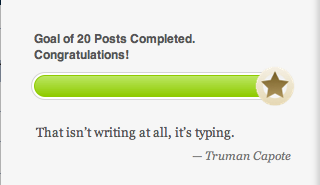
Look at all of the positive imagery there: “Goal completed”, “Congratulations”, a big green line that is completed and a gold star!
And then look at the quote. For those who don’t know, that was Capote’s response to Kerouac’s production of “On The Road”, which was written up in a very short time on a giant roll of paper that Kerouac assembled so that he could just keep typing without having to change paper. Now, I know this quote and I’ve even embraced this quote for my personal (art/writing) blog which has the title “This Is Not Art, This Is Typing”. I’ve embraced it for projects such as NaNoWriDay – 50,000 words in 24 hours, which I did for charity. I’m (strangely) proud of my ability to write quickly.
But this response took the wind out of my sails a bit. I’d been mostly ignoring the ‘goal’ messages because I schedule my posts for publication, rather than hitting publish immediately, and this means that I haven’t seen one for a while. I happened to hit the update and got this – my initial thought of “wow, 20 posts, I’m sticking to my plan” was a nice bit of positive reinforcement.
But what is that quote doing there? The automated system has counted my posts and thinks this is the best thing that should come up? Is it a joke? Is it supposed to be a gentle ribbing or something?
I pretty much write for a living. I’m used to people criticising my work. I guarantee you that someone is going to be ruder than this to me today – and it will be personal, rather than just randomly allocated. Imagine what happened if someone had spent a year pouring their heart out into their blog and, on post 20, *ding* well, ok, 20 posts, but, just so you know, it was all just typing.
Now my point here is not that I’m under psychic assault but it is a fantastic example of how, with the best intentions, one careless piece of assembly can completely undermine everything that you’ve tried to achieve with well-designed courseware and attractive, positive messages.
I would suggest that the Capote quote should never show up on WordPress. To be frank, the quote has never really contributed anything anyway – just another Capote quote, somewhat clever, very snide, generally nasty. It’s the kind of thing people say when they want to diminish the value of what you’ve done. In the education business, we do not get paid to make people feel bad about how much smarter we are than they.
Sadly, too many educators still take that path. We’re dealing with forming minds – intellectual embryos – we have to choose our words carefully, our materials even more carefully and always be aware that accidental juxtaposition risks being seen as deliberate when people are sensitive or looking for reasons to doubt themselves.
This quote, which I know and I’ve integrated into other places, in this context, made me question the value of what I’m doing here. It’s a valuable reminder of the power of reinforcement and feedback – positive and negative.
Why you can still read this blog during the blackout
Posted: January 19, 2012 Filed under: Opinion | Tags: PIPA, reflection, SOPA Leave a commentThis is an ‘out of sequence’ post, to explain why my blog is still available during the SOPA/PIPA blackout. You’ll note that the blog is sporting the “STOP CENSORSHIP” ribbon because I don’t want any censors to have hips. More seriously, both bills will fail to achieve their (purported) primary aims, do not take into account a number of key technology issues and can easily be exploited to censor content, for any reason, at any time. The main thing that must be said is that these bills will not usefully stop piracy, any more than DVD regionalisation stopped dodgy copying.
However, I haven’t gone to the WordPress blackout option because it links to information on how you can influence your representatives and, while SOPA and PIPA would (if passed) affect me, I am not an American citizen, permanent resident or resident of any kind. Yes, I hope these bills die but I am not comfortable with directing people to vote or contact their representatives in a specific and certain way when I am (legitimately) not entitled to vote in their country.
I support a free and open internet, where illegal activity is dealt with by established legal precedent and the forging of technically sound, fair and suitable agreements between countries to deal with the difficult problem of international boundaries. I do not support a system where a rumour of misconduct can wipe out a site in seconds. But, note carefully, I do not support piracy. I do not support theft. I also do not support bad tech, political posturing and the false dichotomy that to be against SOPA/PIPA is to be pro-piracy.
It is up to the American people, and their elected representatives, as to what they do with this. I’ll just keep my fingers crossed.
Who told you that you couldn’t?
Posted: January 18, 2012 Filed under: Education | Tags: education, higher education, reflection, teaching, teaching approaches 3 CommentsOne thing I often encounter when talking to people about designing teaching materials is that a lot of highly-qualified, sensible, smart and otherwise perfectly reasonable educators are adamant that, somehow, even a skerrick of visual design is beyond them. There are lots of good reasons why certain approaches work in certain areas, and, to be honest, sometimes black on white and simple is the way to go (like here), but I sometimes sense a resistance. This always makes me wonder “who told you that you couldn’t do this”, and then, almost immediately, “and why are you still listening to them?”
We are an amazing species. We live in so many different places, adapt so quickly and are very, very hard to stop. But, somehow, after you’ve made it through a degree or two, teaching qualifications, maybe a PhD (or two, you keen devil, you), secured a teaching spot and managed enough time to read this rant… you can’t sit back for five minutes and see which colours, typefaces and layouts make the key points stand out in your presentations?
I was having lunch with a friend and was ranting on about design, I am so much fun to have lunch with, and when I said that I thought it was an important thing for everyone to think about, he said “We can’t do everything.”
I completely agree to an extent – if we never try anything, we certainly can’t achieve it. Of course, there are degrees of all of this. Much in the same way that my oil paintings are more likely to serve as paintball targets than hang in National Galleries, there are people who have more or less talent in using visual representation to present knowledge. But zero ability? I think that there are surprisingly few of those.
But this is where you support network comes in. They aren’t a cheer squad – if something is bad they should tell you. If something is bad, and someone tells you, then you either fix it or remove it. But if something is good, or has any merit, then these external voices can help you to overcome that whole “I’m a scientist, not a graphic designer, Jim!” thing.
You don’t have to be a graphic designer. There are many tools around that, with a little thought, will help you make some interesting choices that won’t break people’s eyes. Keynote and PowerPoint have quite sensible defaults and well-designed templates. Using one of these and not jamming three million lines on to the screen will generally result in a tolerable outcome. Using the notes feature in either and printing out take away handouts for students will deal with the ‘presentation versus notes’ problem. Look at other presentations that you’ve liked and, respectfully, adopt the features that work. Learn and use some of the simplest techniques for making things look better. Things like the Golden ratio for working out relative text sizes – simple but effective. Things like checking your work for its black and white contrast or what happens if the colours change… (more on this later) Some of the big companies have spent a lot of money to hire designers to make your job easier. Don’t fight it – use it!
Ok, some of you can’t do this. I get that. If you’ve tried, and all you get is TimeCube (NOT SAFE FOR WORK IN SO MANY WAYS), then step away from the keyboard. 🙂 But if you haven’t really tried because you’re scared of getting it wrong, or because, years ago, someone put you in the box of “No, you can’t”, then try again. Get an honest mirror to look in and try again.
True confessions time: Are all of my materials at a level where I’m proud of them and think that I’ve done as much as I can? No, not yet. But I am working on them and converting them, consistently and maintaining the integrity of the course, as much as I can and as fast as I can. I am on the same path that you are and I still have a lot of work to do but sharing with my local, extended and network community makes me value my efforts in this direction more. And all my student feedback says “Not only do we like it, but we seem to learn better from it.” Maybe it’s because I like it more – maybe the materials are better. For once, an outcome will suffice.
Today’s homework, which you are so free to ignore, is to consolidate an entire lecture’s key points into one slide – at the presentation systems’s default font size (no shrinking!). Can you? Should you? Why or why not? If this slide, assuming it exists, was up the front, would it make the entire lecture easier to understand? If at the end, does it tell everyone what they should know? How has it made you think about the lecture? What would a student learn if you set this to them as an assignment?
The Zeroth Law of Teaching: “No Negativity?”
Posted: January 10, 2012 Filed under: Uncategorized | Tags: higher education, reflection, teaching, teaching approaches Leave a commentI was at a conference recently and I was chatting with the PhD students at their poster session. One of them summarised his life philosophy as ‘no negativity’. I looked at him to see if he was joking and then replied “So, positivity, then?” The student’s eyes lit up as he thought about what I’d said, and his own comment, laughed and agreed.
When I first told this story on one of my other blogs, a number of people responded by saying “Oh, but he could have meant ‘at least neutrality'” and, while I didn’t argue it there, ultimately this was missing both the point of my critique and the student’s response. The first thing I considered when responding to the student was that he was obviously looking for something short, sharp and shiny to contain his world view. The second thing I considered was that I didn’t want to be negative, so my comment had to be chosen carefully. The third was based on my assessment of the student.
The student was a very positive, enthusiastic and creative person. When he said ‘no negativity’, he fairly obviously meant ‘positive, creative energy!’ He wanted a short way to express this but, as we are all prone to do, he focused on the antithesis and then negated it. Now, of course, by doing this he created an automatic contradiction in his own maxim. That’s why I checked to see if he was joking first because, as an ironic statement, it’s wonderful. My belief, based on initial reaction and his reaction to my comment, was that he hadn’t consciously realised that he was rejecting negativity with a negative. Now he has the choice to either be deliberately ironic or to be succinct and clear.
English is a funny beast. If I say “I don’t disagree with you”, it doesn’t always mean that I agree with you, double negatives or not. It’s also confusing for people with English as a second language because it appears very similar to “I’m not disagreeing with you”, when the two have different uses and, depending on your cultural background, very different interpretations. I choose my language, my idioms and my examples very carefully to make sure that I pitch myself to the current audience. This means that my classes in Singapore are run and presented slightly differently from my classes in Australia. Same knowledge. Same standards. Different presentation to maximise my efforts.
If you don’t know your audience, then your humour, your use of language subtleties and, especially, the use of sarcasm and irony can be missed completely and people won’t know if you are being exceedingly clever or if you’ve missed the point. If a student misses a subtlety, then do you think that they’ll always stick a hand up to check? Are they going to learn something incorrectly or miss a key step?
That, for me, is the Zeroth law of teaching: “Know your audience.” If you pitch yourself at the right level, to the right group, at the right time, you will be far more likely to pass on the knowledge in the most effective and useful way possible.

 Nick Falkner