
ITiCSE 2025: Working Group 1 – exciting news!
Posted: February 14, 2025 Filed under: Education | Tags: computer science education research, education, games, higher education, ITiCSE, learning, play, research, teaching, technology, thinking Leave a commentTwo posts in the same year? Something must be up… and it is! After the successful presentation of Dr Rebecca Vivian and my work at Koli as both DC tool and award winning poster/demo, I looked into taking this to a working group and Dr Miranda Parker agreed to co-lead it with me, as Rebecca is currently on leave. Miranda and I have been digging into all of the aspects of this in the middle of both our day jobs and it’s been a lot of fun to work on! You think you’ve got difficult collaborators? Miranda has to listen to me pontificate about ontologies, paradigms, and philosophies!
It’s really important to recognise Rebecca’s ongoing connection with this project, as it’s still very much Rebecca’s work that got us here and she will continue to be a significant part of this, we’re just making sure we have the co-leadership of people who aren’t on leave to make it work. It’s really exciting that our Workgroup has gone to the advertisement stage!
You can see all of the WG proposals here, and sign up (maybe to ours if you like what you read here) here. We’re happy to answer questions and it’s going to be an amazing combination of serious play, serious research, and great fun.
Here’s the ad as a cut and paste!
WG1 – Paradigms, Methods, and Outcomes, Oh My!: Refining and Evolving a Research Knowledge Development Activity for Computer Science Education
Leaders:
- Nick Falkner, nickolas.falkner@adelaide.edu.au
- Miranda Parker, miranda.parker@uncc.edu
Motivation:
Computer Science Education Research (CSER) combines the frequently quantitative approaches of computer science, engineering, and mathematics with the often more qualitative techniques seen in psychology, sociology, behavioural science, and education. It can be challenging to select appropriate research methods in effective and efficient ways.
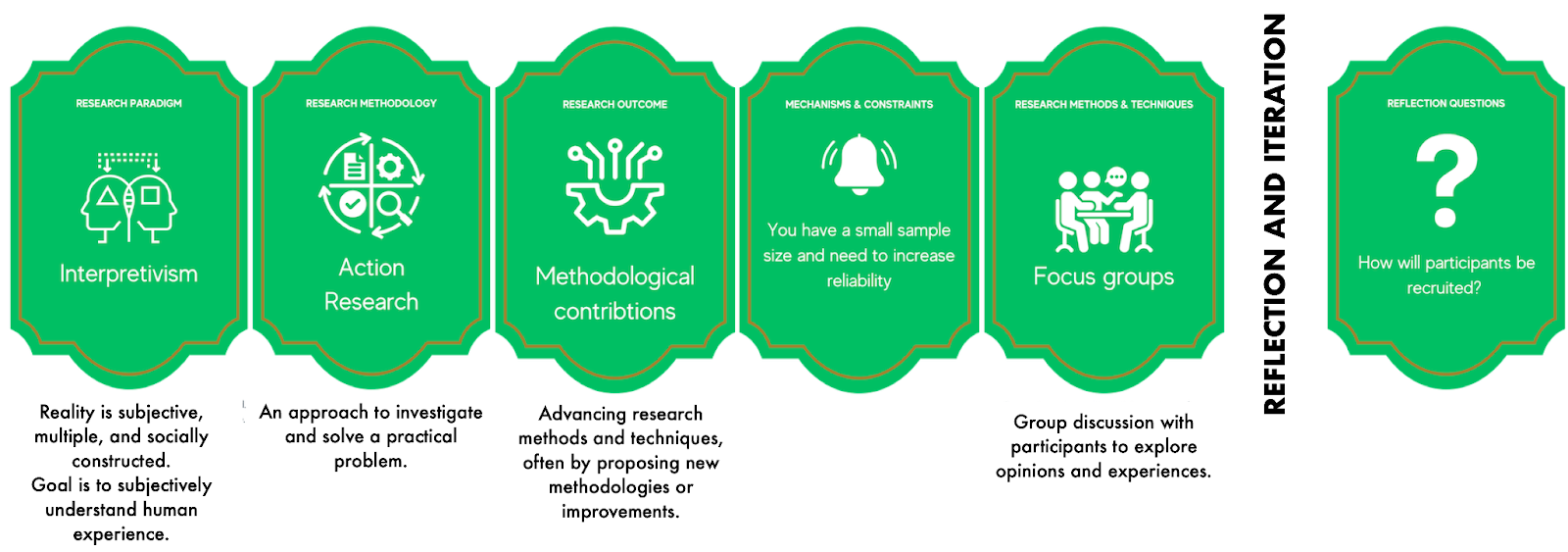
Inspired by the use of card-based techniques in the classroom, the Research Alternatives Exercise (RAE) is a pack of 105 cards introducing a wide range of possible research approaches. RAE provides alternatives to a participant’s current research plans using new random lenses, leading to the sketch of a new research design. The participant refers to their own design through the lens of the randomly drawn card, working to see how well this fits, informs, or improves what they have done.
The initial version of the card deck and examples of play won best paper/demo at Koli Calling 2024 and an example “run” is shown below:
Goals:
- review and modify the existing deck through collaboration in the WG
- develop a version of the deck that can be shared and used widely across the CSER community,
- develop a concise support glossary for the cards
Methodology:
The current deck will be shared with participants, to support targeted literature review, research, and consultation to:
- refine the terminology used for categories, which are currently paradigms, methodologies, outcomes, and methods,
- refine the components within categories,
- review the existing rules for suitability,
- develop the first draft of the support glossary, and
- develop different decks and play approaches for specific purposes.
Following kickoff at the end of March, we will work on Items 1 and 3, aiming for completion by the start of May. When categories are finalized, we will undertake Item 2, where each group member will work in small groups to review each category. Findings will be presented to the whole group by the beginning of June, for further discussion and collaboration. Each sub-group will be responsible for the glossary elements of their contribution, to be completed and reviewed for the start of the in-person WG time. Each working group member will be asked to share the deck with colleagues to provide feedback.
Member Selection:
We seek at least 8-10 individuals to share the required work manageably.
We are looking for participants with at least one of:
- Experience with a wide variety of research methodologies,
- Experience in supervising graduate students,
- Interest and knowledge in using game-based and facilitated techniques, or
- Experience with research skills development.
We actively invite applications from disciplines beyond computing for diversity in research skills development experience. We seek a diversity of experience, background, and culture, to ensure that the feedback encompasses the full range of CSER community experience. We also welcome student applications.
Successful applicants will:
- Attend fortnightly 60-90 minute online progress meetings, held from mid-late March to the end of June,
- Register for ITiCSE 2025,
- Physically attend the full duration of the working group, and
- Make significant contributions during the pre- and post-ITiCSE Working Group activities (3-4 hours a week).
Great News, Another Group Paper Accepted!
Posted: June 2, 2012 Filed under: Education | Tags: blogging, computer science education, computer science education research, design, education, education research group, educational research, higher education, icer, icer 2012, identifying at risk students, research, sigcse, workload Leave a commentOur Computer Science Education Research group has been doing the usual things you do when forming a group: stating a vision, setting goals, defining objectives and then working like mad. We’ve been doing a lot of research and we’ve been publishing our work to get peer review, general feedback and a lot of discussion going. This year, we presented a paper in SIGCSE, we’ve already had a paper accepted for DEXA in Vienna (go, Thushari!) and, I’m very pleased to say that we’ve been just been notified that our paper “A Fast Measure for Identifying At-Risk Students in Computer Science” has been accepted as one of the research papers for ICER 2012, in Auckland, New Zealand.
This is great news for our group and I’m really looking forward to some great discussion on our work.
I’ll see some of you at ICER!

Click here to go to the ICER 2012 Information Page!

 Nick Falkner