
The Pipeline and How to Swing it
Posted: January 7, 2012 Filed under: Uncategorized | Tags: education, teaching, work/life balance, workload 1 CommentGetting everything done would be easy if we had very little to do or unlimited time in which to do it. Sadly, by the time you stack up what your students need you to be, your school or faculty needs you to do, the parts of you required for your colleagues and your family, it gets hard to get things done. That’s where good pipeline management gives you a bit of help in encouraging you to prioritise in a way that lets you maximise your use of your own time.
Some things cannot be handled in advance. You can’t mark an assignment until the students have returned it, you can’t publish the exam results until all of the marking and any adjustments have been taken into account. Some things have to be dealt with by you being there and dealing with the events as they happen. To be good at learning and teaching requires a lot of your time, there’s no disputing it, but trying to do it all at the same time will crush you. Some of things that we need to do can be reorganised in terms of their importance, amount of preparation time and deadline, and this is where your pipeline comes from. If you currently have a to-do list, but you don’t do any real longer-term forecasting, then this post is probably for you.
If you’re not good at breaking things into manageable tasks, like me, then go and grab one of the many good books that can help you. I have had a lot of great use of a book called “Getting Things Done” by David Allen. You may want to start by looking at a website called 43 Folders. If that appeals then you might want to replace your existing paper to-do list (or e-mail notes, or sticky notes) with some task management software. I use OmniFocus on iPad and Mac for task tracking and Merlin for project management. Whatever you use isn’t important but what you need to be able to do is to work out:
- What you want to do
- How it breaks into components (and you should know the order of these) – you must be able to identify the FIRST STEP. This will lead to the second.
- When it is due (set this wherever you need to in order to finish on time)
- How long each component will take
- Who else is involved
- What other resources you have
Then, armed with a list of all of the projects that you have to achieve, and a list of the first steps in each one, you can work out which has to be be tackled first. Something not due for a month? How long will it take? A month? Start now! A week? Get it to pop up in two weeks time. Maybe you can handle it early and go on to something else.
A to-do list is a great start but it’s only as good as the bigger list of projects that feeds it new to-do items. A good to-do item can be achieved in 15 minutes, maybe an hour. Why so short? Because then you can tick it off and move on to the next task. If you spend a day working and you tick nothing off your list, how much will you feel like you’ve achieved? If your to-do items, for writing an exam say, were “review last year’s exams”,”copy LaTeX template to repository and check security and backups”,”Write question 1 on underwater knitting” you can look at your work at the end of the day and, if you’ve got to Question 2, you can tick off three things. Doing things this way also gives you some checkpointing and rollback if you get interrupted, or distracted, or come down with a cold. Short tasks are also easier to interleave and it may help if you set up your pipeline so that short high-reward jobs get bumped up the queue occasionally to give you some needed endorphins for the longer haul projects such as grant writing or course re-design.
I wrote a 36 lecture course late last year and the pleasure in ticking off 36 individual ‘complete lecture x’ items was much greater than waiting two months to tick off ‘write lectures’. Apart from anything else, a good, concise task description will remind you what you were thinking and get you back into work more quickly – your ability to context switch will improve.
How you refill your list is up to you but, given how busy we all are now, it’s better to have the list showing you what you’ve achieved but listing what you could do next than to let you think that there’s nothing you have to do. If you want to take a breather, schedule it into your calendar or your list and stick to it. Got 15 minutes paper review time? Print the paper, leave your office, sit down somewhere else and read, if you can. One very good suggestion is that you take a break every hour to rest your aching back, get your eyes away from the computer and refresh. That’s harder sometimes than others but always be open to taking a brief , refreshing pause that will let you finish your work, get home, enjoy dinner and sleep.
And, if you actually know all of your deadlines, and what has to happen and when, you will worry less about what you’re missing and, with any luck, the sleep you have will be deeper and better. Sometimes, yes, it’s going to be a mad rush to completion but doing that all the time will burn you out. Use some of the excellent references and technology to do what you have to do and what you want to do in a timeframe that makes everyone happy and keeps you sane.
Happy pipelining!
Surviving and thriving on collaboration.
Posted: January 6, 2012 Filed under: Uncategorized | Tags: collaboration, education, higher education, SWEDE, work/life balance, workload Leave a commentJuggling all of the things that you’re supposed to do as a University academic can be tricky. The traditional academic is supposed to conduct large amounts of valuable, cited and grant-rewarded research, be an exemplary and inspirational teacher, and also find time to sit on lots of committees, fill out forms and not get in the way, too much, of the central administration process. As a junior academic, you’ll sit on fewer committees but you may, instead, get admin jobs like ‘collecting the software requirements’ or ‘looking after the casual teaching budget’, so there’s always something to do.
The biggest mistake a lot of people make is trying to do it all themselves. Yes, you must be involved with these tasks, you will be responsible for their successful completion, but it doesn’t mean that you can’t consult other people to help, or involve them for collaboration, or bring other people in when the scale of what you’re trying to do might crush you.
The quick summary of this post is that if you get good at collaborating with other people, and you can set up a relationship that is on a roughly equal footing, then everyone benefits. However, you need to work out what each person is bringing and who is the right person to involve.
You can read a lot of self-help books that, effectively, boil down to “making it appear as if there is more than one of you”. When you can set things up so that you put in some vital, required, element, but then the heavy lifting or continued presence is handled elsewhere, then you’ve achieved this because you can then devote yourself elsewhere. Some things require you to be there the whole time: your own wedding, any event where you are supposed to be the speaker (which includes lecturing) and a lot of meetings. Some other things on our long to-do list require us to be involved, but not necessarily to be the sole operator. Let’s start by looking at research.
Research, in terms of finding ideas, pursuing ideas, getting results, writing them up and publishing them, is a time-intensive activity that requires reasonably long stretches of uninterrupted time to get the best results. Unless you have a research-only position, or you’re on sabbatical, that’s very hard to achieve. However, this doesn’t mean that we can’t do it and we don’t necessarily have to sacrifice all of our weekends to do it. (Seriously, though, you’re going to lose some leisure time here and there. Academia is not a 9-5 job.)
One of the big advantages of having research collaborators is that your research and its publication, hence visibility and possible grant success, is always moving forward. These collaborators might be colleagues in a research group, research fellows, post docs, research assistants and PhD students (in later stages) and most of these, especially people who are paid to research, can keep the flow going when you’re tied up having to be in another place.
All these staff sound fine but this assumes that you’ve had the success required to employ all of these people! So how do we start down this track?
The answer is collaboration: finding people who are doing similar things so that you have more than one of you working on research, papers and grant applications. Look around inside your own school, or faculty, and work out if you have something that you’ve done that, combined with someone else’s work or input, can give you both some benefit if you work together. Ideally, the effort expended by each of you is approximately 50-70% of the effort required individually but still achieves the outcome. The more you work together, the more synergy that you’re likely to achieve because you start to have small copies of each other in your heads.
The same is true for learning and teaching based research and development. Can you find someone who also wants to do what you’re doing and can you work together so that you achieve the same result with less individual effort? Can you find someone to bounce those early ideas off to get better ideas forming?
We all know that your students learn more when they’re excited and engaged and discussing things with their peers. Research success can be achieved on the same basis. If your research is rewarding and you have someone to bounce it off, someone who can enthuse you or bring it back on track, you will do more and you will achieve more.
Forming a collaboration should be rewarding and all parties should benefit from it. Some collaborations stop after one effort, because one side or the other feels that they have been exploited. Yes, sometimes this happens, but you’ll quickly work out who you can and can’t work with. Forming successful collaborations early on, before you have the money to employ your own continuity providers, makes your job more manageable and allows you to bring more of yourself to other places, including your home life.
Here’s my (not exhaustive) list of things to think about when setting up a collaboration:
- What are you going to do? You should know what the task or project is, including every subtask you can think of, so there are no surprises later on.
- Who is involved? Work out who you are working with and have them involved from the start.
- What is everyone doing? Who is responsible for what?
- How much is everyone bringing to the arrangement? Resources, time, people or goodwill – cards on the table up front to avoid disappointment.
- When is everything due? Know your internal and external deadlines.
- How often will you meet? Will you be minuting things, e-mailing, using wikis or just having chats to keep track?
- How will credit be allocated? If it’s a paper, what does the author list look like? How could it change? If it’s a grant, what’s the money division?
- Do you have to worry about IP or commercialisation? If so, this gets tricky fast and makes 4 and 7 more complex. Sort this out BEFORE someone runs off with the IP and founds MicroGoogleII.
- Evaluation. How will we know that this worked for us and if we should continue? Sounds premature but if you have a rough idea of what you think denotes a successful collaboration, and you discuss it early on, then everyone knows the rough behaviour that’s expected.
Finally, here’s my list of 5 things to look out for as possible warning signs that your collaboration is not as solid as it could be.
- The other party has a lot of equipment resources and makes them available to you but does no actual research or writing, they just expect credit. Credit as an acknowledgement on a paper or grant app is one thing, expecting lead authorship or a slice of the funding is another. This isn’t always invalid but it’s almost always cleaner to pay cash money for resources, or resource access, and remove any doubt about credit. (A senior person who demands lead authorship regardless of involvement is much harder to manage here. That’s a political problem I leave to you although I might try and comment on it later.)
- Your collaborators have lots of ideas but never seem to produce anything. However, after five meetings, when you present the final work, they will still expect full credit for their ideas, regardless of the quality or usefulness. If you’re a non-producing ideas person, then other people will be just as grumpy with you. There are ideas and then there are ideas.
- Your collaborators rewrite everything that you submit, or redo the design, or experimentation, because it’s not up to ‘their standards’ or they just feel like it. I’m not saying that they or you are wrong – but your expectations aren’t aligned and one of you is going to get frustrated quickly.
- Deadlines slip or you end up in a deadline-chasing model that doesn’t work for you. Some people like to work in a panic close to the deadline, some don’t. If working up until the minute before hand-in is your thing, but gives your collaborator heartburn, don’t expect the relationship to survive. If you and your group can’t agree upon whether deadlines are really important or not, the stress risks breaking the relationship.
- You walk away from most of the meetings wondering why you bothered. If either of you is thinking that, you have to either address it up-front or finish what you’re doing, tie it up and find someone else to work with. Discussing it might be able to save the relationship (some people just don’t realise what they’re doing) but always be ready to close off your project neatly and start again elsewhere.
Collaboration is a fantastic way to get more results for less effort by recognising that people can work well together and, carefully controlled, it is the ultimate tool for junior academics to make it to being more senior (and tenured) academics. Just go into it with open eyes and be frank in your early discussions and it will work for you, rather than becoming a cautionary tale for the future.
Happy collaboration!
THE (Thinking Higher Education).
Posted: January 5, 2012 Filed under: Uncategorized | Tags: education, educational problem, higher education, MIKE, SWEDE 2 CommentsWell, if you’ve survived the MIKE post and the SWEDE post, you’ve probably guessed that I like acronyms. However, TMASTB (Too Many Acronyms Spoil The Broth), so I’ll present one more and go back to discussing other issues. However, these three acronyms together will drive a lot of what I talk about and, with any luck, I’ll have strangers around the world muttering “MIKE THE SWEDE” at each other.
I’m not holding my breath.
There are so many different ways to educate, some many different environments, students and teachers, choosing an approach that will work can sometimes appear to be an overwhelmingly difficult problem. How do I cater for everyone? How do I deal with large ranges in ability? How can I be fair to all the groups I deal with and, at the same, fair to myself and my own family, giving myself enough time to work and live.
This is where “THE” comes in. I’m not trying to solve every educational problem, I’m thinking about higher education. The students that I deal with have already shown that they can handle education to some extent, whether traditional classroom-based study, collaborative group learning in more experimental frameworks or home-schooling. They have passed sufficient entry requirements to attend classes at my institution. They can read. They can write. They are fundamentally numerate. They may have pre-requisite subject requirements to meet on top of this. For example, all of my students have at least one course of mathematics to the matriculation level. As an educator, I have so much to be grateful for in that a lot of the hard work has already been done by the educators before me, who excited these students about learning, who gave them the basis upon which they could develop to the point that they made it to me. For the families who supported them, or the groups that supported the students or the families when they families couldn’t do it by themselves.
I looked into publishing a book once, on computerising wineries (previous career), and I attended a really interesting workshop on pitching books to publishers. One of the most important pieces of advice was that no book was ever really suitable for ‘all ages from 8 to 80’, so don’t claim it. Work out who your book is for, write it for that group and then advertise it correctly. Who should my courses be suitable for? What do they come in with? What do I want them to leave with? How do I tell people that they will benefit from this course so come and try it?
Thinking Higher Education means thinking about students who have already demonstrated an ability to work within our systems, who have already stuck at education for 12+ years and who most likely perfectly capable of passing our courses, if we keep them engaged, do our jobs properly and their own lives don’t get in the way. Yes, there will be ranges of ability and dedication, but these tend to be smaller than are seen in the early primary or early secondary years. The kids who caused lots of trouble in class probably aren’t here anymore although, with any luck, they’ll sort themselves out in a while and we’ll welcome them back as mature-aged students with open arms. Yes, you’ll have mature-aged students sitting next to 17 year olds and you’ll need to think about that but if they’re sitting in your course then they need (and sometimes even want) you to teach them. Or to give them the right environment in which they can teach themselves. But they all need the same thing and, theoretically, they are on a much tighter track in their quest for degree completion than trying to match the diverse requirements of a group of 15 year olds sitting in an English class.
It’s not impossible. It’s certainly not easy and it doesn’t downgrade the role of a University educator but, despite having students from all over the world, the country, the age groups, the demographic spectrum – we can manage this problem and share our knowledge.
So THE is a positive thing, a reminder that our job is manageable, an appreciation of the work that has been carried out before by our colleagues in schools, a mark of respect to their successes and an awareness that students come to us with a great deal of potential and previous experience, both of which will shape their future.
Putting it together – Measurement, Environmental Awareness and Managing Scale, you get MIKE THE SWEDE.
Happy muttering!
(No more new acronyms for at least a few days, I promise!)
SWEDE: Scale Will Eventually Demolish Everyone
Posted: January 4, 2012 Filed under: Uncategorized | Tags: education, higher education, learning, SWEDE, teaching, teaching approaches 1 CommentYes, I like acronyms – a good acronym is memorable, meaningful and it makes you think. I wanted to explain why measurement was so important in the previous post but I neglected to tell you why I thought that we had to consider changing our learning and teaching approaches in the first place. So here’s my next higher ed teaching maxim – Scale Will Eventually Demolish Everyone. Even if we don’t change what we do, we have to be aware of why change should be considered and I want to give you a reason that doesn’t require you to have a fervent commitment to the nature of assessment or new technology. I’ll appeal to your existing knowledge – that you’re already too busy and things are getting busier.
Why do we even have to think about change? The first reason is that things change. New technologies become available, student expectations change, materials change – things change. The second reason is that we now have a lot of students in tertiary education and, if your government is anything like mine, the goal is to increase that number. We may not necessarily have more students in a given classroom, although that is a likely outcome, but we may certainly be teaching more students. We are already teaching a very large number of students and we are a long way from sitting around the agora in small groups, listening to someone who, through Socratic technique, will take three to four years to guide us towards mature and complete knowledge. Some techniques just don’t scale and we have to recognise this, while still providing as many, if not all, the benefits of our knowledge to our students, regardless of how many are in our classes.
I have taught classes as small as 7 and as large as 360, I know that some of you handle much larger and you have my deepest sympathies, and I cannot apply the same techniques in both and expect the same results, unless I work out how to handle the scale. An individual only has 168 hours in each week, fewer if they have the audacity to sleep or eat. Even if we were devoted beyond belief, lecturing, assessment and marking load will eventually reach a point where we cannot handle any more. Reduce this 168 to a (marginally) manageable 70-80 hours to allow for sleep and some outside activities and we can handle half the students. But I still need to pass my knowledge on, encourage them, give them feedback, provide assignment work and examinations, mark everything, give it back in a timely fashion and be what I am supposed to be, doing what I’m supposed to do.
Sometimes we handle scale through the use of other people – TAs, marking teams – and this certainly works. But it’s usually not the same as us, the lecturer, being there, unless you’re very lucky in the way that your teams are made up. There should be a reason that we’re there, that the students want to come and listen to us, to discuss the knowledge with us, to learn from us and while there is certainly a place for other people, including using students themselves, we have to think about how we are going to do it properly and in a way that scales to the right level while providing everything that the students need. This places an obligation on us to provide quality control for external marking, to provide strong guidance and rubrics for markers, for learning how to control the class when it moves in and out of ‘nearest neighbour answer checking’, to think about all of the techniques that could be used to increase the quality of our teaching while recognising the pragmatic limitations imposed upon us by the tyranny of scale. Among many, many other things.
We can handle scale if we make sensible use of existing techniques, actively search out new ones (whether philosophical, pedagogical or electronic), assess how we are meeting (or not meeting) our goals and we are clear about what our teaching goals actually are. Frankly, you’re probably already too busy – too many of you are reading this on your phone as you sit on the bus or while you chew your dinner. You don’t need to make things harder for yourself when new approaches come along that can allow you to do the same, if not better job, with less effort. If we don’t choose to handle scale and balance this with our requirements to provide teaching, then eventually we risk reaching a point where we won’t be able to provide any teaching at all – because our time to do everything will blow out so far that even if we are phoning it in, we just won’t get the marks processed in time, or assignments back.
Despite me talking about quality control and our requirements, protecting ourselves from the expenditure of unnecessary effort is the only sensible way to approach a time-consuming, difficult but very enjoyable job. We want to use our individual effort in a way that maximises our results – this is where measurement, process awareness and honesty comes back in, reinforcing my previous post. This is where being open to change, to assessing what you need, to finding new techniques and from doing it properly comes in. Because we have to.
Because, ultimately, SWEDE – Scale Will Eventually Demolish Everyone.
MIKE: Measurement Is the Key to Everything
Posted: January 3, 2012 Filed under: Uncategorized | Tags: education, higher education, learning, measurement, MIKE, teaching 2 CommentsOne of the problems in convincing other people to try alternative learning and teaching approaches is that, basically, everyone is as busy as you are. While you might not accept that, you might be the busiest person in the Universe, then perhaps you can accept that everyone thinks that they are as busy as you are. In a world where academics struggle to fit in research, administration, teaching, marking, personal development, grant applications – oh, and their real lives – it’s not surprising that a lot of first reactions to ‘have you tried something new’ is ‘do you know how busy I am?’
We have a big advantage in ICT in that most people are very open to the scientific method of measurement, analysis and evaluation (potted version). So why is it that when someone says “Have you tried this” and you ask something in return like “Well, no, but how long will it take and what will be the benefits?” you’ll be lucky to get an answer to the first half of that compound statement, let alone the benefits. “Your students will be happier” is very hard to quantify – but “we reduced our drop-out rate by 30%” is a cold hard fact. (Well, it purports to be. If someone has done their due diligence, it’s a fact.)
There is, of course, a problem. In order to be able to assess the impact of what we’re doing, we have to establish the baseline (how things were before we started), apply our changes, measure the outcomes and then try and determine if what we did had anything to do with the perceived change or whether it was all random noise. This is not helped by the fact that a lot of classes are small, smaller than we need for statistical validity, or that we can’t easily establish cohorts of the right size or consistency. But, being honest, the first problem for many people is that they do not even think of measuring the impact of what they’ve done until after they’ve done it.
So here’s the first of my three slogans.
MIKE: Measurement Is the Key to Everything.
Looking at that model that I keep discussing, I have three separate places to “lose” knowledge in its flow to my students (to reduce the efficacy of flow). The first is in the teaching process itself. If I don’t have the knowledge, I can’t pass it on. If I choose not to share the knowledge, I can’t pass it on. Next, the medium of exchange (that disconnected external transfer from teacher to learner) will make a difference. If I write everything I know in a book and give it to my class, tell them that the final exam is in two months and walk off – I’m in a high-loss environment. So the medium can and does make a difference but it can only facilitate knowledge transfer by minimising the loss or maximising availability of learners to knowledge. It can’t add knowledge. Finally, what the learners themselves do will have a big impact on how the knowledge is processed and assimilated. That’s why, even without curve grading, those Bell curves seem to show up so frequently – in a similar teaching environment, with the same lecturer, individual students still have some variation. We can, of course, vary the peak of the curve but we would expect to see some variation in an otherwise identical environment. A lot of this has to do with the environment that students had before they reached us, which is interesting if only for the fact that this medium of knowledge transfer may now appear to have both memory and temporal aspects – perhaps our dealing with this previous environment, or accepting that such differences exist, in the construction of our transfer medium is as important as the knowledge that we bring to the situation.
Now I can quantify the effort that I put in to my teaching activities, if I’m honest with myself and count time spent actively creating new approaches or materials – and discounting those times I spend in the tea room pontificating about things I never apply. (I don’t think that such sessions have no value, but I hesitate to count them in a genuine measurement of producing new teaching materials unless I am actively mentoring or I run off and do something with that. Even then, I discount the time for each coffee I had. 🙂 ) If I have assessed the student quality or class metric that I want to change, and I have established a baseline on the cohort (somehow), I can come up with an measurement of time spent, or difficulty level to surmount, to implement my new approach and I can then present the effort, and the outcome, along with the environment in order to show other people what I did and how they could do the same thing.
I recently made some changes to a new first year course and I was fortunate in that I achieved a much higher pass rate than usual for the effort that I expended, with excellent process awareness of how to correctly design and finish programming projects on time. Hooray, you might think. Aha – I had only 21 students (it was the first offering and the pipeline was barely filled) and these students had, in the main, correctly self-selected as having programming experience before coming to University. Yes, we had a good result, excellent engagement, and high participation and we achieved it with the standard load model for writing a new course but our environment was not the standard one. Next semester, when I have 130 students from across the range of the intake, I will have an environment where, when I measure how many hours I spent on each activity, I will have much more applicable environment to realistic teaching situations in other Australian Universities.
I’ll be able to assess each student’s early indications of prowess, from their marks in other courses, and compare them to what is achieved in this new course. I can then start to make statements indicating what the benefits of the approach are. But, to do that, I have to think measurement from the moment I start working on the course, keep track of my time, note where I make changes, look for which factors are being affected and, finally, be honest if I can see trends but not significance, an indication of a Bayesian model but not a confirmation. I have to think about quantitative and qualitative assessment mechanisms – I may have to get surveys pre-approved or start designing custom assessment forms. I have to think about how I am going to be able to assess the worth of what I’ve done in the ground-up design of this course weeks before Week 1 – not only for my own benefit, but for communication with others and for possible papers or presentations.
Ultimately, I can give you a warm feeling and tell you that ‘students will love this’ or I can show you the well-written, thoughtful and mature advice on process improvement for timely completion of software projects, well proof-read and easy to read, that I received from the vast majority of the students that I had in my course – after they’d been in the system for less than 12 months. And I could tell you how much effort that took, and the caveats of the environment, and then, with all of those caveats, you might think about how you could do a similar thing in order to achieve a similar result. Or to see if I’m barking mad. That is, after all, what we expect our students to do: assemble evidence, weigh and analyse, complete the evaluation and come to a conclusion. Then act.
Measurement: it really Is the Key to Everything.
Examining my L & T diagram
Posted: January 2, 2012 Filed under: Uncategorized | Tags: education, higher education, learning, teaching 4 CommentsI was discussing yesterday’s blog post and a couple of questions came up, which prompted me to re-evaluate the simple diagram and look for a cleaner form. Among those questions:
- Are learning and teaching such distinctly separate activities? What about what we learn while we’re teaching?
- Is it just very good students who rise to the teaching level amongst their peers?
The sketchy model in the previous post is based on the flow of knowledge. (I note that I’ve been relaxed in my use of the terms information and knowledge semi-interchangably. That’s something for another post but, very briefly, I support the data/information/knowledge model where knowledge is the contextualised and useful form of what entered our sphere as raw data.) The notion of the necessity of an external supply of knowledge, produced by teachers and consumed by learners, is obviously generally false, as the formation of complex knowledge occurs somewhere in our species, in reaction to the data we are exposed to, but that is far more suited to a discussion of research. Our research locates, classifies and develops new knowledge into a form where this can then be used, or passed onto learners to provide a basis for their development in a discipline area. So, specifically for learning and teaching purposes, our system is effectively built on the idea that the teachers have identified areas of knowledge that are to be passed on, in some form, and they provide the mechanisms and structures required for learners to gain this knowledge. Some of this knowledge may be in the area of knowledge location and development, our research training is, of course, an area of concern for both learners and teachers.
So, to answer question 1, why have I separated learning and teaching? When thinking about flows, flows start somewhere and finish elsewhere. Hence, any model of knowledge flow has to show it starting from somewhere and going somewhere else. Much like working out in a gym, standing there with static muscles doesn’t do very much – static and stagnant knowledge flows do even less because you’re not even sweating. I have implicitly accepted that there is some sort of knowledge repository, somewhere, that has transferred a quantity of knowledge to the teachers, somehow, and that these teachers will send the knowledge out again into a communication medium that the learners can then draw knowledge from. But what about the things we learn when we are teaching? Where does that fit in this model? Have I chosen a model that presumes too much?
Thinking about it, what is it that we learn while teaching? If it’s that something has changed in the material, where did we find it? If it’s from the literature, or colleagues, or any other external source, then we switched into learning mode outside of teaching. If it was during a class, where we hit upon a student question that changes the way we think about something, I would argue (and hopefully not as an empty argument of pure semantics) that while we are absorbing this, we are really not capable of teaching this new ‘discovery’ until we have finished the learning phase and then can project it back out to our learners. Even so, our own thoughts on the matter (and my earlier digression on research) indicate that there is some sort of internal learning/teaching mode that does not require external knowledge, per se, but is an internal transformation of data in the context of our existing knowledge. The arrows of knowledge that traverse the boundaries of student and teacher do form a proscriptive barrier to the teacher who learns from themselves and, of course, the learner who teaches themself.
Thus, the sketch is incomplete. I still believe that learning and teaching are separate activities for a given body of knowledge in a single individual, much as an internal combustion engine has different activities at different times, but I need to show the possibility of learning and teaching working together inside an individual.
But how do we fix the sketch? Here are some attempts that I came up with.
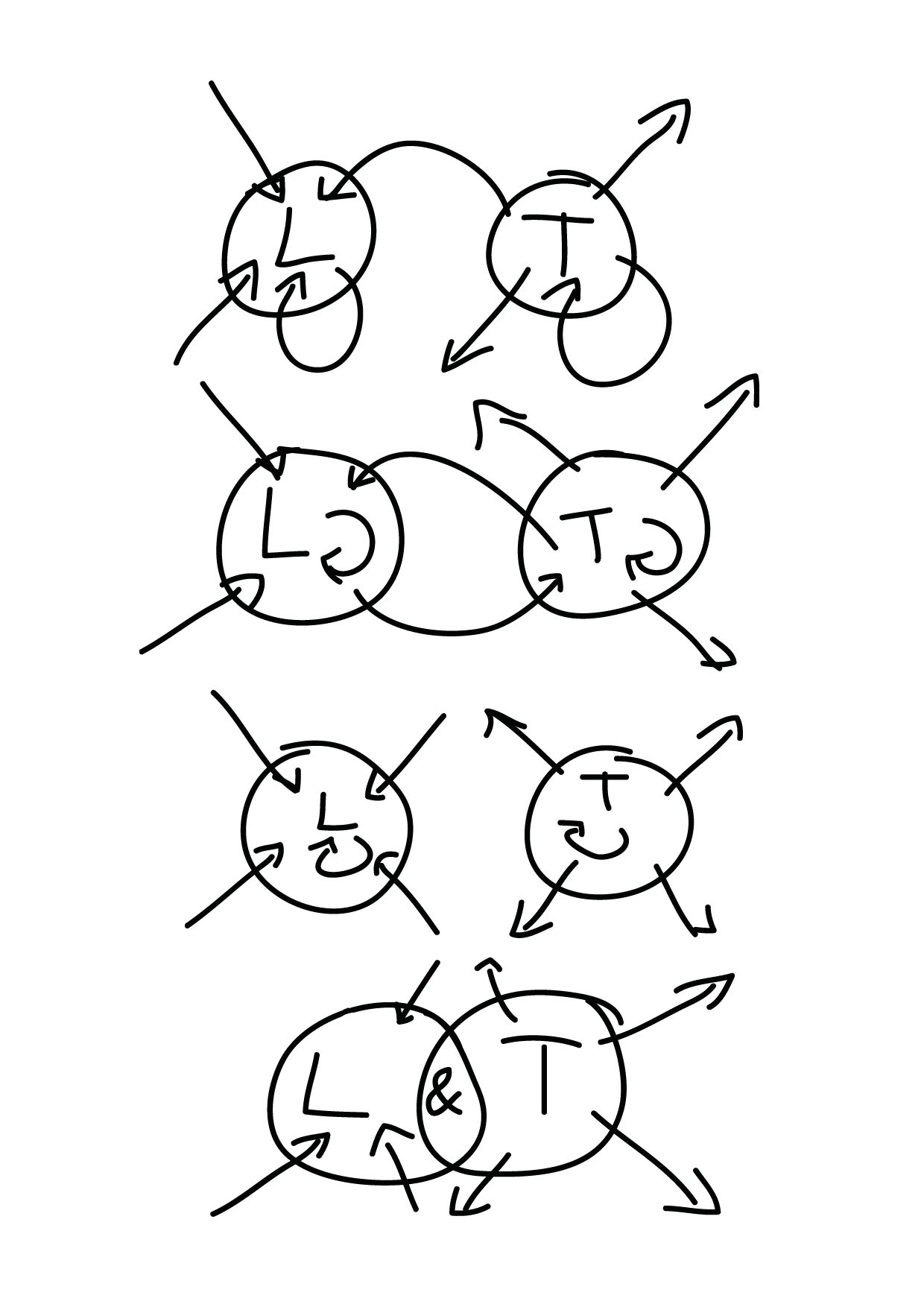
The first shows learners learning from themselves, and teachers teaching themselves, but the arrows, for clarity, leave the individual and loopback. I’ve also tried to show that the learner and teacher can be the same person by linking together both bubbles with a link. I don’t like this as it makes it look as if you have to stand in a room and yell the knowledge, then listen to it. This led to the second diagram, where the arrows are now inside the bubbles, and learners can teach teachers, and teachers can learn from learners. The third diagram is a similar concept but with the introduction of the ‘disconnecting medium’ that means that all teaching is viewed through a veil, of sorts, no doubt darkly on occasion. What we teach may not be interpreted in the way that we meant it to be.
I thought about this some more and came up with the final diagram, which unifies the two activities, but without the confusion of the arrows. Learning is still mostly an in-flow activity from multiple sources, teaching is still an out-flow activity to multiple recipients, but the intersection reflects the ‘&’ state: this is the point where people can teach themselves, without recourse to any additional knowledge sources. Latent knowledge, experience, raw data, thinking time, all live in the space called ‘&’ and complete the sketch.
I produced two versions of this in a neater form (I generally use OmniGraffle Pro and Adobe Illustrator for my diagrams, on OS X, if you’re curious. These are both Illustrator). I’m unsure which most embodies the idea the best, although I lean towards the horizontal version as it does not provide a visual hint that one is subordinate to the other. Reading left to right, as we do in English, it also implies that learners can become teachers.
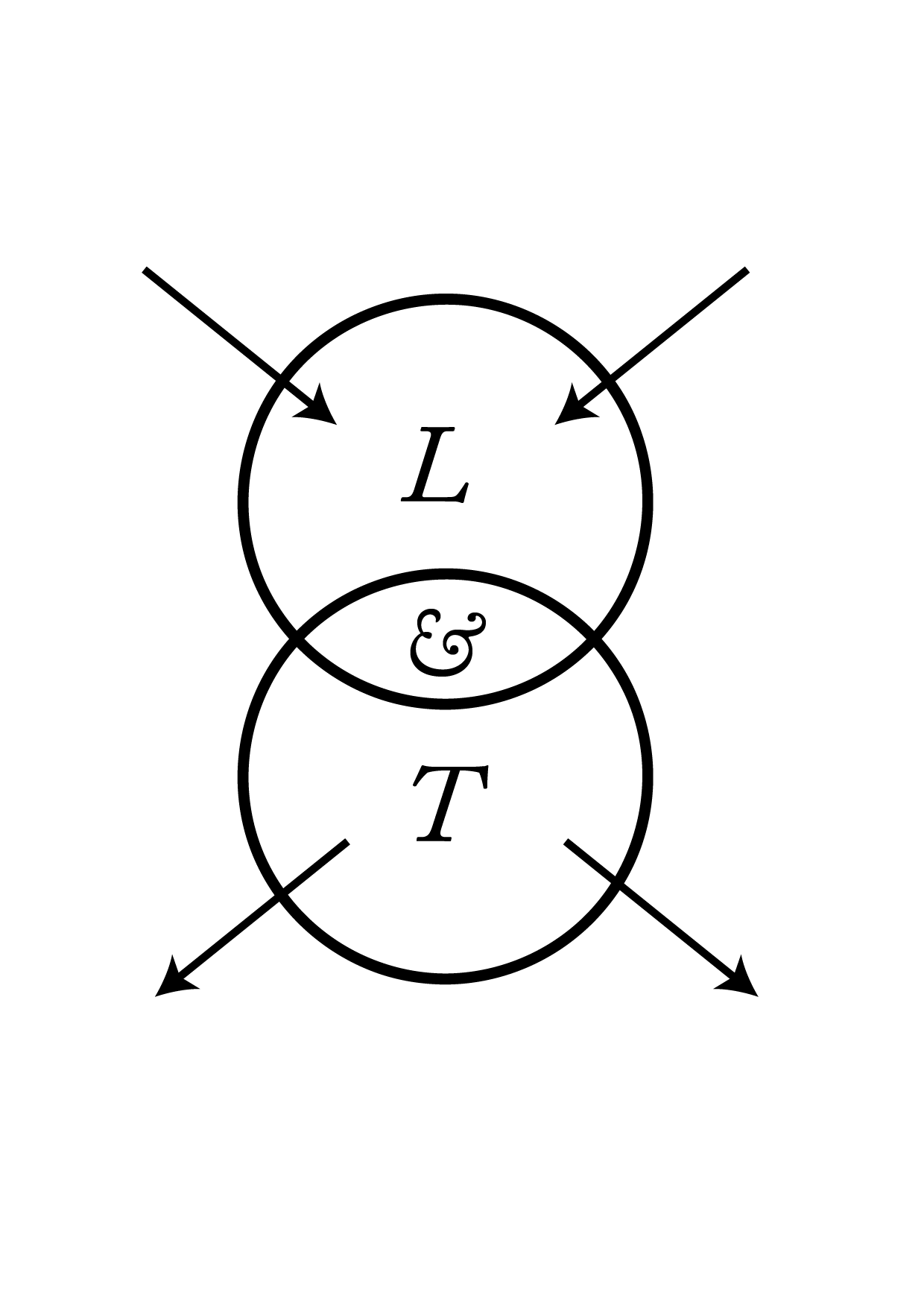

I’m also happy because I was able to use the Caslon italic ampersand, which is a fundamentally beautiful character. Apart from the slightly dynamic air to the diagram lent by the use of italics, the italicised L and T are now of the same type family and style as the ampersand. They will almost always be more visually pleasing to most viewers and, for those who know their typefaces, the diagram will look more consistent.
To, finally, address question 2, I realise that I was too vague in meaning in my last post. While I believe that a student has to be a good student to move to the teaching phase, that is a point at which many students may find themselves at a certain time or in a certain area. A student needs to be confident, accurate and capable of communication in order to share their knowledge but, with careful maintenance of the environment, provision of opportunity and encouragement, on their day, any learner can be a teacher. The new diagram reinforces that: add knowledge, add the correct medium, stir, a teacher may emerge.
This new diagram also provides a basis for measurement that can also be handy. MIKE: Measurement Is Key to Everything. But that’s another blog post…
A new year, a new role, a new blog
Posted: January 1, 2012 Filed under: Uncategorized | Tags: education, higher education, learning, teaching 1 CommentThis year I’m taking on a number of additional duties, on top the usual research, teaching and administration requirements of a tenured academic in the 21st Century. Among them is my role as an inaugural Fellow of the Australian Council of Deans of ICT’s Learning and Teaching Academy. I’ll call it ALTA from now on because it takes a very long time to type. We’re still in the planning stages for exactly how we, as a group of fellows, will bring together the people who are carrying out good learning and teaching in Australia but I thought that I could blog some of my own early thoughts here.
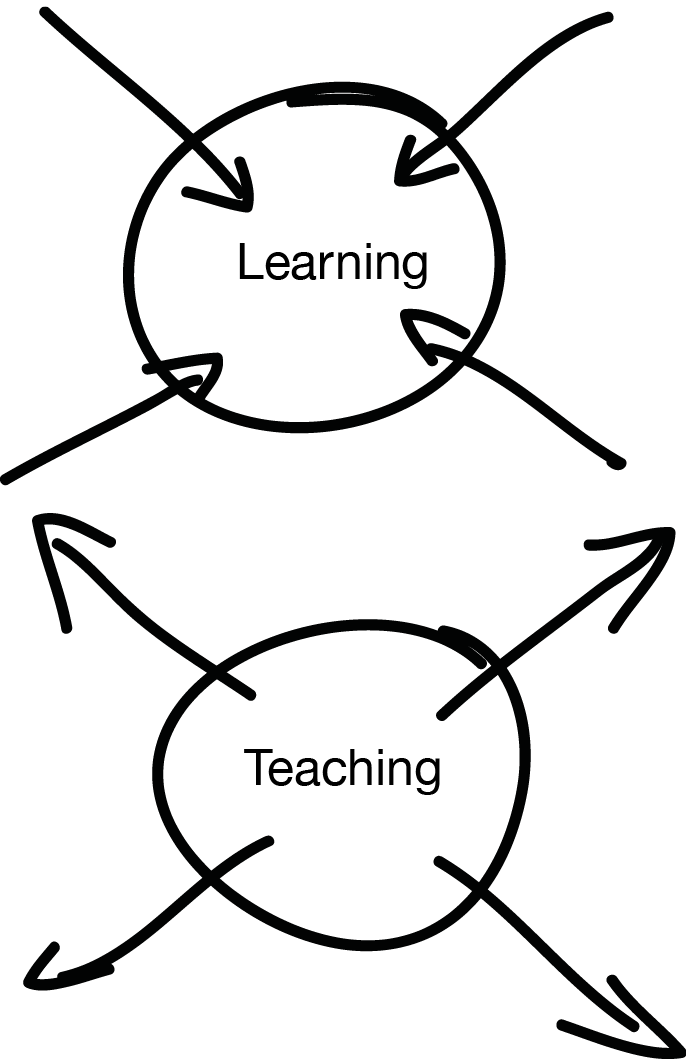
So that is a quick diagram I drew up using Adobe Ideas. I love having an electronic sketchpad but the flow of my hand across the relatively cramped screen of an iPad often gives me jittery lines. Enter Ideas, which smooths the lines and makes up for my rubbish neural feedback.
My first question is “What do the arrows mean?” We can see the words “learning” and “teaching” on the screen, but it’s not immediately clear what the arrows signify, nor the relationship between the bubbles themselves.
Normally, I’d draw this diagram and get people to think about the way that information flows when we are conducting one or other of the activities in question. Then, it starts to make sense. The arrows show information flow. Teaching is all about the flow of information out of the person who has it, and learning is all about the flow of information in the person who wants to learn. I like this diagram because it also hints at one of the core issues in both activities – as a teacher, I can push my knowledge out but, once it leaves my boundary, there’s no guarantee that it’s going to be any good. Similarly, the act of learning requires the learner to bring the knowledge into their own sphere and then carry out some work on it. The bubble boundaries signify the locus of control in both activities. I have deliberately not connected the two bubbles together because there is a medium of exchange that the knowledge has to traverse – if I accept that there is no guaranteed connection between learners and teachers, then it’s up to me to think about the way that the largest number of teaching arrows end up in a space where a learner can grab them and start doing something with them. In designing good educational activities, I have to think about the role of the teacher, and the learner, and the vagaries of the mechanism if I want to succeed.
I’ve deliberately avoided words like teacher or student in the diagram because good teachers are also, quite frequently, learners and some very good students are also teachers, of themselves, of their peers and as part of the informative framework that makes teachers better teachers.
The diagram also has one more important function for me as it clearly illustrates that some of my learners are learning things from other people, whether it’s uni work, life or how to juggle relationships, the knowledge that I’m trying to share is only one part of their sphere of influence. I’m competing with other interests and I should always keep that in mind. At the same time, if my students thought about it, they’d understand that I’m teaching more than just them and that could explain why I make some of the decisions that I do.
It’s a simple diagram but it’s effective. Or, at least, it is for me!
Is this diagram clear to you now? It is helpful? Could it be better? What do you think?

 Nick Falkner