
Never Put The Roof Up First
Posted: January 29, 2012 Filed under: Education, Opinion | Tags: education, higher education, reflection, teaching, teaching approaches 1 CommentI had a great coffee meeting on Friday with a friend and colleague (who will be feeling self-conscious if he’s reading this now) and we were talking about a number of things, some education related, some research, some relating to the fact that the coffee shop was closing early. He reminded me, however, of some of the most important lessons I learned last year when I finally got the chance to produce a new Computer Science course from the ground-up, with no previous offerings at our Uni. So, with thanks to Jono, here are the things I learned about how to build a course, in a building metaphor to allow me to draw pretty pictures:
- Buildings Don’t Just Happen
Fortunately for the building industry, bricks do not spontaneous leap together to form load-bearing structures. Resources need to be identified, plans need to be drawn, tasks need to be allocated. The fundamental requirement is that you know what kind of building you’re trying to construct!
Similarly, for my course, I had to work out what I wanted to teach by looking at the curriculum to determine the scope and area. I had to figure out what students already knew by looking at previous courses and performance. I had to work out what people expected my students to know in terms of overall degree, courses that used mine as assumed knowledge and pre-requisites, and in terms of how much more each area would be taught. Once I knew that, I had my overall goal in my head and I had a much better idea of what I was supposed to be doing.
Yes, I could have just put together a course on advanced C++ programming with some data structures but any meeting of the goals I was supposed to have been achieving would have been accidental. You don’t ask a builder just to build you ‘a house’.
- Never Put The Roof Up First
You can’t put the roof on a building until there are enough supporting structures. Same process in a course. You can’t build to advanced concepts without fundamentals. You can’t generalise in a meaningful manner without knowing when to use specifics. For me, having determined my goals, sketching out all of the concepts in turn allowed me to think about how I was going to relate them. How I would move from one to the other. We can generally all agree on what the key concepts are but there are some ways of ordering them which are better than others. Ultimately, don’t start with the capstones! Things without support fall down.
- Think About The Occupant
A well-designed and well-built building is a fantastic thing. Everything is in the right place, everything works. When all of the resources and plans have been assembled and used in a way that the final realisation is optimal for the occupant, happiness ensues. We’ve already talked about our goals and concept building – is this now set up in a way that works for your students? Are you building for one cohort or all of them? Is there space for different academic levels in the student body (because they will be there) or will people pass “if they’re smart enough”. Who will be in your course? Are your course features going to be appreciated as features? Are they even, being brutally honest with yourself, features… or rationalisations?
- Get It In Writing
The builder does not pass on instructions via psychic powers. Apart from anything else, there are too many people to talk to, some of whom may not even be on site. Your carpenters, plumbers, brick layers, electricians, inspectors… the list goes on and, if you had to constantly check every little thing every time, your building will never get built. Good, and large-scale, builders not only have plans, they have specific plans for specific jobs so that everyone who works for them knows what they need to do as part of the bigger picture, with the spotlight on their area of expertise. Once you know concepts, relationships and targets, you can put together a plan that anyone can follow, assuming that they have the skills, to build you the house (or the course) of your dreams.
Your overall plan could include your examination scheme (what’s in it? what form does it take? how long is it?) which assesses all of your target concepts. Built around these are the details of examinations, assessments, exercises and the lectures and content required to pass all of this on. Do you need a course provided in Blackboard or Moodle? Any special requirements? You can spin off a sub-section and get it to the right person so that, instead of waiting until the beginning of term and doing it in a flat panic WHEN they can find you, the relevant people can create what you want from your plan. Got TAs? A good design and plan will show them what they are lecturing, when and what you expect them to highlight. Yes, you’ll still need management meetings along the way most likely, but this will save you a heap of work later.
Time spent now will almost always save you more time later and make your life easier.
Think about it. What happens if you get really sick and someone needs to sub in? What would you prefer? A phone call during your prostate surgery that screams “Your course is on C++, what do they know?” or an e-mail that says “I’ve got all of your notes and plan. I’ll run that in-class quiz from the scratchies you prepared. Did you want me to cover anything else?” (Hey, I know, chances are you’re going to get called anyway because people are people but good preparation and planning will make the call shorter. 🙂 )
- Sometimes Things Go Wrong
Builders are lovely people but, from my experience, if one told me that the work was going to be done tomorrow, I still wouldn’t buy the champagne until a week from now. Complex assemblies of things are prone to interruption – whether big builds or entire semesters of new content. You can’t expect everything to go to plan. You have to allow yourself some flexibility to cover those situations that will occur in a new course. You won’t necessarily pitch the course at exactly the right speed. Do you have additional activities if you get through lectures more quickly? Do you have a disposable slot in case you need to extend a lecture. Or you get sick. Knowing what your core material is allows you to quickly refactor the course and keep the good stuff in (which you’ve already identified and is already in the exam, maybe) and get rid of some fluff.
What? No fluff? It’s ALL core? It’s going to be a long exam then! More seriously, can you move lecture content to tutorial, or extend an assignment a little, or put up a podcast, or arrange an extra session? If the answer to all of these is ‘No’ then you want to know this before you waste days of your time trying to make it happen. Sometimes things go wrong. A plan can help.



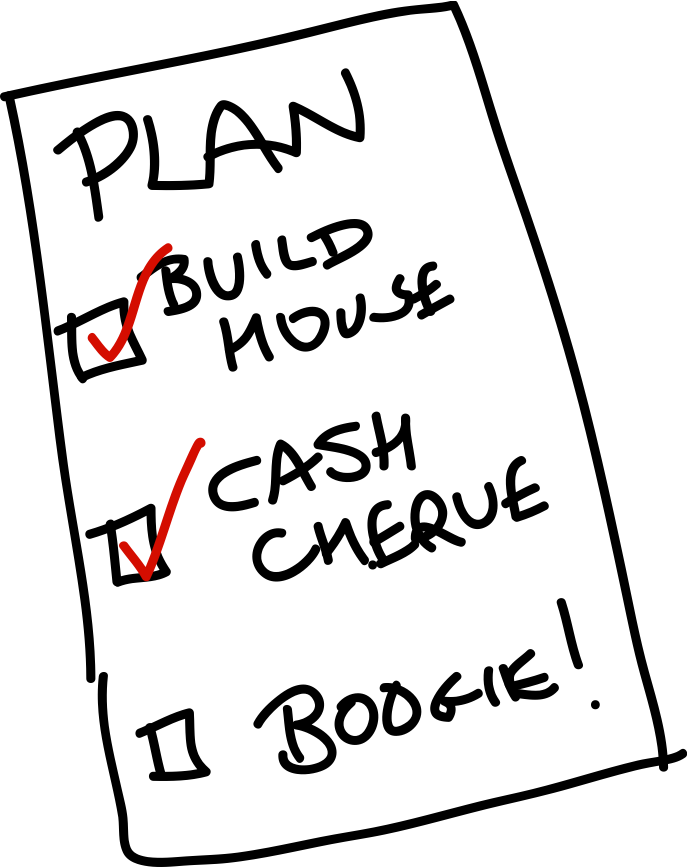

This is, most definitely, not the definitive list of things you should know but it’s certainly at least some of them! It was a fascinating process to go through. Next time I hope to make my attempts to live up to my own goals even better. Fingers crossed. 🙂
Short and sweet
Posted: January 28, 2012 Filed under: Education, Opinion | Tags: education, higher education, reflection, teaching approaches Leave a commentOne of my favourite lines from “Good Will Hunting” is the one that Robin Williams uses, and Matt Damon borrows, to explain why they’ve had to make certain decisions. As Matt Damon’s character, Will, puts it:
“Sean, if the Professor calls about that job, just tell him, sorry, I have to go see about a girl.”
It’s easy to talk about some of the objective aspects of teaching: curricula, concepts, relationships, abstractions, taxonomies, lesson plans, objectives… (it’s harder to do things with them but we all understand that) It’s harder when we think about the overall support, mentorship and influence that we’re going to have on our students, our colleagues and the world. Will’s quote is borrowed from a story that Sean (Robin Williams) told him earlier, how he made a choice that he never regretted to pursue his (future) wife.
A bad teacher will probably more influence, in many ways, than a good one. The things we say will be remembered in one way or another but, given that very few of us have scriptwriters, we may never get memorable or Oscar-winning quotes out. The negative things we say? If we ever belittle someone? You know that’s going to be remembered. Anything we do that’s unfair? That makes people seethe? Probably going to be remembered. That is, of course, why we should never say things like that or do things like that. I’d rather be forgotten than infamous.
We are, above everything else, people. We have strengths, weaknesses, good days and bad. We strive to excel, we succeed when we can, we learn from our mistakes if possible and then we do it all again.
Now of course, lecturing ICT is not just C++, Java, data structures and databases. It’s professionalism and ethics and dealing with subtleties… For me, the most important aspect is consistency. Every student should get the same Nick, the same amount of time, the same attention and, more importantly, I try to apply my teaching philosophies uniformly. One of the things I encourage is that my students tell me what’s going on so that I can help them or be ready for it. So that other people can plan around it. It should never be an excuse for laziness but it should be a sign of forethought, planning and honesty. So, in the spirit of reflexively applied consistency, here’s what’s happening for the next week or so. I’ll still be blogging daily but the posts may be a bit shorter, hopefully combining that with being a bit tighter at the same time.
Tomorrow there will be a long post with lots of graphics that I spent some time on and I hope you enjoy – it’s a bit of fun with (I hope) something useful. The rest of the week is going to be a series of short and sweet posts, the first of which is already in the queue. My usual long ramblings will return soon enough.
Dead man’s curve: Adventures in overdriving.
Posted: January 28, 2012 Filed under: Education | Tags: education, higher education, reflection, teaching, teaching approaches 6 CommentsLooking at my previous posts, you’ll know that I have a strong message for my students: do the work, do it yourself, get the knowledge and you’ll most likely (at least) pass. Part of my commitment to my side of the bargain is that a student almost exclusively controls the input that controls his or her own mark. Yes, very occasionally, we will scale a bit if we think that students are being disadvantaged but I have never seen a situation where we have increased the number of students who fail. (To be honest, our scaling is really lightweight.)
In particular, I do not fit grades to a curve. I rarely have so many students that such an approach would be even approaching statistical validity and, more interestingly, I tend to get an approximately normal distribution anyway, without any curve fitting. My position on this is more than mathematical, however, as it doesn’t sit well with me to fail someone because someone else did better.
Because we try very hard to not have to shift marks, we have an implicit obligation to manage the courses so that a pass mark represents a sufficient level of effort in assimilating knowledge, completing assignments, participating in individual and group interactive activities and the exam. Based on that, if everyone has done enough work to pass, then I can pass everyone. The trickier bit is managing the difficulty of the course so that the following conditions hold:
- A pass mark represents a level of effort and demonstrated knowledge that means that a student has achieved the required level of knowledge.
- A fail mark represents a level that, over a number of opportunities for improvement, indicates a combination of insufficient knowledge and/or effort.
- There is scope in every activity for students to demonstrate excellence. These excellence marks go ON TOP of the ‘core’ marks.
- The mark distribution is not bimodal around 0%/100% but has a range of possible values.
To avoid having to manually redistribute the buckets using curve grading, I have to build the course so that the final mark is built from assignments that meet all of those criteria and in a way that the aggregate of these marks will also produce marks that meet the final criteria. This, of course, means that I advertise assignment weightings, combinations and criteria as early as possible to allow students allocate their effort and then I have to incur the marking burden of applying a marking scheme that, once again, gives me this range.
One of the reasons that I believe this is important is because we risk overdriving one of our key student characteristics if we create an artificial curved-based separation. My students have all been through a fairly rigorous selection system by the time they reach me – the numbers dwindle through to final year of high school and the number who go to Uni are less than a quarter of those who start school. The ‘range’ of these students is the ‘not only passed but made it to a Uni course’. This automatically bands them relatively closely. If 100 students sit a course and half get 60 and half get 65 then, assuming I’ve done my job correctly in the design, they all deserve to pass because they are quite close in in-coming ability and they have achieved similar results. More importantly, the half who got 60 don’t deserve to fail because the other half get 65. If you overdrive noise then all you get is loud noise, not some sort of ‘better’ signal.
I’m not opposed to adaptation in teaching – in fact, I’m a huge fan of using challenge and extension questions to allow people other opportunities to excel, to refine their knowledge or to get a chance to be more specific. However, I support it from an additive approach, where marks are added for success, rather than a subtractive approach, where not managing to add more marks is treated as a mark removal exercise if a sufficiently large group of other people manage to add marks. This requires me to design courses carefully, give enough assignment opportunities for people to demonstrate their skills and provide a lot of feedback.
I note that I use almost no standardised testing and, where I do use multiple choice questions, I either require an accompanying explanation or the component is worth a small number of marks. As a result, I have a lot of flexibility in my marking.
I am not saying that we need to dumb down our material – far from it. If we design our courses with ‘acceptance level = pass, extension achievement = distinction’ we can isolate the core material and then put the ‘next stages’ in as well. As I’ve said before, letting a student know that there’s somewhere else to go and something else to do can be a spur to higher achievement.
Coincidentally, I had a meeting today with a colleague who has done some very interesting work on identifying and assessing the amount of ‘core’ material a student gets right from the ‘advanced’ material. From his early figures, there is very little variation in core material achievement level, as you would expect from all of this explanation that I’ve put up, but there was a vast range of achievement in the advanced material. More investigation required!
Two Slides Enter an Alleyway – Only One Returns!
Posted: January 27, 2012 Filed under: Education | Tags: education, higher education, resources, teaching, teaching approaches 6 CommentsOne of the commenters asked for examples of what I thought were examples of (relatively) poor material design and (relatively) better design. I’m not trying to weasel out here by using (relatively). These things are relative. Both slides I’m going to show you have good and bad points. From my experience, one is less well-received than the other and I can list some reasons for it.
Both slides are from first year courses, one taught in 2006 and one taught in 2011. The first is Powerpoint, the second is Keynote. (All copyright and page number data has been removed.)
Here’s number 1, which is a ‘not so great’ example.

And here’s number 2, which is probably better:

So, what are the major differences? To me:
- Slide 1 is cramped and hard to read. Following the long yellow lines, despite the fiendishly good contrast, is difficult.
- Slide 2 is simple and pretty easy to read. To be honest, it’s also covering much less ground but its intention is clear. The little node structure, which graphically links this slide to all previous work on linked lists.
- Slide 1 is not a relaxing slide to look at – imagine that dominating a darkened lecture theatre.
- Slide 2 has clear separation between English and not-English, very easy on the eye.
Slide 1 is a multi-stage proof, an extended working piece that takes multiple slides. Slide 2 is a revision slide and summarises the core of a previous concept in one slide, allowing the lecturer to add information, question the class and embellish. The class will have read Slide 2 in a short time and then be able to concentrate. People will be starting at Slide 1 for some time, trying to follow the lines and work things out.
So there are, as promised, some examples for you. Do you agree with my assessment? There are many other things to say about both. What do you think?
Farewell, Distributed Systems Class of 2011.
Posted: January 26, 2012 Filed under: Education | Tags: education, higher education, reflection, teaching, teaching approaches 1 CommentHere is the message that I wrote on the forums, after my final lecture to my third year Distributed Systems class. I demand a lot of my students. Most of all, when they leave us to go out into the world, I expect them to have some knowledge. All of us, everywhere, who educate, know how precious knowledge is and how special it is when someone finally gets it. I’ve said a lot of this in lectures, and to individuals, but I always like to say one last thing before we turn off the lights and go in our separate directions.
Sometimes, for some people, what let them down was their ability to tell me what they knew. My advice is that you should always be working on the way in which you can describe and share your knowledge. The majority of marks in the examination were lost for loose descriptions, confusion of concepts and, in some cases, blatant and desperate attempts to arrive at the correct solution by writing everything you can think of. Focus on telling me what you know to be right and spend less time on trying to fool me.
A number of you will hit the workforce next year – you will need to be able to communicate your knowledge and convince people that you know what you’re doing. Maybe your excuse to yourself is that you’re not that interested in DS. Well, fine, but don’t expect everything in the work world to be fascinating and amazing.
(I love teaching but marking exams is one of the least enjoyable jobs ever – but it has to be done, done well and done in a way that supports all of the other activities that lead to it. A lot of things are like this.)
Alan Noble put it really well when he described what the Google Engineers did. They don’t just sit in their offices and code, they go out and talk to their colleagues and other business people. They communicate. They share ideas. They can put their knowledge into practice as coders and as communicators.
Let’s finish on a positive note. When you check your marks, if you’ve passed this course then you can rest assured that you’ve demonstrated enough knowledge to have earned your pass. You know enough about distributed systems that you can work in an industry where these concepts become more important by the day, towards a future that will make extensive use of the underlying principles that you learned here.
If you did pass, how did you do it? What can you learn from it that will increase your chances of success in the future? People say that they learn the most from failure, and I think that’s true, but unless anyone got 100% for everything, you can still improve. Was there something I said that can help you improve that in the future? I hope that at least some of it has been useful.
Now, if you didn’t pass, why was that? Were you doing too much? If you could get into this course then you have the aptitude to pass but we know for a fact that life often gets in the way. You need to allow yourself enough time to study for these courses and put enough work into the assignments and examination preparation. If you have a supp, study as hard as you can and try and get through it. If you come back next year, start from scratch and do everything again, as if it’s for the first time.
We are, above all, scientists. If have a set of possible actions and a set of possible outcomes, how do we select our actions to select our desired outcome?
We have covered an introductory set of knowledge in a fascinating, growing, active and exciting area of research and practice. It’s now up to you to make use of that knowledge.
I’m not teaching third year in 2012, as I’m working on a new degree program, so I may not see many of you again. If I don’t, I wish you the very best of luck in the future, wherever you go and whatever you do.

Ready to roll (or teach)
Posted: January 24, 2012 Filed under: Education | Tags: education, higher education, resources, teaching, teaching approaches, workload Leave a commentYesterday I mentioned CS Unplugged. Today I’m helping out, somewhat last minute, at a CS Unplugged event that I didn’t even know about yesterday! Perhaps I should write a post about “Nick gets lots of free money given to him” and keep my fingers crossed?
This does actually segue into something semi-useful and blogworthy in that my general principle in my career is “always be ready to seize a new opportunity”. I stick my hand up for a lot of things but I never stick my hand up if I don’t think that I would do a good job. The price to pay here is that you must always know what you can do, what you have time to do and, harder, have a good enough vision of the future to have the right skills.
I don’t pretend to be an expert here but I have a short list of things that I do that help me to do this:
- I prepare myself for the idea that opportunities could come along and think about how and why I should accept them.
- I talk to lots of people. I attend events, talk shop, listen, contribute, write several blogs, read just about everything I get sent, send a lot of things on and, generally, try and stay as connected as possible. Why? Because then I know what is happening in my own discipline, in my own Uni and in my own country. Very few announcements are surprises to me because the (much more informed) people I’ve been speaking to have seen it in the wind and suggested it as a possibility. Other people think that I may be able to help them, which means that they may get in touch with me later.
- I write down my ideas and what it would take to make them happen. When I have a good idea, I generally discuss it or write it up as a possible funding opportunity – or just sketch out a plan for it. If you came to me tomorrow and said “Nick, I have 10K/30K/100K/1M for a project” I can have an outline to you in about 10 minutes. Wow, that seems a bit… creepy. Why are you planning for money you don’t have? Aha, it’s because…
- I have a long term focus. Research this year turns into papers next year turns into grant applications the year after that. Teaching plans for next year have to start now. I don’t naturally have a long term focus! I like to work day-to-day like normal people but I kept finding that I ran out of time because I never really knew what to do next. I referred before to the joys of the pipeline and admitted that I’m naturally not good at this. But that leads me to point 4.
- Not being good at something isn’t an excuse. It’s not an excuse for our students (there’s a lot of difference between ‘not enough practice’ and ‘zero aptitude’) so it’s not an excuse for us. This is especially true if it’s part of the job. It’s a hard job. It’s a great job. It’s being responsible for the provision of knowledge to the next generation of scientists, teachers, educators, people, parents, children – it’s the whole human race that we’re working with here. Not being good at something is an opportunity to get better.
- I work out when I should say no. I am a hopeless overcommitter but I have now reached a level where I can’t fit any more in so I say ‘No’ more often. I have no kids and my wife is another academic so she has the same time pressures – I have a great deal of time flexibility at home. But I still need to hang out, relax, eat and sleep or I will go mad. But some things are time critical. While I was writing this a mail came in asking if I could have something (that didn’t have a solid deadline) ready in a week. I thought about it and decided to say ‘Yes’. If I work on this tonight, I can do it. It’s definitely worth it to do this and I want to do this project so I can spend a couple of hours in front of the computer instead of watching Doctor Who re-runs. It’s a delicate balancing act but some of the best opportunities have no initial load or money associated with them – they are overtime eaters until they pay off. If they pay off…
- Not everything pays off but take enough opportunities and one probably will. This is the big one so I’ll finish with it. The more things you try (which you have any chance at success with) the more likely you are to succeed. This is often demoralising, time consuming and, until something does pay off, it often makes you feel that you’re wasting your time. Look at this blog. It’s eating at least half an hour a day and for what? This has no pay off associated with it!
Or does it?
Well, it does. It forces me to focus for at least one part of a day that could be filled with admin and research on my teaching! On thinking about how I teach, how I learn, how I think my students learn and what I want to share with the world on this. Every post I write makes me a better writer. Gives me more ideas. Focuses me on teaching as I lead back in to first semester. No-one’s going to give me any cash for this, or load relief, and none of my jobs require this – but working here helps me think about how to manage other opportunities. Something here may one day head off into a seed grant idea. Some of your feedback may make me think about things in a different way.
Working on this blog prepares me for other opportunities and makes me open to share and receive new knowledge. It’s like a workout for my opportunity muscle.
What do you think? What are the best ways to prepare for an opportunity?
Teaching without technology: CS Unplugged
Posted: January 23, 2012 Filed under: Education | Tags: education, higher education, teaching, teaching approaches 3 Comments“Computer science is no more about computers than astronomy is about telescopes.” Edsger Dijkstra
“Here we are, in a school with no electricity, and no computers, trying to teach ICT. I get Charles to ask the class how many of them have seen a computer. (Answer: about a third). Then I get him to ask them how many have used a computer. Answer – none. They laugh nervously at the very thought that any of them might have had a chance to use a machine.” Bruce’s Rwanderings: the ups and downs of life as an education adviser in Rwanda.
There are some really interesting and clever projects that deal with teaching parts of information and communications technology without using any technology. You may have heard of the CS Unplugged website. If not, check it out because it has a whole lot of fun and interesting CS projects that don’t require a computer or any other supporting technology. Well, ok, some projects do require string. I’ll concede the point.

It always bothers me when I end up doing something that has an implicit price barrier on it. There’s a world of difference between “not having enough knowledge to proceed” and “not having the resources to even be able to get to the knowledge, so don’t proceed”. I don’t want to set up a resource constraint that limits my students to “only those people who can afford technology x”. What I often forget is the level of privilege that I enjoy which gives me a choice of technologies in the first place. That’s why things like CS unplugged are great because they remind you that Computer Science is often implemented on computers but, as the quote implies, they’re just tools. Knowledge can be transferred in many ways and the lessons learned through enjoyable activities away from the computer can be more meaningful and far less confrontational than staring at the vast unfriendliness of a blank screen.
CS unplugged is active, it doesn’t need a big box of computers, it can be done anywhere, it works when the power is out. It’s free. A lot of the activities are what I refer to as contagious knowledge – you show someone, they like it, they someone else. It’s like an amusing picture of cats with a caption in Impact, except, well, useful.

Every so often, rarely these days, a student transfers in who has a degree from a place where they studied Computer Science without any computers at all. There wasn’t one in the school or, if there was, it was so valuable that the students weren’t allowed near it! It’s obvious when another teacher has taken the wrong approach: depending on memorisation of algorithms or characteristics as an indication of knowledge, rather than trying to come up with techniques to apply and extend knowledge. Why didn’t the previous teacher do something better? The science of computation and algorithms should always be more than just a tool course.
But that is so easy for me to say, with all of the resources that I have. It’s ignorant and arrogant for me to try and apply intention to the outcomes that I perceive. The right thing for me to do is, as always, think “How can I fix this?” Increasing knowledge reduces ignorance. How can I help people who may not have access to some of the resources I take for granted?
How did I find out about CS Unplugged? Someone told me about it, then explained how it was being used in places like small schools, or in underfunded districts, or where student numbers had grown but labs hadn’t, or where people thought that it was a great way to teach Computer Science without having to worry about “Ok, now right click on the third tile on the left hand side of the second screen.” Imagine that, teaching CS without having to worry about whether all the logins have been created, the network is up, if all the patches have been applied. Teaching CS without wondering who is secretly Facebooking or IMing in the middle of your lessons.
As always, this approach is part of your tool box. You look at the problem, think about it and then pull out an appropriate tool. Sometimes, of course, we have to wander off and forge a new tool – exciting, arduous and rewarding all at the same time. If you haven’t heard about CS Unplugged, welcome to a new tool. If you have, but you haven’t used it, maybe it’s time to trot it out somewhere to see how it could work for you. If you like it, pass it on!
Fiero! The joy that makes you want to punch the air.
Posted: January 22, 2012 Filed under: Education | Tags: education, fiero, games, higher education, reflection, teaching, teaching approaches Leave a commentAfter a fun couple of hours writing the previous post, I’ve decided to hunker down and read some more books on data visualisation. However, I wanted to update you on my Summer Research Scholarship student – the one who was developing the game. Well, he demo’d the basic computerised version on Friday and, simply, it works, it’s fun, and he’s got a simple text display going. Next week it’s GUI + networking design and build, then two more weeks of coding and wrapping it up for week 6 with API documentation, extensible framework and a plan for porting it to Android and iPhone.
Let me remind you that he started two weeks ago, was given some books, a brief, and a lot of access to me and my time, as well as my planning skills and overall management. In that time, he has learnt about an entirely new way of presenting information, come up with six ideas, found the best one and chased it with an amazing passion. In two weeks he has a simple working game that could be played right now. The more I work with students, the more I realise that my fears about what they can’t achieve often become constraints on what I allow them to achieve. I (implicitly or explicitly) tell people that This is enough when it sets a false level of achievement for the struggling and it bores the gifted. Yes, there are varying levels of ability and we must educate all of our students, but I’ve seen so many people soar when I’ve given them open skies and a jet pack, that I can spend the time to help those who are still walking, or have fallen once or twice. My belief is that most, if not all, will fly one day. If I don’t believe that, then what am I doing?
It’s the weekend and I’m blogging this because I want you to know how much we can do, as educators, as people, as mentors and, sometimes, as the ones who stand back and let people try. We have to build our world in a way that it’s possible to fly but it’s not fatal to fall.
It’s an enormous challenge and I love it. Fiero is a word that we use for that feeling of achievement and joy that makes you raise your fists into the air and punch out to the sky because you can’t contain how good you feel. My student had such a moment when he worked out one of the core design issues that turned his game from dull to fun. He told me about it, using terminology he’d picked up on this project to describe that joy. Now, I have that feeling because I think that good things are happen. What more can any of us ask for in our jobs, once the mundane issues are settled?
Have a great weekend! Find the joy! Punch the air!
Your cheating heart will do you wrong
Posted: January 21, 2012 Filed under: Education | Tags: education, higher education, teaching, teaching approaches 3 CommentsOne of the most unpleasant things I have to do is dealing with students who cheat. We have a pretty thorough and fair process for handling this and, most of the time, we catch someone once for basically being lazy or stupid, they lose the marks for the assignment and they never do it again. Even so, the number of people who write “this lecturer is the worst person in the Universe” on their end-of-semester assessment forms is generally the same number of people as I caught cheating – it has an impact on both of us.
When I see someone again, or someone comes up for a second or third offence, that’s sad. It’s sad for so many reasons. It’s sad because, this time, they risk a penalty of getting zero for the course. Or getting kicked out of Uni. It’s sad because they haven’t taken in what I was telling them about knowledge being more important than cramming or copying. But, for me, it’s sad because now I feel that I’ve failed the student. Somewhere along the line, they got the message that 75/100 cheating is somehow better than 50/100 fairly earned.
That a pass by any means is better than a fail.
Of course, pragmatically, it is. Student are paying, directly or indirectly, to study and they want to be in the workforce as soon as they can, with the best marks possible. But what that means is all those talks on ethics, on professional practice, on honesty, on integrity, have missed these students entirely. Students aren’t buying a degree, they have an opportunity to earn a degree. (Ideally, I’d like everyone to have the opportunity to go to the college and course of their choice. Real world factors jump on my head really quickly there.)
Even if a student sneaks through with undetected cheating, they still have a problem, because their lack of knowledge will probably get found out once they hit the job market. They may get one job, or two, but once it becomes obvious that they don’t know what they’re supposed to, people’s estimation of them will drop. People’s ideas of what our degrees our and what our school does will drop. Everyone loses.
I’m up front about my dislike of cheating. But I’m also fair in my reaction. When it’s dealt with, that’s it. Records leave me to go elsewhere and I try my hardest to forget the details so that I don’t stare at that student for the rest of their time and wonder what they’re doing. Give me 6 months and I’ve achieved it. The student is back in the pack and, if it doesn’t happen again, it never gets mentioned again. It’s a trap to immediately scrutinise everything as if the student is cheating again. Has action been taken? Yes? Is it over? Yes? Move on. Ok, they might do it again but that’s what you have Turnitin and MOSS for. If they do it again then, yes, it may be systematic and more action has to be taken but, while cheating is not anything that should be condoned or excused, I can almost understand why a confused, rushed 17-year old might thing it was not the worst idea in the world to save themselves some effort.
But it is the worst idea in the world, because it can damage the learner-teacher relationship and risk a student’s entire career. In a harsh school, it can be an inescapable sentence for the rest of someone’s career.
This is a G-rated blog, so I can’t tell the joke about “I kiss one goat” here but those of you who know the joke know that the punchline is that the teller is a man of great merit, has done many things, but he kissed one goat and he is henceforth known as Henri the Goat Kisser. So, yes, I don’t like cheating, and I wish people would stop, but I try not to categorise someone by actions that they may only take once in their life, and regret for the rest of it, because part of my job is making new and better people. Well, that’s over-stating it really. Part of my job is helping people to make themselves new and better.
When I’m teaching, I’m often thinking about how I can structure assignments to reduce the temptation and opportunity to cheat. I think about how I can make students interested enough to take part, to be involved – this often involves other students, using neighbour techniques. But, when cheating happens, I try to be as understanding as I can – while still having a firm line that cheating doesn’t fly here. It’s hard and I welcome comments from other people who’ve had to deal with this.
I’m giving you positive feedback, you idiots.
Posted: January 20, 2012 Filed under: Education | Tags: education, higher education, reflection, teaching, teaching approaches Leave a commentWhen I posted my last message, I had, without realising it, posted 20 messages. WordPress gives you positive visual reinforcement when you hit certain milestones, which many of you will know. You also get little quotes along the way. Here is an example of what I would consider to be questionable positive feedback.
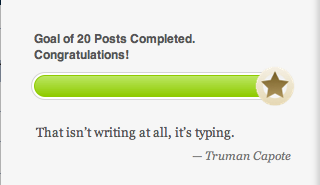
Look at all of the positive imagery there: “Goal completed”, “Congratulations”, a big green line that is completed and a gold star!
And then look at the quote. For those who don’t know, that was Capote’s response to Kerouac’s production of “On The Road”, which was written up in a very short time on a giant roll of paper that Kerouac assembled so that he could just keep typing without having to change paper. Now, I know this quote and I’ve even embraced this quote for my personal (art/writing) blog which has the title “This Is Not Art, This Is Typing”. I’ve embraced it for projects such as NaNoWriDay – 50,000 words in 24 hours, which I did for charity. I’m (strangely) proud of my ability to write quickly.
But this response took the wind out of my sails a bit. I’d been mostly ignoring the ‘goal’ messages because I schedule my posts for publication, rather than hitting publish immediately, and this means that I haven’t seen one for a while. I happened to hit the update and got this – my initial thought of “wow, 20 posts, I’m sticking to my plan” was a nice bit of positive reinforcement.
But what is that quote doing there? The automated system has counted my posts and thinks this is the best thing that should come up? Is it a joke? Is it supposed to be a gentle ribbing or something?
I pretty much write for a living. I’m used to people criticising my work. I guarantee you that someone is going to be ruder than this to me today – and it will be personal, rather than just randomly allocated. Imagine what happened if someone had spent a year pouring their heart out into their blog and, on post 20, *ding* well, ok, 20 posts, but, just so you know, it was all just typing.
Now my point here is not that I’m under psychic assault but it is a fantastic example of how, with the best intentions, one careless piece of assembly can completely undermine everything that you’ve tried to achieve with well-designed courseware and attractive, positive messages.
I would suggest that the Capote quote should never show up on WordPress. To be frank, the quote has never really contributed anything anyway – just another Capote quote, somewhat clever, very snide, generally nasty. It’s the kind of thing people say when they want to diminish the value of what you’ve done. In the education business, we do not get paid to make people feel bad about how much smarter we are than they.
Sadly, too many educators still take that path. We’re dealing with forming minds – intellectual embryos – we have to choose our words carefully, our materials even more carefully and always be aware that accidental juxtaposition risks being seen as deliberate when people are sensitive or looking for reasons to doubt themselves.
This quote, which I know and I’ve integrated into other places, in this context, made me question the value of what I’m doing here. It’s a valuable reminder of the power of reinforcement and feedback – positive and negative.

 Nick Falkner