
I’m giving you positive feedback, you idiots.
Posted: January 20, 2012 Filed under: Education | Tags: education, higher education, reflection, teaching, teaching approaches Leave a commentWhen I posted my last message, I had, without realising it, posted 20 messages. WordPress gives you positive visual reinforcement when you hit certain milestones, which many of you will know. You also get little quotes along the way. Here is an example of what I would consider to be questionable positive feedback.
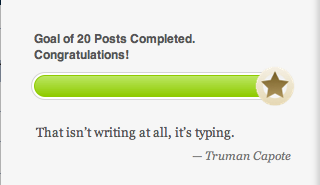
Look at all of the positive imagery there: “Goal completed”, “Congratulations”, a big green line that is completed and a gold star!
And then look at the quote. For those who don’t know, that was Capote’s response to Kerouac’s production of “On The Road”, which was written up in a very short time on a giant roll of paper that Kerouac assembled so that he could just keep typing without having to change paper. Now, I know this quote and I’ve even embraced this quote for my personal (art/writing) blog which has the title “This Is Not Art, This Is Typing”. I’ve embraced it for projects such as NaNoWriDay – 50,000 words in 24 hours, which I did for charity. I’m (strangely) proud of my ability to write quickly.
But this response took the wind out of my sails a bit. I’d been mostly ignoring the ‘goal’ messages because I schedule my posts for publication, rather than hitting publish immediately, and this means that I haven’t seen one for a while. I happened to hit the update and got this – my initial thought of “wow, 20 posts, I’m sticking to my plan” was a nice bit of positive reinforcement.
But what is that quote doing there? The automated system has counted my posts and thinks this is the best thing that should come up? Is it a joke? Is it supposed to be a gentle ribbing or something?
I pretty much write for a living. I’m used to people criticising my work. I guarantee you that someone is going to be ruder than this to me today – and it will be personal, rather than just randomly allocated. Imagine what happened if someone had spent a year pouring their heart out into their blog and, on post 20, *ding* well, ok, 20 posts, but, just so you know, it was all just typing.
Now my point here is not that I’m under psychic assault but it is a fantastic example of how, with the best intentions, one careless piece of assembly can completely undermine everything that you’ve tried to achieve with well-designed courseware and attractive, positive messages.
I would suggest that the Capote quote should never show up on WordPress. To be frank, the quote has never really contributed anything anyway – just another Capote quote, somewhat clever, very snide, generally nasty. It’s the kind of thing people say when they want to diminish the value of what you’ve done. In the education business, we do not get paid to make people feel bad about how much smarter we are than they.
Sadly, too many educators still take that path. We’re dealing with forming minds – intellectual embryos – we have to choose our words carefully, our materials even more carefully and always be aware that accidental juxtaposition risks being seen as deliberate when people are sensitive or looking for reasons to doubt themselves.
This quote, which I know and I’ve integrated into other places, in this context, made me question the value of what I’m doing here. It’s a valuable reminder of the power of reinforcement and feedback – positive and negative.
Can you read what I see?
Posted: January 19, 2012 Filed under: Education | Tags: education, higher education, resources, teaching, teaching approaches Leave a commentI’m going to touch on an area that I don’t have a great deal of experience with but that I’ve thought about a lot: making teaching material available to students who are visually challenged. My terminology here is important because I don’t want to ‘deal with’ these students, mainly because I think that it sets my mind into the wrong framework. You ‘deal with’ parking tickets. You ‘deal with’ onerous problems. What I want to do is to make teaching material available to everyone but, if I’m using a visual focus, I have to consider alternative delivery mechanisms for people who don’t have that capability.
(I should note that, when I first wrote that paragraph, autocorrect decided that I wanted to make material available to students who were visually challengING. Proof reading is really your friend, sometimes.)
Let’s talk about one of the first issues you might encounter: people who are, to some degree, colour-blind. How many people do you think are colour-blind?
1 in a million?
1 in a thousand?
1 in a hundred?
8 in a 100 men are colourblind, compared to 1 in 200 women. Get 64 men in a class, you are 99% likely to have someone who is colour-blind. Most of these people will have red/green discrimination issues. The most extreme will see no colour at all.
So how do we deal with that? Well, a number of products have modes that allow you to simulate colour-blindness to see what your work will look like. Turn off the colour or print it in black and white – how easy is it to discriminate based on the contrast of the work stripped of colour. Given those numbers, you may have a friend or colleague who can look at your work and tell you how it works for them.
Does this mean that you can’t use colour? No! What it means is that you can’t depend upon colour alone for contrast and separation. Do you have a complicated pie chart with 27 segments, using colour to separate them. (Firstly, why? Too much fine detail can distract people from your core point.) What happens if you outline the segments in black and switch off the colour? Does it look like a bicycle wheel? In motion?
Colour as a highlight or attention grabber will work for the vast majority of the population. It is, however, always helpful to think about those 8 in a 100 who will not get your message if you have depended too much upon colour contrast or a particular shade mix. (As always, keep trying, find what works, learn, evolve, start over from step 1!)
The more severely visually impaired, where part of the field of vision is lost, will have different techniques for managing things. Some will need pre-printed blown-up notes. Some will use telescopes. In my experience, most people are very straight forward about their requirements.
The one challenge, I find, is where I have a diagram that I wish to explain to someone who has no sight or has never had any sight. There’s my L&T diagram on the first and second posts of this blog (Jan 1 and 2). The text for this should be:
“A diagram showing the relationship between learning, teaching and the flow of knowledge. Two circles are placed, horizontally, so that they overlap with a small intersection. The left-most circle contains a capital L character, the intersection contains an ampersand character and the right-most circle contains a capital R character. Lines with arrows on their ends are placed around the diagram to indicate information flow. Two arrows, starting from outside the left most circle, pierce the left-most circle’s left boundary, terminating inside, with their arrow heads pointing towards the intersection to indicate the knowledge flows into the Learner. A similar pair of arrows start inside the right most circle and cross the boundary, with the arrow heads outside and pointing away from the intersection to indicate that the flow of knowledge is from the Teacher to the teacher’s environment.”
Now, even then, I’m not all that happy with this description. I don’t know what it is to not have any visual information – does right most or left most make any sense? Should I be more abstract? Am I depending too much on visual cues, still?
However, thinking about it makes me think about what my diagram stands for, how I would explain it and, to be honest, any description is better than none if it’s honest and accurate.
As always, don’t make this an excuse NOT to try this out. Think of this as one more small piece of information that can make it easier when you do decide to give it a try.
If you happen to have personal experience on this, from addressing this or living this, please throw in a comment. I’d love to hear from you, even if you are going to tell me that I’ve got it all wrong – it’s the only way I’m going to learn.
Who told you that you couldn’t?
Posted: January 18, 2012 Filed under: Education | Tags: education, higher education, reflection, teaching, teaching approaches 3 CommentsOne thing I often encounter when talking to people about designing teaching materials is that a lot of highly-qualified, sensible, smart and otherwise perfectly reasonable educators are adamant that, somehow, even a skerrick of visual design is beyond them. There are lots of good reasons why certain approaches work in certain areas, and, to be honest, sometimes black on white and simple is the way to go (like here), but I sometimes sense a resistance. This always makes me wonder “who told you that you couldn’t do this”, and then, almost immediately, “and why are you still listening to them?”
We are an amazing species. We live in so many different places, adapt so quickly and are very, very hard to stop. But, somehow, after you’ve made it through a degree or two, teaching qualifications, maybe a PhD (or two, you keen devil, you), secured a teaching spot and managed enough time to read this rant… you can’t sit back for five minutes and see which colours, typefaces and layouts make the key points stand out in your presentations?
I was having lunch with a friend and was ranting on about design, I am so much fun to have lunch with, and when I said that I thought it was an important thing for everyone to think about, he said “We can’t do everything.”
I completely agree to an extent – if we never try anything, we certainly can’t achieve it. Of course, there are degrees of all of this. Much in the same way that my oil paintings are more likely to serve as paintball targets than hang in National Galleries, there are people who have more or less talent in using visual representation to present knowledge. But zero ability? I think that there are surprisingly few of those.
But this is where you support network comes in. They aren’t a cheer squad – if something is bad they should tell you. If something is bad, and someone tells you, then you either fix it or remove it. But if something is good, or has any merit, then these external voices can help you to overcome that whole “I’m a scientist, not a graphic designer, Jim!” thing.
You don’t have to be a graphic designer. There are many tools around that, with a little thought, will help you make some interesting choices that won’t break people’s eyes. Keynote and PowerPoint have quite sensible defaults and well-designed templates. Using one of these and not jamming three million lines on to the screen will generally result in a tolerable outcome. Using the notes feature in either and printing out take away handouts for students will deal with the ‘presentation versus notes’ problem. Look at other presentations that you’ve liked and, respectfully, adopt the features that work. Learn and use some of the simplest techniques for making things look better. Things like the Golden ratio for working out relative text sizes – simple but effective. Things like checking your work for its black and white contrast or what happens if the colours change… (more on this later) Some of the big companies have spent a lot of money to hire designers to make your job easier. Don’t fight it – use it!
Ok, some of you can’t do this. I get that. If you’ve tried, and all you get is TimeCube (NOT SAFE FOR WORK IN SO MANY WAYS), then step away from the keyboard. 🙂 But if you haven’t really tried because you’re scared of getting it wrong, or because, years ago, someone put you in the box of “No, you can’t”, then try again. Get an honest mirror to look in and try again.
True confessions time: Are all of my materials at a level where I’m proud of them and think that I’ve done as much as I can? No, not yet. But I am working on them and converting them, consistently and maintaining the integrity of the course, as much as I can and as fast as I can. I am on the same path that you are and I still have a lot of work to do but sharing with my local, extended and network community makes me value my efforts in this direction more. And all my student feedback says “Not only do we like it, but we seem to learn better from it.” Maybe it’s because I like it more – maybe the materials are better. For once, an outcome will suffice.
Today’s homework, which you are so free to ignore, is to consolidate an entire lecture’s key points into one slide – at the presentation systems’s default font size (no shrinking!). Can you? Should you? Why or why not? If this slide, assuming it exists, was up the front, would it make the entire lecture easier to understand? If at the end, does it tell everyone what they should know? How has it made you think about the lecture? What would a student learn if you set this to them as an assignment?
Appealing to the Viewer
Posted: January 17, 2012 Filed under: Education | Tags: education, higher education, resources, teaching approaches Leave a commentIn this post, I’m going to touch on something that has become an integral part of my teaching: effective presentation. I’m going to focus on visual presentation but I do realise that not every student can see to the same degree as others. However, the majority of most of our audiences can see and benefit from time spent on visual design. That doesn’t diminish the requirement to cater to universal accessibility.
Over the past year I’ve been thinking a lot about graphic design. How can I produce images that convey knowledge so well that people can’t help but learn from it? A successful piece of design is a transforming medium for the message that it carries. It enhances. It clarifies. It elevates.
The design of this blog is deliberately easy on the eye. I’ve used straightforward typefaces, soothing colours and a slightly ambiguous main image. (Am I the water or am I the rock? For reference, I am the rock but I’m laminated. Long story.) The mobile device version uses an orange-based theme, with Helvetica, because it’s a different space, less cluttered because most mobile devices only show one surface (hence I can use brighter colours) but readability is crucial, so I used straight-forward, classic, typography.
A year ago, I wouldn’t have done that. But, between now and then, I’ve been exposed to a whole range of really good books that look at data visualisation, graphic design, typography and colour. I’ve started painting in oil colour, which has ramped up my appreciation of colour, contrast, warmth and texture. I’ve started developing postcard and t-shirt designs, messing around with typefaces, started really taking notice of how colour, shape and face are used to manipulate the way that we think. I’ve redesigned an entire course with a uniform design template, as I’ve mentioned before, and seen the benefits of it.
I’m sure that some of you are already mumbling about “content trumps presentation” and I would be the first person to agree that a content-free presentation is useless, no matter how beautiful. However, if I can make my content more appealing, more focused, more engaging and easier to understand through the use of good design – why shouldn’t I? In fact, let’s make a stronger statement – I should use as much skill as I can to make my presentation of my material as good as it can be.
Our students are surrounded by good design, all the time. That’s how people sell things to them. That’s what their magazines and web experience looks like. That’s why TV looks the way that it does. Did you like the typeface used on the Obama campaign? That typeface is called Gotham and is so ‘on message’ in terms of the campaign it’s bordering on hypnotic. That’s what our students see every day. Those “Keep Calm and Carry On” signs that are being riffed on all over the place? Hand-drawn lettering, beautiful in its simplicity, clear in its message. (Just to geek out for a moment, the closest approximations to that typeface we have are probably Avenir or Gotham. You can forget that information if you like.)
Good design. Convincing design. Strong colour cues. Heavy image association. Making knowledge transfer better.
I’m an educator. I try to leave branding to my marketing department. However, if I can make my knowledge transfer devices (slides, presentations, movies) look reasonable then, and this is important, my lessons will not be the dullest things that my students see all day.
Here’s a slide that I inserted into the first lecture of one of my courses. Yes, it breaks my negativity guidelines but the overall message is strong and it resonated with the students:
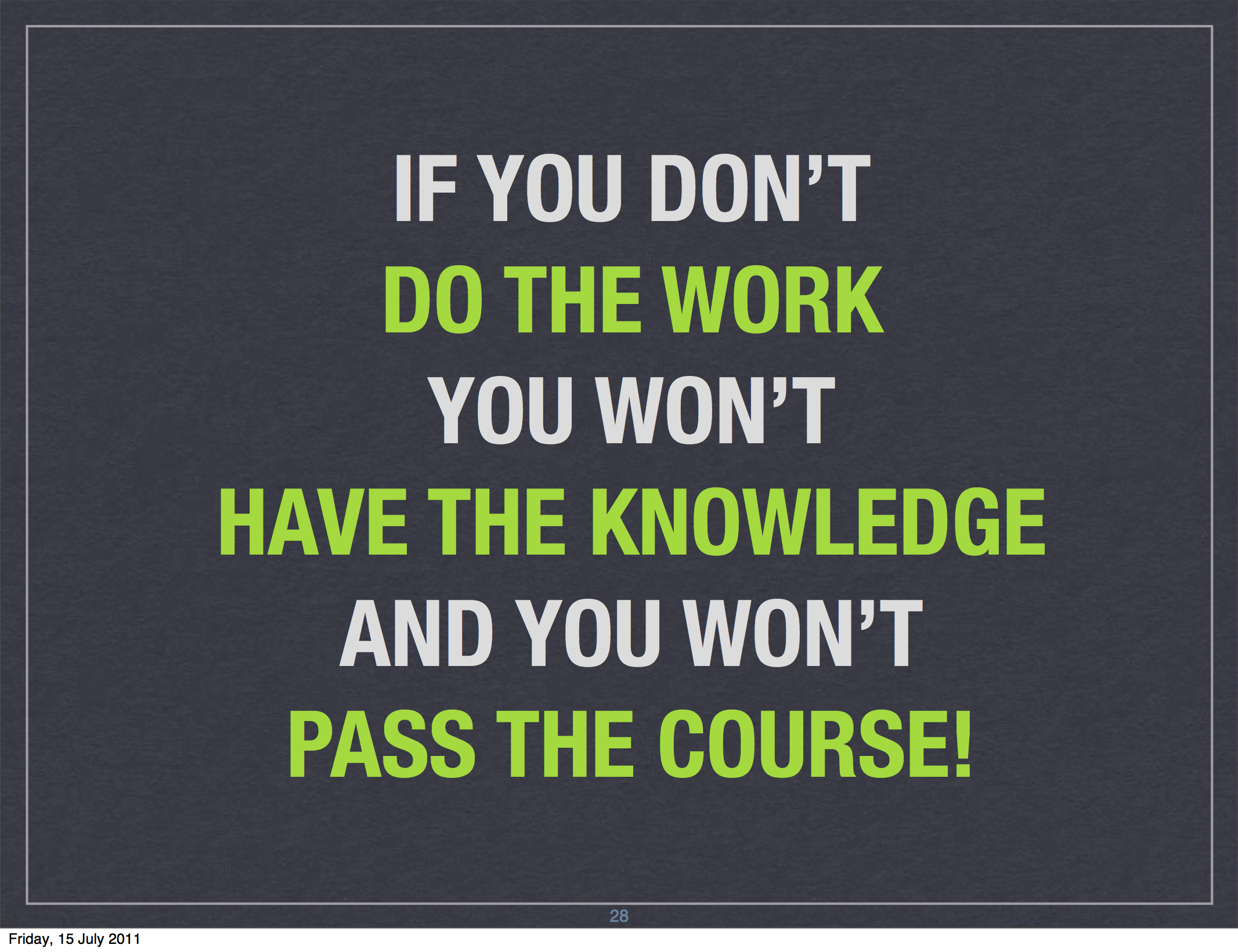
What leaps out at you? What’s the simple message? How can you do it? There are many ways to address this problem, here’s another that iamfatamorgana developed as a desktop background (I believe, feel free to correct me):
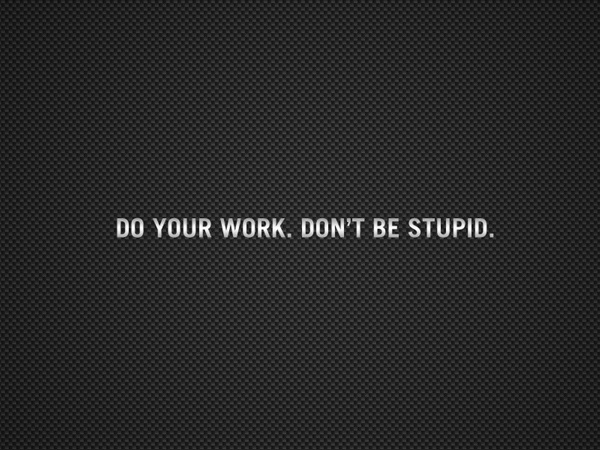
The second is fine for personal motivation – we can all be this harsh with ourselves – but this is not, in my opinion, the right approach for students. It’s interesting to look at the two of them side-by-side.
If you’re interested in reading about these things, then you can check our Information is Beautiful, Doug McCandless’s site (or you can buy the excellent book). I also have a book, at much higher level, on European commercial design for data representation called Data Flow: Visualising Information in Graphic Design, which is far more detailed and really good (there’s a good review of it, if you’re curious). If you’re wondering about how to make colours work better together, you can buy colour index or palette books from art stores. Different ways that we can communicate scientifically or mathematically? Try Bret Victor’s site. Go to FlowingData or buy Nathan’s book “Visualise This”, which will also give you a good grounding in R. Want to get into typography? Go to your bookstore and see what you can dig up. The AVA library series are all pretty good, or you can pick up reprints of books by Goudy, or read books that will help you to “Stop Stealing Sheep”. Art galleries almost always have a lot of good books on this. I picked up “The Artistic Licence” at SF MOMA and I’ve never looked back.
You’ll start looking at the world through different eyes. After a while, you might realise that Arial really doesn’t look as good as Helvetica. Comic Sans really isn’t that funny (nor is it that truly awful). Papyrus is about as Egyptian as pizza. IMPACT IS LIKE SHOUTING. S p a c i n g i s i m p o r t a n t. The medium matters. The message matters more, but the medium matters.
Fall in love with it, if have the time. Try other templates. Try other programs. Keynote and PowerPoint take very different approaches, as does Beamer under LaTeX (you old school presenter, you). Find like-minded people who aren’t too smug or arrogant and share some ideas. Try stuff. Ask students. Try again. Use coloured paper if you like. Draw freehand curves of great beauty and fill them with water colours. Find a graffiti artist to generate a tag for the front of your book of notes – no, you’re not cool (and I never have been) but it will probably raise a smile or two.
The greatest thing about this whole design journey that it will open your mind to how heavy the influence of good design is on the viewer. Once you understand that, you understand why good design is now essential to teaching material design – because anything else will look bad when our students look at it.
Smart and Beautiful
Posted: January 16, 2012 Filed under: Education | Tags: education, higher education, resources, teaching, teaching approaches 1 CommentThis week I’m planning to write a series of posts on design and graphic issues in teaching. The first thing I want to say on this is that it is possible for all of our teaching materials to be full of knowledge AND to look good: “Smart and Beautiful.”
Why think about visual design? Because, if you’re actually carrying out a design process, it’s not all that much more effort to add into the mix. If you’re not actually sketching out a design before you put a course or course materials together… urm… why? I realise that there are people out there who can put an entire course together in their heads, present it flawlessly and make it look beautiful and effortless. However, I’m pretty sure that a lot of you are like me – with work you can achieve a lot but to appear effortless and beautiful takes a lot of preparation and a looooooong run-up.
All of you who can throw it together with no planning – you’re excused, have a coffee or beverage of your choice. I’ll be talking about other stuff that will interest you tomorrow. For the rest of you, let’s quickly talk about basic design principles again: what am I trying to do, who is my audience, what do I have to work with? Your visual design comes in for the last two. Limitations of presentation should not have an impact upon your teaching (although, sadly it can if you’re resource starved). Knowing who you are writing for and what you have to write WITH tells you a lot about what your course will look like.
Let’s be clear. I’m not saying “Your PowerPoint must be beautiful”, I’m saying “Are you going to use PowerPoint? How are you going to communicate your information to a predominantly visual group of learners?” (Those of you dealing with the visually challenged have another challenging problem that I hope to discuss later this week. I’m not ignoring this issue, but I want to focus on the graphic issues first.)
May I give you a small piece of work to think about? What was the best presentation that you ever saw – do you remember it? The one where the information unrolled itself so well that a single image or slide conveyed a vast amount of information? We can’t all have stage presence and be good presenters, so I don’t want you to think about the best presenter you ever saw, I want you to think about the resources that were used.
Now, thinking about that, could you use anything from that in your own teaching?
I’ll see you tomorrow to talk about this some more.
Bang, bang, you’re educated.
Posted: January 14, 2012 Filed under: Uncategorized | Tags: education, games, higher education, teaching, teaching approaches Leave a commentI currently have a summer research scholarship who is working on a project called “Bang Bang, you’re educated: Serious games in Computer Science”. For the last week, he’s been reading a number of books I’ve lent him, reading across a number of key websites and thinking, based on his own experiences, how he could build a game that teaches people interesting things about CS or gives them practice in key skills in CS.
The core book was “Reality is Broken” by Jane McGonigal, who wonders at length why people spend so much time playing games, given how hard it is to get them to perform similar actions in reality. I wouldn’t say I agree with everything that she suggests but as a unifying introductory document, especially with key vocabulary, it’s very valuable. My poor student has a number of other books, of varying age, that he’s using as references to get more depth in key areas. To his credit, not only is he immersed in these books, he reads to and from Uni as well. [ I thought we’d almost managed to stamp out reading? 🙂 ]
He has six weeks work on this project and he started on Monday the 9th. I’d given him some pre-reading, all web-based, before he showed up but on Monday he got all of the books and instructions to read all of “Reality is Broken” while thinking about the project overview and how he could answer some key questions. Tuesday afternoon we met, discussed what he’d done, and then I told him to come up with 5-6 target student groups, approaches, techniques and (ultimately) games. I gave him a giant desk-based flip pad (3M sticky note topped A2 sheets. Very cool), some sticky notes and told him to throw ideas together – then pick the three best for presentation on Thursday.
Thursday he came in and presented three game ideas of which two blew me away and one of which was (only) pretty good. Clear presentation. Good ideas. But, most importantly, he had also selected his favourite (which happened to be mine as well). It was a great moment and, in the spirit of random reward, he walked out with praise and Lindt chocolates. He also left with instructions to turn the prime candidate into a five week development plan, with risk assessment, weekly project goals and extension possibilities. For presentation today.
Today, he presented the candidate, to me and another academic, and the game sounds great. At this stage, it sounds like it will meet the requirements that I set for him at the start. In outline, they were:
- The game must either increase CS knowledge or develop a CS skill.
- It will be sufficiently enjoyable that students will want to play it.
- The game is generally accessible to people at all levels of knowledge and skill.
- Playing the game enhances learning, it doesn’t detract from learning.
- The game may be integrated with external reward activities (as part of an alternate reality game link to a class, for example)
- The game will be ready for students to play in 5 weeks.
The successful candidate is being play tested, with the paper rules, for the first time on Tuesday. Tune in then to see how we went!
The joy of X (kcd)
Posted: January 13, 2012 Filed under: Uncategorized | Tags: education, higher education, resources, teaching, teaching approaches Leave a commentxkcd is a fantastic webcomic written and illustrated by a very interesting guy called Randall Munroe. As he puts it, it’s a “webcomic of romance, sarcasm, math, and language.” (Note the Oxford comma!) The comics are out every Monday, Wednesday and Friday and cover a wide range of topics.
From a teacher’s point of view, they can be quite abstract and cover adult content, but the sheer breadth and delight of the comics are amazing. Take the one that is currently on the site “Game AIs”:
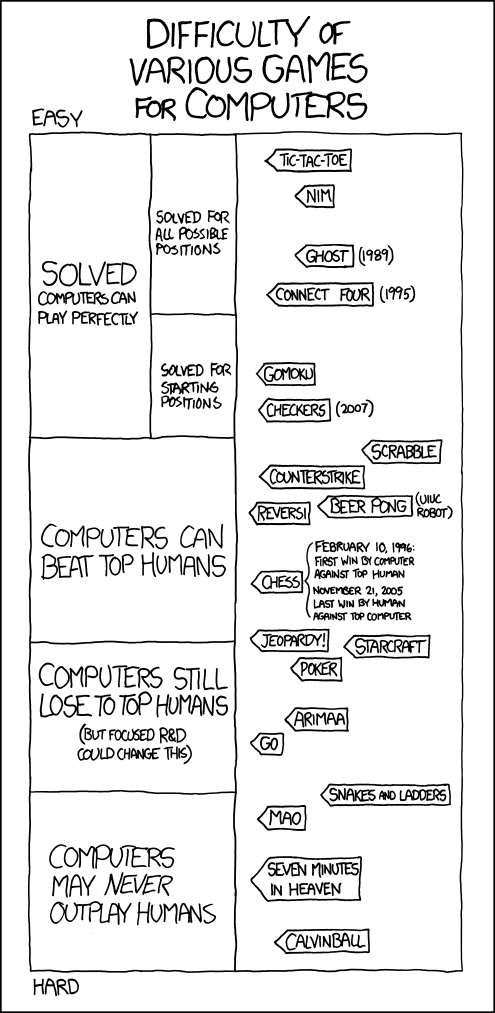
If you can’t find a way to integrate this diagram into a discussion on complexity, computer science, programming, artificial intelligence or games – you may not be trying hard enough. And xkcd is full of this kind of stuff. Giant scale diagrams from the smallest particles to the Universe. Ways of thinking about different amounts of radiation.
Beautiful little stories about flying ferrets who save people lost at sea.
You may have to be a little cautious on occasion, because some of it is quite adult, but choosing some images from this site for teaching, which Randall allows under most circumstances, can bring a lesson to life. If you haven’t seen it before, grab a comfortable chair, sit down and have a good read. There’s something here for most people who teach in or anywhere near the sciences.
Do you have your teaching buddy?
Posted: January 12, 2012 Filed under: Uncategorized | Tags: collaboration, education, higher education, learning, teaching 1 CommentHow are you developing and maintaining your learning and teaching support network? Do you have one, formally or informally? Thinking about it right now, can you name at least one person you can turn to, to bounce ideas off, to proof-read things, to discuss research with?
If not, then you need one! With a support network of even one person you’ve got someone else to talk to, to sanity check you, to help you laugh when things aren’t funny and to balance you if you’re going off-kilter.
It doesn’t need to be someone in your own discipline, although that can help, but it does need to be someone who understands what it is like to be an educator. There’s a lot of gallows humour, of joking about the things that are making us despair, and sometimes other people, especially partners, don’t get how we can complain about something so much and still love it so much. That’s where your teaching buddy comes in. With any luck you have more than one, you have a network of these people. These are not just the people whose blogs you read or whose books you have, these are people you can message or mail to ask a question or grab a coffee with or just sit down and have a long “GRAAAAA” chat with – without losing your job.
Sometimes teaching feels like an us-and-them kind of job. Us is always us, but them can be our students, or our administrators, or our bosses. You don’t want to gang up on any of these people but, at the same time, you don’t want to find yourself crawling the walls. Apart from anything else, working on cool projects is always more fun with a friend to help out, to throw ideas around with and to just sit down and talk to.
Do you have a network? Do you know someone who doesn’t? Can you reach out to try and help?
Are you working alone? Is there someone you could ask, anywhere? Have a look around, there are lots of professional networks – conferences and workshops are a great place to meet like-minded people. It’s ok, we’re not talking about marrying these people, you can even, if you’re so inclined, look at it as a very casual speed-dating set-up if you’re nervous. But you’ll be amazed how many people out there are ready to talk, want to talk and, working together, we can probably all achieve that little bit more.
“That” student.
Posted: January 11, 2012 Filed under: Uncategorized | Tags: education, higher education, learning, teaching, teaching approaches Leave a commentIf there’s one piece of advice I would give to anyone starting college, it would be “Don’t be that student”. Despite what many students think, while we pretty much know who you are, depending on class size, we don’t have the time we’d like to be able to track every student in detail. The students we see the most, deal with the most, and talk about the most tend to fall into two categories: the very high-achievers and that student. The high-achievers come to make sure that they’ve dotted all the i’s, that their question on a possible interpretation of something on slide 3 has the answer that they think it does and to talk about honours or PhDs or job references or things like that. When we talk about those students, the high-achievers, it’s generally because they’re moving on, doing interesting things.
The rest of the class? We’ll see them periodically, in lectures, on the forums, around. Even those who are struggling, who we see more, we probably won’t see as often (although we’re probably trying to). We’ll try to learn names, get an idea of who you are, but we’ll probably never see you enough to get much depth.
But that student? That student we deal with a lot. We generally don’t gossip but, sometimes, if someone is expressing exasperation with a student, or can’t get their head around why one of their students is doing something odd, we might, from time to time, lean across and say “Student X?” “Yup, that student.”
Let me be frank. If you’re trying, but you’re struggling, but you stay in touch and do your own work and you come to appointments? You’re not that student. If you don’t show up to class or do any of the work and fail silently, despite all of the e-mail asking you to get in touch? You’re not that student. People who know that they are struggling and are striving to fix it are my bread-and-butter and I’ll try to get you back. People who don’t show up at all and don’t respond? You’re only wasting your own time. It’s a shame (and I’ll keep trying to get to you) but you’ve made a decision, of sorts.
So who is that student? If you:
- never hand anything in on time, even with extensions, and you have no real reason and you can’t even be bothered to think of one;
- stick your hand up in lectures frequently, which is good, but only ask irrelevant questions, frustrate your classmates and then, a week later, do the same thing again without a hint of introspection – you’re not dumb but you can’t be bothered listening;
- show up without having done any of the pre-reading or any of the previous assessment and then complain that you don’t know what we’re talking about;
- can’t see why your group would care that you only started your section of the group assignment 12 hours before deadline;
- make an incredibly urgent appointment one afternoon for early the next morning and then don’t show up because you forgot – or just because;
- can’t understand what’s wrong with the previous entries on this list…
then you might be that student. Sadly, until you actually decide that you want to be in the course, and you devote the effort, and you work out what you have to do in order to pass, then there’s not much that I may be able to do for you. Why are you showing up if you’re not doing anything? I can try and help you to work out how to get ahead but, until you accept that you’re going to need to allocate more time and yourself to this course, there’s not a great deal I can do.
And every lecturer you run across, who doesn’t know you, is going to try and help you as well, because that’s our job. But, you, if you’re that student, you’re making yourself nigh-on impossible to help.
Some come good. That’s always a huge blast when someone genuinely sorts themselves out, gets their courses done and graduates. We’re genuinely happy for your achievement – not because we’ve got rid of you (seriously!) A lot, however, get kicked out after they’ve under performed for too long and that is such a huge waste of potential and time. And that, most of the time, is what happens to that student.
We offer a lot of opportunities for redemption and, honestly, it makes me really sad when someone stays on the path that will ultimately lead to them being kicked out. Half the reason we can even identify that student is because so many people will try and bring them back, get them on the righteous path and bring them up into the general body. Hey, if you can get that student into over-achieving, you’ll really have achieved something good!
Not everyone has to, wants to or needs to go to tertiary study. But if you’re going to do it, why not give it a good shot? I sincerely hope that there is enough good teaching around for everyone to be able to make the best of their shot. (Sometimes that’s not true but I can always hope that we’re all trying to make our teaching better.)
Like always, all joking aside, we have to focus on imparting knowledge (teaching) but that requires that our student be ready to receive knowledge (learning). Seriously, no-one really wants to be that student.
The Zeroth Law of Teaching: “No Negativity?”
Posted: January 10, 2012 Filed under: Uncategorized | Tags: higher education, reflection, teaching, teaching approaches Leave a commentI was at a conference recently and I was chatting with the PhD students at their poster session. One of them summarised his life philosophy as ‘no negativity’. I looked at him to see if he was joking and then replied “So, positivity, then?” The student’s eyes lit up as he thought about what I’d said, and his own comment, laughed and agreed.
When I first told this story on one of my other blogs, a number of people responded by saying “Oh, but he could have meant ‘at least neutrality'” and, while I didn’t argue it there, ultimately this was missing both the point of my critique and the student’s response. The first thing I considered when responding to the student was that he was obviously looking for something short, sharp and shiny to contain his world view. The second thing I considered was that I didn’t want to be negative, so my comment had to be chosen carefully. The third was based on my assessment of the student.
The student was a very positive, enthusiastic and creative person. When he said ‘no negativity’, he fairly obviously meant ‘positive, creative energy!’ He wanted a short way to express this but, as we are all prone to do, he focused on the antithesis and then negated it. Now, of course, by doing this he created an automatic contradiction in his own maxim. That’s why I checked to see if he was joking first because, as an ironic statement, it’s wonderful. My belief, based on initial reaction and his reaction to my comment, was that he hadn’t consciously realised that he was rejecting negativity with a negative. Now he has the choice to either be deliberately ironic or to be succinct and clear.
English is a funny beast. If I say “I don’t disagree with you”, it doesn’t always mean that I agree with you, double negatives or not. It’s also confusing for people with English as a second language because it appears very similar to “I’m not disagreeing with you”, when the two have different uses and, depending on your cultural background, very different interpretations. I choose my language, my idioms and my examples very carefully to make sure that I pitch myself to the current audience. This means that my classes in Singapore are run and presented slightly differently from my classes in Australia. Same knowledge. Same standards. Different presentation to maximise my efforts.
If you don’t know your audience, then your humour, your use of language subtleties and, especially, the use of sarcasm and irony can be missed completely and people won’t know if you are being exceedingly clever or if you’ve missed the point. If a student misses a subtlety, then do you think that they’ll always stick a hand up to check? Are they going to learn something incorrectly or miss a key step?
That, for me, is the Zeroth law of teaching: “Know your audience.” If you pitch yourself at the right level, to the right group, at the right time, you will be far more likely to pass on the knowledge in the most effective and useful way possible.

 Nick Falkner