
Coffin, meet nail.
Posted: November 15, 2026 Filed under: Education, Opinion | Tags: education, higher education, learning, learning styles, teaching, teaching approaches Leave a comment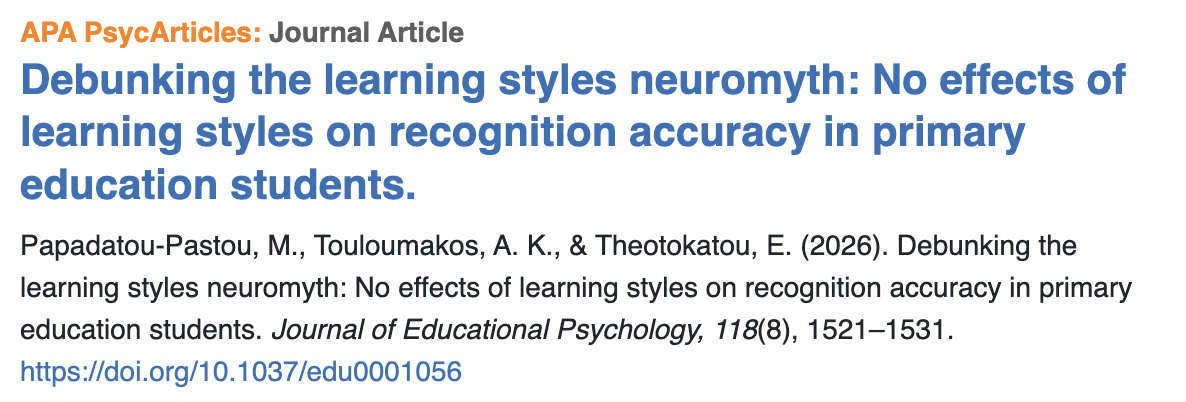
An interesting article just showed up on APA PsycNet from the Journal of Educational Psychology, entitled “Debunking the learning styles neuromyth: No effects of learning styles on recognition accuracy in primary education students.” The authors, Papadatou-Pastou, Touloumakos, & Theotokatou, use a sample of 194 primary school students to further refute the notion that underpins the folk pedagogy (neuromyth) of learning styles, that matching instruction to a preferred modality improves learning. The study did show that audiovisual presentation outperformed single-modality instruction for all groups and students’ self-reported preferences didn’t reflect reality.
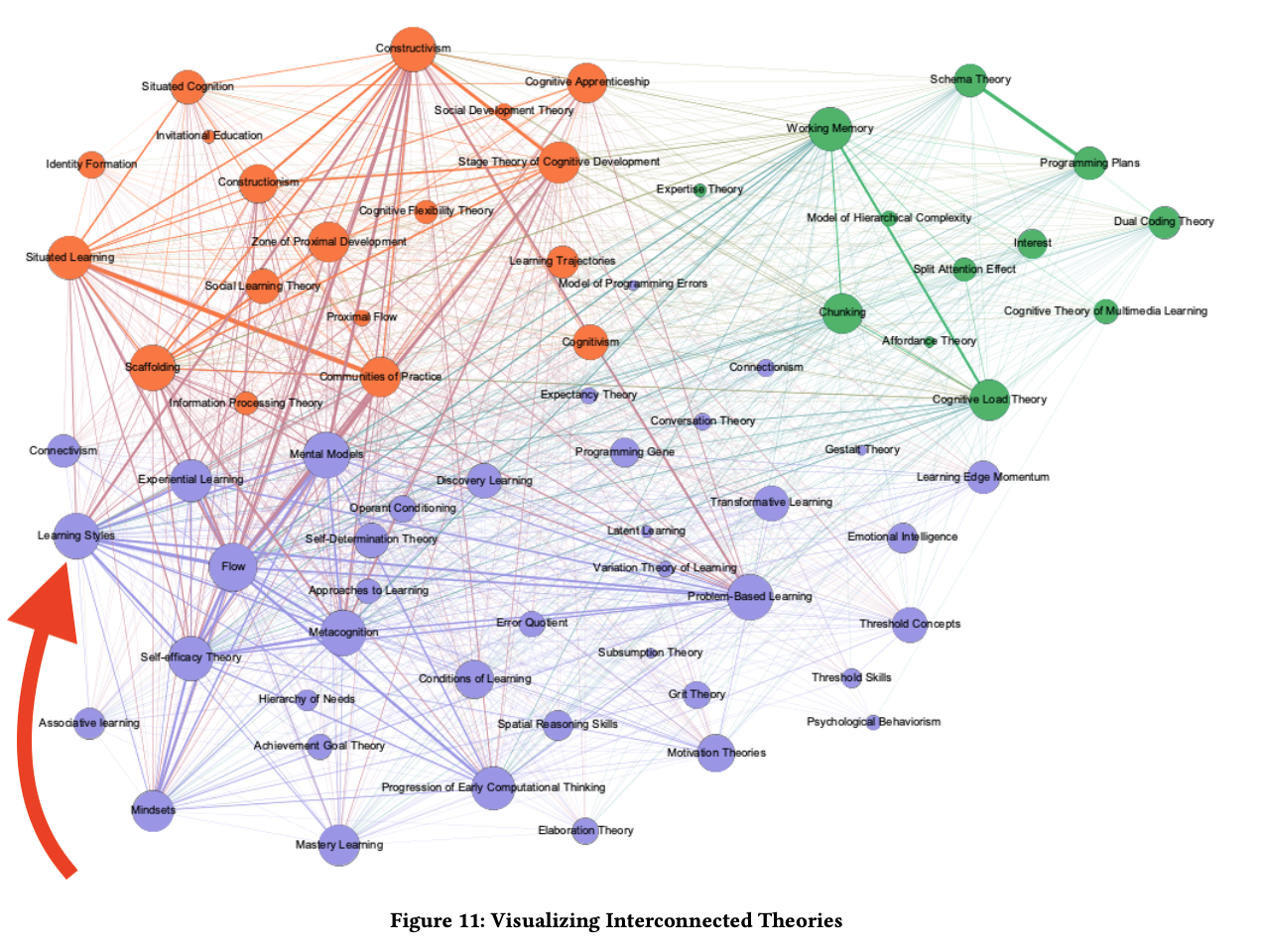
Learning styles have long been a difficult topic in educational research as so many people believe that they are real (For example: someone is a visual learner, someone else is a kinaesthetic learner) yet we have never had strong empirical evidence to justify this belief. What appears to be worse is that someone who does try to match instruction to a student’s perceived style of learning may, from this study and others, be doing them a disservice because they’re ignoring the multimodal approach that seems to work for the vast majority. To give you an idea of how widespread learning styles are, a paper we wrote back in 2017, “A Periodic Table of Computing Education Learning Theories“, looked across the corpus for all uses of learning theories returned a total of 45,210 hits across the ACM DL, 15,557 in CS Ed venues, and, of these, learning styles represented 2,219/1,390 hits respectively – an enormous presence for a theory with no empirical foundation. The diagram below (Figure 11 from the previous paper) shows the relative scale and connectivity of Learning Styles, marked on the lower left side with a very large arrow.
The CS Education community has reduced its use of the term over time, driven by the lack of supporting evidence, but it’s fascinating to see a solidly constructed study that tests key aspects of the learning styles hypothesis and finds it wanting. Now, this is not to say that you can’t, and shouldn’t, personalise learning in other ways, especially in the use of allegories and context to reduce obstacles but there still is no support for the idea that there are groups of students who are genuinely uni-modular in a way that has a measurable impact of their ability to learn.
I think of learning styles as a tombstone area; we have no evidence that it works so we should bury it unless we get enough solid evidence to dig it up. As it stands, it’s not something we should continue to use in educational delivery and pedagogical design. I’m not saying that we will never find evidence to support it but every experiment that comes back with a “no” just adds more weight to the idea that we should leave it behind.


